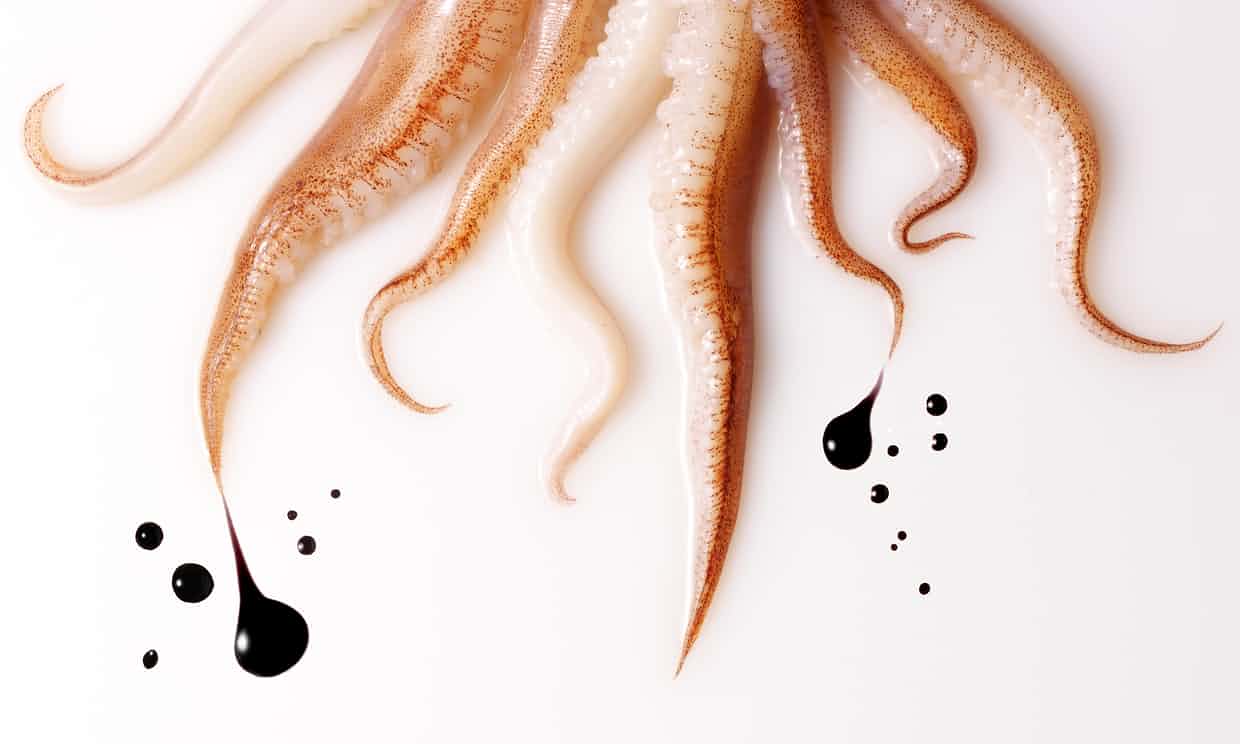
If you’ve ever wondered what squid ink is made of, here’s your answer:
Generally, cephalopod ink includes melanin, enzymes related to melanin production, catecholamines, peptidoglycans, free amino acids and metals.
But mostly melanin. And mucus.

If you’ve ever wondered what squid ink is made of, here’s your answer:
Generally, cephalopod ink includes melanin, enzymes related to melanin production, catecholamines, peptidoglycans, free amino acids and metals.
But mostly melanin. And mucus.

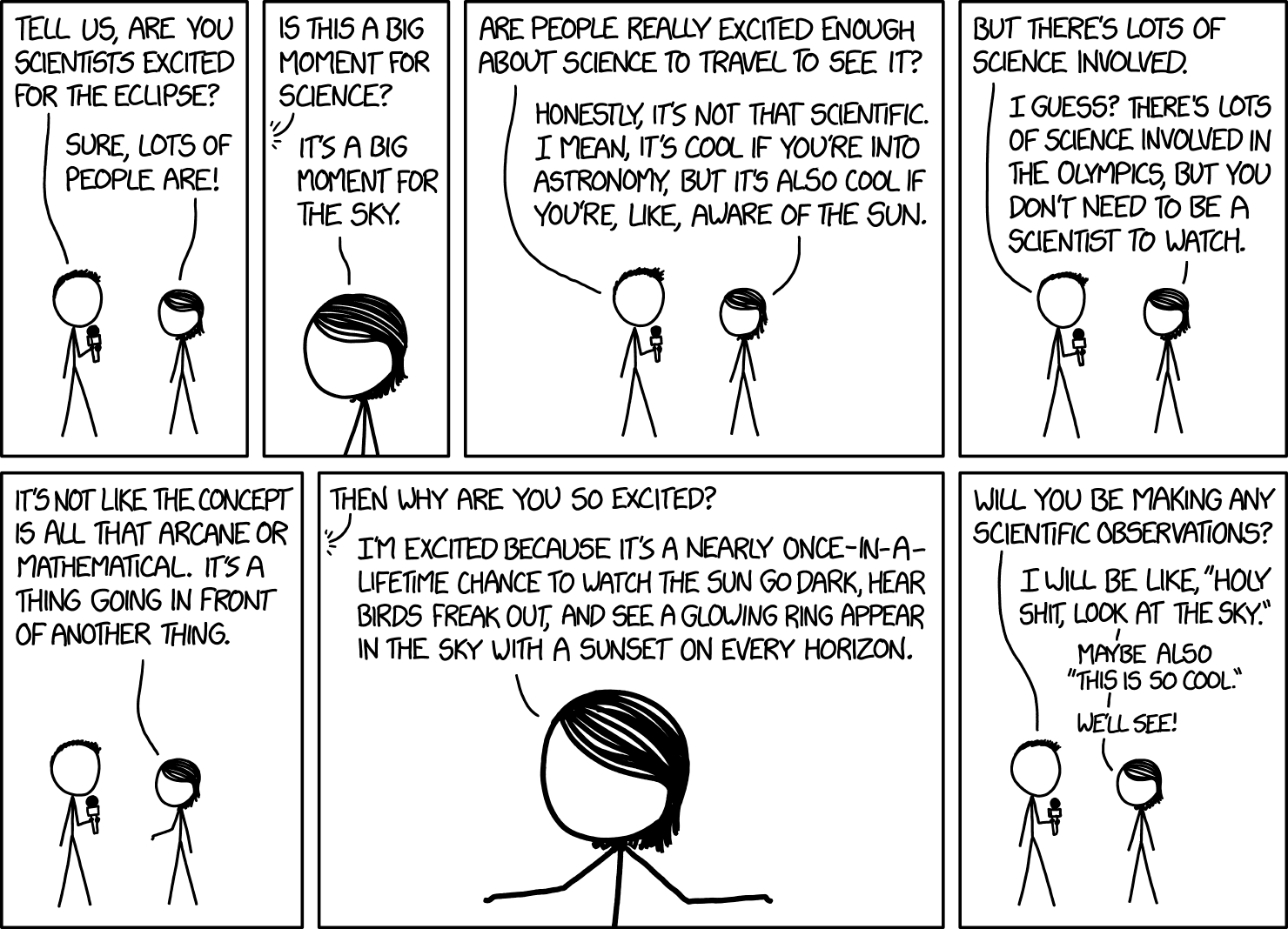
Mano Singham is unenthused about the eclipse. Same here. It’s neat, would be an interesting phenomenon to observe, but I’m not going to travel out of my way to witness a few minutes of darkness. I also wouldn’t be seeing it as a scientist, but as a tourist, nothing more.
Fortunately, xkcd seems to share our views.
So if you’re going to make an effort to see the eclipse, have fun! Take pictures!
If you’re not going to see the eclipse, have fun! Enjoy a nice August day!

The sequel is going to go a bit dark: this is a deep ocean sponge. It’s dark and ominous, and it’s also carnivorous, with sticky spines for capturing and killing passing animals.
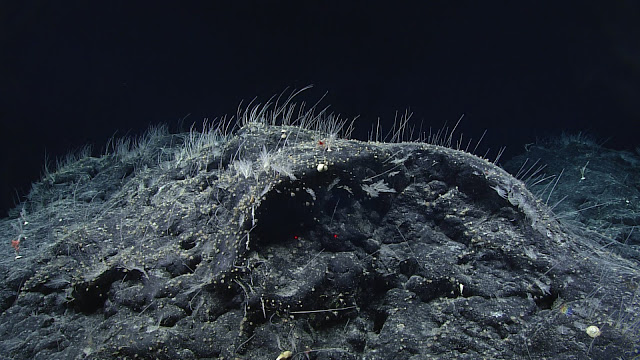
I think that thing has been waiting for me in a lot of my nightmares.

Last week, Mary Beard was getting sneered at because she agreed that the Roman Empire was ethnically diverse, and that — gasp, shock horror — there were brown people living in ancient Britain. She’s still getting sneered at, of course, because one thing racists really hate is being told their prejudices aren’t empirical facts. But at least the silly contretemps stirred up some excellent responses.
Jennifer Raff summarizes the complexities of ancient DNA analysis, and also makes an important point: it takes a village. There isn’t one unambiguous perfect path to the Truth™.
Framing this issue as a debate between hard science and fuzzy humanities is simply nonsense. Reconstructing the past is a multidisciplinary effort, and I can’t think of a single geneticist who wouldn’t candidly admit to many limitations in our approaches. To get around these limitations, and to improve the collection and interpretation of our data, we work closely with collaborators in other disciplines: archaeologists, linguists, osteologists, specialists in stable isotope analysis, and yes, even historians. Perhaps instead of fussing about whether cartoon characters conform to our beliefs about how the ancient world should have been, our energies would be better spent in learning more about how it actually was.
Yes. One of the hallmarks of the current round of Nazi pseudoscience is their claim of far more certainty than we actually have, and insistence that genetics and molecular biology, which they don’t understand, offer perfect clarity on race. The only perfect clarity we have is that it’s a complicated muddle.
Massimo Pigliucci goes after the philosophy behind these biases, and offers a good explanation of scientism.
It’s a good thing Mr. Taleb was being polite, I hate to imagine what he’s like when he’s not. Of course, so far as I know, he is no rocket scientist either, and he also operates under a “structural bias.” We all do, there is plenty of empirical evidence (not to mention good philosophy of science, but of course that’s just part of the humanities, which lack intellectual rigor anyway) that everyone is affected by personal cognitive biases. Moreover, any organized enterprise — not just the academic study of history, but also the practice of statistics, or population genetics, or whatever — is affected by structural constraints and biases. That’s just another way of saying that no human being, or organized group of human beings, has access to a god’s eye view of the world. All we have is a number of perspectives to compare. Which is a major reason, as articulated by philosopher Helen Longino, to work toward increasing diversity in the sciences: many individually biased points of view enter into dialogue with each other, yielding a less (but still) biased outcome.
The mistake of scientism is to elevate scientific knowledge and data crunching to a level of certainty and competence they most definitely do not have, while at the same time dismissing every other approach as obsolete nonsense. But human knowledge and understanding are not zero sum games. On the contrary, they work best when we expand, rather than artificially or ideologically limit, our methods and sources of evidence. The scientistic game is foolish not just because it is incoherent (what statistical, empirical evidence do we have that scientism works? What does that even mean??), but because it is dangerously self-serving. It makes a promise on behalf of science that science cannot possibly maintain. And this in the midst of an already strongly anti-intellectual climate where half of the American public, for instance, rejects the very notion of global warming and does not believe in the theory of evolution.
It really bugs me to see prominent people spreading a cartoon version of what science is — whether it’s Pinker to now, Taleb — and continued progress in science demands that we explore multiple perspectives on the evidence, and try our best to shake ourselves out of our comfortable biases.

I was out for my morning walk and discovered this sphinx moth clinging to the side of the science building. I had to capture his portrait.


I feel terrible for being critical of this science story, but it annoyed me in a couple of ways. First, it’s kind of a cool idea — they’re using micro-CT to scan living insects in 3 dimensions, and then they can just fly through the tissues. Neat!
It’s also significant that they’re doing it on living animals that survive the procedure, so you can repeat it later, opening the door to longitudinal studies of developing tissues in individual animals.
But here’s what bugs (get it?) me about the story: the story is all about the wrong things. There’s a lot of fluffing of the institute that did it (it’s interdisciplinary!), chatter about how new all this is (micro-CT has been around for years, and anesthetizing insects with CO2 has been routine for decades, so no, it isn’t), and then there’s all the clueless bullshit scattered throughout. It starts this way:
Until now, insects have been too wriggly to make good subjects for scientists wanting to understand more about insect innards.
Wrong. Insects have been model systems for development and physiology for ages — if a reporter had come into any of the insect labs I worked with 30 or 40 years ago and announced that the research subjects were “too wriggly” for the work they were doing, they would have been quietly shooed away.
The team has managed to create spectacularly detailed, three-dimensional views of insects’ insides—without harming them in any way—by using carbon dioxide to place them into a state of temporary suspended animation.
That’s nice. The anesthesia is trivial, though. Say something about what they’ve learned.
And this is just irritating.
The resolution shows detail to 20 microns (about five times smaller than the width of a human hair) and clearly shows the organs, reproductive system and other internal morphology.
20 microns is also more than twice the size of a typical cell, 10 times larger than an axon, 200 times larger than a filopodium. This is pretty coarse. The stuff I’m interested in would require subcellular resolution, and this doesn’t even come close — but there are interesting questions that could be asked on the organ level, like how trachea develop, if only the damned article had bothered to ask any of them.
This kind of formless, clueless goo is typical of university PR departments, and phys.org, unfortunately. Science journalists need to be informed enough to ask the right questions and focus on the relevant science, rather than getting distracted by shiny buttons on the gadgets.

In another response to the awful A.N. Wilson article, Jules Howard exposes our secret.
The truth is that – and this is worth saying a million times over – most scientists probably don’t think about Darwin very much in their day-to-day studies and would consider themselves as much “Darwinist” as they would “round-Earthers” or “wifi-users”. This is, after all, the best working theory we have to understand the nature that we see around us. Also, I think we are all OK with entertaining the idea that, if a more scientifically accurate way of explaining the diversity of life on Earth comes along, Darwin would be ousted. It’s just that, based on current evidence, Darwin’s ideas still seem capable of explaining much, if not all, of what we see in nature. Hence, our kids learn about him in schools and popular science books that refute his influence are treated with understandable confusion, concern or disdain.
It’s true. I probably think about Darwin more than most, simply because I teach and think it’s important to toss in some history and philosophy of science with the subjects I cover. But otherwise, I don’t have a shrine to Darwin, I don’t worship him, most of the papers I read in evolution, development, or genetics don’t even mention him. It’s a fine example of projection when creationists assume that Darwin is our Jesus-substitute.
Unfortunately, this fact can be turned around into another creationist trope: Darwin (and therefore evolution, because Darwin and evolution are synonymous in their minds) isn’t a necessary component of biological science, because you can do experiments without ever thinking about the old man, and because the literature contains millions of papers that don’t mention Darwin, he’s obviously superfluous and we only continue to bow to his shrine out of religious fervor.
Of course, I watched Game of Thrones on the ol’ TV the other day, and I didn’t think of Philo Farnsworth even once; I also have to note that my TV is one of those flat-screen jobs that doesn’t even have a cathode ray tube in it, so it’s far advanced over anything he ever did. Therefore, since Philo and TV are synonymous, I couldn’t actually have watched it.
I guess I’ll have to put up a Farnsworth shrine in my house and pray to it if I want to see the next episode.

Wow. That’s some scam. Read about Research Features, a publisher who will write a glossy story about your work for their fancy magazine, which I’ve never heard of before and have never seen. Looks slick and very professional.
Is there a catch? Of course there’s a catch. You have to pay them $2230 for your vanity puff piece. It’s just like those awful Who’s Who books — I’ve been contacted so many times (the first when I graduated from high school, which is apparently an amazing accomplishment) about getting a small, brief blurb in a Who’s Who book, for a small fee, and I’ve always blown them off. Not because the fee, but because it was obvious that no one reads these things, and they’re purely ego fluff and clutter, and profit for the publisher.
Although I might be tempted to browse Research Features, if I ran across it, purely to determine who was so narcissistic to throw money away on this crap. It’s negative advertising.
I hope no one used grant money to buy this kind of useless padding.

Time to forage.