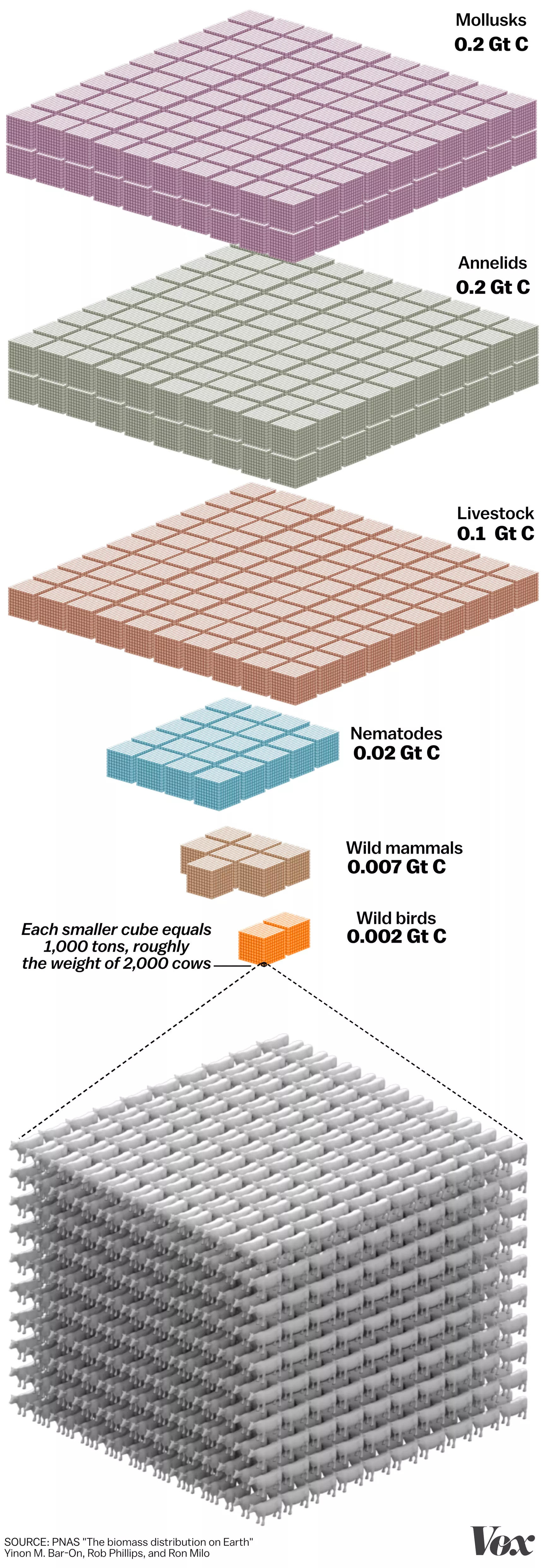
Just look at these estimates of total biomass on Earth. Why are we wasting our time harvesting cows, when there’s so much more worm and mollusc meat available to us?
Of course, even that’s a silly question. Go take a look at total plant biomass.
Just look at these estimates of total biomass on Earth. Why are we wasting our time harvesting cows, when there’s so much more worm and mollusc meat available to us?
Of course, even that’s a silly question. Go take a look at total plant biomass.
It’s an honor he deserves. First he was extrapolating from lobsters to people with a lot of naive and misunderstood neurobiology and evolutionary biology, and now Jordan Peterson is misreading a paper about ants to misapply it to humans.
30% of the ants do 70% of the work. Not a consequence of the West, or capitalism, in case it needs to be said :) https://t.co/z45k6ENzYJ pic.twitter.com/pWuwF4d37d
— Jordan B Peterson (@jordanbpeterson) August 19, 2018
Because “the West” and “capitalism” are social constructs that ants are not aware of. Unfortunately for Peterson, an ant expert stepped right up.
The point Jordan Peterson is trying to make is that people he doesn't like are lazy, and is misquoting a research result as some sort of proof.
The paper itself did not show that 70% of ants are lazy. They stepped up as soon as the working crew was removed. https://t.co/Dkr5eDIeYY
— Alex Wild (@Myrmecos) August 19, 2018
Maybe Peterson will announce that he’s a myrmecologist next?
Anyway, I read the paper. He doesn’t get it. The research shows that when fire ants are excavating narrow tunnels, where only a few at a time can be at the digging face, they optimize their behavior, avoiding a mad, industrious rush that would merely clog the tunnels and hinder hauling grains of dirt away. They did things like remove the 5 most active digging ants, and found that there was no reduction in the rate of digging, because others would readily step forward to fill in. It’s not at all about what fraction of the population are doing their fair share of the work; it’s about an optimal strategy for a specific task.
I guess he thought he was making a joke to reinforce the biases of his followers — but instead people who know something about ants and logic have turned him into the joke.
Did you know we’re in the midst of a vitamin D deficiency epidemic? By the standards of the Endocrine Society, 80% of Americans have inadequate vitamin D levels. You better go buy some pills! You better buy Michael Holick’s books! He’s the guy who is obsessed with warning everyone about their dangerously low vitamin D, and he’s not kooky at all.
The Boston University endocrinologist, who perhaps more than anyone else is responsible for creating a billion-dollar vitamin D sales and testing juggernaut, elevates his own levels of the stuff with supplements and fortified milk. When he bikes outdoors, he won’t put sunscreen on his limbs. He has written book-length odes to vitamin D, and has warned in multiple scholarly articles about a “vitamin D deficiency pandemic” that explains disease and suboptimal health across the world.
His fixation is so intense that it extends to the dinosaurs. What if the real problem with that asteroid 65 million years ago wasn’t a lack of food, but the weak bones that follow a lack of sunlight? “I sometimes wonder,” Holick has written, “did the dinosaurs die of rickets and osteomalacia?”
I’ve seen this phenomenon in educated people before: they latch onto one explanation for something, and suddenly they apply it to everything, regardless of the evidence or lack thereof, and insist that it is the One True Theory, and all must bow before it. For other examples, see the Aquatic Ape Absurdity and Brian Ford’s Bullshit. It’s the lure of the Umbrella Hypothesis, braced by a little factlet of truth.
So yes, you can be deficient in vitamin D, and it can lead to real diseases. It’s just that here in developed countries with actual policies that lead to reasonable monitoring and addition of supplements to key foods (milk has been supplemented with vitamin D for over a hundred years to prevent rickets), we’re fine. You don’t need to go to extremes to correct an imaginary deficiency.
Except that inventing imaginary problems and selling the cure is extremely profitable.
Since 2011, Holick’s advocacy has been embraced by the wellness-industrial complex. Gwyneth Paltrow’s website, Goop, cites his writing. Dr. Mehmet Oz has described vitamin D as “the No. 1 thing you need more of,” telling his audience that it can help them avoid heart disease, depression, weight gain, memory loss and cancer. And Oprah Winfrey’s website tells readers that “knowing your vitamin D levels might save your life.” Mainstream doctors have pushed the hormone, including Dr. Walter Willett, a widely respected professor at Harvard Medical School.
He’s been getting paid a thousand dollars every month for his vitamin D promotion! He’s received hundreds of thousands of dollars from pharmaceutical companies! The tanning bed industry donated $150,000 to his research!
I’ve been missing out on the gravy train, and I’ve got to start hawking my own supplement. I thought of one. You know, I bet you’ve eaten hardly any spiders lately. It’s true, isn’t it — they aren’t part of our usual cuisine, and no one spices their food with ground-up spider bits, except for those wierdos in Cambodia, so I can argue without being gainsaid that almost all of us have a spider deficiency. I can even make up statistics, like that 99.7% of Americans haven’t eaten any spider at all lately, and trust that no one will say I’m wrong.
Now I just need a common disease that I can blame entirely on arachnoinsufficiency, and before you know it, Gwyneth Paltrow will be knocking on my door.
A creationist told me I had to explain the origin of life to him. So I did.
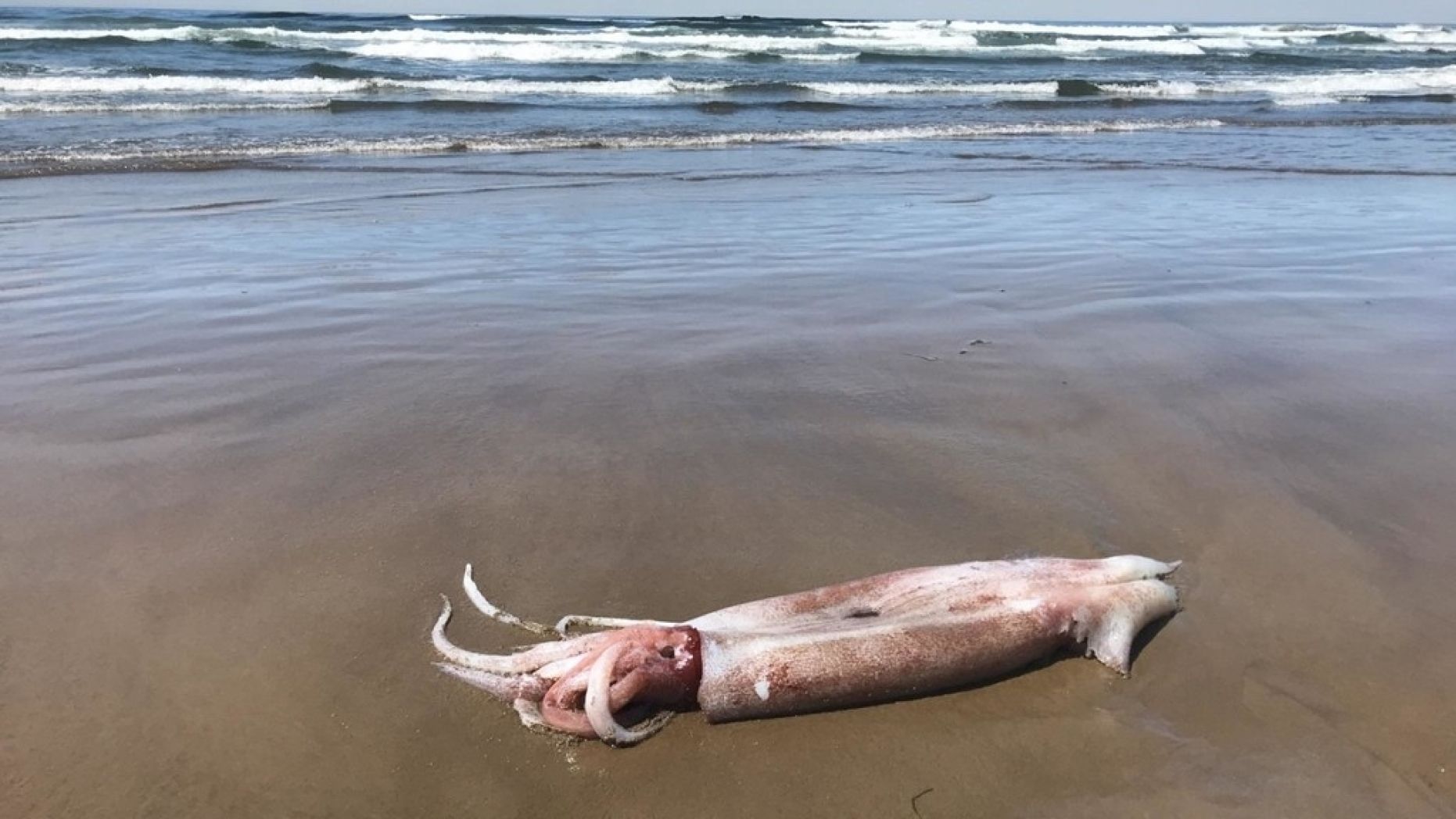
Last week, I reported that a 3-meter long clubhook squid had washed up on an Oregon beach. This week, I must report that it has happened again.
You must understand that if a few have died of natural causes, there must be a legion of them lying in wait off the coast. This can mean only one thing: the Cephalopocalypse is nigh. I must get myself to Oregon soon, so I can stand on the beach to greet the onrushing horde, and praise them, as they devour me first.
There’s this article in the popular press titled “Scientists calculate the speed of death in cells, and it’s surprisingly slow”, and the title is backwards. It’s summarizing an article in Science magazine which measured the speed of a wave of apoptotic signaling in dying cells that concludes the exact opposite: cells die fast.
Apoptosis is an evolutionarily conserved form of programmed cell death critical for development and tissue homeostasis in animals. The apoptotic control network includes several positive feedback loops that may allow apoptosis to spread through the cytoplasm in self-regenerating trigger waves. We tested this possibility in cell-free Xenopus laevis egg extracts and observed apoptotic trigger waves with speeds of ~30 micrometers per minute. Fractionation and inhibitor studies implicated multiple feedback loops in generating the waves. Apoptotic oocytes and eggs exhibited surface waves with speeds of ~30 micrometers per minute, which were tightly correlated with caspase activation. Thus, apoptosis spreads through trigger waves in both extracts and intact cells. Our findings show how apoptosis can spread over large distances within a cell and emphasize the general importance of trigger waves in cell signaling.
To put that in context, 30 µm/min is more than 40,000 µm/day, or 40mm/day. Back in the day when I’d stick proteins in one end of a cell and wait for them to get to the other end, we’d estimate that the rate of transport was a couple of millimeters per day — so if you were working with an axon that was a couple of centimeters long, you might have to wait a week or two for a complete traverse. I’m impressed with 30 µm/min.
Another way to look at it is that if your typical cell is about 10µm across, once the apoptotic enzymes in one spot are activated, the whole cell is self-destructing in 20 seconds. The pop sci article uses a different example: “That means, for instance, that a nerve cell, whose body can reach a size of 100 micrometers, could take as long as 3 minutes and 20 seconds to die.” That’s still fast. That’s faster than diffusion. The authors ruled out diffusion as the mechanism, and suggest that it’s a wave of activation.
The unusual size of the Xenopus egg raises the question of how an all-or-none, global process such as apoptosis spreads through the cell. One possibility is that apoptosis spreads through the egg by random walk diffusion, ultimately taking over all of the cytoplasm. A second possibility is suggested by the existence of multiple positive and double-negative feedback loops in the regulatory network that controls apoptosis. These loops may allow apoptosis to propagate through self-regenerating trigger waves. Trigger waves are propagating fronts of chemical activity that maintain a constant speed and amplitude over large distances. They can arise when bistable biochemical reactions are subject to diffusion or, more generally, when bistability or something akin to bistability (e.g., excitability or relaxation oscillation) is combined with a spatial coupling mechanism (e.g., diffusion or cell-cell communication). Familiar examples include action potentials; calcium waves; and the spread of a fire through a field, a favorable allele through a population, or a meme through the internet. Trigger waves are an important general mechanism for long-range biological communication, and apoptotic trigger waves may allow death signals to spread rapidly and without diminishing in amplitude, even through a cell as large as a frog egg.
That makes sense. The apoptotic enzymes are distributed throughout the cell in an inactive state at all times; you don’t have to physically move the proteins around, you just have to switch one on, which then switches on its neighbor, which switches on its neighbor, and so on.
I’ve seen many cells die, as I’m watching them in the microscope. It’s always impressively swift and thorough: one minute, round, plump healthy cell; next minute, membranes are blebbing out all over the place, the cytoplasm goes all granular and curdled, and at the speed of light I’m cussing over yet another failed experiment.
I’m not sure why the editor or whoever slapped that confusing title on the article. There may have been some confusion about scale: a 2 meter tall human doesn’t die by the propagation of a signal from a single point on a cell, spreading at a rate of 40mm/day (if it worked that way, you’d stub your toe, a cell would die, and you’d have to wait a month and a half for the death signal to reach your brain). That would be slow. Multicellular organisms die by systemic failure of a network, not the progressive collapse, cell by cell, of all of its components.
An article asks, Reaching the stars: is human hibernation really possible? It’s not very deep — and it seems to not understand that hibernation is a physiological state of reduced metabolism, rather than a kind of freezing — and it seems to shift the goalposts a couple of times. It also seems to think that therapeutic hypothermia is a practical way to fly to Mars.
A few years ago, SpaceWorks Enterprises delivered a report to NASA on how they could use this therapeutic hypothermia for long duration spaceflight within the Solar System.
Currently, a trip to Mars takes about 6-9 months. And during that time, the human passengers are going to be using up precious air, water and food. But in this torpor state, SpaceWorks estimates that the crew will a reduction in their metabolic rate of 50 to 70%. Less metabolism, less resources needed. Less cargo that needs to be sent to Mars.
Whoa. Therapeutic hypothermia is a technique to reduce cerebral metabolic demand when the cranial circulatory system has been compromised. As the article notes, it’s been used for as long as two weeks, with intermittent arousals. Would a healthy astronaut be willing to undergo this procedure? Doesn’t sound wise to me. And do I really want to go on a trip where the bean-counters have figured out that they can pack half as much oxygen for me by rendering me unconscious in an ice bath for half a year?
A 50% reduction in metabolism also isn’t going to get anyone to even the nearest star, sorry.
But even worse — therapeutic hypothermia isn’t trivial. Here’s a review of the medical consequences of therapeutic hypothermia.
Treated patients in this trial reached target temperature to 34°C quickly but adverse events included periorbital emphysema, epistaxis, perioral bleeding, and nasal discolorations.
Not too bad, right? Air around the eyeballs, nosebleeds, small hemorrhages around the mouth, and bruised noses. I suppose that’s manageable. But then there’s this:
Adverse events associated with endovascular cooling include pneumonia, cardiac arrhythmia, thrombocytopenia, and vascular dissection.
I’d definitely want a doctor attending my awakening. Unfortunately, the doctor might have experienced this:
Uncontrolled re-warming has been associated with rebound cerebral edema, elevations in intracranial pressure, and death.
I think I’ll pass. It’s not to say it doesn’t have benefits in specific medical situations, but I wouldn’t want to risk compromising a currently healthy body.
It’s also completely different from the idea of freezing someone solid, to virtually no metabolic activity, and then thawing them out and having them survive. There’s a kind of bait-and-switch at play in these kinds of articles: squirrels can hibernate all winter long, and hey, doctors have cooled people’s body temperature to 34°C, so why not just suggest the feasibility of sub-zero freezing? The problem is that these are entirely different problems and technologies, there is no continuum here, and you can’t make this kind of blithe extrapolation.
In the next few years, we’ll probably see this technology expanded to preserving organs for transplant, and eventually entire bodies, and maybe even humans. Then this science fiction idea might actually turn into reality. We’ll finally be able to sleep our way between the stars.
I don’t think so. And it wouldn’t be anything I’d call “sleep”, either.
I was asked to summarize my Ph.D. thesis research…I usually think of this kind of question as more relevant for someone currently or recently working on their thesis, but hey, OK, I can take a trip down memory lane.
Man, memory lane keeps getting longer and longer. This was 3 or 4 decades ago.
You can find the most amazing things. Like a 3 meter long clubhook squid washed up on the shore.
I was out for my morning saunter when I spotted this at a local pond: a baby turtle hitching a ride on a swan. Clearly, this is the laziest turtle in the world.