Friday Cephalopod: They’re going to outbreed us!

Here they come, the legions of cephalopods. Massive aggregations of brooding octopuses were found near Monterey Bay.

That’s not all. The University of Georgia had a single octopus in their aquarium, Octavius, presumed male, until they discovered a surprise one morning.

“I noticed this cloud of moving dots and I realised, ‘Oh my God, she had babies. There are babies. There are babies everywhere.’ And a sort of panic ensued,” aquarium curator Devin Dumont told Mary Landers at Savannah Now.

“I immediately started scooping them out and putting them in buckets and there were just buckets and buckets and buckets full of tiny octopi.”

Finding a tank full of baby octopuses (or octopodes for language pedants) would certainly be enough to shock anybody into mixing up their Greek and Latin word roots.

I, for one, welcome our breeding swarms of transgender octopuses, and will greet them as saviors when they emerge to release humanity from its misery.

You’re not a very arachnophobic bunch

I tallied up your responses from that post about arachnophobia, and took a quick look at the distribution. Several of you complained that you had no idea what the range should be — that was intentional. You’re not supposed to be trying to fit yourself into a particular bin, you should be just answering for yourself. There’s no judgment here!

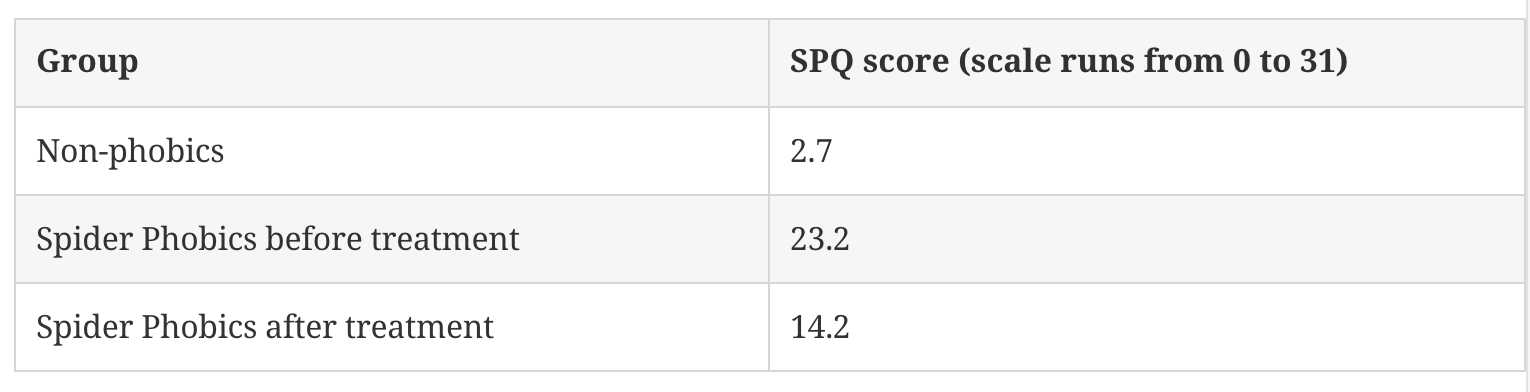
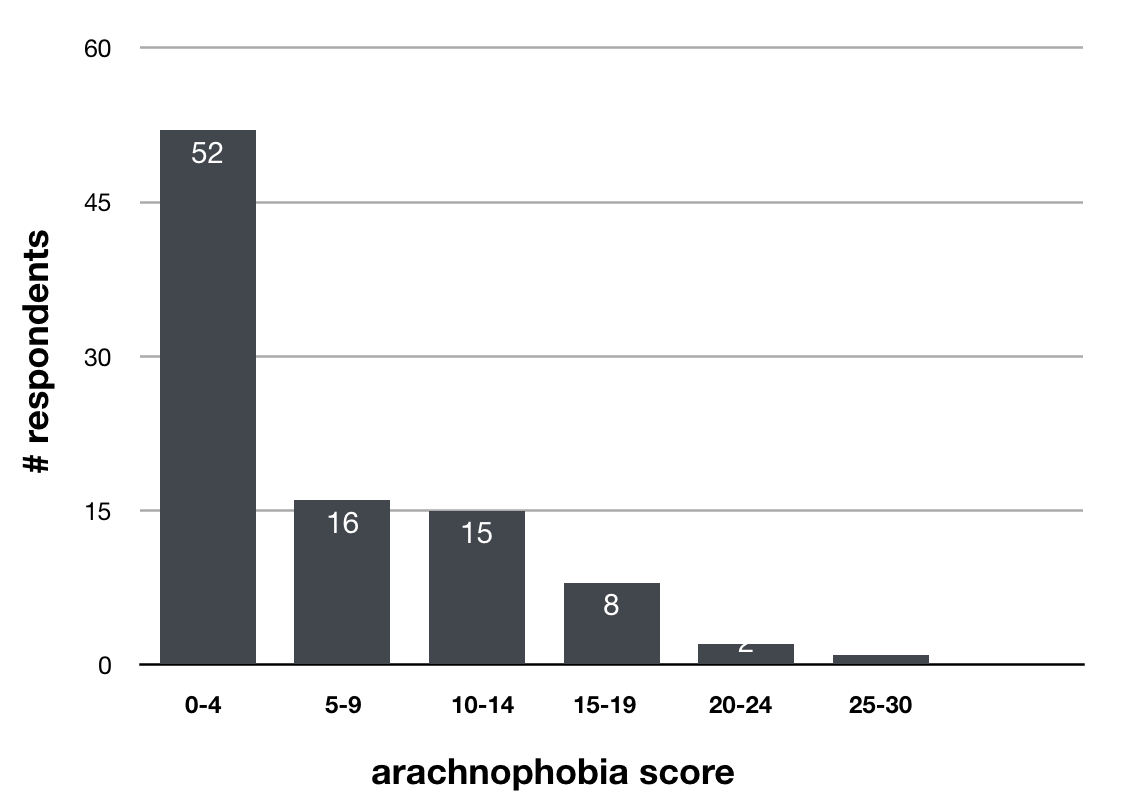
But if you’re curious, here’s the source with some general numbers. Serious arachnophobia — where the fear is actually debilitating and impairs a person’s life — is relatively rare, less than 5% of the population. There isn’t a magic number in the score that says whether you’re an arachnophobe or not. As many of you also noted, the questions are fuzzy and subjective, and as you might expect, produce a range of results. It’s a continuum — some people want to hug & kiss & love widdle spiders forever, others are horribly repulsed by them, and others are in the range from take ’em or leave ’em to “oooh, icky”. Here’s what I saw in this group of 113 participants (not a scientific poll, obviously, with a self-selected group and arbitrary participation, etc.)

Most of you are way down on the scale! It’s probably a biased sample here — I’ve chased away all the deeply arachnophobic types. I got a few responses on Facebook, and they tended to be somewhat higher than blog commenters, but the numbers are too small to come to any strong conclusions.

A new science video for Halloween!

Wednesday is Halloween! Yay! My favorite holiday!

Unfortunately, I’ve got a work engagement that’s going to tie me up for a couple of days, so no Halloween for me. Boo.

The good news, though, is that the work is playing with the gang at the Science Museum of Minnesota on a new exhibit! Yay!

The bad news is that I’ll have to neglect the blog for a while. Boo.

The good news is that I scheduled a new evo devo video for tomorrow! It’ll be available at 7am Central time, and you’ll be able to criticize it on YouTube while I’m watching the premiere, which I plan to do before getting in the car and driving to St Paul! Yay, I think?

The bad news is that there are no spiders in this video at all. Boo.

But there are cephalopods! Yay!

You say that like it’s a bad thing

There’s a surge in the spider population going on, and people are calling it an Arachnid Apocalypse.

It isn’t just your imagination. Scary sightings of larger-than-usual spiders are on the rise in Metro Vancouver this fall.

Pest control specialist Randy Bilesky has seen a 50 per cent increase in calls to his service this season over last.

“People panic … we get the phone call after someone has walked through a spider web,” said Bilesky. “They are sure it’s still in their hair, especially if it is one of the big hobo spiders.”

I prefer the term “Spider Renaissance”.

What next? Is everyone going to start complaining “Oooh, there are too many squid in the ocean” and “Ick, there are prokaryotes crawling around in my colon”?

Hate the implicit teleology…

…but love the unforeseen consequences.

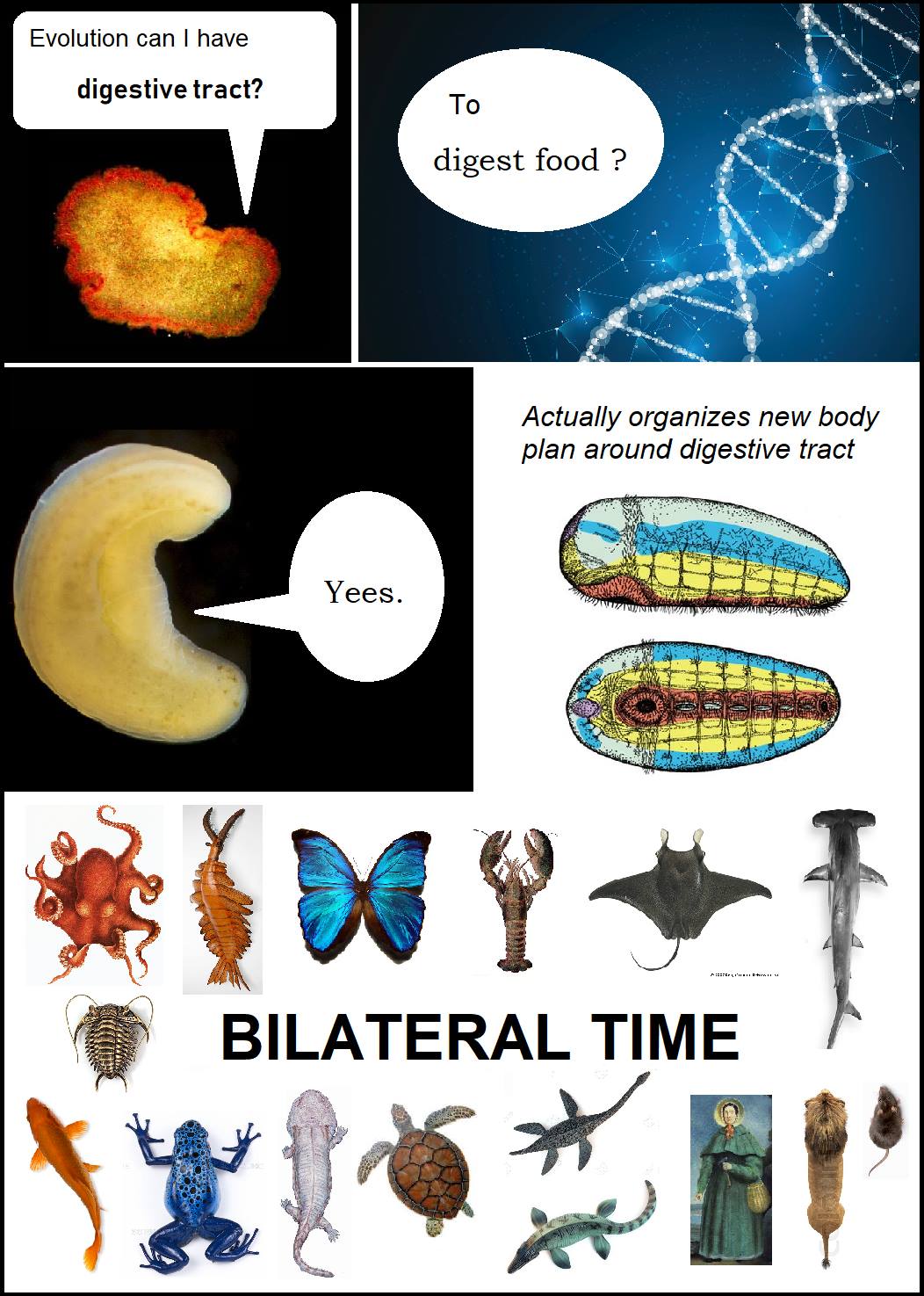
Guts really do make the bilaterian. Everything follows from making a tube-shaped body plan — all the increased potential for signaling between different tissues multiplies the number of possible developmental histories, and leads to all kinds of novelties. Like a central nervous system. You wouldn’t be reading this if there’d been no gastrulation. Brains, a coelom, a circulatory system, etc. were all side-effects of a successful feeding strategy and triploblasty. You should be grateful to your guts for making you.

Although, if they hadn’t, I suppose the life of a jellyfish isn’t all that bad.

Geneticists have the right answer. Now they just need to work harder to disseminate it.

In the past, I’ve been the recipient of floods of angry messages from racists who claim that their beliefs are “scientific”, that by rejecting their defense of “white genocide” I am denying Darwin, that evolution says that white people are distinct and special. I’ve had Jim Watson personally try to convince me that his racism was rational.

They’re all full of shit.

Now, as reported by the NY Times, the American Society of Human Genetics has denounced their ideas. Of course, being the NY Times means that the sensible text is surrounded by alt-right racist memes — lots of them, all blinking and flashing, loaded with false claims about genetics. I almost closed the window to the article because at a glance it looks like it’s promoting pseudo-scientific racism.

Here’s ASHG’s official position:

  • Genetics demonstrates that humans cannot be divided into biologically distinct subcategories. Although there are clear observable correlations between variation in the human genome and how individuals identify by race, the study of human genetics challenges the traditional concept of different races of humans as biologically separate and distinct. This is validated by many decades of research, including recent examples.
  • Most human genetic variation is distributed as a gradient, so distinct boundaries between population groups cannot be accurately assigned. There is considerable genetic overlap among members of different populations. Such patterns of genome variation are explained by patterns of migration and mixing of different populations throughout human history. In this way, genetics exposes the concept of ‘‘racial purity’’ as scientifically meaningless.
  • It follows that there can be no genetics-based support for claiming one group as superior to another. Although a person’s genetics influences their phenotypic characteristics, and self-identified race might be influenced by physical appearance, race itself is a social construct. Any attempt to use genetics to rank populations demonstrates a fundamental misunderstanding of genetics.
  • The past decade has seen the emergence of strategies for assessing an individual’s genetic ancestry. Such analyses are providing increasingly accurate ways of helping to define individuals’ ancestral origins and enabling new ways to explore and discuss ancestries that move us beyond blunt definitions of self-identified race.

Or you can read this summary at BigThink.

The society, which is the largest professional organization of scientists who work in human genetics, has about 8,000 members. Its statement calls the ideas of white supremacists about genetics “bogus,” “discredited” and “distorted”. The ASHG also makes a clear point that as far as the scientists are concerned, the age-old concept of race is wrong and humans cannot be split into subcategories that would be biologically different from each other.
The reason there is no race purity is due to the genetic intermixing of populations that results from constant migrations which have taken place all throughout human history. The constant movement of people resulted in very blurry genetic lines between groups.

And if you’re wondering whether this is something controversial in the scientific community, the statement goes on to say that the fact that there are no completely separate races is supported by decades of research, including six recent studies like the 2017 paper from the Center for Research on Genomics and Global Health, directly titled “Human ancestry correlates with language and reveals that race is not an objective genomic classifier”.

It’s a good statement, but ASHG has more work to do — you can’t just plop out a position statement in a journal only geneticists read, and then expect the general public to regard it as authoritative. You need to work at it. Just ask <a href=http://mathbionerd.blogspot.com/”>Melissa Wilson Sayres, who had a few criticisms for ASHG.

Read the whole thread. This is a common phenomenon: scientists who work in these fields know the racists are full of crap, see no point in discussing the crappiness with other scientists who also know they’re full of crap, and think that publishing a statement that “They’re full of crap, full stop” in a journal is sufficient. It isn’t. Evolutionary biologists also don’t talk about creationists at evolution meetings, and geologists don’t talk about flat earthers at geology meetings, except maybe to laugh at them over a beer at the bar after the daily sessions. And the people who do try hard to bring these issues to public attention are sneered at as popularizers who aren’t doing the real work. Meanwhile, racists and creationists and climate change deniers are climbing the civil service ladder and getting elected to high office, and making decisions about science funding.

But at least the meetings remain pure and unsullied by nonsense.

Which means that the scientists are cheerfully unaware of how their sloppy public speaking on the issues gets appropriated by ideologues. The shorthand of science is easily abused, technical terms get colloquialized in invalid ways (see the word “theory” for an example), and sometimes scientists let their biases lead them down unsavory paths (see James Watson) and get treated as respected fonts of wisdom rather than cranky outliers. We also see that the media cannot address what scientists take for granted without giving lots of press to the ignorant, anti-scientific ideas of bigots and fools in the name of ‘balance’ or ‘teaching the controversy’ — it doesn’t matter that there is no controversy, they’ll invent one.

Geneticists are walking through a minefield. They ought to learn about the dangers rather than just taking a blithe, heedless stroll.

Boom, they all died

An analysis of sedimentary deposits laid down in the times bracketing the Permian extinction reveals something a bit unsettling: the Earth’s biota was thriving and doing just fine right up to the sudden end, and then almost all species abruptly kicked the bucket in a geological flash.

The end-Permian mass extinction, which took place 251.9 million years ago, killed off more than 96 percent of the planet’s marine species and 70 percent of its terrestrial life—a global annihilation that marked the end of the Permian Period.

The new study, published today in the GSA Bulletin, reports that in the approximately 30,000 years leading up to the end-Permian extinction, there is no geologic evidence of species starting to die out. The researchers also found no signs of any big swings in ocean temperature or dramatic fluxes of carbon dioxide in the atmosphere. When ocean and land species did die out, they did so en masse, over a period that was geologically instantaneous.

So what could have caused the sudden, global wipeout? The leading hypothesis is that the end-Permian extinction was caused by massive volcanic eruptions that spewed more than 4 million cubic kilometers of lava over what is now known as the Siberian Traps, in Siberia, Russia. Such immense and sustained eruptions likely released huge amounts of sulfur dioxide and carbon dioxide into the air, heating the atmosphere and acidifying the oceans.

Complicating matters, though, is that these eruptions proceeded for a long time before, during, and after the mass extinction, so it seems that life persevered until it reached an abrupt breaking point, and then ecosystems collapsed.

“We can say there was extensive volcanic activity before and after the extinction, which could have caused some environmental stress and ecologic instability. But the global ecologic collapse came with a sudden blow, and we cannot see its smoking gun in the sediments that record extinction,” Ramezani says. “The key in this paper is the abruptness of the extinction. Any hypothesis that says the extinction was caused by gradual environmental change during the late Permian—all those slow processes, we can rule out. It looks like a sudden punch comes in, and we’re still trying to figure out what it meant and what exactly caused it.”

“This study adds very much to the growing evidence that Earth’s major extinction events occur on very short timescales, geologically speaking,” says Jonathan Payne, professor of geological sciences and biology at Stanford University, who was not involved in the research. “It is even possible that the main pulse of Permian extinction occurred in just a few centuries. If it turns out to reflect an environmental tipping point within a longer interval of ongoing environmental change, that should make us particularly concerned about potential parallels to global change happening in the world around us right now.”

This is why we need a big-picture perspective of our planetary environment. It’s like a game of Jenga — we keep knocking out little bits and pieces (or species or biomes) and congratulating ourselves that the tower is still standing, but eventually we’ll reach the point where one last insult causes everything to topple. Then, I’m sure, there will be people lying in the rubble, wondering why they’re starving or dying of disease or watching the natural catastrophe rolling in their direction, and they’ll be totally surprised by it all.

If it’s Monday, it must be spider feeding day

Mondays are usually awful, but now at least I have one thing to look forward to: it’s feeding day down on the spider ranch. The adults get a nice chewy cricket each, while I go through the spiderlings’ chambers and toss them a fruit fly each. Since Vera was so avidly hungry today, I recorded her trapping her prey and then picking at it for an extended period of time.

This one is only for spider obsessives who can enjoy staring at close-ups of arachnids doing strange things with their jaws for 15 minutes or more. Are you one? Let me know, and we can start a club.

[Read more…]