Santa, all I want for Christmas are spider eggs

When I got home from my week in Denver last night, the very first thing I did was rush off to the lab to check on the spiders. They were fine! Completely unperturbed by a week of neglect! They even produced egg cases for me! Well, one healthy egg case. Vera continues her habit of dumping dessicated dead eggs in ill-formed egg cases, which you may recall was something Gwyneth did before she died, too.

Oh, yeah, then we checked on the cat. She was fine, too.

Sneaking political commentary into science papers? Glorious!

Via Jonathan Eisen, a simple exercise.

Please take a minute to experience for yourself one of the greatest scientific Easter eggs in a long time.

Step 1: download the PDF of this paper: https://www.nature.com/articles/s41598-018-20427-9

Step 2: Go to Page 3.

Step 3: Zoom way way in on the turd in Figure 1.

Step 4: Enjoy and share.

The article is titled “Methylation-based enrichment facilitates low-cost, noninvasive genomic scale sequencing of populations from feces”, in case you’re interested.

For those of you who don’t want to take the trouble, I’ll put the illustration of a baboon turd below the fold. You never know, someone might decide to insist on having it redrawn.

[Read more…]

The problem of homology

We don’t get to see our granddaughter this morning — she’s getting her pediatric checkup today — so while sitting on my thumbs in my hotel room this morning, I threw together a video on the problem of homology, as misrepresented by Jonathan Wells and Paul Nelson. Seriously, they get it all wrong with tendentious misrepresentations.

There is a real problem of homology, because homology is rendered difficult to see by standard, naturalistic evolutionary processess. Wells and Nelson get it all exactly backwards. That homologies are obscured by the nature of evolutionary change is what we’d expect from evolutionary theory. It’s like how bioinformaticians will talk about the problem of long branch attraction; it’s a real problem, but it doesn’t imply that evolution is wrong, because it’s an expected effect of evolutionary change.

Likewise, evo-devo people will write long papers about the problem of homology, because the action of evolution obscures homologies and we have to struggle to see beyond it. Only a pair of buffoons would argue that it means evolution is false.

I don’t have a script for this one, because it’s just me talking extemporaneously in a dull hotel room, sorry. But I do have a good quote from Mary Jane West-Eberhard, and that’ll have to do if you don’t have the patience to listen to some geezer talking at a camera.

Changing characters do not march ever outward along the branches of a phylogenetic tree. While homology, parallelism, and convergence remain useful conceptual guides, they need to be seen against a background of continual reshuffling with a particulate, mosaic phenotype that renders linear terms like parallelism and convergence only approximate, and potentially misleading, descriptions of evolution.

Does a concept of mixed or partial homology just make a mess of homology? In fact, evolution makes a mess of homology.

Mary Jane West-Eberhard

I was born too late

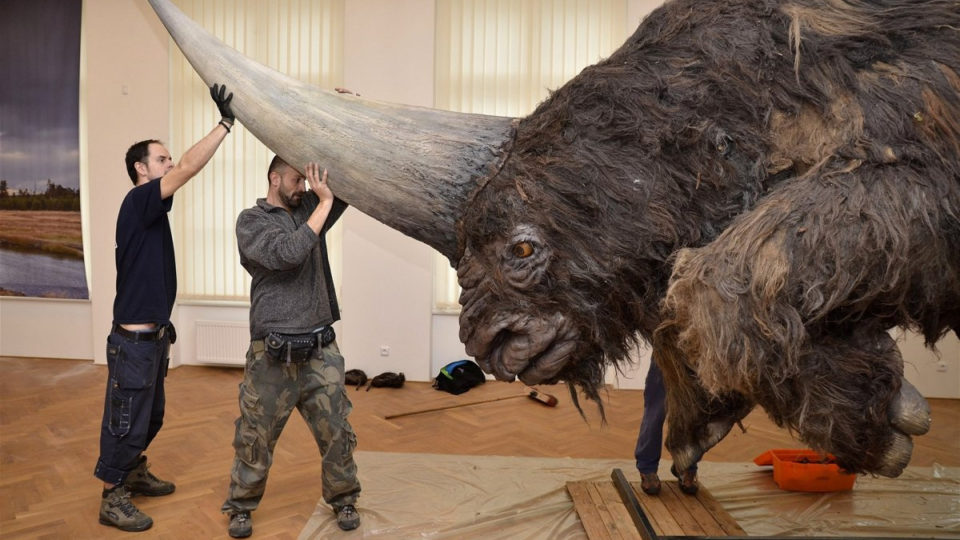
See, I just barely missed my chance to witness an Elasmotherium.

Scientists originally thought that Elasmotherium sibiricum, commonly referred to as “Siberian Unicorn,” died out around 100,000 to 200,000 years ago. But a recent study published in Nature Ecology & Evolution, a peer-reviewed journal, reveals the species was alive until at least 39,000 years ago, a contemporary of both humans and Neanderthals.

Awesome. Although I do have to think about whether it would be a fair trade-off to have been born 40,000 years ago in Siberia in order to see an animal that would stomp me flat.

Spider update

All I want for Christmas is another egg sac, and they aren’t obliging.

  • Vera ate another husband. Again. She’s the voracious jaws of death, and all I can hope for is that the poor doomed fellow inseminated her before getting sucked dry. Vera is hugely bloated right now, having consumed a large male and a smorgasbord of flies.
  • The other pairs of spiders are much more placid and are coexisting well, but no eggs yet. I did notice that one of them had molted, so maybe they’re too young? Have I set up a Blue Lagoon scenario here?
  • All of the spiders (except those sacrificed to the bloodthirsty Vera) are looking healthy and active, and are quite swift in demolishing flies presented to them.

So I’m just waiting. Waiting waiting waiting. Don’t they realize I’ve got plans for their progeny?

Now thinking about starting up a dairy spider farm on the prairies of Minnesota

There are these weird salticid spiders that have evolved a radically different morphology — they live in ant nests, and physically mimic the ants. Look at this ant-spider. Isn’t this amazing enough?

That’s a spider? Yeah, count the legs. It’s trying so hard to fit in with tunnel-dwelling insects with three body segments, you just have to applaud the effort.

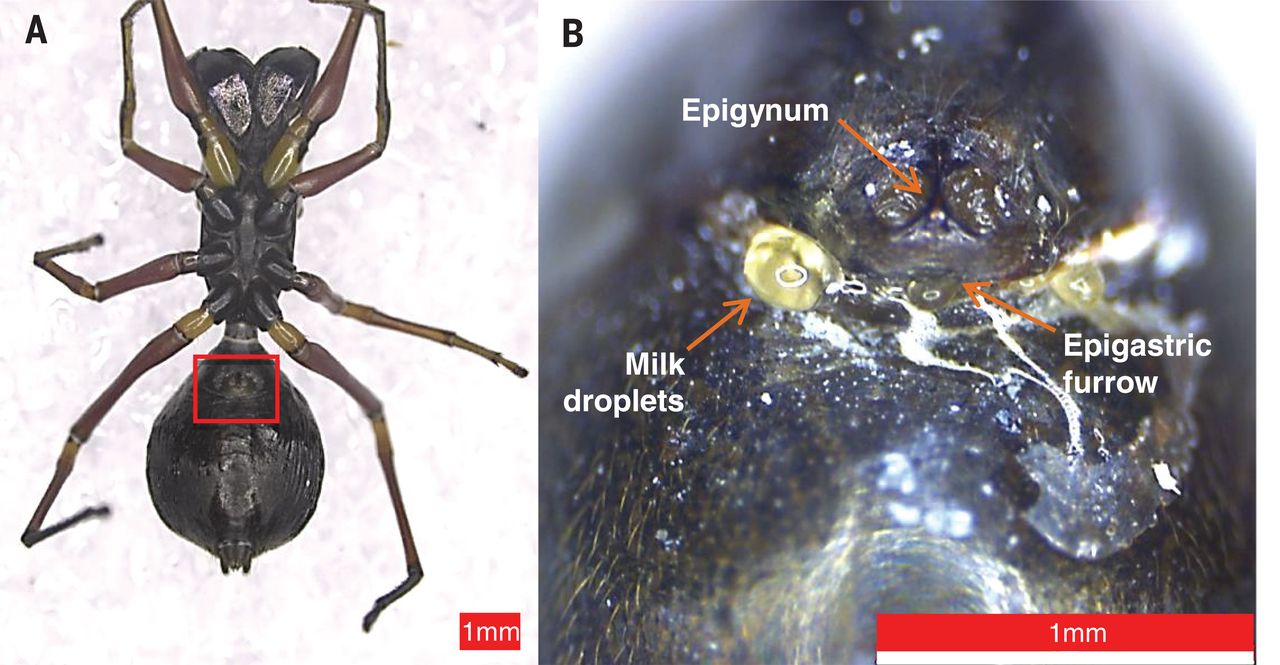
What’s more, they’ve acquired another evolutionary novelty: they secrete ‘milk’ to feed their young, and have extended parental care. The necessity of milk production was tested with the cruel experiment of painting over the epigastric furrow (the site of secretion) with White-Out, and what happened? All the spiderlings starved to death. The utter bastards. There are things you can get away with when working with invertebrates that you couldn’t do with cute fuzzies with bones. Try doing that experiment with bunnies, just be prepared for torches and pitchforks.

There’s another revelation in this figure caption.

Spider milk and its secretion site in Toxeus magnus.

(A) Ventral view of mother. (B) Milk droplets secreted after slight finger pressure on abdomen.

Did you get that? They are milking spiders. I come from a long line of Norwegian dairy farmers in Minnesota, so you can guess where my mind went from here. Can I get state and federal subsidies for my spider farm? I’ll have to look into it.

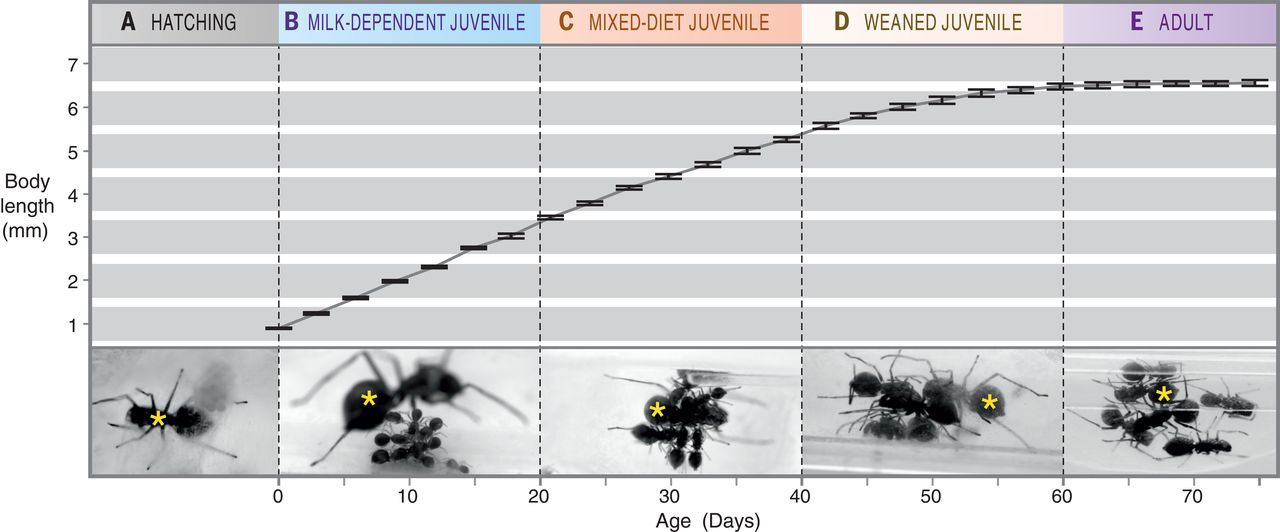
The study is primarily about the life history of this spider species, with some experimental manipulation, and it does a thorough job of that.

T. magnus offspring body length growth and food resources during development.
(A) Egg hatching. (B) Absolute milk dependence: Spiderlings do not leave the nest, and the mother releases milk droplets to the nest internal surface. (C) Spiderlings forage during the day and suck milk at night. (D) Subadults nutritionally independent but still return to nest. (E) Spiderlings reach sexual maturity, but some stay with the mother. *The mother. N = 207 offspring, Nnest = 19 surveyed nests, error bars (SEM).

It’s missing one thing, though: any analysis of the chemical make-up of spider milk. I’m going to take a wild guess that unlike mammal milk, which is rich in fats and carbohydrates, spider milk is going to be more like a protein shake — that it’s going to be in many ways similar in composition to the dissolved bug guts that spider adults live on, to simplify the transition from an independent hunting spiderling to a spiderling with an obligate dependency on parental care. Which means a) humans can probably synthesize it by homogenizing masses of fruit flies in a blender with some digestive enzymes, and filtering out the chitin, and b) there’s not going to be much of a human market for it. Alternatively, they suggest that spider milk may have evolved from the breakdown of trophic eggs — that is, eggs produced that do not develop, but provide a food source for other members of the brood. In that case, it may be a soup of phospholipoglycoproteins, similar to the vitellogenins of other arthropods, and its closest vertebrate analog would be egg yolks.

Inquiring minds want to know. They’re going to have to milk a lot of spiders to get enough to analyze, though!


Chen Z, Corlett RT, et al. (2018) Prolonged milk provisioning in a jumping spider. Science 362(6418):1052-1055. DOI: 10.1126/science.aat3692

P.S. There is a Minnesota milk song. They might have to change some of the hand gestures.

Always ask for permission first, before playing God

That story I posted yesterday about the rogue Chinese gene editor? The Chinese government has responded swiftly and repudiated He Jiankui’s work.

Chinese Vice Minister of Science and Technology Xu Nanping told state broadcaster CCTV that his ministry is strongly opposed to the efforts that reportedly produced twin girls born earlier this month. Xu called the team’s actions illegal and unacceptable and said an investigation had been ordered, but made no mention of specific actions taken.…He’s experiment “crossed the line of morality and ethics adhered to by the academic community and was shocking and unacceptable,” Xu said.

Uh-oh. He’s in trouble. I know there’s the idea that it’s easier to ask for forgiveness after the fact, but maybe that doesn’t apply when you’re tinkering with human lives.