A few weeks ago, I had an absolutely delicious stout at a brew pub in Alexandria. I’m going to have to remember it, because it may have been the last time I let alcohol pass these lips. Why? Because I’m slowly turning into one of those snooty teetotalers who tut-tut over every tiny sin. It started with vegetarianism, now it’s giving up alcohol, where will it end? Refusing caffeine, turning down the enticements of naked women, refusing to dance? The bluenose in me is emerging as I get older. I shall become a withered, juiceless old Puritan with no joy left in me.
It didn’t help that last week I was lecturing on alcohol teratogenesis in my eco devo course, and it was reminding me of what a pernicious, sneaky molecule it is. I’ve known a lot of this stuff for years, but there’s a kind of blindness brought on by familiarity that led me to dismiss many of the problems. You know the phenomenon: “it won’t affect me, I only drink in moderation” and other excuses. Yeah, no. There are known mechanisms for how alcohol affects you, besides the obvious ones of inebriation.
- It induces cell death.
- It affects neural crest cell migration.
- It downregulates sonic hedgehog, essential for midline differentiation.
- It downregulates Sox5 and Ngn1, genes responsible for neuron growth and maturation.
- It weakens L1-modulated cell adhesion.
I already knew all about those first four — I’ve done experiments in zebrafish like these done in mice.

Take a normal, healthy embryo like the one in A, expose it to alcohol, and stain the brain for cell death with any of a number of indicator dyes, like Nile Blue sulfate in this example B (I’ve used acridine orange, it works the same way). That brain is speckled with dead cells, killed by alcohol. If you do it just right, you can also see selective cell death in neural crest cell populations, so you’re specifically killing cells involved in the formation of the face and the neurons that innervate it. In C, you can see the rescuing effects of superoxide dismutase, a free radical scavenger, and that tells you that one of the mechanisms behind the cell death is the cell-killing consequences of free radicals. I could get a similar reduction in the effects with megadoses of vitamin C, but that doesn’t mean a big glass of orange juice will save you from your whisky bender.
I was routinely generating one-eyed jawless fish, a consequence of the double-whammy of knocking out sonic hedgehog and cell death in the cells that make branchial arches.
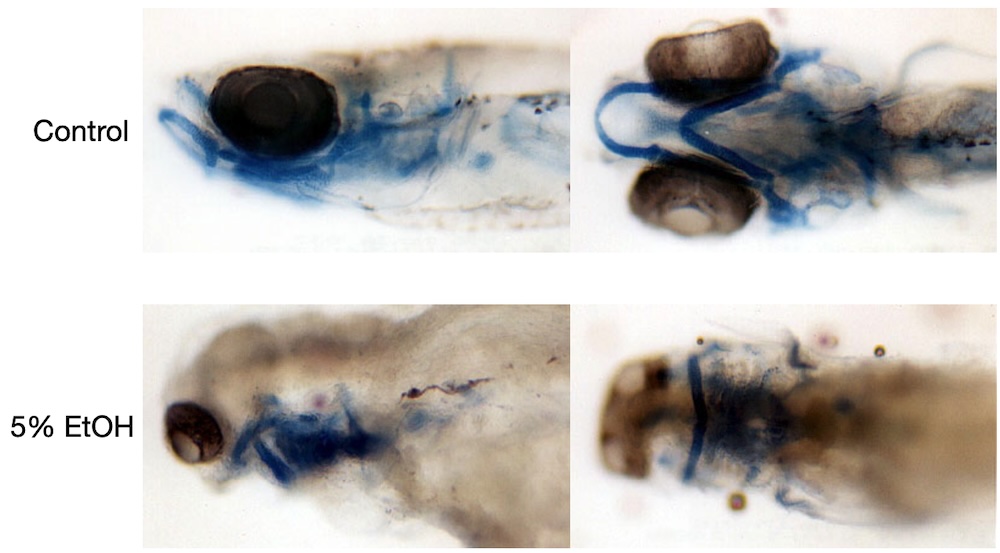
You can wave away these results by pointing out those huge concentrations of alcohol we use to get those observable effects, but we only do that because we don’t have the proper sensitivity to detect subtle variations in the faces of mice or fish. So we crank up the dosage to get a big, undeniable effect.
I only just learned about the L1 effects, and that’s a case where we have a sensitive assay for alcohol’s effects. L1 is a cell surface adhesion molecule — it helps appropriate populations of cells stick together in the nervous system. It also facilitates neurite growth. It’s good for happy growing brains.
It also makes for a relatively easy and quantitative assay. Put neuronal progenitors that express L1 in a dish, and they clump together, as they should in normal development. Add a little alcohol to the medium, and they become less sticky, and the clumps disperse.

What’s troubling about this is the dosage. Adhesion is significantly reduced at concentration of 7mM, which is what the human blood alcohol level reaches after a single drink. The fetal brain may not be forming as robustly when Mom does a little social drinking that doesn’t leave her impaired at all, not even a slight buzz.
Maybe you console yourself by telling yourself a little bit does no harm, your liver soaks up most of the damage (and livers are self-repairing!), that it’s only binge drinkers who have to worry about fetal alcohol syndrome, etc., etc., etc. We have lots of excuses handy. Humans are actually surprisingly sensitive to environmental insults, we have mechanisms to compensate, but there’s no denying that we’re modifying our biochemistry and physiology in subtle ways by exposure to simple molecules.
Now maybe you also tell yourself that you’re a grown-up, I’m talking about fetal tissues, and you also don’t intend to get pregnant in the near future or ever. I’m also a great big fully adult person who is definitely not ever going to get pregnant, but development is a life-long process, and we’re all fragile creatures who nonetheless soak up all kinds of interesting and dangerous chemicals during our existence. We know alcohol will kill adult brain cells, but what else does it do? Do you want to be a guinea pig? I think that, as I age, I am becoming increasingly aware of all the bad stuff I did to myself in my heedless youth, and am starting to think that maybe I need to be a little more careful, belatedly.
Oh, you want some reassuring information? Next week we’re discussing endocrine disruptors in my class — DDT, DES, BPA, PCB, etc. — all these wonderful products of plastics and petrochemical technology. You’re soaking in them right now. They never go away. How’s your sperm count looking? Any weird glandular dysplasias? Ethanol looks pretty good compared to chlorinated and brominated biphenyls.