Happy Ada Lovelace Day!

ada

Today we celebrate women in science and technology by remembering Ada Lovelace. We also take note of how tech companies still fail to meet gender equality standards (so they better hire my daughter when she graduates), and the miserable failure of academia to end sexual harassment. So it’s kind of a mixed celebration.

Do read that last link, if nothing else.

Last week I watched a documentary by Louie Theroux, about Jimmy Savile and the child rape scandal. In it, Theroux said something that struck me; “monsters don’t get close to children, nice men do”. I think the same can be said of these sexual harassment and abuse stories that we hear of so often now in STEM disciplines. The perpetrators of harassment and abuse are not monsters, they are often highly respected and inspiring figures at first. They can be our friends, colleagues, and mentors. That’s what makes it so hard if we find out that this trusted friend, colleague, or mentor has been abusing and hurting other people. The resulting cognitive dissonance keeps us from accepting that it is even possible that our trusted friend, colleague, or mentor is capable of these behaviours and therefore, we automatically ignore what we hear from survivors. We believe the excuses and explanations that the perpetrator comes up with. And I have come to realise that this is just one of the many ways that our society allows sexual harassment to go on as long as it does, and why survivors are so scared to come forward. Even when they do, we expect these survivors to shoulder the emotional labour of reaching out to other victims, talking to the media, and reliving the harassment, all while trying to hold the perpetrator accountable for what they did. And if that wasn’t enough, survivors also have to deal with those within the community who question the veracity of their experiences.

On a cheerier note, at least now you can buy badass women of science t-shirts.

What about the men who play chess?

queens

The Fédération Internationale des Échecs (FIDE) has foolishly scheduled the world chess championships for Tehran, Iran, which has declared that The Islamic Republic … demands even non-Muslims visiting Iran to wear the hijab. This is contemptible, and we should not tolerate that kind of sexist imposition. People are planning to boycott the event. However, I’ve noticed something peculiar about the reporting of this boycott.

“Top female chess players in the world say they won’t compete in Iran if they’re forced to wear the Islamic headscarf,” says The Atlantic.

The Independent declares, “Female chess players from around world outraged after being told to wear hijabs at tournament in Tehran.”

“Female chess players protest wearing hijab at Iran world championship,” says CNN.

Hey, I say, what about the men? Shouldn’t the male grandmasters also be announcing their solidarity with their colleagues?

Perhaps male chess players tend to be insensitive sexists who don’t care what happens to the women players. Or perhaps they are cowards who are relieved that the theocratic rule is going to eliminate much of their competition. Or perhaps journalists assume that only women can get outraged at discrimination against women.

I don’t know. I’m just making reasonable guesses.

I hear that women are made of exotic matter

The Nobel in Physics has been awarded for research on exotic matter, but I think you’d be better off looking for a physicist to explain it. I’m sure it’s good work and that the three scientists are deserving, but I just have to leave this fact on the table.

No Nobel Prize has come close to being equitably distributed by gender, but physics has the worst record of them all. Zero women have won it in the past 50 years. Exactly two women have won it ever.

Again, this does not detract from the accomplishments of Thouless, Haldane, and Kosterlitz, but it does make one wonder how much further physics would have progressed if it didn’t have a culture that discouraged half of humanity from participating.

Who knew books could be divided into just two categories?

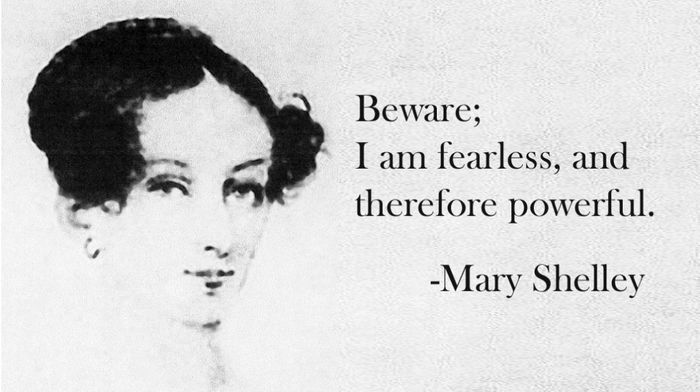
maryshelley

Here are six books that come highly recommended: the were on the Royal Society shortlist for the Insight Investment Science Book Prize this year. I’ve got two of them, I should probably add some more.

The Most Perfect Thing by Tim Birkhead
The Hunt for Vulcan by Thomas Levenson
Cure by Jo Marchant
The Planet Remade by Oliver Morton
The Gene by Siddhartha Mukherjee
The Invention of Nature by Andrea Wulf

Notice anything about the range of books and authors?

My first thought was that hey, 5 of the 6 are about biology or the environment. Excellent!

The winner is the book by Andrea Wulf, which raised a curious concern in the mind of an editor at The Guardian — by gosh, 2 of the 6 were written by women. Isn’t that remarkable? As he notes, women haven’t normally been recognized for science writing.

In the previous 10 years, only three out of 60 Royal Society shortlistees were female, with precisely zero women appearing on the shortlist between 2010 and 2013.

An injustice is slowly being corrected, I would say. But that’s not the interpretation Dugdale reaches for, strangely. As Tom Levenson (note: one of runners-up for the prize) notices:

Five days after the award was announced, John Dugdale, the associate media editor of The Guardian, wrote a piece that asked “Why have women finally started winning science book prizes?” You might think: Good question! Women have been writing great science books for a long time now. Why haven’t more of them been recognized?

But that’s not why Dugdale asked the question. According to him, the Royal Society caved to pressure created by the example of another “more female-friendly” prize. His piece suggests that the judges’ taste is shifting from “male” approaches to science writing that emphasize “a problem, a mystery, or an underexplored scientific field,” towards a feminine tendency “to focus on people.”

My jaw dropped at that clumsy attempt to impose a peculiar gender essentialism on science writing. Levenson must be exaggerating. But no, that’s exactly what he said.

So perhaps female science writers are more likely to focus on people, while their male counterparts are more likely to address a problem, a mystery or an underexplored scientific field.

He goes further to somehow divide the attendees at the awards ceremony by sex. Somehow, he thinks there is some significant difference between these books based on the sex of the author, which is just plain weird.

The men on the shortlist introduced books about geo-engineering, eggs, the hunt for a non-existent planet and the history of genes. In contrast, Wulf enthused about her globetrotting genius and Jo Marchant read a passage from her exploration of mind-over-body healing, Cure – the only extract that reached for the messy subjectivity of the first person.

Has he even read these books? There’s just no way to split them into only two categories in a way that neatly segregates the Wulf and Marchant books into a common pigeonhole. Maybe he sensed a magical “estrogen vibe” at the ceremony that then suffused the books. Or maybe I had failed to notice that the authors of books written in the first person, like American Psycho, Fight Club, Moby Dick, All Quiet on the Western Front, Post Office, and The Curious Incident of the Dog in the Night-Time were all women. The surprising things you can learn from media editors at major newspapers…


Also, don’t miss GrrlScientists scathing takedown of Dugdale.

The theme for the day seems to be…

What is this, Gender Pronoun Day?

Jordan Peterson, a professor at the University of Toronto, is railing against “political correctness”, generally a good sign that we’re dealing with a right-wing wackaloon, depending on what has gotten them wound up. In this case, it’s safe to say he’s an outraged wingnut, because this is what has got him upset:

Gender identity is defined by the Ontario Human Rights Commission as “each person’s internal and individual experience of gender. It is their sense of being a woman, a man, both, neither, or anywhere along the gender spectrum.” The commission defines gender expression as “how a person publicly presents their gender,” which can include behaviour and outward appearance such as dress, hair, make-up, body language and voice, as well as a person’s name and the pronouns they use.

Yes? Seems like plain old ordinary common sense to me — gender is complicated and messy, and a matter of personal experience as well as biology. All I should care about is how a person presents themselves, and I should respect that.

But no, not to Jordan Peterson! This is unadulterated crazy talk.

Peterson is critical of these terms and their definitions as outlined by the commission, and compares the changes Bill C-16 would bring about to the policing of expression in “totalitarian and authoritarian political states.”

I think he’s got it backwards. Demanding that individuals conform to one of only two gender roles is the totalitarian/authoritarian position.

He also argues against the existence of non-binary gender identities, or those that are not exclusively masculine or feminine, saying “I don’t think there’s any evidence for it.”

By the way, he’s a professor of clinical psychology.

You could try typing evidence of non-binary gender identities into Google Scholar and see what comes up. Do you think it might be a blank page? It isn’t.

Peterson said that if a student asked him to be referred to by a non-binary pronoun, he would not recognize their request: “I don’t recognize another person’s right to determine what pronouns I use to address them. I won’t do it.”

Amazing. Why? So it would be OK for me to address Jordan Peterson as “she” or “her”? He seems to be saying the subject of a reference is not to be allowed any say in how they are addressed. I also wonder if he’s one of those professors who insist that students address them as “Professor” or “Doctor”.

It’s common courtesy to ask how someone wishes to be addressed, and especially in a formal relationship, to respect that. There’s nothing wrong with a professor insisting that they be addressed by title, or by first name — and students should respect that convention. Would it be OK if, against his wishes, I addressed Jordie-boy as “Maximum Sphincter Peterson” in the classroom?

Peterson told the National Post that he decided to make the video and go public with his views after receiving a memo from university HR outlining new mandatory anti-racist and anti-bias training. “That disturbs me because if someone asked me to take anti-bias training, I think I am agreeing that I am sufficiently racist or biased to need training,” he said in an interview.

Yes, Maximum Sphincter Peterson. You are sufficiently biased to need training. We all are. I have a terrible habit of calling an awful person a “sphincter”, and I could probably do with a little conversation about how it makes others feel.

A big deal on campus

My little university is hosting the Minnesota Out! Campus Conference this year — and it’s looking like a very well organized and busy event.

MOCC 2016 is hosted by the University of Minnesota Morris!

MOCC is a premier opportunity for students, staff, faculty, alumni, and community members from Minnesota, Wisconsin, and the surrounding areas to discuss issues facing lesbian, gay, bisexual, trans, queer, intersex , asexual, and two spirit persons (LGBTQIA2S+) on college and university campuses and in the greater community

You’re invited this November 11-13, 2016 to join the University of Minnesota Morris for MOCC 2016. This year’s theme is “Connecting to Our Roots: Where We’re From and Where We’re Going.”

By inviting leaders from across the state to our community we hope to encourage a conversation on discussing how we can best support LGBTQIA2S+ communities in the face of numerous challenges and limited resources. In places such as Morris, opportunities to host events such as MOCC are few and far between. And, as such, hosting this conference means a great deal to us! We are proud of the work we have accomplished and hope to use this conference as a catalyst to create even greater change at our small campus and the community surrounding it.

I hope there’s good attendance — we need more people to come on out to our little town on the prairie to see that rural America can be open and tolerant and welcoming.

How not to apologize

This is an amazing response. VOYA (Voice of Youth Advocates) reviewed a young-adult book and flagged it as “recommended for mature junior and senior high readers” because it used naughty language and one of the main characters was described as bisexual. Not that it described sexual activity explicitly, but simply that the character was stated to be bisexual.

Horrors. Can’t have young people discovering that sexuality isn’t a simple binary switch.

Just to make it even more fun, the review was published around the time of Bisexual Awareness Week. So readers called out the magazine for their inappropriate and thoughtless commentary. Wait until you get a load of how VOYA responded to that.

notpology

I’m impressed. That’s a world-class notpology. But it looks like they’ve practiced a lot, because the whole magazine went into a prolonged notpological freakout over the fact that readers criticized them.

This has led me to the SorryWatch blog, which is most entertainingly horrifying. But they also have an excellent post on what makes a good apology, and a fun post on what makes for a bad apology. Both are useful resources.