Maybe we just need them for the ones who think global warming attracts meteors.
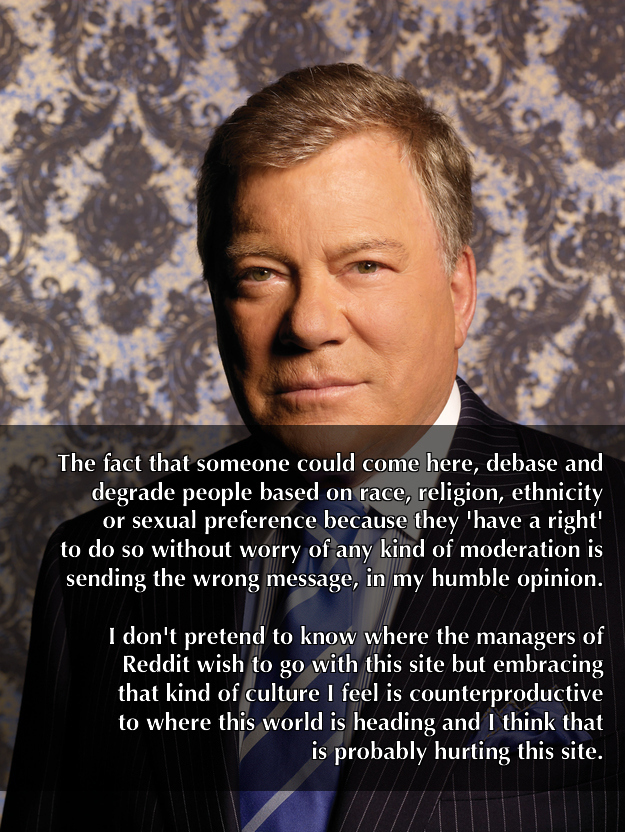
Captain Kirk always was willing to violate the Prime Directive when it suited him. He went on Reddit to do an IAmA, and guess what he did? Shatner dissed Reddit and the whole idea of irresponsible speech!
Now watch: I’m going to immediately derail the whole comment thread by starting a real nerd war: This just confirms that Star Trek TOS was the very best of all the Star Treks.
Uh-oh — I told a student just last week that I thought she’d make an excellent science journalist. Maybe it wasn’t such good advice.
95 weekly science sections in newspapers in 1989
34 weekly science sections in newspapers in 2005
19 weekly science sections in newspapers in 2012
The good people at CFI have been getting spammed by the usual cranky suspects on twitter, so they have officially announced their policy for blocking people on twitter. It’s a good set of general rules, and is actually simple common sense: there are people out there who don’t recognize reasonable limits and use twitter for non-stop harassment. I personally am pretty liberal about blocking — with something like a hundred thousand followers, it’s fairly easy to get swamped with noise, and one person trying to dominate a conversation can really derail everything. As Fidalgo points out, “‘block and ignore’ is Twitter’s own advice about handling this kind of thing.”
There are six comments on the announcement so far. Would you believe every one of them is from a slymepitter whining bitterly about the policy? Yes, of course you would. When all they’ve got is “raw hectoring” and abuse to offer, of course they’re going to complain when someone declares that they won’t be listening to raw hectoring and abuse.
Many of you already know that Aaron Swartz, an online activist, committed suicide earlier this week. I didn’t know much about him, but now I’ve learned two things.
One, he was a victim of depression. I’ve never experienced this personally — at worst I can say I’ve been sad and stressed at time — but let’s be clear about something: depression is something altogether different. Swartz wrote about his depression, and got across a little bit about what it actually feels like. This is good communication.
Your face falls. Perhaps you cry. You feel worthless. You wonder whether it’s worth going on. Everything you think about seems bleak – the things you’ve done, the things you hope to do, the people around you. You want to lie in bed and keep the lights off. Depressed mood is like that, only it doesn’t come for any reason and it doesn’t go for any either. Go outside and get some fresh air or cuddle with a loved one and you don’t feel any better, only more upset at being unable to feel the joy that everyone else seems to feel. Everything gets colored by the sadness.
At best, you tell yourself that your thinking is irrational, that it is simply a mood disorder, that you should get on with your life. But sometimes that is worse. You feel as if streaks of pain are running through your head, you thrash your body, you search for some escape but find none.
Two, I’m outraged at the criminal abuse by the justice system that exacerbated his problems. The man was hounded to death, threatened with long prison terms by MIT and JSTOR, the journal archive service.
Aaron’s death is not simply a personal tragedy. It is the product of a criminal justice system rife with intimidation and prosecutorial overreach. Decisions made by officials in the Massachusetts U.S. Attorney’s office and at MIT contributed to his death. The US Attorney’s office pursued an exceptionally harsh array of charges, carrying potentially over 30 years in prison, to punish an alleged crime that had no victims. Meanwhile, unlike JSTOR, MIT refused to stand up for Aaron and its own community’s most cherished principles.
You might be wondering what awful crime he committed that justified arresting him and confronting him with a 50 year prison sentence: he downloaded scientific research articles and then made them available to others (Wait…apparently, he didn’t even share them, but just downloaded them via MIT’s protocols). Uh-oh. I’ve done this…just not on the scale of Swartz’s efforts. Swartz was committed to Open Access.
This is the problem: not that Swartz opened the door to scientific research, but that we’re laboring under an antiquated system of scientific information storage that privileges profit-making over open access to the results of publicly-funded research.
Not so good, I’m afraid.
If you feel like torturing yourself some more, read the comments on that youtube video. They are…typical youtube comments.
I’m not a woman, but I’m a nerd, and we aren’t looking so hot, either.
I said I was done with this guy, but his latest includes a bit that annoys me to no end. Keith Kloor interviews Daniel Sarewitz to get ammo for his claim that religion and science are compatible.
Based on your piece, I would presume that you think the two are compatible. However, some of the prominent New Atheists, such as PZ Myers and Jerry Coyne, insist that science and religion are incompatible. Why has this discussion become so binary? Why the either/or mindset exhibited by some atheists?
DS: There are lots of scientists who are also religious, so as an empirical matter science and religion are apparently not incompatible.
Gah. Dumb.
There are scientists who believe the earth is 6000 years old and that there was a global flood 4000 years ago. Therefore, science and creationism are perfectly compatible.
There are accountants who skim off profits and hide them in the books, therefore accounting is compatible with criminal larceny.
There are doctors who smoke, therefore smoking is compatible with healthy lungs.
Why has this discussion become so binary? Easy. Because some scientists have gigantic religious blindspots and want to pretend that their gullibility is part of their science.
When I agreed that many so-called ‘controversies’ don’t warrant a debate, I wasn’t saying that we shouldn’t cover them…just that they should be addressed appropriately, as fringe issues. The last thing we would want is media silence on, for instance, creationism! Ars Technica has a good piece on why we mustn’t be quiet about weird political positions.
Through the years I have received countless e-mails and have read hundreds of article comments imploring Ars to keep "political" stuff off the site. Such entreaties most commonly occur in relation to our scientific coverage of climate change or evolution, but also when we cover biological and anthropological matters of gender and sex. (They also come to a lesser extent when we cover the inherently political world of intellectual property, where, coincidentally, there are far fewer facts—but that’s outside the scope of this editorial.)
What those petitioners do not realize is that in asking us to be silent, they require that we take a politicized stance. Intentional silence is support for the status quo, and as such, it’s inherently political. Note that I’m speaking of intentional silence or avoidance, purposely not covering a topic so as not to bring light to it. Inasmuch as our editorial mission is, in part, to cover the issues relating to science and technology that are most challenging to our culture, it is unthinkable for us not to cover these issues. To reiterate, not covering them would be just as "political" as covering them.
This is also why I ignore or mock people who complain that “The movement has been co-opted by people with an agenda” — everyone has an agenda. Demanding silence on topics you don’t like is a symptom of having an agenda.
David Hone has a good piece on what constitutes an appropriate subject for debate, and how the media fails.
The truth however, is near inevitably that there is only a very small minority making a disproportionate noise about their case. There is no debate over evolution, or the dinosaurian origin of birds, or that HIV leads to AIDS, or that climate is changing, or a great many others. That there are real, accredited scientists who do not think this is the case is not in doubt (sadly). But that this represents a real schism in the scientific community, that large numbers of researchers take these positions and that it occupies a significant amount of scientific research, or that there is good evidence for that position is certainly incorrect. One or two people arguing a point (and often doing so primarily in the media) does not make a debate.
…
This for me seems like the opposite of what good journalism should be. Surely the point is to provide a representation of the true state of affairs rather than spin (even if unintentionally) the fact that there is disagreement as something that is effectively 50:50, when it’s 99.9:00.1 or less. This can be humorous from an insider’s position when one sees the media triumph a paper as ‘reigniting the debate over x’ when in truth the researchers have looked at the paper, noted an obvious flaw or that it simply rehashes old and incorrect arguments or data, and carried on. The flipside of this is where there really is a scientific debate, in which case the debate is not reignited at all, but merely still going on, it has merely come to the attention of the press and public again which is not the same thing at all.
At least I have noticed over the years a decreasing tendency for newspapers to try to couple every discovery about evolution with a quote from some creationist somewhere, so I think the situation is slowly improving.
So I checked the lead political story on CNN:
CNN poll: It’s a dead heat
Then I checked the lead political story on MSNBC:
NBC/WSJ poll: Very close race with one day to go
Feeling desperate, I even checked Fox News:
CLOSING TIME: In Final Hours, Are
There Still Undecideds Left to Swing?
Do you sense a theme? It’s one that we’ve suffered with for the entire election season: news media that are obsessed with the horse race rather than the issues.
Fuck the media. Only xkcd sees the truth.
And tomorrow is the race itself, with non-stop coverage of exit polls, with maps showing trends, and predictions, and declaring that one state has gone to one candidate or the other — it’s all our media live for, I think, is the ultimate orgasm of who wins, rather than the substance of the consequences of electing either of these people.
I hate them. I hate them all. I will not be watching any of those channels, I will not be visiting their websites at all tomorrow: I am going to vote and then I am going to shut out the yammering ninnies for the whole day, and I will check my newspaper for who the winner was on Wednesday. I might be nice and create an election day thread for you all here, but I will not be reading it myself.
The real election campaign is long over. We were supposed to have news that clearly discussed the differences and similarities between the two. We didn’t get that, so now we get numbers filtered out of noise.
Also, Salon’s top two articles on tomorrow’s election are all about the polls…but they also have an article by Robert Reich on Romney’s destructive policies. More of that, please. I don’t give a damn about the polls — the only one that counts is the election itself.