Oh, dear. All of the Christians who’ve been pounding this particular kind of argument into the ground are going to have to convert to Asatru now.
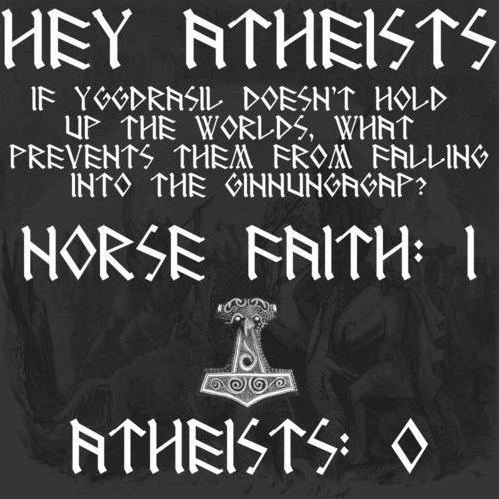
And I guess I’m going to have to start worshipping Loki.

Oh, dear. All of the Christians who’ve been pounding this particular kind of argument into the ground are going to have to convert to Asatru now.
And I guess I’m going to have to start worshipping Loki.

I discovered I was an atheist when I was 18 years old, but it would probably be more accurate to say that’s when I discovered other people weren’t atheists.
I grew up in the midwestern USA in the 80’s. Nobody in my family ever mentioned anything about religion when I was a child. It’s not that anyone was against it, they just didn’t bring it up. I was generally aware that many of my friends and acquaintances went to church on a fairly regular basis, but they never mentioned anything about any god in my presence and I assumed that it was just a cultural habit they inherited from their parents, and if their parents didn’t attend they wouldn’t either.
Then, one year, I got invited to Christmas Mass with a good friend. My family always had a Christmas tree and exchanged gifts, but it was a completely secular affair. I’d never actually been in a church as anything other than a tourist looking at architecture, and I thought it would be interesting to see what happens in practice. The fact it was a Catholic service made it ever more interesting.
It was pleasant enough, and at times you could even call it uplifting. Even when I was there, however, I didn’t get the feeling anyone actually believed anything they were singing about, and even the priest seemed more of a philosopher than a theist. It was all exactly the sort of “be nice to each other” messages that I’d expected, and I didn’t hear much of anything that required any particular religious sentiment. There was obviously some readings from a bible that mentioned god and angels, but I took that more like a reading of poetry that was the cultural basis of all the “be nice to each other” songs and speeches. In other words, I managed to get through an entire Christmas Mass as an atheist without feeling out-of-place.
It wasn’t until after services that I started talking to my friend and found she genuinely believed in some kind of supernatural entity. By coincidence, quite a few other friends also started becoming more engaged with religion over the following year, and I discovered they all seemed to have a nonspecific belief that something supernatural is afoot. They were so vague on the details that I wasn’t entirely sure what it was they believed. They clearly had a firm belief in somebody named Jesus and that it was vitally important to believe he existed, but that was about the end of it. It seemed to be mostly that they enjoyed the sense of community they felt when they said and did the proper things, plus it was a security blanket to make them less afraid of death and the randomness of the world.
To this day, I’m still baffled how so many people claim to be Christian but seem to have no understanding of the basis of the religion they profess to embrace. I honestly think that the ranks of atheists are far larger than the statistics suggest. How can someone be religious when they have no understanding of their religious they profess to follow? Many people identify themselves as Jewish and openly treat it as a cultural/ethnic quality that no longer has any religious significance. For many people there’s no conflict in being a Jewish atheist because Jewishness has become a matter of heritage. Many Christians are the same, but they’re afraid to actual use the word “atheist”. With all due respect to folks like PZ and Dawkins, I also think that the increase in open atheism in recent years isn’t because people are actually changing their views, it’s because they’re realizing they never believed in their religion in the first place.
Anonymous

This is how it is done. The Todd Stiefel Foundation is rallying freethinkers to help raise money for cancer research, sponsoring the Light The Night Walk through the Foundation Beyond Belief, to benefit the Leukemia and Lymphoma Society. They are doing this as a secular organization, for a secular cause, and they are making an effort to clearly define this as a freethinker-led initiative…although, of course, religious people will be warmly welcomed as friends and colleagues if they wish to join in.
I’ll be promoting this more in the near future and will be deciding whether to support a team or create one of our own (there is none near Morris, Minnesota), but I’ve got to hold off a bit — we’re in the last two weeks of the semester and grading and other work is consuming everything right now — but I wanted to let everyone know now. Don’t wait for me, get out there and see if there is a team near you that you can join.
The goal is to raise a million dollars for cancer research. I know we can do it.

I’m an atheist because when I asked questions like, “Did Jesus really
come back from the dead?”, my parents said, “What do you think?”
I’m an atheist because, when given permission to think for myself as a
child, I compared the Bible stories with reality and realized they
belonged with fiction. Believing in the Bible, to me, is like
pretending that Lord of the Rings really happened. Actually, if I was
given the choice, I would rather believe in Gandalf than God, because
Gandalf is at least likeable.
Cheryl J Sonnier
United States

Because I have learned to think for myself.
Rajesh Shenoy
India

Enough. These wimpy billboards have to stop. Look at the horrible billboards the Skepticon conference is putting up.
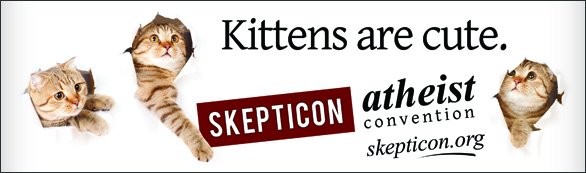
Kittens??!? It’s kittens everywhere. But you know the only use we have for kittens at an atheist con is as hors d’oeuvres.
So I quickly and roughly threw together the billboard I want to see.
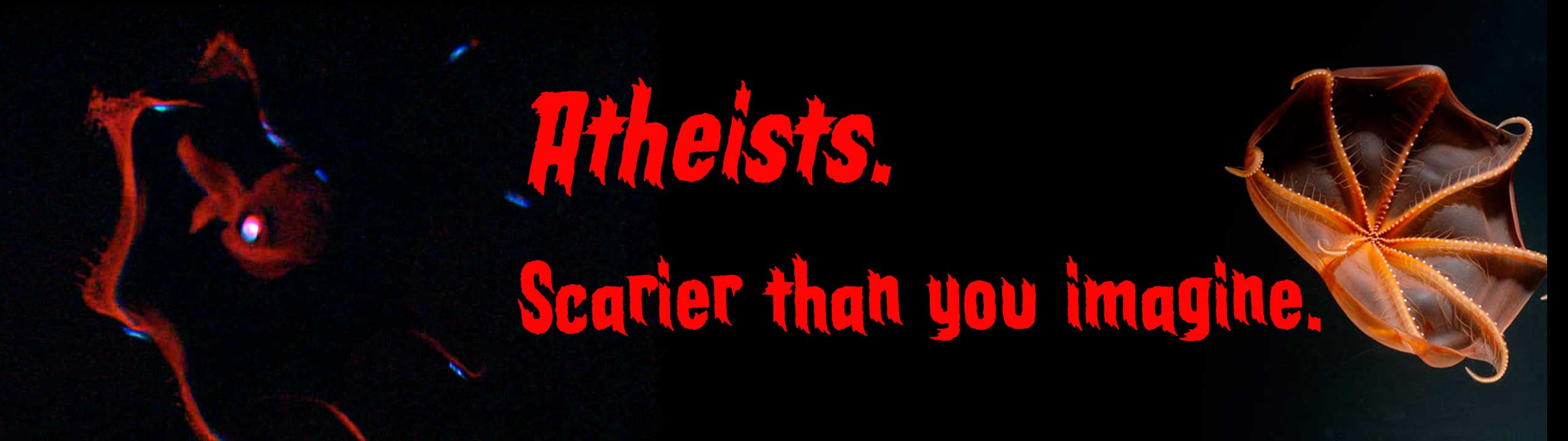
Much better.

I was raised as a Roman Catholic but honestly, only in a vague way. My mother never went to church until she married my father. My father is religious, says the rosary before going to bed, but also hated going to church, especially if there was singing. (Mostly he’s just an old Yankee curmudgeon who doesn’t like people in general.) My parents worked at a state hospital that was basically a nursing home. My mother and I would go to services at the hospital where I would help out with the giving of communion by giving the patients cups of water. It was service to me. I wasn’t an alter girl officially. I just liked helping people and helping to put away the church items-snuffing the candles and playing with the wax and such.
I officially became an atheist around 6th grade. I realized I really didn’t believe in anything I’d been learning about in CCD or heard in church. It didn’t hurt that I’m chemically sensitive and the church we started going to around that time used incense and we always managed to sit near someone who bathed in perfume. I spent a large amount of time standing in the foyer with time to think. For me CCD was basically school…you read the textbook, did crafts, took tests, memorized things…got grades. Standard school stuff. I think the thing that stuck with me, and really cinched it for me, though was this ridiculous explanation of “Hell” from ‘Father Mike’ (clearly one of the new school priests). He said that Hell was like an ice cream shop where all your favorite flavors were present but the spoons were too big to use and no one would help you. I still remember this vividly to this day. It was the stupidest thing I had heard up until that point in my life.
After I told my parents they were, blessedly, totally supportive. I’m sure they were disappointed but they knew me well enough to know that I meant what I said and would only change my mind if I came to a new conclusion. Again, it didn’t hurt that the Deacon of the church called my parents on more than one occasion to try to convince me to come back. (I’d left right before the final test of the CCD year and the year before confirmation classes.) My mother tried to explain that I’d stopped believing in God. He didn’t seem to care…as if it were not an issue or that he was sure I would change my mind.
I’ve never looked back. I think I’m one of those people who didn’t have the ‘god gene’ or something. I don’t think I ever really believed. I don’t ever remember fearing hell or worrying about sinning. The thing I remember from my childhood is spending years making sure my hair was over my ears before I went to bed because I saw Star Trek, the Wrath of Khan too young and feared insects would crawl into my ears if they weren’t covered. That was my Devil. The dreaded earwig. I still get an instant fight or flight response if I see one.
Stacey Cooney
United States

Here’s another summary of the fun times in Melbourne. Of particular interest is AronRa’s awesome rant at the Christian protesters.
I had lunch with him the next day. He could barely speak.

Uh-oh. Nick Matzke doesn’t like that recent paper by Jerry Coyne on the causes of creationism. It is telling, though, that Matzke’s reasons are terribad. He lists four.
Theodosius Dobzhansky was a Christian and a scientist, therefore he was an accommodationist, therefore…I don’t know, what? How does that refute anything Coyne wrote? No one is claiming that it is impossible for people with screwy personal beliefs to be significant contributors to science.
Darwin was an agnostic, and he would be called an accommodationist today, therefore…again, this is a meaningless argument. Neither Dobzhansky nor Darwin were infallible. Matzke seems to be trying to salvage accommodationism by arguing that people who were significant contributors to science in key domains could not possibly be wrong in others.
Coyne relies, Matzke claims, on claiming that religious people aren’t allowed to endorse natural mechanisms as a method of God’s action. That argument is false and incoherent. Of course religious people can endorse natural mechanisms: every good scientist, of which Matzke has mentioned two, endorses natural mechanisms. Where his argument falls apart is in this bizarre notion that you can simultaneously claim that a mechanism is natural and that it is driven by a supernatural entity. OK, show me such a thing. Show me evidence that mutation, for instance, is the result of a god diddling DNA.
Matzke just doesn’t like that word “accommodationist”. At the same time, though, he claims that accommodating religious beliefs to science is a good thing, so presumably the word isn’t so bad, then. What he doesn’t recognize is that accommodating religion to science means jettisoning supernatural explanations, which we flaming atheists would also say is a most excellent thing; the problem, though, is that accommodationists instead make excuses to modify science to fit their religion…for instance, claiming that quantum indeterminacy is god’s way of tinkering with life.
Then he wraps it all up by questioning whether atheist interpretations of evolutionary biology ought to be allowed to be published in good journals of evolutionary biology, because it isn’t “serious”. That’s ironic. Apparently, it is serious to promote liberal Christianity as an ally of evolution, as the NCSE does.
Those are all pathetically weak “arguments”. Matzke ought to be embarrassed to have made them.

This picture is all over the place, so I don’t have the original source to credit, but it’s still wonderful. At the Global Atheist Convention 2012, we were picketed briefly by an angry mob of Muslims who wanted us all to go to Hell, the sooner the better. So in response, two gay men…
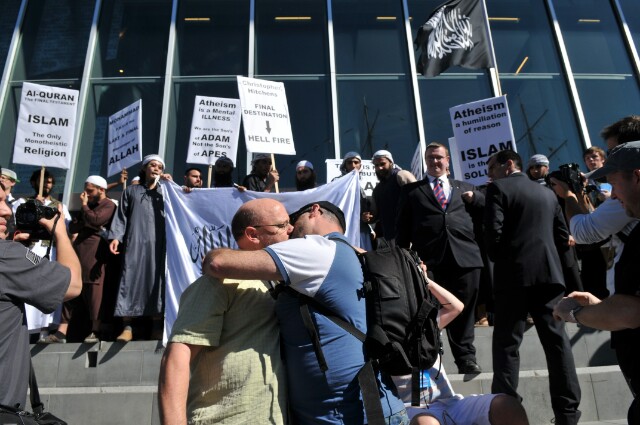
Love vs. Hate, Tolerance vs. Intolerance. That’s what it’s all about. I’m glad I’m on the right side.
(Whoever took that photo, let me know and I’ll update this. I met the two subjects of the picture too — very nice guys, but I didn’t get your names. Fill me in!)
Got the info: that’s Gregory Storer and Michael Barnett.
