I think youtube culture really has gone pathological

OK, people, you insisted and demanded and rebuked me for not watching Thunderf00t’s latest video, so I did.

It was a great steaming pile of dishonest, sleazy shit, disgraceful propaganda to serve the cause of sexism.

Guess what? I’m never taking your advice again. Jerks. What a waste of time.

At least one good thing has come out of it, though: Michael Nugent takes it apart piece by piece. I can tell he was as appalled by the shameful smears as I was.

I also hadn’t realized until I watched it that Thunderf00t concludes by calling on conference organizers to blackball Rebecca Watson, Melody Hensley, Amy Roth, me, and all those other people who want to make the events respectful of women. It’s truly remarkable. He’s been whining about censorship! and bannings! and FREE SPEECH! yet here he is, organizing his followers to bombard secular leaders to silence feminists. I haven’t seen anything remotely similar from our side of this argument, yet here is the champion of holy sacred FREE SPEECH calling on his mob to ostracize people he disagrees with.

His priorities are genuinely screwed up, and if anyone is guilty of hypocrisy, it’s Phil Mason. Michael Nugent gets it right:

Please consider channeling your passion for freedom of expression into our fight for the right of people to express their secular beliefs without being beaten or jailed or killed for blasphemy, instead of fighting for the imaginary right of the Wooly Bumblebee to call Melody Hensley a twat on YouTube without having her video flagged.

The Paingod

Once upon a time, there was a little paingod attached to humanity. It was mostly benign and useful; it was there to warn people not to step into that patch of thorns, that that spearpoint was sharp, that fire was hot, that you’d regret drinking that whole skin of beer in the morning. It brought with it the gift of empathy and forethought, as well, so the people were mainly well-served by its presence.

Humanity prospered and grew, and the paingod got ever busier; as societies got larger, not only were there more people experiencing or avoiding pain, but the complexity of their lives created new opportunities for pain. New diseases erupted in the denser populations, wars flared up between competing city-states, social stratification created breeding grounds for envy and contempt. The paingod also grew.

Now this is the thing about gods of all types: they are ambitious. They all aspire to be the greatest manifestation of their gift that they can be. After all, people had been defining god as “that than which nothing greater can be conceived”, so there was definitely pressure to escalate — if it wasn’t the greatest of all possible paingods, then it really wasn’t a god at all, now was it?

But now comes the tricky part. The paingod served humanity, and that was also an essential part of its existence. It could not simply lash out and promote death and suffering, like a cartoonish cult in a cheesy sword-and-sorcery novel; no, it had to convince people that their personal pain was a great boon, get them to revel in it, and also get them to willingy define their existence by their suffering. Then the paingod would be the the ultimate deity!

And so was hatched a cunning plan. The paingod would ask everyone to give it their pain as a gift; it would present itself as a savior to the world, telling everyone that they can find salvation from the suffering they experience by consecrating it to the paingod, that it loved them so much that it would accept their burdens and bear them for humanity. And it spread a story that claimed the paingod took on the form of a man and suffered heinous torture and died in agony, just to prove it was willing to take on the very worst that people could offer.

It was actually true. The man, though, was symbolic; it was the paingod, and it experienced every death and felt every person’s agony. There was no sudden change in the paingod’s role, only a clever semantic twist: now you metaphorically bestowed your unhappiness on the paingod as an offering, and it was no longer your fault or your responsibility, or anyone’s responsibility, really. It was the paingod’s will. Your duty was to bear up under it, and thank the paingod for sharing it with you.

And so it came to be that the people accepted the paingod’s rationale. When the inequities of their society bore them down, they wouldn’t rise up to change them — they’d go to the paingod’s church and praise it. When the paingod’s acolytes enthusiastically embraced their role in giving charity — after all, the poor and hurting were clearly the most blessed of the paingod’s subjects — they subverted that role into one of maintaining poverty and disease. They would provide a quiet place for people to die as slowly as possible, every moment one of redemption as you shared your pain with the paingod.

Every improvement that reduced the people’s suffering was shunned, and every social change that might make pariahs appreciated for who they were was discouraged. The paingod rules, and the only way the paingod can grow in power is if the misery of our existence were made the central focus of our lives.

And now we live in the world the paingod made, and true to form, it’s a world of pain.

We can’t end the pain, but we can kill the paingod and end the cycle of reinforcement. We can own our pain. It’s not the god’s, it’s ours — we don’t reduce it by pretending to share it with a supernatural being. We cause pain in others, and we don’t minimize it by claiming our sins are redeemed by the paingod — we accept the fault as our own, and struggle to change and repair and redeem ourselves. Tell the paingod that nobody died for your sins, they can’t…because they’re yours. The suffering we cause, the inequities we propagate, the unfairness and misery of a world split between those who have and those who don’t, those are all our responsibility, and no one else’s, especially not a paingod who feeds on grief and regret and sorrow and harm.

Keith Kloor responds

And it’s even worse than I expected. I had presentiments of failure: last night he tweeted this at me.

kloor

Talk about completely missing the point…he had previously written a post quoting Saul Bellow saying science was unsatisfying; I was baffled about why he thought Bellow was a particularly insightful contributor on this topic, especially since his comment was so banal and ignorant. I was NOT suggesting that he needed to get a better-ranked author to convince me; I’ve got nothing against Bellow’s literary contributions. But that seems to be the only thing he took away from my post.

So now he’s put up a short post (promising more later) which consists of little more than a quotation from Margaret Atwood.

I think that the religious strand is probably part of human hard-wiring…by religious strand, I don’t mean any particular religion, I mean the part of human beings that feels that the seen world is not the only world, that the world you see is not the only world that there is and that it can become awestruck. If that is the case, religion was selected for in the Pleistocene by many, many millennia of human evolution.

Like the Bellow quote, I really have nothing against the source; in fact, I’ve enjoyed the writings of both Atwood and Bellow. My complaint is with the abysmal vacuity of the content, and the fact that Kloor seems to be playing a game of Darmok and Jalad at Tanagra. It doesn’t advance the argument to quote someone else saying something wrong. (Although he probably feels it gives him cover.)

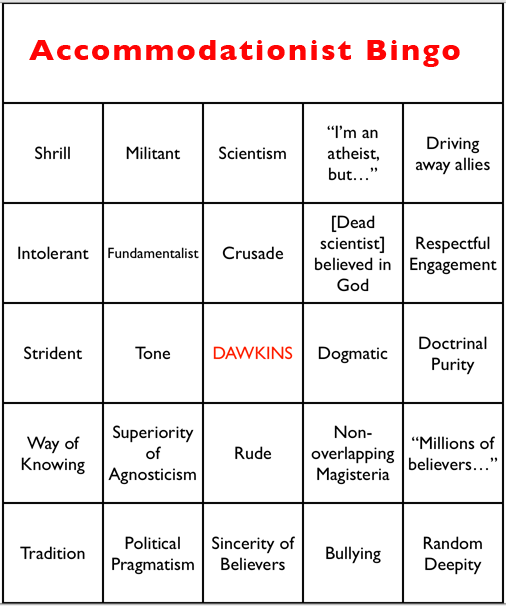
I will congratulate him on dodging my accommodationist bingo card — there were so many possibilities to fit into a mere 25 boxes, and “religion is hardwired” didn’t make the cut, because I really didn’t think he’d be so stupid as to trot that one out.

“Awe” is probably hardwired as an emotional response. The effort to try to comprehend the world around us is probably hardwired into our brains. Religion isn’t. Religion is a parasitic phenomenon that short-circuits honest sensations, the desire to understand and our humility before the complexity of the universe, and plugs in a false belief that we do understand everything to resolve the two. That’s my objection: not that there are sincere and interesting questions about our place in the cosmos, but that religion lies and claims to have all the answers. Yet when we actually look at what religion focuses on, it’s all petty trivial dogma and weird justifications for tribal cosmetics.

What the New Atheists actually argue is that we aren’t giving up wonder, but that we focus on real paths to knowing and understanding, rather than the delusions of prophecy and pettifogging scriptural interpretation and blithe acceptance of the inanity of “god did it.”

And then this final gambit is ludicrous.

You’d that think the atheists who are evolutionary biologists would be able to process this with their super-rational minds. And that they (Myers, Coyne et al) would be smart enough to recognize that one-size-fits all denunciation is likely counterproductive to their goal.

There must be a name for this logical fallacy: “You accept [broad scientific discipline], therefore you ought to accept [my quirky and unfounded personal interpretation of it]!”

I have little hope that his continuation of this discussion will be any better.


Sweet jebus, he’s continuing — and just when I can’t imagine him getting any dumber, he says this:

I don’t understand why he’s making such a big issue of me quoting writers like Saul Bellow and Margaret Atwood.

Aargh! No! I haven’t made a big issue of it — I was baffled by why he was making those quotes the centerpiece of his argument, and why he was making such a big issue of the quotes. But that’s all he sees.

I’m done with him. He’s too stupid to argue with further.

Accommodationists are so easy to outguess

Brace yourselves. Keith Kloor promises to rebut me once he finishes watching some football game today.

Just to make it easier for him, though, I threw together a simple accommodationist bingo card. Let’s see if he can do it while avoiding these extraordinarily cliched words and concepts.

accommbingo

I’m going to predict it will be the same old tired whine, without a single original idea in it.

The new definition of “fundamentalist”

Keith Kloor, a journalist and blogger at Discover, really doesn’t like those fundamentalist atheists and he echoes those ridiculous comments by Peter Higgs.

The other big argument waged by a vocal group of prominent scientists involves the assertion that science is incompatible with religion. This insistence by the likes of Richard Dawkins and Jerry Coyne is a puzzler. As someone who dislikes dogma of any kind and distrusts vested powers, I’m no fan of institutional religion. I’m also an atheist. But I see no value in making an enemy of virtually the whole world. What’s more, an argument that lumps together the Taliban, the Dali Lama, and Jesus strikes me as rather simplistic. The atheists who frequently disparage religion for all its faults don’t dare acknowledge that it has any redeeming value, or that it provides some meaning for those who can’t (or aren’t yet ready) to derive existential meaning from reason alone.

This sneering and strident approach by the religion haters is not just bad manners, it is puritanical. That’s what scientist Peter Higgs (of Higgs Boson fame) is getting at with his recent sharp criticism of Dawkins.

Jerry Coyne has already replied, but that comment was so appallingly dumb that I have to chime in.

This isn’t a matter of making an enemy of the whole world; it’s an issue of scientific integrity. Are you going to sit back and let people say things that are wrong simply because you’re afraid to annoy them? And yes, you can legitimately lump together the Taliban, the Dali Lama, and Jesus together on certain traits: they’re all three promoting superstition and falsehoods. That doesn’t mean you think the Dali Lama blows up statues, or that Jesus is crusading for Tibetan independence.

I am unimpressed with this constant claim that religion has redeeming value. What is it? That it provides dishonest answers to questions that trouble people? How is that a virtue? Only apologists for religion seem to think it is.

And now Kloor has doubled down with a reply to Coyne.

He quotes Saul Bellow. Seriously, dude: Saul Bellow? Why? He’s a good writer, but does he have some special authority on this matter?

What do you think happens at death?

This I don’t know, but I don’t think everything is resolved with the destruction of the body. What science has to say seems to me insufficient and unsatisfying.

Saul Bellow’s dissatisfaction with an honest truth is not an argument. It’d be like me saying I’m unsatisfied with astronomy because it doesn’t have enough squid in it, or that science education needs more parades and trumpets. Your personal expectation of what reality ought to deliver is not a valid criticism; I’m not going to claim that Islam fails because 72 virgins isn’t enough. (If only they promised 73, I’d convert in a flash.)

To wave away the persistent questions and yearnings that still drive the religious impulse as merely the last bastion of ignorant superstition is, as I wrote here, “inconsistent with the spirit of science.”

The assertion that religion and science are incompatible has become an article of faith for some–a kind of dogma that I recently discussed in this post. Aside from this being a form of fundamentalism, I also said that I saw no constructive use “in making an enemy of virtually the whole world” by broadly denigrating all religious believers.

I’m not waving away the yearnings, they’re real enough, and we all have them. I’m waving away the goddamned answers as inadequate, contradictory, and false.

You do realize, Mr Kloor, that that’s what religion promises? Not more questions (if that were the case, it would be philosophy), but deep cosmic truths, answers hallowed by nothing more than generations of prophets pulling stories out of their asses? It is “inconsistent with the spirit of science” to simply accept those claims unquestioned, to assume that there is some validity to them because you’re afraid that pointing out the flaws might be regarded as “denigrating all religious believers.”

If telling people that they are wrong is denigrating, then my profession of education is dedicated to denigration.

I guess it also makes me a fundamentalist, if your definition of fundamentalis is lacking in reverence for the unsupported authoritarian dogma of religion, and feeling no respect for faith at all.

Spleen venting, or the inadequacy of twitter

For the last few days, my twitter account has been getting spammed by some twit named @lettlander; he seems to be one of those Christians who is infatuated with the First Cause argument. Here’s a small sampling:

@f0xhole @pzmyers @Pipenta something appearing out of nothing isn’t just scientifically impossible – it’s logically self-refuting.

@f0xhole @pzmyers @Pipenta The ONLY way the problem of an infinite regress can be solved is the postulation of an extra-natural element

@f0xhole @pzmyers @Pipenta Besides, you’re perfectly fine with scientifically asserting the universe was uncaused, right? Why not “God”?

@f0xhole @pzmyers @Pipenta Since science and philosophy lead us to a concept of a contingent universe, a non-contingent element must exist

Don’t you just love how these guys pompously dress themselves up as philosophers and scientists to defend the silly notion of a god? But let’s go through those one by one.

1. Something appearing out of nothing is impossible? Tell that to Lawrence Krauss and other physicists. Not only can it theoretically happen, it happens all the time. We must be done already — he’s simply wrong.

2. Since I don’t accept the premise that simple causation is present at all levels, microscopic and macroscopic, no, I don’t have to postulate an “extra-natural element”. The initial cause could have been a quantum fluctuation in nothingness, nothing more. I certainly don’t have to postulate a grand, intelligent cosmic being.

3. Caused, uncaused, it doesn’t matter — show me the evidence for an intelligent agent at the beginning of the universe. I’m not a physicist, though, so I’m neither an authority nor a committed proponent of any particular model of origins, and I’ll heed instead what people like Krauss and Hawking and Stenger say…and they all argue that god is an unnecessary hypothesis.

Why not “god”? Why not a purple space gerbil? Why not snot from the nose of the Great Green Arkleseizure? Even if @lettlander were correct and there was a reasonable logical argument for a necessary first cause, it wouldn’t mean Jesus was the one.

4. On the large visible scale, the scale that we perceive and operate under, it is true that we see a pattern of contingency, where one event leads to another. But on the quantum scale, that is no longer true: science and philosophy lead us to a completely different, unintuitive understanding of how the universe works, and the naive and silly guesses of theologians do not apply.

And isn’t it cute how these kooks blithely reduce their omnipotent, omniscient god to “non-contingent element”? It’s as if they expect that if we acknowledge the possibility of a spontaneous accident, a fleck, a speck and spatter of a singular dot of existence that is not the product of a causal chain, then they’ve proven the existence of the Christian God, the truth of the Bible, and the veracity of their own personal dogma.

Sorry about all that. I couldn’t fit that all in a tweet — although I suppose I could have reduced it to a simple accusation of “bullshit!” It’s just that these presumptuous pseudoscientists who claim science supports their cult leave me cold and contemptuous.

No one should be embarrassed to speak the truth

Peter Higgs, the physicist, has spoken out against Richard Dawkins’ views.

“What Dawkins does too often is to concentrate his attack on fundamentalists. But there are many believers who are just not fundamentalists,” Higgs said in an interview with the Spanish newspaper El Mundo. “Fundamentalism is another problem. I mean, Dawkins in a way is almost a fundamentalist himself, of another kind.”

You know, whenever I see people babbling ignorantly like this, I have this urge to strap them down Clockwork Orange style and force them to watch an hour of James Dobson or Tony Perkins or Ken Ham or Bryan Fischer, and then ask them, “Do you still think Dawkins is a fundamentalist?” The only way you can make this ridiculous comparison is by cultivating a near-total ignorance of what fundamentalists are actually like. But then I have to confess that forcing someone to correct their folly and putting them to the question is exactly what a fundamentalist would do, so I can’t. (I notice in the article that Dawkins simply refused to respond to Higgs.)

He agreed with some of Dawkins’ thoughts on the unfortunate consequences that have resulted from religious belief, but he was unhappy with the evolutionary biologist’s approach to dealing with believers and said he agreed with those who found Dawkins’ approach “embarrassing”.

Higgs is an atheist. He agrees with Dawkins that religion has lead to some ugly outcomes. But speaking out about them? Actually saying out loud in public that religion is wrong, faith is a delusion, and that there is no god? Oh dearie me, how embarrassing. Not the thing a proper gentleman would do at all.

And that’s really the problem. Society has so thoroughly beaten the default assumption of respect for religious lies into our heads that even many atheists are made deeply uncomfortable at the prospect of openly rejecting faith-based nonsense. But criticizing fellow atheists? That’s easy. That’s thoroughly sanctioned by culture. You can freely make stupid accusations against atheists without suffering the pushback you’d get if you made honest statements of fact about priests.

What I learned from this interview is mainly that Peter Higgs is an intellectual coward who retreats from his convictions in the face of potential social disapproval, and will cheerfully join in the mob in kicking a fellow atheist. He should be…embarrassed.

Fishing for meaning in a dictionary of genes

I’ve constricted my anus 100 times, and it isn’t helping! I’m still feeling extremely cranky about this story from the NY Times.

Scientists intend to sequence Adam Lanza’s DNA. They’re looking for genetic markers for mass murder. Why? Because some scientists are stupid.

Some researchers, like Dr. Arthur Beaudet, a professor at the Baylor College of Medicine and the chairman of its department of molecular and human genetics, applaud the effort. He believes that the acts committed by men like Mr. Lanza and the gunmen in other rampages in recent years — at Columbine High School and in Aurora, Colo., in Norway, in Tucson and at Virginia Tech — are so far off the charts of normal behavior that there must be genetic changes driving them.

“We can’t afford not to do this research,” Dr. Beaudet said.

There must be genetic changes underlying this specific behavior? There is no reason at all to assume that. Furthermore, this isn’t “off the charts of normal behavior” — there have been 62 mass murder events in the US in the last 30 years. There are witch-burnings going on in Africa right now. European Americans casually exterminated the native population of the Americas, and now pens the remnant population in reservations where they are kept in poverty. We had entire nations worth of people involved in the mass murder of 6 million Jews in the last century. Hey, shall we round up a bunch of Germans and take DNA swabs so we can figure out what there is that’s unique to their genes that allows them to commit genocide? (I better be clear here: I’m being sarcastic. I really don’t think Germans have a biological predilection for racism or murder, any more than any other people.)

I would ask whether there is any reason to assume that this behavior is a heritable trait. Is there a familial history of mass murder? Are we really going to assume that the diverse individuals who have committed these horrific crimes are all related, or all carry some common marker that isn’t found in people who don’t commit murder?

I can predict exactly what will be found when they look at Adam Lanza’s DNA. It will be human. There will be tens of thousands of little nucleotide variations from reference standards scattered throughout the genome, because all of us carry these kinds of differences. The scientists will have no idea what 99% of the differences do. They will make dubious associations — for example, they might find a novel nucleotide in a gene that has other variants correlated with schizophrenia — and in the absence of any causal link at all, they’ll publish garbage papers that try to impute a signal to common genetic noise. Some idiot will make noise about screening for an obscure mutation that Lanza carried, just because it’s something different.

I wonder if there are neurologists poking around in his brain, looking for differences, too. It’s the same issue; we don’t understand the majority of the functional consequences of individual variations in connectivity in the brain, and we have a population with large amounts of random variation. So how are you going to recognize what’s special and unique and causal about Lanza’s brain (or Einstein’s brain, or my brain, or yours)?

Fortunately, there are some sensible people out there.

“It is almost inconceivable that there is a common genetic factor” to be found in mass murders, said Dr. Robert C. Green, a geneticist and neurologist at Harvard Medical School. “I think it says more about us that we wish there was something like this. We wish there was an explanation.”

I suspect the explanation is going to be more a consequence of individual experience, although of course biology is going to shape how we respond to circumstance. But to go rifling about in a genome we don’t understand to find a simple cause is ridiculous and futile. Sure, freeze some cells down and store them away; maybe some day we’ll understand more and there will be a legitimate and specific hypothesis that can be tested by examining killers’ genetics…but a fishing expedition is pointless and dumb, and at this state of our understanding, only opens the door to misconceptions and ethics abuses.

An insider’s perspective on Dover

Via Ron Sullivan, who posted a link on the Great Blue Evil, an amusing story about a visit to Big Bend National Park in which the ranger in residence turns out not to be from around there:

Bob Hamilton 65, is a retired biology teacher and high school principal from Carlisle, Pa. He works six months a year in Big Bend and five more in Yellowstone.
I ask him where he was principal. He says York. I ask what school. He says Dover.
My eyes must’ve been wide as dinner plates. My insides roiled with barely contained glee.
My unexpressed response: No shit!
What I say: “The infamous Dover High School?”

That’s this Dover, the school district in Pennsylvania where creationists pressured the local Board of Education to introduce “Intelligent Design” into the high school biology curriculum in January 2005. Parents sued the Board, which subsequently got its collective ass handed to it in court. The judge’s 139-page opinion on the case called the change in curriculum “breathtakingly inane,” for instance.

Apparently, the inanity was taking people’s breaths for a few years before 2005:

Hamilton, who retired as principal of Dover High School in 2002, stood on the ground floor of Dover’s Intelligent Design era. He saw the storm brewing.
“Don’t quote me on this, but I knew that board was going to get us in trouble,” he said.
There was no doubt I was going to quote him on this. I think he realized this. I hope so, anyway.
“There are great kids in the community,” he says. “The kids in the community in no way reflect the ideas coming out of that school board. None of those people had any connection to the kids.”
According to Hamilton, then-school board president Donald “Daddy” Bonsell used to haunt his office and harangue him on behalf of the burgeoning wingnut conspiracy. Bonsell badgered Hamilton to do his part to get Intelligent Design into the Dover curriculum.
“He came in one day, and finally I told him, ‘OK, I’ll put Intelligent Design into the curriculum … if you start a petition and get all the local ministers in the community to sign it saying they’ll allow the teaching of evolution in Sunday school,’” Hamilton says.

I like the fact that this guy “retired” by continuing to teach kids about science on the National Park Service’s dime. Good for him.