Here’s a fascinating old photo.
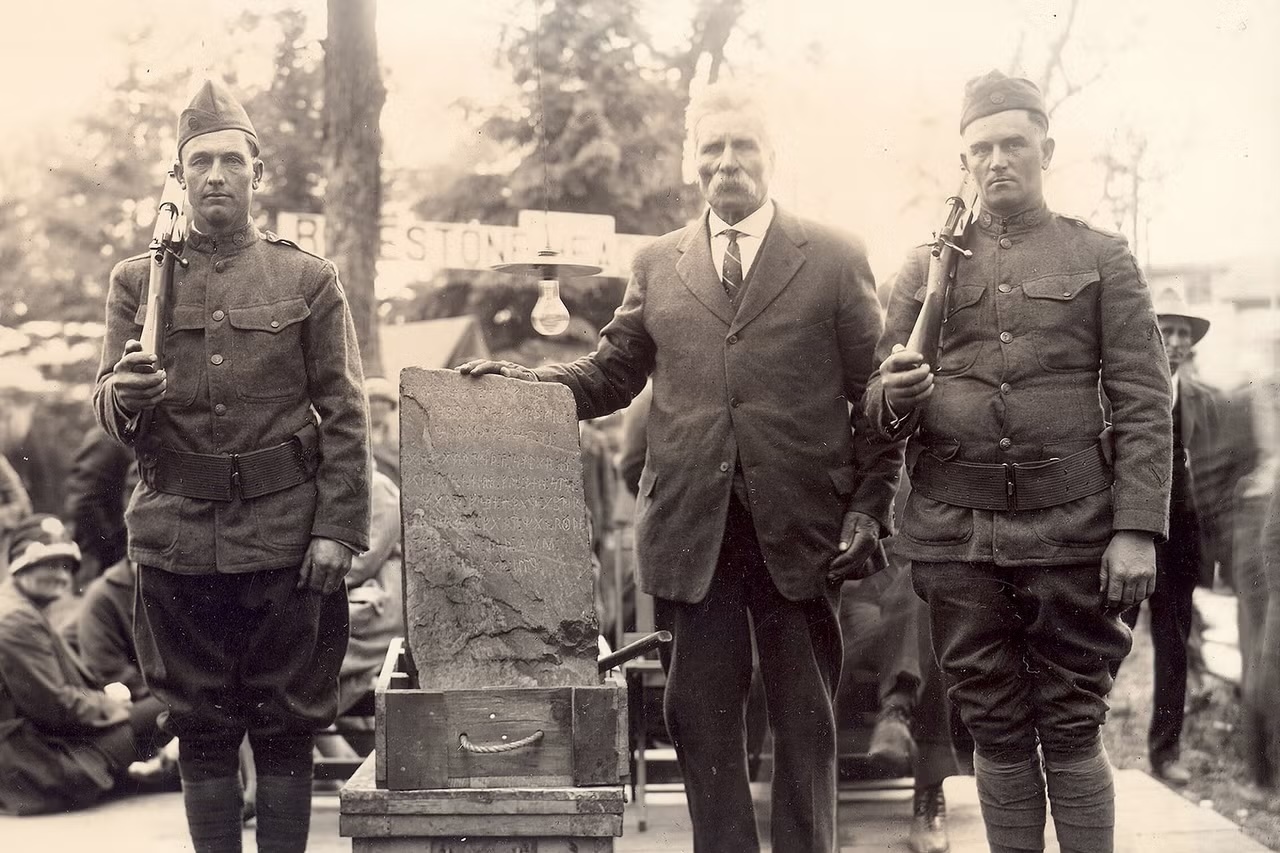
Farmer Olof Öhman (center), who reported the artifact’s discovery in 1898, at a carnival held to raise funds to buy a park for the Kensington Runestone, 1927.
I’ve seen the Kensington Runestone, it’s in a local museum just north of here. I’ve been to that park several times — it’s nicely maintained, it has a large, mostly empty building used for presentations (it’s always been locked when I visited), and it’s a bit out of the way, several miles away from a town of any size. It’s notable only because a fair amount of money and time has been invested to enshrine this fraud in local culture. It was probably an even bigger deal in 1927, when that photo was taken, and when the old farmer who ‘found’ it was the center of attention.
What I just learned is that there were other runestones all over the country. There’s the Yarmouth Stone and the Narragansett Runestone in Nova Scotia and Rhode Island. The Heavener Runestone in Oklahoma. The Poteau stone, and Shawnee stone, also in Oklahoma. The Braxton Runestone and Grave Creek Stone, in West Virginia. They even found a second runestone in 2001 near Öhmon’s original ‘discovery’ to ‘corroborate’ it. You’d think there were armies of Vikings tromping all over the eastern half of the US in the 14th century, all busily chiseling rocks and scattering them about to entertain tourists in the 20th and 21st.
The article gives a couple of explanations for this curious phenomenon. One is that the Viking sagas were popular at the time. I don’t find that convincing — you’d expect every literary fad to generate a pile of phony artifacts if that were the case. The second is that the wave of Scandinavian immigrants were trying to build validation. I can sympathize with that a little more. If Italian immigrants could take pride in Christopher Columbus, well, Swedes and Norwegians would hold up Leif Ericson as their hero.
I’m inclined to favor their third explanation.
The third factor was the urge to assert European prior claim to land, which predated the Columbus expedition of 1492, and furthermore, gave it a northern European character. At times, this involved the expropriation of Native American monuments as part of a process which sought to belittle Native American cultural and monumental achievements by claiming Viking ancestry for them—and at times, claimed that those responsible were just about anybody, so long as they were not Native Americans.
The Mormons did it. The Mississippi valley settlers who denied that indigenous peoples could have been the Mound Builders did it. All those batty von Dänikenites who claim aliens built every bit of non-European architecture do it. Why couldn’t my Scandinavian ancestors have done it?
The Runestone park is a pleasant little spot, but fundamentally it’s an embarrassment.