Pwning David Barton

Barton is such a lying tool. Chris Rodda catches him in an outright lie: Barton claims that gun accidents didn’t occur in 18th century America, and that he could only find two accounts of such problems. I guess he must be a very bad historian, then, in addition to lacking any sense, because Chris just went browsing and found lots of accounts of accidental shooting deaths and injuries (as you’d expect — guns are dangerous tools, of course you’re going to get accidents!)

One other thing you might do, though, is that a link to the story is on Reddit…and some people have even downvoted it. Why? I don’t know. Rodda’s story is full of hard evidence that Barton was completely wrong. Those of you with Reddit accounts might head over there and give your honest opinion.

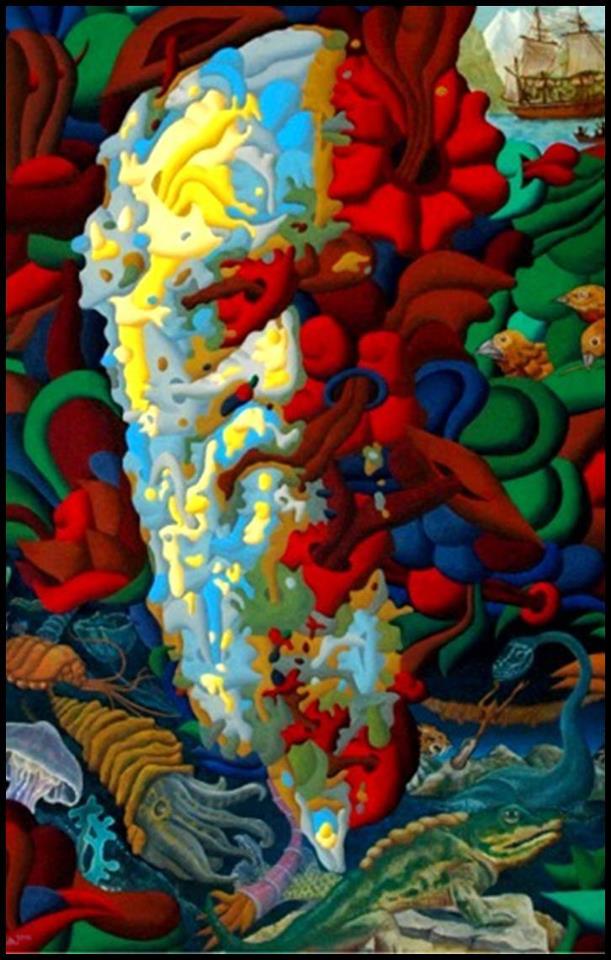
Happy Darwin Day!

colorfuldarwin

I hope you all have grand plans to celebrate. I’m a bit swamped with work today, so I think I’ll be deferring my holiday to this weekend.

I think I’ll go to Florida. We’ve just dug out from a blizzard, so I think it’s brilliant of me to flit down to Fort Lauderdale.

Hmm. Maybe I should visit Broward College while I’m in the neighborhood. It looks like a good place.

And as long as I’m there, I should join in the Broward Darwin Day event, give a couple of talks, maybe say hello to James Randi, you know, the usual.

It’s what Charles Darwin would do.

A story

She stormed into the living room, throwing her tools at the storage bench. The clatter would have startled him, if he hadn’t heard her cursing all the way up the hill. “Vile-assed, scum-eating, mouth-breathing idiots!” She pointed an angry finger at him. “They wouldn’t know competence if it dropped a hammer on their toe, and all they can do is sit around and make stupid fucking comments about women’s body parts.”

“Sweetheart, really. You shouldn’t let the Neanderthals get to you like this.”

“I’m not talking about the Neanderthals. You don’t get it. I’m about fucking ready to move in with the Neanderthals. This is the men in your clan. The so-called progressive males of our vaunted fucking Cro-Magnon community. They’re a bunch of mis-bred, ill-trained, self-absorbed, mouth breathing, own-breath-smelling…”

[Read more…]

The present is the past, the past is the present

Ken Ham is preaching about what science is again. He’s accusing the secular activist Zack Kopplin of being “brainwashed” by evolutionist propaganda, and to support this claim, he once again drags out the tired proposition that there are two kinds of science, historical and observational, and that only the observational kind is valid; well, unless the historical version is based on the Bible, which in his dogma is an unassailable compendium of absolutely true facts about the past.

What’s more, Kopplin—like almost all evolutionists—confuses historical science with operational (observational) science. Operational science is indeed observable, testable, falsifiable, and so on—but none of those words describes evolutionary ideas! While biblical creation may not be provable through tests and observation, neither is molecules-to-man evolution (or astronomical evolution). And in fact, the evidence that is available to us concerning our origins makes sense in the biblical creation-based worldview, not the evolutionary one. Of course, secularists mock creationists for separating out historical science and operational science. But they do that because the secularists want the word science to apply to both historical and operational science so that they can brainwash people (like Kopplin) into thinking that to believe in creation is to reject science.

This is utter nonsense. It’s a phony distinction he makes so that he can bray, “Were you there?” at people and pretend that he has refuted anything they might say about the past. It is a set of appalling lies from a know-nothing hidebound fundamentalist who knows nothing about science, and who happily distorts it to contrive support for his ridiculous beliefs.

It is false because of course I can observe the past. The present is the product of the past; if I open my eyes and look around me, I can see the pieces of history everywhere.

I live in the American midwest. I can go into my backyard and see on the surface the world as it is now; fenced and flattened, seeded with short grasses, surrounded by paved roads and houses. But it takes only a little effort to observe the past.

In ditches and pioneer cemeteries and dry unplowable ridges, traces of an older world, the prairie, still persist. I can find clumps of tallgrass, scattered forbs, rivers fringed with cattails, turtles like primeval tanks on the banks, frogs and salamanders lurking in tangled undergrowth, fragmented bits of the pre-European settlement. I can see relics of a changing human presence; there are places where flint arrowheads turn up regularly, and to the south are the native pipestone quarries. I can walk along the increasingly neglected railroads, and trace how they contributed to our presence here; small towns sprinkled along the railroad right-of-way, acting as central depots for tributaries of wagons on dirt roads, hauling corn to the granaries. It’s all here if you just look; it’s not a story told by fiat, poured into books that we accept as gospel. That history lies in scars in the land, observable, testable, falsifiable.

I can dig into the ground with a spade and see the rich dark loam of this country — the product of ten thousand years of prairie grasses building dense root systems, prairie dogs tunneling through it, the bison wallowing and foraging. This isn’t an illusion, it’s the observable result of millennia of prairie ecosystems thriving here, and it’s the source of the agricultural prosperity of the region. I can sieve through the muck that has accumulated in prairie lakes, and find pollen from the exuberant flora that grew here: clover and grasses, wildflowers and the flowering of the wetlands. I can track back and see the eras when the great eastern deciduous forests marched westward, and when they staggered back. It’s all in the record. It all contributed to what we have now.

We can go back and back. We can see the scattered rocky debris left as the glaciers retreated; we can see the vast depressions left by the pressure of ancient lakes; we can see the scouring of the land from their earlier advance. Seeing the landscape with the eyes of a geologist exposes its history. While the glaciers demolished the surface, we can also find places where seismic cataclysms thrust deeper layers to the surface, and there we find that millions of years ago, my home was the bottom of a huge inland sea, that diatoms silted down over long ages, burying the bones of plesiosaurs and nautiloids in chalky deposits.

Again, this is not mere historical assertion (and isn’t it demeaning to treat history as something empty of evidence, too?). Open your eyes! It’s all written in towers of stone and immense fractures in the earth, in microscopic drifts of long dead organisms and the ticking clock of radioactive molecules. We are immersed in the observable evidence of our past. Everything is the way it is because of how it got that way — you cannot blithely separate what is from the process that made it.

I can see it in me, too — biology is just as much a product of the changing past as is geology and ecology. I can look in the mirror and see my mother’s eyes and my father’s chin; I can observe myself and see my father’s sense of humor and my mother’s bookishness. I remember my grandparents and my great-grandparents, and looking back at me are a collection of familial traits, all shuffled and juggled and reconstituted in me.

Beyond those superficial impressions, I can have my genome analyzed and find my particular pattern of genes shared in distant places in the world. I know that my family came from Northern Europe, that in turn they migrated out of central Asia, that before that they were living in the Middle East, and long before that, a hundred thousand years ago, they were an adventurous (or desperate) tribe of people moving northward through East Africa. This is not a mere story, a fairy tale invented by ignorant scribes — my ancestors left a trail of alleles as they wandered over three continents, a trail we can follow even now.

“Were you there?” Yes. Yes, I am here, imbedded in this grand stream of history, aware of my place in it, seeing with open eyes the evidence that surrounds me. And I pity those unable to see the grand arena they are a small part of, who want to deny that history is observable.

Root of all evil?

While I’m criticizing the South, I should also damn the whole country. They Yankees also contributed to the history of slavery: that whole second amendment thing that troubles us so much now was a sop to slavery, enabling ‘militias’ that were intended to capture escaped slaves and suppress insurrections.

…most southern men between ages 18 and 45 – including physicians and ministers – had to serve on slave patrol in the militia at one time or another in their lives.

And slave rebellions were keeping the slave patrols busy.

By the time the Constitution was ratified, hundreds of substantial slave uprisings had occurred across the South. Blacks outnumbered whites in large areas, and the state militias were used to both prevent and to put down slave uprisings. …slavery can only exist in the context of a police state, and the enforcement of that police state was the explicit job of the militias.

So many of the high ideals of this country were poisoned by compromises to allow deep inequities. And the founding fathers were complicit.