
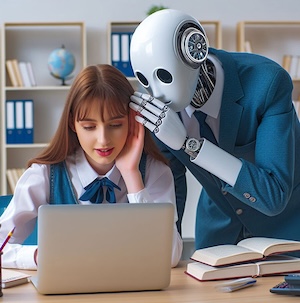
You don’t say. This is a story about a professor who discovered his students will use AI to cheat.
Serrano decided that his spring 2026 section of the quite difficult ECON 1170 would allow take-home exams for both the midterm and the final. Suddenly, the course received an influx of students. El País has the story:
The course… typically attracts few students, but very good ones. [Serrano] has never had more than 30 students enrolled at a time, and on some occasions he had only eight. This semester, probably because of the new evaluation system, 86 students signed up for the class. The results of the midterm exam, which was administered on March 5, were extraordinary, with an average score of 96 out of 100. Forty students scored a perfect 100.
This was indeed extraordinary, because as Serrano told Inside Higher Ed, “Historically the average grade in the midterm of this course has ranged between 65 and 80 [percent], and this exam was harder than the exams I wrote in the past, because… take-home is an opportunity to challenge the class a little bit more, given that you’re giving the students unlimited time.”
I figured this out back during the pandemic, when by necessity I had to offer exams online. Scores shot up! I knew immediately what was going on, but I didn’t punish the students — I couldn’t blame them for taking advantage of the system. This professor decided to test his students.
A suspicious Serrano decided that he would make the final exam in-person; he would see if students did similarly well on it. He emailed his class, telling them, “I am not declaring [the midterm] void for now. I am going to give the class a chance to prove me wrong. That is, if the distribution of the final exam is roughly similar to the distribution of the midterm, I will count the midterm. Otherwise, which is of course what I expect to happen, I will declare the midterm void and reweigh the final accordingly.”
Eighteen students suddenly dropped the course, while nine others didn’t even attend the final exam. Of those 27 students, El País noted, “22 had scored a perfect 100 in the midterm exam.”
Among those who took the test, the average score plunged—from 96 all the way down to 48.
He should have known that the scores on the final were not going to come close to the scores on the midterm. I knew in my classes that grades were going to drop when I stopped offering online exams. I wouldn’t have offered a phony deal like that to my students.
My classes were a bit different, though. It sounds like Serrano’s econ exams consisted of a lot of essay questions which could be flooded with AI slop; my exams are much more quantitative, with questions that are answered by numbers, which you’d think would be even more susceptible to AI cheating, but where I catch students who fail to grasp the process to solve the problem. You gotta know how to ask the AI how to solve the problem to get a good answer!
But still, exam scores were notably elevated during the pandemic, so once I could rely on instruction to return to normal, I made all exams to be in-class. However, I still offer weekly online quizzes. Quiz scores are significantly elevated, but constitute less than 10% of the final grade, and I don’t have a problem with that — I tell the students to cheat freely, to collaborate with their fellow students and work through the quizzes together. That’s been a benefit, because it forces students to think through the problems in a kind of practice exercise, and if they are working together they are teaching each other.
I’ve got one more year of teaching ahead of me. I plan on sticking to this same procedure in the next two semesters.

And, on top of facilitating cheating, destroying neighborhoods, muskrat’s AI creating porn, AI is now being used to steal people’s lives.
‘The Creepiest Possible Path’: Meta Letting Facebook, Instagram Use Your Personal Posts for AI Image Generation
“People should not wake up to discover their face has become raw material for someone else’s AI experiment. This is another invasion of consumers’ privacy.” Brad Reed Jul 08, 2026
https://www.commondreams.org/news/meta-muse-image-privacy
As for quantitative tests…. My late wife’s math was pretty weak. As a student (she majored in Linguistics), she took a Physics course as a breath requirement. Another student living in the same facility was in the same section of the course. So the two of them would get together to do the problem sets. The other student knew how to use a slide rule (this being the early 1960s), so my wife would set up the problems and the other student would then do the calculations to get the numerical answer.
Came the time of the final exam. My wife reasoned that, this being a Physics course rather than a math course, she went through and set up all equations and then went back to laboriously solve as many as she could in the available time. She got a quite decent grade. The other student did much worse as she struggled to set up the problems so she could solve them.
I used to work at a physics department, and during the pandemic, one of the professors spearheaded a study on Chegg and student cheating. (Basically, if a problem existed, students would be able to find a solution online. Chegg also offered live question-answering services, so he recommended that if we did online exams, they should be all at once and time-restricted such that anything short of ‘have your friend in the room’ was unlikely to get the exam finished in time.)
But I ended up doing the same solution as you: most of the course grade was in-person exams or problem-solving sessions, and points for homework or reading quizzes were minimal. (I already used online homework where students had multiple tries to get the correct answer, so I was scaling assuming students would do better on them than the exams even without cheating — the points were largely because I wanted students to do them.)