
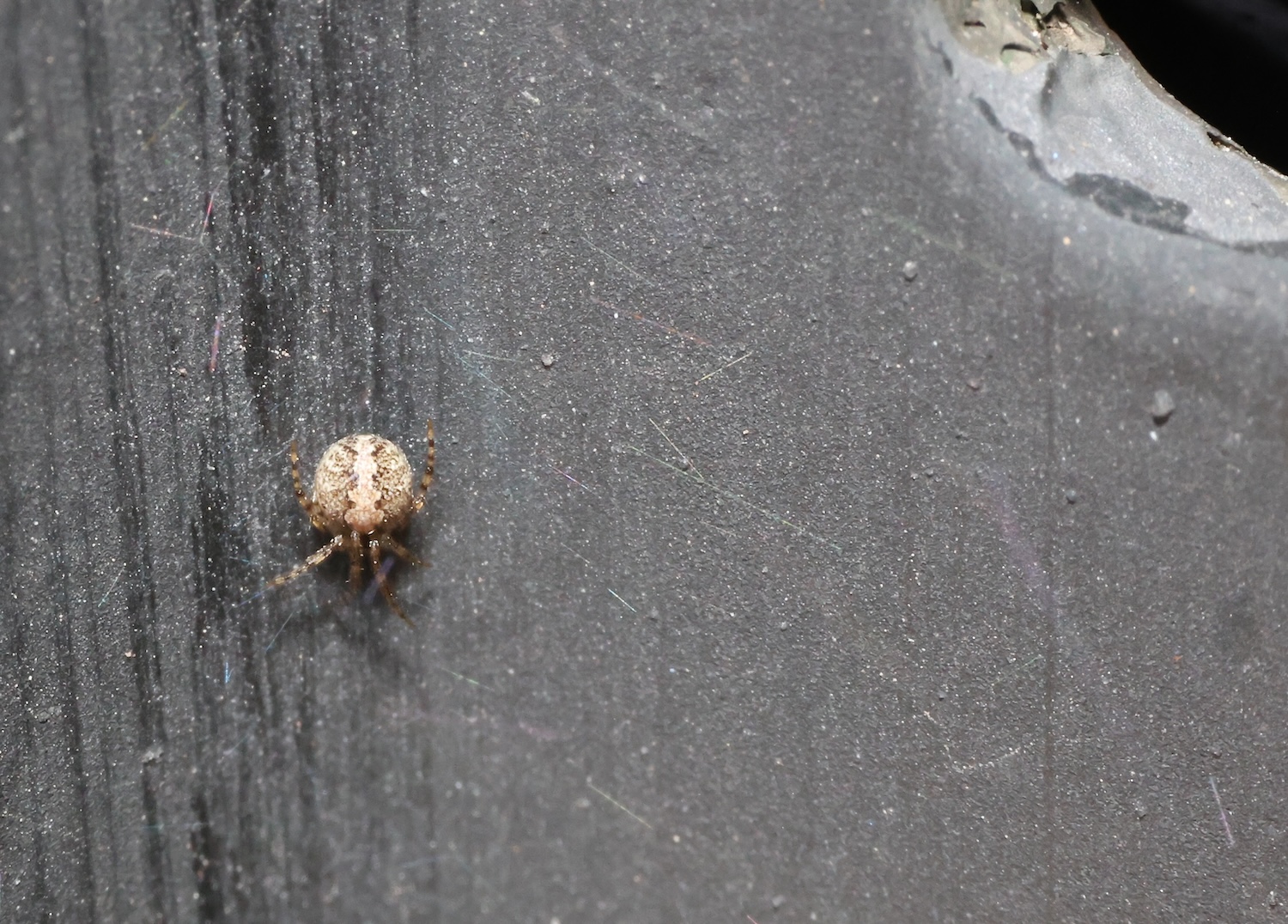
For years, one of the earliest signs of the spider season is the appearance of spider silk criss-crossing these metal signposts around campus. I rarely see any of the animals making the silk — they tend to hide in the holes that puncture the posts. But today I spotted one hanging out in a visible place! They are spiders in the subfamily Theridiinae, probably in the genus Theridion. I do not know why they favor this one peculiar habitat. These black metal posts get really hot in the sun, so these spiders must like it hot.
They have quite pretty patterns on their abdomens.
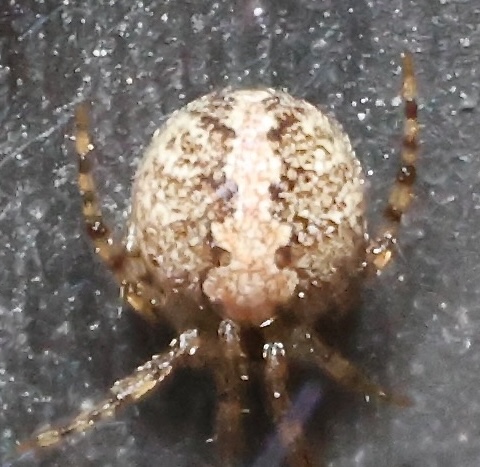

the question I have is what kind of prey is also attracted to that area and what time of the day because that spider sure looks well fed.
Does the heat give spiders more energy – aren’t they endothermic? (~ish?)
“Does the heat give spiders more energy – aren’t they endothermic? (~ish?”
Easy enough to look it up, these days:
Spiders are ectothermal species, i.e., the internal temperature depends on heat transferred from the external environment; and they are also poikilothermic, i.e., body temperature varies, but can be regulated behaviorally. All metabolic activities depend on temperature, which is expressed through the relationship of Van’t Hoff-Arrhenius, valid for all living organisms: M = c · mᵦ³ᐟ⁴ · e⁻ᴱⁱ ∕ ᵏᵀ, where c is an arbitrary constant, mb is the body mass, Ei is the average energy of activation of biochemical enzymatic reactions of metabolism, k is the Boltzmann constant and T the temperature in degrees Kelvin (Gillooly et al., 2001). This relationship shows that there is an extreme dependence of metabolic rate on temperature in poikilothermic animals, increasing exponentially with temperature.
(https://pmc.ncbi.nlm.nih.gov/articles/PMC4531227)
—
Surely one can trust the Canadians:
https://www.trulynolen.ca/what-happens-spiders-when-cold-weather-comes/