
I have a lot of different genetics texts, and I sometimes browse through them to get different perspectives, or in this case to get ideas for exam questions. I was skimming through Cummings’ Human Heredity: Principles and Issues when I ran into this surprising text box.
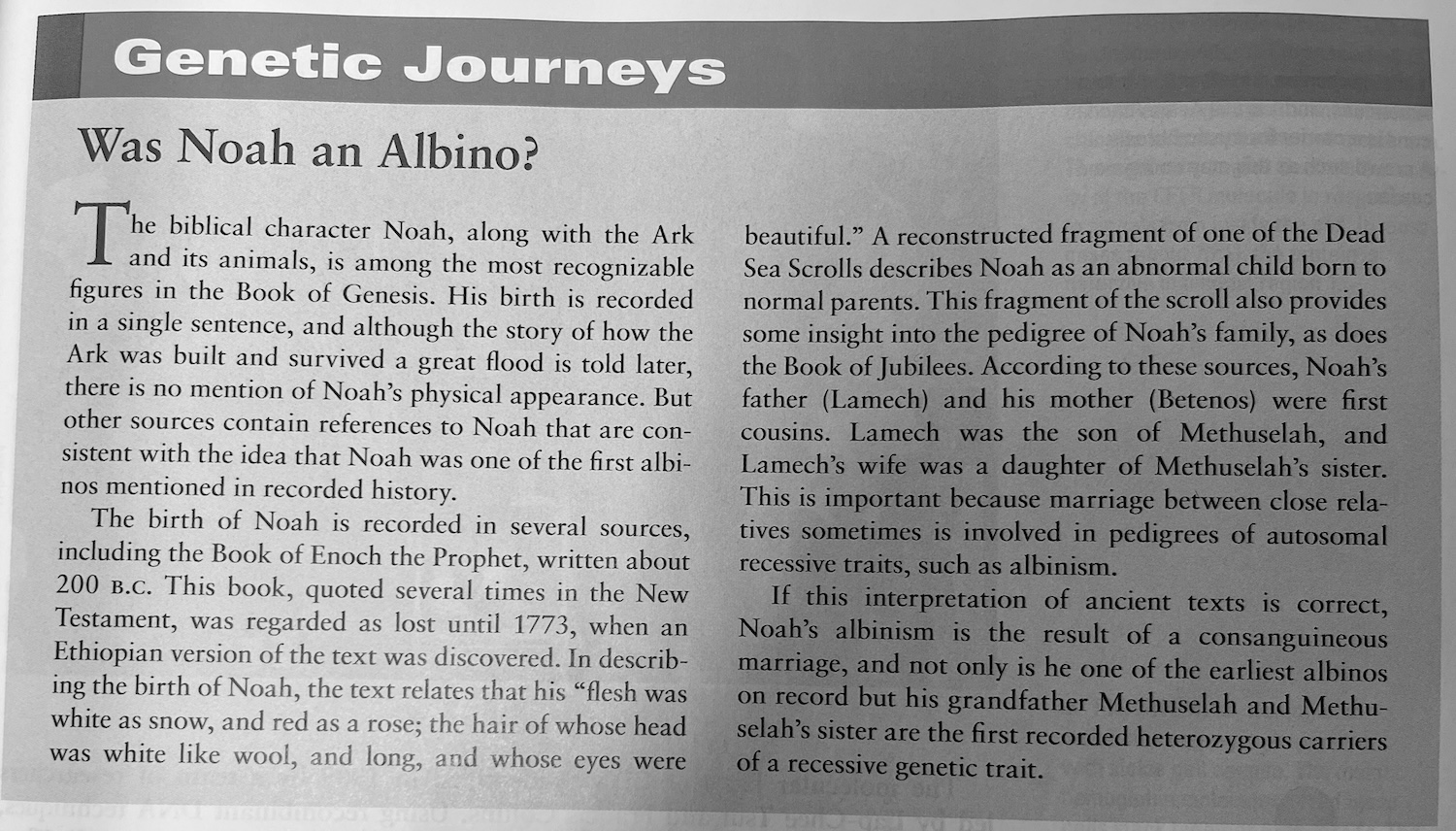
The biblical character Noah, along with the Ark and its animals, is among the most recognizable figures in the Book of Genesis. His birth is recorded in a single sentence, and although the story of how the Ark was built and survived a great flood is told later, there is no mention of Noah’s physical appearance. But other sources contain references to Noah that are consistent with the idea that Noah was one of the first albinos mentioned in recorded history.
The birth of Noah is recorded in several sources, including the Book of Enoch the Prophet, written about 200 B.c. This book, quoted several times in the New Testament, was regarded as lost until 1773, when an Ethiopian version of the text was discovered. In describing the birth of Noah, the text relates that his “flesh was white as snow, and red as a rose; the hair of whose head was white like wool, and long, and whose eyes were beautiful.” A reconstructed fragment of one of the Dead Sea Scrolls describes Noah as an abnormal child born to normal parents. This fragment of the scroll also provides some insight into the pedigree of Noah’s family, as does the Book of Jubilees. According to these sources, Noah’s father (Lamech) and his mother (Betenos) were first cousins. Lamech was the son of Methuselah, and Lamech’s wife was a daughter of Methuselah’s sister. This is important because marriage between close relatives sometimes is involved in pedigrees of autosomal recessive traits, such as albinism.
If this interpretation of ancient texts is correct, Noah’s albinism is the result of a consanguineous marriage, and not only is he one of the earliest albinos on record but his grandfather Methuselah and Methuselah’s sister are the first recorded heterozygous carriers of a recessive genetic trait.
I fail to see what this would add to a student’s understanding of genetics: OK, lot of inbreeding among the Biblical patriarchs, I was entertained by the description of Noah that sounds more like Snow White, I guess Michael Cummings is revealed to have an interest in obscure Biblical text reconstruction, and it might appeal to theologically inclined students, but yeesh, I expect my students to have a better appreciation of the quality of the data.
I don’t think you can claim that Noah was an inbred albino on the basis of such slim evidence. This is a figure who is pretty well swaddled up in myth and legend, who is claimed to have lived through a global flood that didn’t happen, who lived, supposedly, to the age of 950, and who is claimed to have lived around 3000BCE, when your evidence is based on a text fragment from 200BCE. And now we’re going to deduce a detail of his genetics? No, thank you.

No, this will not end up as an exam question.
I suppose it’s possible that whoever invented the Noah character, or decided to make up a description of him later, was inspired by a real person he knew, or knew of. That’s the only sense in which this could be kinda true, it seems to me. But it’s hardly a revelation that albinos existed in 200 BC.
I recommend “The Ark Before Noah” by Irving Finkel.
Much of this rubbish was stolen from the Babylonian ark myth (remember, prominent Jews were working in the Babylonian palace during the Babylonian captivity and they grew so integrated in the culture that when they returned, the name for one of the months was replaced by its Babylonian name).
The absurdly long life spans of some biblical characters can be explained by a glitch when transcribing cuneiform from the Mesopotamian templates of the myths.
A fascinating book with much information about cuneiform. It deserves a place in every well-stocked library, which is why I donated my copy.
It’s interesting in that the ancient Israeli people had a paradoxical attitude towards disfigured people. If you were not powerful having any disability, disfigurement or disease was considered a curse from God, a sign that God disapproved of you. You were banned from central positions in the tribe, treated badly and might be thrown out entirely. For the most powerful though it became a sign of their relation with God and supported their religious authority.
It says a lot more about early Israeli society then it does about genetics.
With fictional DNA, you can make up anything you want.
the name for one of the months was replaced by its Babylonian name
And even some of their own names. For instance, Zerubabbel (“Son of Babylon” IIRC).
Seems to me it is likely a teaching illustration used by him to introduce the concept of autosomal recessive inheritance via a cultural lens. Can’t imagine too many USAnians aren’t familiar with Noah.
(Like using a cartoon or a meme type of thing)
The flood myth in the Gilgamesh saga says a man named Utnapishtim and his wife were told by a god to build a big boat, which is how they survived the flood. One scholar has suggested Noah is a short version or nickname for Utnapishtim.
The details of the story, which was as much as 1500 years old than the Noah myth, clearly show the latter is taken directly from the former. It included the birds sent out to find land, and the goddess Ishtar creates a fly with rainbow-colored wings as a promise the gods won’t try to wipe out humanity again.
If Noah was an actual albino, his skin and hair color might have been noted, but what would REALLY have been noted would have been his red eyes.
Not seeing how that detail would have been omitted.
@ ^ Snarki, child of Loki : yeah – red isn’t usually considered a “beuatiful”eye colour, quite therevesre -as shallow as that is.
Still it does cast a very different light on who Noah was – if he wa sacually real and the unusualness of it almost make sme think its mor eplausible albeit obvs NOta global flood but just a reallysevere regional one wth few survivors that got massively exxagerated.
Clearly the most parsimonious explanation of Noah’s pale skin and long lifespan is that he was a vampire. He needed two of every animal to feed his blood hunger.
Dóh! Correcting that ^ :
@ Snarki, child of Loki : yeah – red isn’t usually considered a “beautiful” eye colour, quite the reverse – as shallow as that is.
Still it does cast a very different light on who Noah was – if he was acually real or abse dona real figuire and the unusualness of it almost makes me think its more plausible albeit obvs NOT a “global” flood just a really severe regional one wth few survivors that got massively exxaggerated in the retellings over the years and generations. Ancient mesopotamia was a flood plain and for most at the time was all they knew after all.
Wonder if that would count as the earliest recorded record of an albino person too.
@3 birgerjohnson: Why would the absurdly long life spans have to be a translation error? Aren’t things like the Sumerian King List also full of people living for many centuries?
P.S. Sorry I mistyped your handle. :(
lol
Just more fodder for apologists to claim how much they ‘know’ about biblical characters. I don’t care about an ancient guys albinism or not, just as I don’t care about some ancient guy called Jesus (or whatever). What i care about is that there was never a world wide flood, and there was never anyone who fed 5 thousand people with a couple of fish and a loaf or 2 of bread. When either of those things can be demonstrated, or any of a host of other stuff, then I’m listening. Otherwise, aside from it helping out some of the most obnoxiously wrong and irritating people on the planet, I. Just. Don’t, Care.
Enoch is Biblical fan fiction. Genesis was written around 800BCE, Enoch around 200BCE. The reason it was “ lost “ is that neither the Jews or the Christians could take it seriously enough to stick it in their cannons. Mainly because its the book where evil comes to Earth when rebellious angels mate with women and produce a race of evil supermen who teach human about makeup & other evils. Also a fanfic from the arc story. But still. Not because it describes a flat earth. Or the geography of heaven.
@#3 If you are interested in cuneiform, you might try the recently released “Between Two Rivers” by Moudhy Al-Rashid, just released.
Monad at 13.
Of course! The years were shorter then! About (quick scribble) 35 days long. The Earth was just inside the orbit of Mercury, but was kept cool by lots of icy comets raining down, like, all the time. Unforetunately this also caused flooding… or something.
Calling the flood myth ‘recorded history’ is quite a stretch…
@ ^ macallan : Recorded mythology maybe?
Further back you go the blurrier the line between myth and history gets..
Some of the mythology might be based on history perhaps, just possibly or perhaps not – ever harder to tell which bits and what’s real and what ain’t.
Now in our time we have AI for that blurriness -and the Trump tyranny and more…
@13 monad
The number system used at the time, and by pretty much everyone, was base 60, and it had a weird thing where you tagged the number with an extra mark to indicate that you needed to either decrease the marked number to the range of 1-9, or increase it to the hundreds. Given both how bloody easy it was to accidentally have an extra mark end up on a clay tablet (the means of recording such things back then), losing one since these where not “fired” tablets, they where kept markable, at least until they dried, or got too close to a fire, and the disturbing tendency on monuments of the people making them to often just not bother to add such marks at all (thus almost always inflating the age of the ruler it was made for)… Yeah, real likely every “age” ever recorded in later texts, taken from those original cuneiform, was either misinterpreted, read incorrectly, etc. This is especially the case when, in cases where some original artifacts have been found, a) the actual ages, when adjusted for this are far more sane, and b) actual cases exist where the date of, for example, the reigns of certain rulers only make sense if you make that adjustment, otherwise you get gaps, or overlaps.
There have been a fair number of people that have done youtube videos on this subject, from an expert, or at least, “I read what the experts say on this.”, perspective. I think part of the confusion over this not possibly being mistranslation is both that they may have used written works, of some sort, not just specific marks, that they used a base that makes sense to us, not base 60, that they did something sensible, i.e., made, say 6 mean 6, not 60, and instead would have required the marking to be something like 6′ to mean 6, and 6* to mean 600 (more or less), etc. Basically, it was real bloody easy to both get the number wrong, and/or intentionally make up a “bigger” one, if you wanted to make your past rulers look to be some god forged individuals, who lived far longer than normal. And, since they seemed to do this almost all the time with statuary… who would know that mattered to the people in power?
@17 francesconic
Right. So is the rest of the Bible.
And yet they decided to keep Revelation, which is bar none the silliest book of the lot.
The number system used at the time, and by pretty much everyone, was base 60…
I heard somewhere that all the various peoples and cultures in that area used a wide variety of number-bases, and base 60 was used as a “common” base by all those peoples, because 60 was a multiple of all those other base-numbers, which made translating numbers from local notation to or from base 60 easier.
So were all those old Bible-characters’ ages originally written in base-60? Not that any of that matters, since there was never any evidence indicating that humans lived that much longer then anyway; so it’s pretty foolish to even take such claims seriously, regardless of where they come from.
PS: Where did my earlier comment go?
If you try to make sense of the anthology we call the “Bible”, created from surviving fragments ranging from bronze age Caananite folk religion to up to twenty competing gospels during the Roman period, I suggest
“Memoirs of God” by Mark S. Smith.
.
It has been out of print for a long time. If the cost of a second-hand copy is prohibitive try a University library or a well-sorted ordinary library.
.
The aforementioned “The Ark Before Noah” by Finkel explains the precursors to the biblical Flood narrative (and you learn a lot about cuneiform along the road).
.
If you concentrate on the New Testament, wossname who wrote ‘Lost Christianities’ (Bart Ehrman? I am not sure) has written a long list of books on various aspects of it. His books are easy to read, even for non-experts like me.
.
Finally Adair has written a critical book about the Star of Betlehem story, a short story in the New Testament that has generated a huge number of theories.
@3 birgerjohansson
I recommend “The Ark Before Noah” by Irving Finkel.
Fantastic book.
Have you seen Finkel’s video about building a new, albeit slightly smaller, ark in India working from the original specs on that tablet?
When the entire concept of religion is bullshit, you can make up as much more bullshit to add to it, that you like. At least it is consistent, in that it’s all bullshit. See AIG, DI, and every crackpot on the internet.