It’s Not Just Summer: Winter Heatwave Scorching South America

As you all know, 2023 has been off the charts, in terms of the global temperature. There have been record-breaking heatwaves and fires all over the northern hemisphere, but we’ve had the predictable chorus of “it’s always hot in the summer”. I don’t expect to persuade any of those people – they’re either wholly detached from reality, or they are being paid to help usher humanity to extinction. They are, however, a useful rhetorical device, and thanks to decades of relentless propaganda, there are still some who are uncertain about the facts of global warming, so in response to that bad-faith argument, I would like to direct your attention south of the Equator, to South America, which is currently in its winter, and has also been undergoing a record-breaking heatwave. From August 3rd:

Now should be South America’s bleak midwinter, but several parts of the continent are experiencing an extraordinary unseasonal heatwave that scientists believe offers a disturbing glimpse of a future of extreme weather.

Argentina’s riverside capital, Buenos Aires, this week recorded its hottest 1 August in 117 years.

Cindy Fernández, a weather bureau spokesperson, said her country was facing “a year of extreme heat”.

“Winter temperatures are way off the scale – not only in the central region where Buenos Aires is but also in the northern regions bordering Bolivia and Paraguay where temperatures reached between 37C (98.6F) and 39C (102.2F) this week.”

Hundreds of miles to the west, in Chile, temperatures rose even higher, towards 40C.

“July was the planet’s hottest month since records began and the Andes are now experiencing their own thermal ordeal,” announced the Santiago-based newspaper La Tercera. “Although we’re in winter, Chile is living through a little hell of its very own.”

Raúl Cordero, a climate expert from the University of Santiago, told the newspaper that as far as temperatures and rainfall were concerned, “Chile’s winter is disappearing”.

“It’s not surprising that temperature records are being set all over the world. Climate change ensures these records are broken more and more frequently,” Cordero said.

Parts of Paraguay, Bolivia and southern Brazil have also been baking in what extreme weather-watcher Maximiliano Herrera called “brutal” temperatures of almost 39C. “For at least five more days there won’t be any relief and we can’t rule out some 40s,” Herrera predicted on Twitter where he claimed the unusual winter heat was “rewriting all climatic books”.

“We are used to the heat in Paraguay, but the weather now makes it so hot we don’t leave the house,” said Ariel Mendoza, a 32-year-old car salesman in Paraguay’s capital Asunción, as the mercury there rose to 33C on Thursday.

Five years ago, winter in Paraguay made for chilly days, Mendoza pointed out. “But now it’s 30C-35C [86F-95F] in the winter due to climate change.”

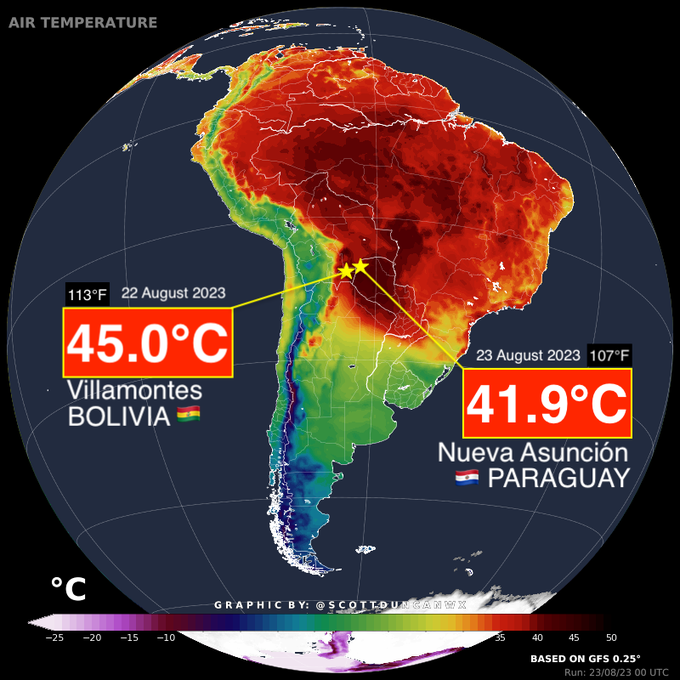
In a stunning turn of events, turning up the temperature of the whole planet, turns up the temperature of the whole planet. The heatwave isn’t over, either. Here’s a lovely map from just a few days ago:

The image is a heat map of South America, showing a deep red over Venezuela, Guyana, Suriname, French Guiana, Brazil, Bolivia, Paraguay, parts of Equador and Columbia. The Andes can be seen as a green stripe hugging the west coast, and turning blue towards the southern tip of the continent. Urugay and Argentina show green, outside the heat dome. Two markers show temperatures of 45C/113F in Villamontes, Bolivia on August 22nd, and 41.9C/107.42F in Vueva Asuncion, Paraguay on August 23.

The image is a heat map of South America, showing a deep red over Venezuela, Guyana, Suriname, French Guiana, Brazil, Bolivia, Paraguay, parts of Equador and Columbia. The Andes can be seen as a green stripe hugging the west coast, and turning blue towards the southern tip of the continent. Urugay and Argentina show green, outside the heat dome. Two markers show temperatures of 45°C/113°F in Villamontes, Bolivia on August 22nd, and 41.9°C/107.42°F in Vueva Asunción, Paraguay on August 23.

The running theme of this century will be that nowhere is safe. This isn’t because we didn’t already know that. It’s been clear for decades that a global rise in temperatures was happening, and that nowhere would be safe from the harm that would cause. Unfortunately, thanks to the corruption and propaganda I mentioned earlier, a lot of people still haven’t really internalized what is happening to our world.

Apparently, they needed to actually see it happen, to actually believe it, and so here we are.

I don’t really blame people who have been duped on this issue, so much as those who have spent and earned fortunes in duping them. Even so, it’s hard not to be angry at those who have spent decades fighting to make this world, with all its horrors, come to be, because they were so afraid of communism, or so hateful of minorities, that they could not see the bigger picture.

It is not just summer. It is global warming, and it is everywhere.

NLRB Decision Is a Major Win for Workers’ Rights

I make no secret of my distaste for Biden on this blog. He’s done a lot during his career in politics to make the US – and the world in general – a worse place to live, and a lot of what he does seems to be in service of that damnable project. That said, despite things like his approval of the Willow Project, his refusal to do anything to oust Trump’s poison pill of a Postmaster General, and his opposition to any kind of universal healthcare system, his presidency has actually done some things to make life better for ordinary USians. I don’t know whether his boast of being “the most progressive president in history” has merit, but if it does, that’s largely because it’s a very low bar to clear.

I think it’s essential to shine a light on his failures – especially those relating to the climate – but today we’re talking about something for which we can genuinely thank Biden. Reuters teased a new era of worker-friendly governance from the NLRB last December, and it looks like we are seeing that now:

Following the NLRB’s decision in Cemex Construction Materials Pacific, when workers ask an employer to voluntarily recognize a union as their bargaining representative, the company can voluntarily do so and begin good-faith negotiations.

Alternatively, the company may file a petition seeking an election, and as long as it does not commit unfair labor practices, one will be held. However, if a company does engage in such violations—or refuses to voluntarily recognize a union and fails to file a petition—the NLRB will now order the employer to recognize and bargain with the union without an election.

In other words, “union-busting just got a lot harder,” More Perfect Union said on social media. “This brings the board’s position closer to the old Joy Silk doctrine, which held that if a majority of workers signed union cards, there didn’t need to be an election at all and bosses just had to recognize the union and bargain in good faith.”

The Joy Silk doctrine came from a 1949 NLRB decision and was replaced by the Gissel doctrine in a 1969 U.S. Supreme Court case.

As VICE reported Friday:

NLRB General Counsel Jennifer Abruzzo issued a memo earlier this year demanding that the board revive Joy Silk, something that labor activists have been fighting for since it was overturned. The Cemex decision issued on Friday is a partial step in that direction.

“What this new decision does is, it’s a compromise,” said Eric Blanc, an assistant professor of labor studies at Rutgers University. “It’s not a return to ‘card check,'” the unionization process in the 1930s and ’40s that said if a majority of workers signed cards stating they wanted a union, the company was obligated to recognize and bargain with them—which Joy Silk had upheld.

“If there’s intense illegal union-busting, as is very often the case, the NLRB can force the employers to immediately recognize the union rather than have to go through another union election,” Blanc said. “But it’s far short of what many union organizers were hoping for. By not making ‘card check’ the norm, [it] still opens up the process to all sorts of legal appeals and delays, which is ultimately one of the main tactics of employers—to delay the union first and then hold things up in endless appeals. This unfortunately doesn’t avoid that dynamic, but it does get the NLRB more powers to require employers to recognize unions, and that should be at least a partial deterrent on employers’ willingness to break the law.”

Brishen Rogers, a professor at Georgetown University Law Center, said on the social media platform X that “Cemex may be the most important NLRB decision in a generation.”

It is “hard to say if it will survive review,” Rogers added. “But labor and the state can use it to change power alignments right now through organizing—which in turn would *help* it survive review.”

This is good news. I’ve come to believe that widespread unionization is the most direct path to the kind of organized labor power we would need to carry out a general strike, to force more drastic action on things like climate change, healthcare, and wealth inequality. This decision will make that a whole lot easier.

Even so, I think we should not forget Biden’s decision to break the rail strike back in December. He ended up getting rail workers some sick leave (less than they need), but I think it’s important to note that he wanted that to happen on his terms, not on the workers’ terms. The Democrats do not want systemic change, and won’t back even a nonviolent revolution. What they will do, is make that far easier to accomplish than it would be under the Christian fascist regime that the GOP wants to impose.

It is important for workers to take advantage of this NLRB and build power, and given the wave of union interest we’ve seen recently, I think they will. This is an opportunity that is unlikely to last forever, given the nature of US politics, and so I think we should expect another turn against unions and workers’ rights within the next decade. The stronger workers get before that happens, the more they will be able to resist the attack when it comes, and oust politicians who’re trying to take away the peoples’ power.

Video: More Perfect Union Takes a Look at Protesting in France and the United States

I follow More Perfect Union on Twitter and Bluesky, but I haven’t gotten around to watching much of their content on Youtube. I’m slowly changing that now, and I wanted to share this one addressing the question of why the US doesn’t protest the way France does. It’s a good look at the subject, and I think you should check it out!

Unrelated, for those who care to know, I’m not going to post on weekends going forward.


Arizona Trans Woman Arrested and Jailed for Self-Defense

Arizona is a “stand your ground” state. For those who don’t know, that means that if you feel threatened by someone, but you have the ability to safely retreat, you have no legal obligation to do so. You are allowed to stand your ground, and use violence. I mention that, because when it comes to self-defense law in the United States, if you claim self defense, in many circumstances, you won’t even be arrested for killing someone. Unfortunately, as with most laws in the United States, the degree to which that “protection” actually protects you will often depend on who you are, and what the cops think of you.

Case in point: A trans woman named Epona Rose was accosted by a group of men who sexually harassed her until realizing she was trans, at which point the harassment became threats and assault. Rose defended herself, and for that she was arrested and jailed with bond set at $500,750, with her arraignment on August 28th. For comparison, Donald Trump, who has a private plane and has “joked” about fleeing to Russia, had his bond set at less than half that. Further, for the crime of defending herself while trans, Rose has been charged with assault and attempted murder:

Flagstaff, AZ — On the morning of August 11th, Epona Rose was attacked in downtown Kinłani/Flagstaff, Arizona by a group of three men while two or more watched. The men were drunk and sexually harassing her. The attack escalated into threats of rape, and then to physical violence, when they realized that Epona is transgender.

Epona defended herself bravely against this attack and did not call the police, but she was the only one arrested. Epona faces felony charges including aggravated assault. She was initially held on the men’s side of the Coconino County Jail in segregation with one hour a day out of her cell. She struggled to gain access to her prescribed medications. Political pressure seems to have improved her conditions; however, Epona is still unable to receive equitable treatment and has filed complaints of sexual harassment. Epona’s arraignment is August 28th and her bond is set for over $500,000. A team of national organizers and local support have mobilized and are fiercely working to overturn such an excessive amount and the fear mongering charges.

An initial arraignment on August 17th was vacated with no reason given by the courts. A rally was held with more than 25 people calling for Epona’s immediate release. A vigil was held outside of Coconino County Jail the previous evening, more than 40 people attended, sharing their stories and chanting, “Who keeps up safe? We keep us safe!”

Epona shared this statement from jail:

I was charged as a man, as I am a woman of trans experience. I was initially booked into jail on charges of aggravated assault, as well as attempted homicide, second degree, unjustly. I was defending myself, my womanhood, against three men. While I’ve been in this facility I’ve been mistreated. I have been treated as a man. I have been asked fourteen times about my genitalia by staff. I have been laughed at and ridiculed. I have been put into isolation. Make no mistakes, the United States is now living in the Weimar Republic era. I have been fighting the way I can from the inside with what little power I have from the inside.

Epona further stated, “I am not safe here, but I am holding on to hope, and I know that I will be free. I want to thank everybody who has shown support and is fighting for me on the outside. Thank you, loved ones, relatives, comrades. I look forward to seeing you. Thank you so much for the fight. Solidarity!”

The longer Epona is in jail, the much more at risk she is exposed to as a trans woman and abolitionist. We cannot let Epona be made an example out of by demanding the basic rights of genderqueer, third gender, Two Spirit, and/or trans people to exist!

Epona’s lawyer, Ryan Stevens of the Griffen & Stevens Law Firm in Flagstaff, explained, “Our priorities are clear: keep Epona safe; get her out; and present a complete defense to her charges in court. We are at the very beginning of what may be a long haul fighting for Epona and asserting her rights in court, including self-defense.”

Arraignment is scheduled for August 28th at 1pm; Epona’s supporters will be gathering at Coconino County Superior Court located at 200 N San Francisco st, Flagstaff, AZ 86001

Epona’s supporters are fundraising for her legal fees and associated costs; please specify that your donation is for Epona. You can also use the “rose” emoji.

Support Epona’s legal defense and bail fund:
Paypal: @brokebackwolfpack
Venmo: @brokebackwolfpack
Cashapp: $brokebackwolfpack

You can also contact the Coconino County Board of Supervisors and demand Epona is treated with dignity as a trans woman:

Phone: 928-679-7120

Toll Free: 877-679-7120 Emails: [email protected], [email protected], [email protected], [email protected], [email protected]

Contact Flagstaff City Council:
All council members: [email protected]
Mayor: [email protected]
Phone: (928) 213-2065
#FreeEpona

There are a lot of problems with the US constitution, and with US law. One of the good things, even if it took almost a century and a civil war to get it, is the Equal Protection Clause of the 14th amendment:

All persons born or naturalized in the United States, and subject to the jurisdiction thereof, are citizens of the United States and of the State wherein they reside. No State shall make or enforce any law which shall abridge the privileges or immunities of citizens of the United States; nor shall any State deprive any person of life, liberty, or property, without due process of law; nor deny to any person within its jurisdiction the equal protection of the laws. [emphasis added]

My only real complaint about this is that it limits its protection to US citizens, rather than all people who find themselves under US jurisdiction. Other than that, this is good and important, and so naturally it’s often ignored by the US law enforcement system. There are many, many ways in which equal protection is denied to US citizens. I’m not talking hundreds of times per year, I’m talking thousands of times per day, across the country. The “trans panic” defense is one of the most heinous examples – a trans person (usually a woman) is assaulted or murdered, and the perpetrator claims that they “panicked” upon learning she was trans, and attacked her. This has existed for a long time, in a variety of forms. So far, the federal ban on this defense hasn’t gotten anywhere, but 17 states have passed their own bans, with New Hampshire being the latest, just 10 days ago (rare Sununu win). The NH ban only applies to homicides, though, so it won’t help people who were “just” assaulted. Arizona is not on that list, and the “panic” defense is still perfectly legal there.

Rose’s case feels as if the police took that “defense” as a matter of law, which made the violence of her attackers justified. That meant that, in the eyes of the police, Epona Rose had no right to self-defense in that situation. The police, and the judge who set a bail of – and I can’t stress this enough – over half a million dollars, have decided to punish her for defending herself, before the trial that is her right has even started. I also have to wonder what role her personal politics are playing in this – my impression is that people in the law enforcement system don’t like abolitionists, despite working so hard to make our case for us.

If you want to help in any way, all the information is in the block quote above. Hopefully Monday’s arraignment won’t be pushed back again, since that would mean still more time imprisoned and abused for defending herself. The extremely high trans murder rate (trans women of color in particular) is something that does get press, albeit far less than it should, but it’s also worth remembering that for every trans person murdered, there are others who are “merely” injured, and that almost never makes the news. This problem is not separate from the way the US “justice” system actively enables this violence, and even enacts this violence, as we are seeing in the case of Enola Rose.

European Wildcat Project Looking for Supporters

Last April, I wrote about the ongoing effort to save the Scottish Wildcat. Today, I want to make you aware of an upcoming project to save the wildcats of mainland Europe. While there’s some debate over subspecies, these are the same species of wildcat as the ones in Scotland, and so they face pretty much the same threats – habitat destruction, interbreeding with feral cats, and disease from feral cats being the big ones. Even so, the degree to which these are problems varies across Europe, which is why it’s great that the European Wilderness Society is gearing up to do an awareness-raising campaign, starting in September of 2024, combined with an effort to collect information:

European Wilderness Society is currently working on a new LIFE project proposal – this time about the European wildcat. The main goal of LIFE Wildcat is to support and strengthen population development of the European wildcat across Austria, Germany and the Czech Republic. The status of the wildcat is already unfavourable; and one of the main threats to it are roadkills and human infrastructure that destroys the cat’s habitat.

Therefore, the project has the following objectives:

  • Analyse habitat and connectivity features on landscape level for improved settling and dispersal of European wildcat
  • Identify hotspots for anthropogenic mortality risks
  • Survey of the degree of hybridisation
  • Boost population development in sparsely occupied yet suitable habitats through reintroduction
  • Centralise European wildcat data from current and previous efforts for a better and more coherent conservation approach
  • Increase awareness on political and public levels for conservation efforts directed to European wildcat

To achieve these objectives, the project partners will:

  • Train key stakeholder groups on necessary conservation techniques
  • Protect key areas that provide suitable habitats for European wildcats
  • Develop a map of habitat connectivity across project focus countries
  • Identify roadkill hotspots and promote mitigation measures to reduce mortality risks
  • Contribute to the establishment of a self-sustaining wildcat population in Austria
  • Create a centralised data repository for EU-wide coordinated conservation activities

The project would start in September 2024 and last for 6 years.

They say they’re still looking people and organizations to sign statements of support, so if that sounds appealing or important to you, check them out at the link above!

The photo (uploaded to Wikimedia commons by Lviatour) is of a European Wildcat sitting on a rock and staring intently at the camera. Its got grey fir with hints of brown, and faint black stripes. Its tail has bolder black stripes, and a black tip. Its fur looks thick and soft, and its face is stripey. Its eyes are a pale blue-green.

The photo (uploaded to Wikimedia commons by Lviatour) is of a European Wildcat sitting on a rock and staring intently at the camera. Its got grey fir with hints of brown, and faint black stripes. Its tail has bolder black stripes, and a black tip. Its fur looks thick and soft, and its face is stripey. Its eyes are a pale blue-green.

Uber CEO’s Poverty Tourism Cannot Fix What Capitalism Has Broken by Design

Every once in a while, I come across the sentiment that if CEOs actually spent time doing what their lowest-paid workers do, then they’d be more inclined to go along with raises or better working conditions. The reality show franchise Undercover Boss is based on this idea, and it’s often pointed out on social media that the work done by a warehouse package-runner is far more difficult than anything Jeff Bezos does. This caught my attention because the CEO of Uber has been getting press for his brief stint “moonlighting” as a driver. He announced this in a Wall Street Journal puff piece back in April, but I guess he wanted more press, because now we’re getting articles about his “most nightmarish experience” while cosplaying as a peasant:

When asked the most nightmarish rider experience he had as an Uber driver, Khosrowshahi said that it wasn’t the riders that gave him issues — it was delivering food.

“I was trying to deliver food and I couldn’t find where to drop it off,” Khosrowshahi told The Wall Street Journal. “Trying to figure out the maze of apartment complexes was a challenge.”

Navigating large apartment complexes has been a pain point the company, an Uber spokesperson told Insider, adding that the company has tried to address this by providing users with more accurate drop-off pins.

Uber Eats wasn’t all bad, though.

“The most fun was delivering food to a touch football game,” Khosrowshahi said. “I was like, ‘Where’s the building I’m supposed to be delivering to?’ It was a field. There was a bunch of dudes.”

Still, Khosrowshahi seems to be aware that Uber drivers face a series of challenges during their shifts.

Improving the company’s working conditions for its drivers starts with corporate Uber employees “using our products” and “getting in the shoes of a driver,” he added.

I think I should say here that as long as we’re going to have CEOs the way we currently do, they absolutely should have to do the worst-paid work in their company. The harms done by hierarchy do seem to be mitigated, at least a little, by those at the top finding some way to empathize with those at the bottom. Unfortunately, this kind of empathy tends to be weak and insubstantial, or even entirely pretended, for appearances only.

See, companies already know how badly their workers are doing. There wasn’t some mystery that just had to be solved by the CEO going undercover as a lowly worker. The workers had already been talking about the problems they faced for years by the time Khosrowshahi had the brilliant idea of doing the work himself to “find out” why drivers didn’t seem to like their jobs.

CEOs don’t consider their employees to be people. Not really. They can’t be taken at their word when they describe problems with the company – those problems only count if the CEO witnesses them first-hand. As appalling as this is, it also underscores the two biggest problems with this misguided bid for improvement via capitalist empathy.

The first, which I already mentioned, is that most if not all CEOs know their workers are suffering, and routinely try to increase that suffering. When they try to justify their obscene wealth by talking about the “risk” they take on as owners and investors, it’s never a risk to their health, or their ability to afford a home. The real risk is losing enough money that they have to work for a living. Their biggest fear, and the risk for which they demand all the reward in the world, is becoming a worker like the people they exploit for their day job. I’ve said this before, but based on the actions of capitalists across the generations, if a worker is happy and fulfilled, that’s seen as proof that they’re not being sufficiently exploited.

The second problem is that there’s no way poverty tourism like this can ever actually generate a true understanding of what it’s like to live as a low-wage worker. The bosses all know that this is a temporary thing, like doing a “boot camp” program for a couple months, where you might have to suffer, but it’s an experience you’re taking on for your own benefit, knowing that you will be going back to your normal, luxurious life at the end of it. These CEOs do the work, and then go back to their mansion at the end of the day. They have the best healthcare money can buy, they can afford childcare, and they pay someone else to do their shopping, cooking, and cleaning. If they attempted to live on minimum wage for a month, or even a year, they would still be doing so with the knowledge that after a set period of time, their ordeal would be over.

People who are actually working those jobs to make ends meet have no such promise. The best most of them can hope for, as a “reward”, is that the job, bad conditions and low wages included, will still be there for them in the future. Even a modest retirement is a distant fantasy for a growing number of workers, sickness means loss of savings and/or debt, and rent just keeps on rising.

The only way to truly allow a CEO to experience what workers’ lives are like, is to put them in that situation, and to take away all hope of ever returning to their fortunes save by the same means available to those workers. That, however, would be considered a grave injustice in our society, no matter how they came by their wealth. So long as we have this kind of extreme hierarchy, there will always be a gap in understanding between the rich and the poor.

Empathy, while hugely important, cannot overcome the extreme divisions of the somewhat-soft caste system maintained by capitalism. As I said before, I’m in favor of CEOs doing low-wage work to see what it’s like, but that can’t be enough to fix our society, because capitalism requires the existence of grinding poverty in order to function. The only thing that has reliably improved life for working people is working people, working together, as unions continue to demonstrate.

Thanks to sonofrojblake for putting me onto this song, covered here by William Shatner.


Global Warming Cripples Panama Canal

When people in the United States talk about refugees from south of the border, they’re often framed as “economic refugees”. Much of the time, this is part of a broader effort to de-legitimize their claim to asylum, and it generally ignores why their home countries might be having economic troubles (the U.S. has often played an outsized role in devastating countries in South and Central America). It also ignores another problem primarily caused by outside forces – global warming.

See, the ways in which global warming is harming poor countries in the “global south” rarely actually make the news in the US, so far too few people are aware that one of the biggest things that Central American refugees are fleeing is drought. Just as parts of the US have now been in a state of semi-permanent drought for what feels like over a decade now, Central America has been far, far too dry, but instead of being part of the United States, these countries spent the last few decades being under attack by the United States. This is why, incidentally, the refugees are willing to try to cross a border where they know government agents are trying to kill them – the alternative is starvation, and the horrible choices made to avoid starvation. Advocates for climate action have been warning for ages that global warming would drive a refugee crisis, and it has been doing just that for years now.

That drought is also, now, having a consequence that I did not foresee, even though I should have.

The Panama Canal is running out of water:

Remember the chaos that ensued in 2021, when a cargo ship got stuck, blocking passage through the Suez Canal?

Now, a massive flotilla of ships is currently stuck in the world’s worst traffic jam at the Panama Canal — and the end of this new watery pile-up could be at least a few weeks away.

As the Wall Street Journal reports, the famous human-dug canal has more than 200 ships waiting to pass through it as its transit continues to be stymied thanks to the worst drought it’s experienced in a century.

The 50-mile-long canal, as the report notes, relies on rainwater to replenish it. When it doesn’t rain enough, the authorities that control the canal have to reduce traffic through it to conserve water, and those that are allowed through have to pay higher fees to do so.

Daily traffic is currently capped at 32 ships, which is down from the prior average of about 36 when there’s enough water for the canal — which uses more than 50 million gallons of water per day — to operate at full capacity.

I really should have seen this coming, because one of my favorite nonfiction books is The Tapir’s Morning Bath, which follows the strange adventures of the scientists on Barro Colorado Island, which was formed when a big section of land was flooded, as part of building the Canal. Writing this, I think I want to see if I can find out what research has been coming off of that island, because I’m willing to bet they’ve got things to say about climate change ecology. I guess I had two points in bringing up this book. The first is that you should all read it, and the second is to emphasize that the Panama Canal is not like the Suez Canal. The Suez is saltwater all the way through, and with the exception of one saltwater lake, it’s a straight canal dug by people.

Panama has some of that, of course, but a huge chunk of the “canal” is a sprawling, man-made lake:

The image shows a map of the Panama Canal. Points of interest are labeled from the Atlantic entrance in the northwest corner of the image (#1) to the Pacific entrance in the southeast corner of the image (#16). The points between list locks, to raise and lower the ships, straight canals, and the turns needed to navigate Gatun Lake. Barro Colorado Island is in the middle, with four marked turns for the ships to navigate around it. From the image, it's clear that the lake, which covers between one third and one half of the width of Panama's isthmus at that point, is part of the local watershed, and a big part of the region's ecosystem.

The image shows a map of the Panama Canal. Points of interest are labeled from the Atlantic entrance in the northwest corner of the image (#1) to the Pacific entrance in the southeast corner of the image (#16). The points between list locks, to raise and lower the ships, straight canals, and the turns needed to navigate Gatun Lake. Barro Colorado Island is in the middle, with four marked turns for the ships to navigate around it. From the image, it’s clear that the lake, which covers between one third and one half of the width of Panama’s isthmus at that point, is part of the local watershed, and a big part of the region’s ecosystem.

As the drought worsened last month, canal administrator Ricaurte Vásquez Morales said during a press event that traffic restrictions may remain in place until the end of the year and added that it will cost the canal an estimated $200 million in lost revenue.

Beyond the regulatory and financial concerns associated with this massive backup, Vásquez Morales suggested that the drought also illustrates one of the biggest existential threats facing the canal as well.

“We have to find other solutions to remain a relevant route for international trade,” he said during the July press summit. “If we don’t adapt, we are going to die.”

Hey, that’s what I’ve been saying! We have all the technology, resources, and knowledge to deal with the climate crisis, but if we don’t use it – if we don’t adapt to what’s happening – we are going to die.

Oil Train Project Hits Judicial Red Light

More good news from the courts!

It has become increasingly clear over the last few decades that even without climate change threatening to wipe out humanity, the fossil fuel industry is incapable of operating in a safe and responsible manner. They spill oil and gas everywhere, at almost every stage of production, and in a time when we’re facing both the climate crisis, and a water crisis (that’s made worse by the climate crisis), the oil company hobby of poisoning land and water is an increasingly unaffordable liability. When the question of oil transportation comes up, most of us probably think of pipelines, but for all their problems, the well-titled “bomb trains” are almost certainly worse. The disaster in East Palestine earlier this year is the biggest recent example of a bomb train in action, but most of the trains that earn the moniker do so by carrying oil.

As we all know, oil companies are dedicated to extracting and burning as much of the stuff as possible before doing so drives us all to extinction. To facilitate the process, there has been an attempt to build a new railway dedicated to moving oil drilled in Utah into the national rail network. See, there’s no money to build new railways for human use, but if it’s going to make billionaires richer at the cost of the planet? Well, money is no object. Fortunately, activists have been fighting this, and have just won a small, but important victory:

“The court’s rejection of this oil railway and its ensuing environmental damage is a victory for the climate, public health, and wild landscapes,” said WildEarth Guardians legal director Samantha Ruscavage-Barz. “The public shouldn’t have to shoulder the costs of the railway’s environmental degradation while the fossil fuel industry reaps unprecedented profits from dirty energy.”

Although the ruling does not necessarily permanently block the project—which would cut through tribal land and a national forest—Carly Ferro, executive director of the Utah Sierra Club, similarly called the decision “a win for communities across the West and is critical for ensuring a sustainable climate future.”

“From its onset, this project’s process has been reckless and egregious. But today, the people and the planet prevailed,” Ferro added. “We will continue to advocate for accountable processes to ensure a healthy environment where communities can live safely, and this win will help make that possible.”

The whole industry is reckless and dangerous, but given the absurd rate of derailments in the US, oil trains really seem like the epitome of irresponsibility. That means, of course, that they’re not going to stop trying to use them, but every obstacle we can place on the tracks is a win.

The [three-judge] panel found “numerous” violations of the National Environmental Policy Act “arising from the EIS, including the failures to: (1) quantify reasonably foreseeable upstream and downstream impacts on vegetation and special-status species of increased drilling in the Uinta Basin and increased oil train traffic along the Union Pacific Line, as well as the effects of oil refining on environmental justice communities the Gulf Coast; (2) take a hard look at wildfire risk as well as impacts on water resources downline; and (3) explain the lack of available information on local accident risk” in accordance with federal law, wrote Judge Robert Wilkins. “The EIS is further called into question since the BiOp failed to assess impacts on the Colorado River fishes downline.”

As the The Colorado Sunreported Friday:

The Surface Transportation Board argued it did not have jurisdiction to address or enforce mitigation of impacts outside the 88-mile rail corridor.

The appeals court ordered the Surface Transportation Board to redo its environmental review of the project. But the court did not agree with Eagle County and the environmental groups led by the Center for Biological Diversity that the Uinta Basin Railway could lead to the opening of the long-dormant Tennessee Pass Line between Dotsero and Cañon City.

The court also did not wholly agree that the transportation board failed to adequately consider the climate impacts of burning the new crude, which could increase pollution and account for 1% of the nation’s greenhouse gas emissions.

Still, the Center for Biological Diversity celebrated the decision, with senior campaigner Deeda Seed saying that “this is an enormous victory for our shared climate, the Colorado River, and the communities that rely on it for clean water, abundant fish, and recreation.”

“The Uinta Basin Railway is a dangerous, polluting boondoggle that threatens people, wildlife, and our hope for a livable planet,” Seed added. “The Biden administration needs to dismantle this climate bomb and throw it in the trash can where it belongs.”

U.S. Sen. Michael Bennet and Congressman Joe Neguse, both Colorado Democrats, also welcomed the ruling in a joint statement.

“This ruling is excellent news,” the pair said. “The approval process for the Uinta Basin Railway Project has been gravely insufficient, and did not properly account for the project’s full risks to Colorado’s communities, water, and environment. A new review must account for all harmful effects of this project on our state, including potential oil spills along the Colorado River and increased wildfire risk.”

“An oil train derailment in the headwaters of the Colorado River would be catastrophic—not only to Colorado, but the 40 million Americans who rely on it,” they added. “We’re grateful for the leadership of Eagle County and the many organizations and local officials around Colorado who made their voices heard.”

The institutions of government are, with very few exceptions, designed to privilege capitalists, which is why it is so slow, painful, and sometimes impossible to actually stop destructive corporate activity, or enact changes to law and policy that benefit people in general. As I said the other day, I’m not inclined to place much hope in courts or the government, but I do like seeing things that make me question that pessimism.

On an unrelated note, does anyone need a Bluesky invite?