Catastrophe comes when crises collide: Heat wave in India and Pakistan has global implications

As many of you are probably already aware, India and Pakistan are facing a particularly nasty heat wave. Heat is much more difficult to escape than cold, without modern technology, and unfortunately there are a lot of people in those countries without access to air conditioning. This is one of those situations where wealthy nations have a moral obligation to the rest of the world. Instead of letting a few monsters become cartoonishly wealthy, we should be working to implement carbon-free power generation around the world, and on making sure that everyone at minimum has access to air-conditioned shelters. Heat waves should be treated as seriously as we treat things like hurricanes or tornados, especially since we know that it’s only going to get worse.

Beyond all of that, however, we also have to come back to one of the central themes of this blog: Agriculture.

A record-breaking heat wave in India exposing hundreds of millions to dangerous temperatures is damaging the country’s wheat harvest, which experts say could hit countries seeking to make up imports of the food staple from conflict-riven Ukraine.

With some states in India’s breadbasket northern and central regions seeing forecasts with highs of 120 Fahrenheit this week, observers fear a range of lasting impacts, both local and international, from the hot spell.

Indian Prime Minister Narendra Modi told U.S. President Joe Biden earlier this month that India could step in to ease the shortfall created by Russia’s invasion of Ukraine. The two countries account for nearly a third of all global wheat exports, and the United Nations Food and Agriculture Organization has warned that the conflict could leave an additional 8 million to 13 million people undernourished by next year.

India’s wheat exports hit 8.7 million tons in the fiscal year ending in March, with the government predicting record production levels — some 122 million tons — in 2022.

But the country has just endured its hottest March since records began, according to the India Meteorological Department, and the heat wave is dragging well into harvest time.

The heat wave is hitting India’s main wheat-growing regions particularly hard, with temperatures this week set to hit 112 F in Lucknow, Uttar Pradesh; 120 F in Chandigarh, Punjab; and 109 F in Bhopal, Madhya Pradesh.
Devendra Singh Chauhan, a farmer from Uttar Pradesh’s Etawah district, told NBC News that his wheat crop was down 60 percent compared to normal harvests.

“In March, when the ideal temperature should rise gradually, we saw it jump suddenly from 32 C to 40 C [90 F to 104 F],” he said in a text message. “If such unreasonable weather patterns continue year after year, farmers will suffer badly.”

Harjeet Singh, senior adviser to Climate Action Network International, said the heat wave would have a “horrific” short- and long-term impact on people in India and further afield.

“[Wheat] prices will be driven up, and if you look at what is happening in Ukraine, with many countries relying on wheat from India to compensate, the impact will be felt well beyond India,” Singh said.

Harish Damodaran, senior fellow at the Delhi-based Centre for Policy Research, said regions that planted earlier tended to escape the worst impacts on their harvests. In other regions, however, the hot temperatures hit during the wheat’s crucial “grain filling” stage, which is critical for producing high yields.

“Temperatures just shot up,” he said. “It was like an electric shock, and so we are talking of yields more or less everywhere coming down 15 to 20 percent.”

What worries me is that this is just a taste of what’s to come. A big part of the reason for this growing global food crisis is that a vicious asshole decided to invade a neighboring country, but the reality is that war is likely to become more common as temperatures increase,  especially if it continues to be so profitable to the ruling classes that tend to start most of the wars. The reality is that war in one region will be increasingly dangerous to everyone else, because the odds grow every year that we’ll have crises collide, as we’re seeing now.

It’s not just the war in Ukraine and the heat wave in India, either. China’s wheat crop is also doing badly right now.

A Chinese agricultural official said on March 5 that this year’s China winter wheat crop could be the “worst in history,” Reuters reported.

Minister of Agriculture and Rural Affairs Tang Renjian told reporters at the country’s annual parliament meeting that a survey taken of the crop prior to the start of winter showed a 20% reduction in first- and second-grade winter wheat, due mainly to heavy rainfall during planting that reduced acreage by one-third.

War has never been something we could “afford”, but now more than ever, it’s something that can have a global impact even without its devastating environmental impact, and the threat of nuclear weapons. I don’t think a more democratic planet would see war eliminated altogether, but I think there would be far less of it driven by the greed or bigotry of people whose wealth and power separates them from humanity. That means doing the work of building democracy – something that was never done, despite all the lip service given to it in the past. As always, I don’t have all the answers. I’m trying to figure out some of them, and for others – like agriculture – I’m relying on the basics of what we know is coming for us.

If we want to avoid mass death on a scale never before seen in history, I think it would be a very good idea for us to invest in indoor food production. As I’ve said before, I think a lot of that effort should go into things like bacterial and algal food stocks that can serve as a staple for most people. I also think we should invest in communal greenhouses, as well as more large-scale indoor farming operations.  The more we plan ahead, and act before disaster strikes, the more we’ll be able to work on things like improving quality of life, and even reducing greenhouse gas levels.

And in case it needs to be said, I really, really don’t care whether indoor food production is profitable right now. I can’t think of a clearer indication that our concept of profit is flawed than the idea that humanity’s survival might be “unprofitable”.

This is a warning, as clear and as dire as those issued by climate scientists. At the moment, it seems that all of our “leaders” are either unwilling or unable to hear or act on these warnings, so we need a different way of managing governance. How much longer will people keep believing that our current political and economic systems are up to the needs of the moment?


If you like the content of this blog, please share it around. If you like the blog and you have the means, please consider joining my lovely patrons in paying for the work that goes into it. Due to my immigration status, I’m currently prohibited from conventional wage labor, so for the next couple years at least this is going to be my only source of income. You can sign up for as little as $1 per month (though more is obviously welcome), to help us make ends meet – every little bit counts!

I’m not OK yet, but I’m back.

For a few years after I finished college, I had a lingering anxiety about school. I’d wake up with my heart racing because I had slept through an exam that didn’t exist, or realize at the end of a bad day that I’d been stressing out because I hadn’t done any homework in a while, so I must be very behind on everything.

I had initially planned to do a longer memorial post about Raksha, but I can’t make myself do it. She was a major factor in my life for almost 15 years, and as she needed more care in her later years, my entire schedule centered on her and her needs. There’s the obvious stuff – any time I went out, I had a timer in my head until I knew I’d have to clean up a mess when I got back, if I couldn’t get back in time.

But more than that, there are the ways in which I shaped my behavior for the comfort of a dog who was convinced that the sky was always about to fall on her head. It was made worse by the fact that, on occasion, we would drop something on her, like a sock.

I don’t think I’d realized how much of my day to day life involved trying to keep her mellow, because any time she got interested in something, or scared by something, she’d get up and pace. Doing so was a struggle for her, near the end. Her hips were barely able to keep her upright, but if I sneezed too loudly, she’d decide she needed to be in a different room.

And I can’t go to bed until I’ve let the dog out. I can’t sleep in, because I have to let the dog out. I had a dream the other night that I woke up one morning, and she was just there, on her bed, as if she hadn’t died in my arms.

I don’t know what I expected, but I’m realizing that it’ll probably take me longer to get over this than it did to adjust to the end of my school life, but I’m not rich enough to take more time off, so I’m back.

Tomorrow, we’ll be back to the usual cheerful content of this blog. Life goes on, and the climate is still changing.

The image shows a dog lying in front of the rusted door of a fort from the American Revolution. She's a German Shepard/Husky mix looking at the camera


If you like the content of this blog, or just want me to feel better about life, please consider joining my patrons – wonderful people all – who support the work I do. Crowdfunding works best when there’s a crowd, so everyone can give when they can, and stop when they can’t, free of guilt. If you want to join my small crowd, you can do so over at patreon.com/oceanoxia

Raksha (2007-2022)

Basil entered my life when I was 6, if memory serves.

He’d showed up at my great grandmother’s door in Texas on Christmas (or at least that’s what I remember being told), and made the journey north to my aunt in Maine, and then south again to my family in Medford, MA. We think he was a black lab/Australian cowdog mix. He was almost universally gentle. The exceptions were a man he thought threatened to me and my brother, and a man who was hitting on my grandmother after being told to piss off. He was the first dog who felt like a part of me, and was my closest friend throughout my childhood.

He was fine up until the night that he wasn’t.

Then, one night in my late teens, something broke in him. My best guess is that it was a stroke, but it’s hard to know for sure. Without going into detail, it was a scary night for all of us, but most of all for him. Had I had the option to spare him that night, I would have done so.

Raksha is 15. When she was 11, she suddenly got severe arthritis in her hips. She couldn’t make it up or down the stairs without help, and by the time we got to the vet, and got her medicated, she’d lost some muscle in her hind legs. She made a partial recovery, but never a full one. Some time after that, her panting turned hoarse, and we later discovered it was because her larynx had been partially paralyzed, leaving that bit to flap in the breeze, as it were. It convinced a child living nearby that she was always growling, but it was just what her panting sounded like. As the vet explained it, that increased the odds that the rest of it would follow at some point. The fact that we moved somewhere with cool summers probably lengthened her life, and helped avoid the death that would have come with her throat suddenly closing itself.

A few days ago, her hip gave out.

It was clear from her panting that she was in pain, but at the same time she seemed to be compulsively seeking food, more or less dragging her leg around the apartment with her. I gave her a treat and something for the pain. In the morning she was better, but not completely. Her leg kept turning like it was almost slipping out of joint, and she couldn’t hold a squat for the time needed. She’s also showing signs of a UTI – her second in as many months. She’s been close to blind for years, and completely blind in the dark for at least six months.

What’s my duty in this case? What’s my responsibility to her?

If I wait, because I can’t bear to let her go, how long until the choice of a peaceful death is taken from us? Summers aren’t hot here, but they’re hotter than winters, and more panting means more of a chance that one day her throat will close. More of a chance that her hip will dislocate and we can’t fix it, or that it will break.

Will her final hours be pain and fear?

Not if I can help it. The choice should be hers, but as smart as she is, she can’t make it.

It’s nice weather today. She’ll have sun, and grass, and meat cooked on a fire. We’ll all be there, including the cat, and at the close of her life, she’ll have sun on her fur, her family’s scent in her nose.

The biggest bright side is that she’ll never have to deal with my death. She was afraid I’d abandon her, once. It feels like I’m doing that now, but she’ll never experience the worse deaths that were waiting for her, and I’ll be there till the end.

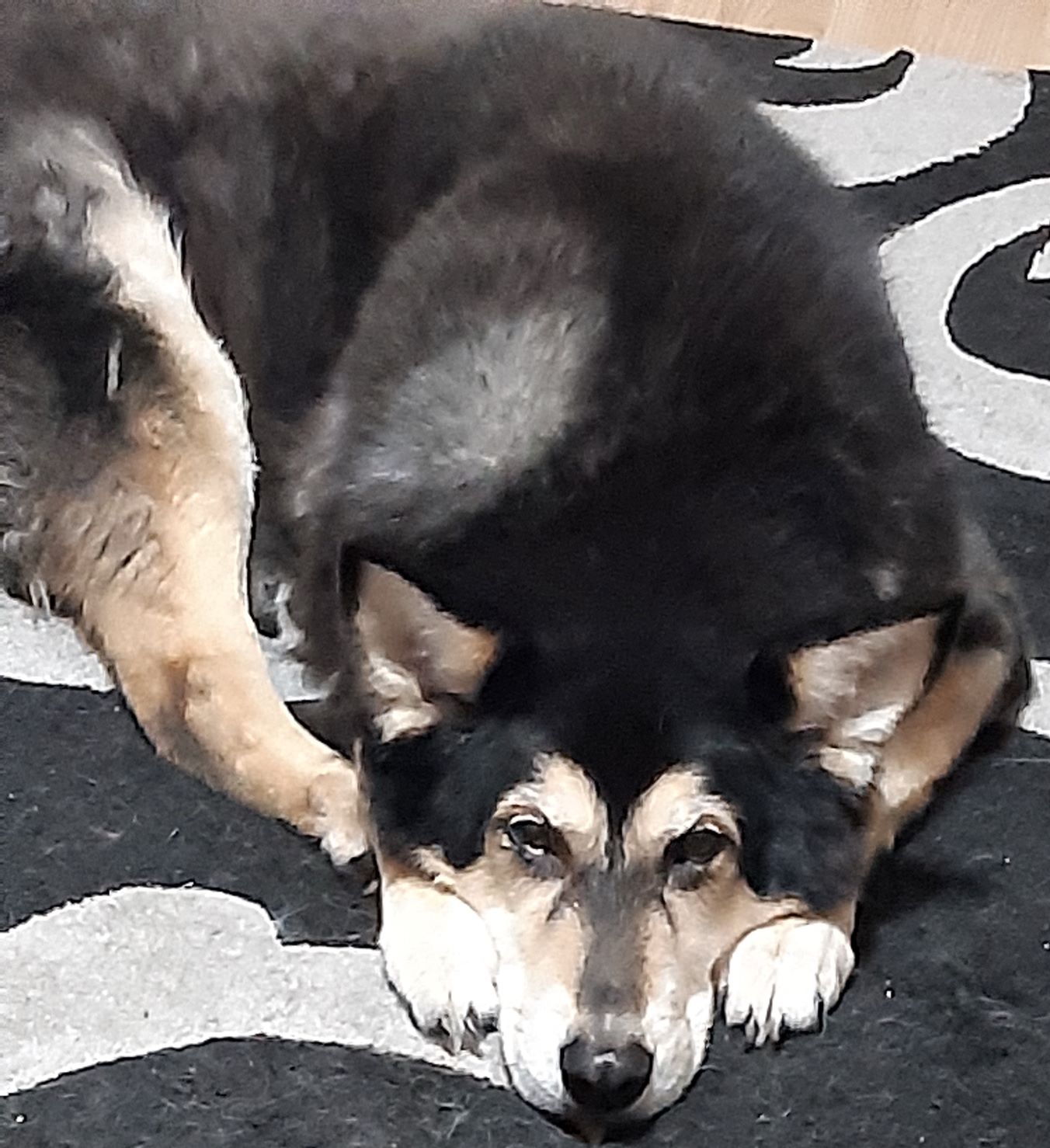
The image shows a German shepard/Husky mix, with cream-colored fur on the inside of her ears, her paez, her cheeks, and the sides of her muzzle. The rest of her fur is black, with white under-fur showing in some places. There's a black stripe down the top of her snout, and across her eyes, but her eyebrows are cream-colored. Her nose is between her front paws.


There will be one more post about this, on Monday. After that, I’ll be back to my regular schedule and content.

Until then, if you have any pets, give them a little extra love.

Tuesday. Also a video.

Tegan is doubly unable to post today. Grad school is –by design– a lot of work. The second part can be found in yesterday’s post, and tomorrow’s post. Also probably next Monday’s post. More on that tomorrow.

This video gets at some of why I feel disillusioned about activism. I’ve been trying to “speak truth to power” since I was a devout member of the Religious Society of Friends (Quakers), and felt called to activism.

As it turns out, power has never actually cared about truth, or those who speak it.

Not as long as the truth has no material power behind it.

If we want to build a better world, we need to understand why this world isn’t working.

Morbid Monday

Some days it’s all just too much, you know?

We’ve got so much information coming at us, and all of it seems to point to looming disaster. It feels like every year the odds get better that I’ll be one of the billions who might be killed by climate change and its effects in my lifetime. The labor action we’ve been seeing in the U.S. is encouraging, but at the same time, corporate/capitalist power seems to be greater than it’s ever been, and perfectly willing to destroy us all in the name of endless growth.

And yet we’re forced to keep pretending that everything’s normal, because that’s what the folks at the top want to believe. We have to keep paying rent, keep paying taxes to governments that refuse to do anything meaningful about the crisis, keep wasting our lives working for the profit of others.

And apparently we have to have war. It’s not enough that we’re destroying the foundations of our own existence, we also have to have bloodthirsty assholes always looking for the next war, apparently delighted that our system seems to depend on an endless market for weapons.

I’d say it’s never-ending, except that it seems to be driving us towards what looks to be a pretty conclusive – and unpleasant – finale. For all we have the material and intellectual resources we need to solve the technical aspects of this crisis, we don’t seem particularly close to resolving the political obstacles. We’re experiencing a convergence of crises, all of which seem to be the result of problems being put off for later. The inherent unsustainability of capitalism, economic and social injustice, the proliferation of horrific weapons, the relentless rise in pollution even in our own bodies, the destruction of ecosystems, the deliberate waste of resources, the warming climate – the list goes on, and on, and on.

But everything’s normal. Everyone has to keep paying someone richer than them for the right to live, to keep wealth and power flowing upwards to the top of this global pyramid scheme we’ve all been forced to join.

Sometimes it all just feels pointless. We’re all condemned, and we’re just going through the motions until the ax falls.

Of course, that feeling in itself is one of the lies we’re told – that all of this is just the forces of nature taking us where they will, rather than the result of deliberate policy, and of wars fought around the world to set us on this path. But the people who benefit the most from a population swamped in despair or apathy just have so much power, and so much willingness to use that power to prevent any change.

Humanity has seen massive political shifts in the past, and that’s cause for hope in itself, but the odds do not seem to be in our favor.

Obviously I’m not giving up, I just wanted to vent a little.

I also wanted to say that I’m not sure what the next couple weeks are going to look like for this blog. It looks like Raksha has reached the point where I have to schedule her death. She’s been a constant part of my life for almost 15 years, and I’m having some trouble coping. I hope you’ll all bear with me.

I think when we’re in the middle of bad times, it’s very easy to feel as though that’s how things will be for ever. Pessimism feels safer, and based on how we’ve been trained to see the world, it often feels more “rational” – If you always expect the worst, all your surprises will be pleasant wants, and all that.

But that’s an illusion that catches us. It’s like deciding to never have a pet, because you will inevitably mourn their passing. It’s like avoiding romance or friendship, because letting people into your life brings the possibility of pain.

It’s a path to never truly enjoying anything, lest the loss of that thing lead to pain. It’s not easy to accept that we’re going to hurt. It’s not easy to accept that we’re going to die, or that those we love will die, or will decide they will no longer be part of our lives.

But that risk is also what opens us up to those experiences that make it all worth it, from watching a puppy bounce through the tall grass, to watching an old dog gallop a couple paces for the joy of it, before returning to her normal slow shuffle.

There may come a time for each of us, when the pain is more than we can bear, but it’s worth remembering that that’s almost never today, and it’s usually not tomorrow either.

And there’s still a lot we can do to make life better for those around us.


If you like the content of this blog, please share it around. If you like the blog and you have the means, please consider joining my lovely patrons in paying for the work that goes into it. Due to my immigration status, I’m currently prohibited from conventional wage labor, so for the next couple years at least this is going to be my only source of income. You can sign up for as little as $1 per month (though more is obviously welcome), to help us make ends meet – every little bit counts!

Video: Why Electric Cars Won’t Save Us

I got sidetracked with a personal issue, so I’m going to have to hand you over to Youtube again. I think this video is a useful look at the electric car phenomenon, and gets at myths and fantasies that I’ve fallen for in the past.

I think electric cars do have a valid place in society, but not as anyone’s default transportation – more for localized transit from mass transit stops to areas not accessible, and for folks with disabilities that require them.

Research team develops new theory for studying mountain stream inhabitants

If we’re to have any chance of re-designing our society to exist in some form of stewardship of the ecosystems of this planet, we need as thorough and understanding of those systems as possible. I’ve written about bioindicators before, and I continue to like that perspective on studying climate change ecology. I also think it’s really neat when research comes along that tests how well theory applies to a particular set of circumstances. It’s moments like this that not only teach us new things, but give us hints about how to improve our search for knowledge.

A new tool can better assess an important but overlooked indicator of global warming: the variety of bugs, worms, and snails living in high mountain streams.

Water-based invertebrates are especially vulnerable when the climate swings from historic droughts to massive floods. Because they serve as food for other forms of alpine life, such as birds, bats, frogs and fish, ecologists worry about the insects’ ability to thrive.

Understanding how these small creatures are affected by climate change requires understanding where we ought to find them. Yet, classic ecological theories did not account for what a team of UC Riverside ecologists and their UC collaborators found on a recent survey of aquatic life in California’s Sierra Nevada.

As a step toward protecting them, the team applied a new theory for predicting biodiversity to high mountain streams. That theory, and the results of the field survey that gave rise to it, are now detailed in an article in the journal Ecological Monographs.

“We’ve come up with new ways of thinking about biodiversity in high mountain Sierra streams, because the old ways weren’t successful for us,” said Kurt Anderson, associate professor of evolution and ecology, and article co-author.

“Classic theories of stream ecology weren’t developed in the Sierras, so we are adapting a new set of ideas to better explain what we’re seeing up there,” Anderson said.

One such classic theory is the River Continuum Concept, which discusses how stream ecosystems function as they move from the stream sources down to bigger, more open rivers. According to the continuum concept, there should be a smooth gradient of change from high to low elevations. The team surveyed for stream biodiversity along a gradient, to test concepts like this one.

“We saw a change, but only partially and not for the reasons the theory said we should,” Anderson said. “For example, we found that lakes tended to interrupt the smooth change we were supposed to have seen.”

The UCR team observed that diversity of invertebrates generally increased in waters headed down and was lowest in steams situated immediately below lakes.

“We believe the lakes may have a disconnecting effect and are causing the downstream waterways to have to start over again in building diversity,” said Matthew Green, UCR ecologist and first author on the new paper.

The team also found a great variety of life forms in cold, isolated streams high up in the headwaters. Despite the general trend toward an increase of diversity moving downstream, sometimes, differences in species among isolated headwaters could be as great as those between upstream and downstream.

“These are the aquatic life forms that are at the edge of the precipice of climate change,” said Dave Herbst, a researcher from the Sierra Nevada Aquatic Research Laboratory, a UC Natural Reserve, and co-author on the paper.

The areas just below lakes were dominated by only a few species of invertebrates and insects with the ability to filter food particles. Other sites with mixed food sources had more species present.

The team recommends that interconnected systems of flowing water be protected from diversions, and from habitat damage caused by unrestrained land development. When waters are allowed to flow as they should, the number of resources available to creatures that live in them support higher diversity.

“That is what will permit these small, but crucially important life forms to thrive,” Anderson said. “Where intact habitats have been compromised, restoration efforts may be key to providing the entire ecosystem with resilience to the coming adversities of climate change.”

Also, for sentimental reasons, I like hearing about benthic macroinvertebrate research.

Sci Fri

Bad writing day. Instead you get part of a story series I haven’t worked on in a while:


There, ahead of the ship it lay! Brigadoon, enchanted refuge at the edge of space! Brigadoon, whose glimmering form lay ahead of us, given a misty halo by the Carina Nebula! And my hands did sweat as the ship docked, and my hands did tremble as I opened the door and stepped forward into a new world.

And then did Ariadne, dark of eye and dark of humor elbow me aside, saying,

“Could you not stand in the doorway? We’ve got shit to move here!”

Downcast I stood aside, and let our own lightning elemental sweep by, searing the world around her as she fled for the wires and conduits that welcomed her rage.

Then did Ebb Spacedragon, steadfast and true, roll forward in her gleaming carriage and lay a hand upon my shoulder. Strength flooded into me once more as she gazed upon me and said,

“I don’t think she even remembers her first time on a space station. Take your time, and if you’re still mad about it, put something snippy in the blog.”

And then she was gone, rolling down the jetty, followed by our chuckling comrades, and then by me. All of us were hushed as we entered the vast hall into which the jetties led, and the silence of ten thousand tons of empty rooms and hallways washed over us. My heart racing, I walked to the dormant fountain that ran the length of the room, slumbering in wait for us. I ran my hand along the smooth stone as I felt the vastness of our home spreading out around me.

Then pain! Fearful, stabbing pain, like needles in my hand. I cried out and leapt away from the cursed fountain, glancing back in terror at the source of my torment. There, crouching upon the stone was a dread beast, with daggers for teeth, and needles for claws, its tail lashing as its evil, slitted eyes gazed up at me.

“Gregg,” I cried. “Did you not swear your furry pets would leave me be? Were they not to remain in your room where they would not shed everywhere?”

“Sorry, Eagun, I just felt like they deserved a chance to explore too, yeah?”

“The pact,” said I, “has been broken, and now there will be much difficulty ere we can repair it!”

“You know damned well I never agreed to keep them locked in my quarters. Don’t worry, I’ll help with keeping the place fur-free. I don’t want any getting into the reactor center. You’d be surprised how much damage a decent tuft of fur can cause.”

“I dare say,” I replied, “but can it even be done? Some surprises are best left in the imagination!”

“I’ve had cats in space stations for years. We need positive pressure in the center anyway to keep any other contaminants out. Don’t worry. I know what I’m doing.”

And with that he was gone, his belongings floating after him.

“We all know what we’re doing!” cried Lisa. She approached the dread beast and sat on the fountain next to it. “That’s why we’re here, right? Eight, Ebb, and Gregg put a lot of thought into who it would take to run this place! I’m so excited to get started!” She held her finger before its fanged maw with reckless courage as it craned its neck up, and ran the side of its face along her long, silver nail. “Honestly Eagun, I know we haven’t known each other very long, but I can’t believe you don’t like Erwin! He’s such a friendly kitty!”

“Spare me your hollow cheer, Provisioner Tambridge. Not only will my first expedition into space be plagued by vicious beasts, but I will assuredly die in a fur-fueled conflagration, far from any world I’ve known.”

“Eag-”

“Why, O Why,” I sighed, “could our Mattersmith not have had sensible, furless, sessile pets like Good Anansi?”

“I like you, Eagun, but don’t drag me or my teachers into this,” said Anansi, and he crept through a doorway and down the hall to his new lair.

With grins suppressed and eyebrows raised, my companions followed, leaving me alone with my thoughts. The beast rolled before me in the fountain, displaying its fearsome armaments as it stretched out on its back.

“And so,” I said “Begins our new life on Brigadoon, Space Station in the Mists!”


If you like the content of this blog, please share it around. If you like the blog and you have the means, please consider joining my lovely patrons in paying for the work that goes into it. Due to my immigration status, I’m currently prohibited from conventional wage labor, so for the next couple years at least this is going to be my only source of income. You can sign up for as little as $1 per month (though more is obviously welcome), to help us make ends meet – every little bit counts!

Unions even help workers who aren’t unionized.

It has warmed my heart to see the wave of labor organizing in the United States, and the apparent blind panic it has caused among executives and their ilk. It’s long been pointed out that when a country has strong unions, it improves conditions even for those workers who aren’t organized, because bosses have a choice between offering jobs that look as good as what unions can get, or having their workers unionize.

I have to say, I didn’t expect to see this happening so quickly.

In this case, it’s a desperate attempt to prevent more Starbucks franchises from unionizing, but the basic pressure seems to be the same. The bosses know that they can’t do without workers, and that they can afford to pay a lot more, and treat people a lot better.

When the U.S. had no real organized labor movement, our rulers could get away with the pretense of benevolent leadership, but now there’s zero ambiguity. People who are worth thousands of millions of dollars only get to that point by viewing their right to every cent they can hoard as more important than anyone else’s right to anything.

Organize. Organize with your fellow tenants. Organize with your fellow workers. Throw out constructed social norms like not talking about your wages. The more power we get, the more they will fight back, but there’s no other path to a better world.

But do you really know how many bees you’ll need?

I don’t know the exact numbers, but a lot of folks hear about declining bee populations, and seem to assume that’s talking about European honey bees. While it’s good to protect and care for our honey bees, the vast majority of bee troubles in the world are suffered by the myriad of wild species, many of which are specialists, surviving by pollinating one plant in particular. That means that if one bee that almost nobody is aware of goes extinct, it could soon be followed by a plant, and any other organisms that depend on it. That has big implications for any efforts at ecosystem management, so I’m glad that this team of researchers was looking into what sort of bee community is needed for a healthy meadow:

Previous research on bees as pollinators tended to focus on specific plants — frequently crops — or on entire communities of plants as if they were a single entity. This tended to over-emphasize the contribution of the most common bees, especially since 2% of the bee species provided 80% of the pollination in crops. But no previous work had asked the basic question: How many pollinator species are needed to pollinate all the species in a given community of plants?

Roswell and his colleagues have now shown that the more plant species there are, the more bee species are needed for pollination. They found that the less common bees often visited specific plants others didn’t. Their findings shed new light on the role of rare species in ecosystems — critical to conservation efforts because rare species are most at risk of extinction from habitat loss, pollution, climate change and other factors. The study appeared April 13, 2022, in the Proceedings of the Royal Society B.

“Our work shows that things that are rare in general, like infrequent visitors to a meadow, can still serve really important functions, like pollinating plants no one else pollinates,” said Roswell, who studies diversity and pollination in the UMD Department of Entomology and is a co-author of the study. “And that’s a really good argument for why biodiversity matters.”

The researchers surveyed 10 plots in New Jersey that included wild meadows and seeded fields over one year. They observed bees from over 180 species making nearly 22,000 visits to over 130 different plant species. The team used these encounters to estimate the pollination services each type of bee provided to each plant, because a plant’s most frequent floral visitors are typically its most important pollinators.

Their analyses showed that an entire meadow community relied on 2 ½ to 7 ½ times more bee species for pollination than a single typical plant species does. They also found that the locally rare species accounted for up to 25% of the important pollinator species, and that number was greatest in meadows with the most plant diversity. This suggests that at larger scales like entire ecosystems, the number of locally rare species that are important for pollination is even greater.

“We were looking at meadows that might be a few acres in size,” Roswell said, “but a typical bee flies over a couple of square miles, which is a really large and complicated landscape filled with lots of different kinds of plants that flower at different times and are visited by different insects. At that scale, even more diversity of pollinators is likely to be important.”

As I’ve said before, I’ve largely given up on stopping climate chaos and mass extinction in my lifetime. My goal is to do what I can to slow it, and to help humanity survive long enough to get our act together. Part of that will need to be ecosystem management. As we work to survive a rapidly warming climate, we should invest whatever resources we can on helping the rest of the biosphere survive as well. Part of doing that is going to be understanding the general shape of a healthy ecosystem, so we can best decide how to help.