The Democrats are not blameless: Some thoughts about how we got here

It looks like we’re fast approaching an end to abortion rights in the United States, as guaranteed by the 1973 Supreme Court case known as Roe v. Wade. From what I can tell, overturning this case won’t just put reproductive rights in jeopardy, but a number of other civil rights as well. I might write more about that in the future, but there’s no shortage of commentary on the subject right now, and for today I wanted to talk about what it looks like when the people in power actually want to deliver on their promises.

It’s becoming increasingly clear to me that the Democratic Party’s inability to deliver on their progressive promises isn’t just a matter of bumbling incompetence. There’s probably an element of that, but to me it looks like they don’t actually want to deliver, when it comes to left-wing policies. Some individuals within the party probably do, but the leadership? Not so much. They don’t do any of the things I’d expect them to do, were that the case.

The Republican Party are to blame for all of the vicious and harmful things they do, but not only do they represent a minority of the country, everybody knows they represent a minority, and they’re fairly often in the minority in government as well. When they are in government, the GOP seems to be far more effective at accomplishing their goals than their counterparts. I think we would be wise to look at how they do things, and take pointers about what can be done in pursuit of our goals, and on what it looks like when political leaders actually want to deliver on their promises.

Not everything will work as well for the left as it does for the right. Conservatives basically “win” every time they delay or roll back a change. They don’t care about the people being hurt by the status quo, so there’s no real sense of urgency about anything except stopping change. That means that it’s far, far easier for them to play a long game, and build up their political power through state and local politics. Conservatives also tend to push the interests of those in power, which means financial support, and an expectation of gentle treatment by the authorities. After the insurrection attempt on January 6th 2021, I saw some of the more revolution-hungry folks in the online left saying that that’s what we should be doing. The most common rebuttal was that there’s no way law enforcement would have such a gentle response to an insurrection attempt by a left-wing mob. We face different obstacles, so it stands to reason that we’ll need different tools at least some of the time.

That said, the GOP shows us what it looks like when a party actually has goals. I’ve said before that I feel the Democrats – or at least the party leadership – view politics as a sort of game. What seems to matter most to them is that the rules be followed, and that the two sides be as evenly matched as possible. Even if they might like to see some progressive change, it’s not something they’re willing to fight for. The Republicans, on the other hand, actually want a lot of the stuff they say they want, and so they do everything they can to get it. When they followed through on their promised Muslim ban, the GOP didn’t bother waiting for some committee to tell them what the courts would probably say, they just wrote the ban and tried it, knowing it would probably be shot down.

Knowing that there would be no penalty for trying.

It was shot down, they adjusted it to fit what the ruling said and tried again. That was shot down, and they adjusted and tried again. Rather than caring about “doing it right”, or playing by the rules, they have a goal in mind, and try everything they can think of to achieve it. The Democratic party only seems to be able to do that when it comes to things like funding the Pentagon. There’s a degree to which it’s useless to speculate on their “real” motivations, but they certainly don’t act as if any of the progress they promise is a real priority, and they haven’t acted like that at any point in my life.

I don’t know whether we have any shot at getting people like Biden or Pelosi to actually fight for the things they claim to want, but I think this is at minimum a good thing to consider when deciding whether they’re doing a good job. It’s been 49 years since Roe v Wade, and there has been a relentless effort – including terrorism – to end the right to abortion. Everyone knew this was coming, and yet for all the times the Democrats held power, and for all their endless campaigning about being the True Protectors™ of reproductive rights, they never followed through. They never actually made the right to abortion law.

And it sure as hell looks like they never actually tried.

Nobody in the party leadership is going to be directly hurt by this. They’re all rich. They’ll all be able to get abortions and any other reproductive care they need, and getting it isn’t going to cause them any financial or legal hardship. The same was true during the “Obamacare” fight – the people who took single-payer and the public option off of the table before negotiations started were never at risk of losing their access to healthcare. It’s not hard to see what it looks like when politicians actually want to achieve their stated goals, and I see no real evidence that anyone in the leadership of the Democratic party ever wanted anything more than endless fundraising off of the precarity of rights they never really intended to secure. It sure seems like they knew they were the only option for people who care about reproductive rights, and rather than deal with the problem, they chose to hold it over people’s heads for votes and contributions.

Everything about this situation makes me angry.


If you like the content of this blog, please share it around. If you like the blog and you have the means, please consider joining my lovely patrons in paying for the work that goes into it. Due to my immigration status, I’m currently prohibited from conventional wage labor, so for the next couple years at least this is going to be my only source of income. You can sign up for as little as $1 per month (though more is obviously welcome), to help us make ends meet – every little bit counts!
Tegan Tuesday: Congrats! You’re poor now!

Every January since 1981, the US Department of Health and Human Services updates the poverty guidelines (aka the poverty line) based on the Consumer Price Index for All Urban Consumers (CPI-U). The poverty guidelines outline the eligibility criteria for a number of US assistance programs such as Medicaid or SNAP. The poverty thresholds were initially created in 1963 by Mollie Orshansky of the Social Security Administration (SSA). To quote from Health and Human Services,

Orshansky used a factor of three because the Agriculture Department’s 1955 Household Food Consumption Survey found that for families of three or more persons, the average dollar value of all food used during a week (both at home and away from home) accounted for about one third of their total money income after taxes.

In May 1965, the U.S. Office of Economic Opportunity adopted Orshansky’s poverty thresholds as a working or quasi-official definition of poverty. In August 1969, the U.S. Bureau of the Budget (predecessor of the Office of Management and Budget) designated the poverty thresholds with certain revisions as the federal government’s official statistical definition of poverty.

Because of this metric, it’s assumed by the Powers That Be that approximately one third of household income is spent on rent, one third spent on food, and the remaining third spent elsewhere – that these ratios have remained unchanging for nearly a century. These are the same metrics that influence whether or not you can rent an apartment based on your income – property management often won’t allow you to spend more than a third of income for rent. Obviously there are ways and means around every system, and I mostly dealt with that in my own life by working with small scale landlords and trying to keep my rent spending below half of my income. When I initially became the primary breadwinner of my household, Abe and I were living in the Boston area, and so our rent was close to 75-80% of my income. And yet, we were ineligible for assistance, as the poverty line for a two-person household was $16,460 a year in 2017 — aka, less than our cheap Boston apartment by approximately $400. We could barely make rent, but we weren’t officially poor as the US government defined it. Note: this and all other statistics used in this article are based off of the rates for the contiguous US – Alaska and Hawai’i have higher numbers to account for their much higher living costs.

The CPI-U is based on the record of approximately 80,000 items each month gathered by thousands of data collectors. There are eight major spending categories (food and beverages; housing; apparel; transportation; medical care; recreation; education; other) and rates of increase can be sorted out by category, by region, or a few other divisions. My concerns with it’s value, as it’s currently set up, as a metric for poverty or government assistance programs can be quoted directly from the Bureau of Labor Statistics website:

One limitation is that the CPI-U may not be applicable to all population groups. For example, the CPI-U is designed to measure inflation for the U.S. urban population and thus may not accurately reflect the experience of people living in rural areas. The CPI-U does not produce official estimates for the rate of inflation experienced by subgroups of the population, such as the elderly or the poor. Note that we do produce an experimental index for the elderly population that is available upon request; however, because of the significant limitations of this experimental index, it should be interpreted with caution.

Another limitation is that the CPI-U cannot be used to measure differences in price levels or living costs between one area and another as it measures only time-to-time changes in each area. A higher index for one area does not necessarily mean that prices are higher there than in another area with a lower index. Instead, it means that prices have risen faster in the area with the higher index calculated from the two areas’ common reference period. Additionally, the CPI-U is a conditional cost-of-living measure; it does not attempt to measure everything that affects living standards. Factors such as social and environmental changes and changes in income taxes are beyond the definitional scope of the index and are excluded. [source https://www.bls.gov/cpi/questions-and-answers.htm]

Because these are self-reported spendings from average, (I assume) middle-class Americans, they almost certainly don’t accurately reflect the spending habits and needs of the demographics that would be eligible for assistance! This is frustrating in a number of ways, and while I can certainly spitball reasons for why those demographics aren’t represented, it doesn’t change the fact that this seems to a problem built into the system. The spending habits of the non-poor was one of the reasons why the UK developed the Vimes Boots Index, after all. But unlike the UK system, I see no evidence that the US reports are built around luxury goods. They are just likely to be middle class. Apparently it was only in 2019 that telephone surveys were replaced as the primary means of data collection, so just think about who was likely to answer phone surveys on spending habits in the past decade – that’s who’s spending the index was based around.

As an additional contrast to the UK, I was pleasantly surprised to find that rent was one of the many things that was included as a metric for the CPI-U. According to the BLS, the CPI Housing survey covers approximately 0.11% of all rental properties in the US, with 32,000 units in the survey. I initially felt that was an outrageously small sample size, but a friend with more experience in population-sized datasets assures me that it’s a fairly normal ratio, so long as it is truly a representative sample. I was unable to find any clear details about how the housing survey is spread across the US, so please let me know if you have any ideas or further information! But I will optimistically assume that these rental properties are a true representative sample and are fairly spread across the US.

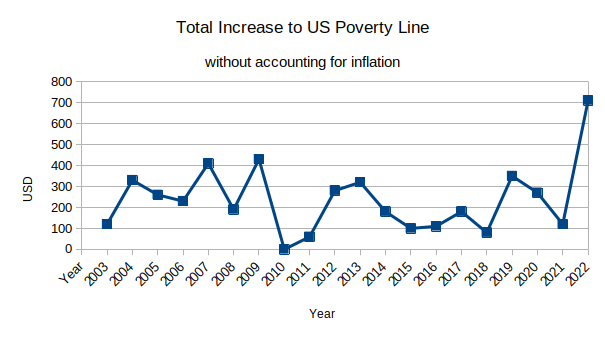
But rejoice! Look at how much the poverty line has increased this year! This means that more Americans are eligible for benefits and are able to take advantage of this opportunity. The higher the cut-off rate for government assistance, the more households that are eligible.

This image is a graph showing the total increase to the US poverty line, without accounting for inflation, since the year 2003. The increase varies from year to year, with the one from 2021 to 2022 being obviously larger than any other year.

This year’s cut off income for a single person household is $13,590 a year, or $1,132.50 per month. That is still outrageously (and intentionally) low. (Note: I did track the rate of change across multi-person households as well, but they follow roughly the same path as that of a single person, so I have simplified the data for ease viewing.) This surely is reflective of the current state of affairs, as the CPI-U takes into account the recent food hikes and the energy price increases and rents that always, always go up (albeit these are based on four-year old data, as that’s how long it takes to process the CPI-U). This $13.5k must be similar to the poverty rate of previous years. Factoring for inflation, however, actually tells a very different story.

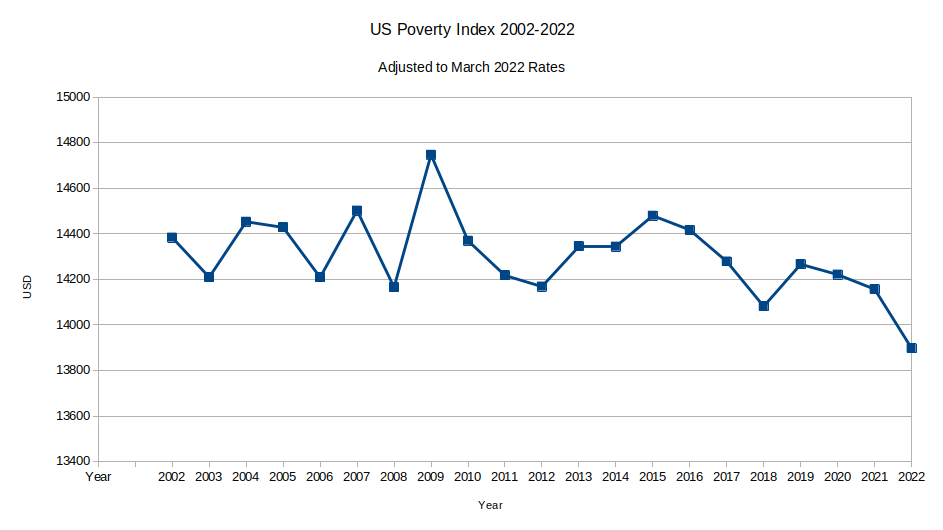
The image is a graph showing the US poverty index from 2002 to 2022, adjusted for March 2022 rates. Since the high point in 2009 at just under 14800, the overall trend has been downward, with a slight recovery in the mid 2010s

This graph shows the income rates for a Single Person Household as given by the Office of the Assistant Secretary for Planning and Evaluation and run through the inflation calculator provided by the US Bureau of Labor Statistics. So each number, assigned in January of the given year, has been factored to represent the spending power of the USD in March 2022. And allowing for inflation, fewer and fewer American households are eligible for government assistance. This assistance could be housing aid, cheaper health insurance, or the various programs lumped together as ‘food stamps’. The only saving grace for poor Americans is that wages have also stagnated over the past two decades, so many people who were near the cut-off point might have slipped into eligibility without having to lose a dime.

It’s not a lie that this year’s poverty index has risen more than any other year in the past twenty – the average increase (not accounting for inflation) is 2.17% and this year’s is a 5.51% from 2021. But inflation has completely overrun everything else, making it harder and harder for the average American to stretch their dollar even as far as it did two years ago. I think it should go without saying, but just in case, I don’t think that anyone should be struggling to put food on the table and keep a roof over their heads.

The past decade has involved a great deal of unlearning my own shame and stigma with being labeled ‘poor’. I am poor – I grew up poor, and for most of my adult life, I have been poor. I have known people with less than me, but I have never been so comfortable as to not worry about food insecurity. It’s probably pretty clear from the guest posts I have done here, but ready access to affordable and healthy food is one of my biggest concerns for the planet. While the new poverty line won’t bring help to as many American households as it should, hopefully it will have an impact on more than it did previously. If you or someone you know is eligible for assistance based off of the new numbers, please start the process to apply. It absolutely sucks – US food and housing assistance have some of the worst bureaucratic hurdles to jump over. But for anyone making under $20k a year, every little bit helps. And even those of us who aren’t near the cut-off point – now’s a good time to start investing in household food storage and larger food networks. Exiting the pandemic, we all could use a little social activity. Why not make it a supper club or a regular potluck? This is social and network building, while also not straining any given household’s resources. More and more people are going to be considered ‘poor’ rather than ‘comfortable’ or even simply ‘middle-class’, and the sooner we can build solidarity among the working poor, the sooner we can build enough momentum to change the system.


If you like the content of this blog, please share it around. If you like the blog and you have the means, please consider joining my lovely patrons in paying for the work that goes into it. Due to my immigration status, I’m currently prohibited from conventional wage labor, so for the next couple years at least this is going to be my only source of income. You can sign up for as little as $1 per month (though more is obviously welcome), to help us make ends meet – every little bit counts!

Beavers encounter Uncanny Valley. Beavers do not care.

One of my favorite things about field biology is the kinds of innovation it tends to require. There’s a degree to which this is true of all fields of science – if you’re always pushing into the unknown, you’re always going to need new tools for tasks that didn’t exist before. That’s why a disproportionate number of chemists are also glassblowers, for example. When it comes to studying animals, however, you have to account for the fact that they all have their own minds, their own opinions, and their own take on how to respond to a given situation. The right tool for the right job can range from using condoms to collect sea turtle poop, to specialized machinery, as we’re about to see.

When I had my brief experience studying iguanas, one trick I discovered by accident was that by bobbing my head at a large male, I was able to get into some sort of contest that overrode his reflex to flee. For myself, I can’t really imagine that if a giant creature approached me and said, “You lookin at me funny?” my reaction would be to get into a shouting match with it. That said, there are a lot of things that animals seem to just take in stride that would very much creep me out.

Take, for example, these robotic “spy beavers”:

I’m sorry, but if I saw a human version of one of those just hanging around my house, I would not just go about my business. That said, big rodents seem to be pretty chill creatures, and I absolutely love the footage these people got. I’ve always found beavers to be one of the neatest species on the planet, and very much want to have my own version of a beaver lodge with an underwater entrance.


If you like the content of this blog, please share it around. If you like the blog and you have the means, please consider joining my lovely patrons in paying for the work that goes into it. Due to my immigration status, I’m currently prohibited from conventional wage labor, so for the next couple years at least this is going to be my only source of income. You can sign up for as little as $1 per month (though more is obviously welcome), to help us make ends meet – every little bit counts!

Video: What is (and is not) anti-fascism?

Way back in 2017, Abigail Thorn published The Philosophy of Antifa – an hour-long breakdown of what “antifa” means, what it doesn’t mean, and what motivates those who make antifascist action a priority. It’s an excellent video, and I highly recommend it to everyone. Now, Leon of Renegade Cut has published his own video on anti-fascism. It delves into the history of opposition to fascism, going back to Italian WW1 veterans organizing to oppose Mussolini.

More importantly, it looks at what caused various anti-fascist resistance movements of the past to fail – very often too long of a delay before organized opposition. This is a sobering and vitally important look at history and at our current conditions. If long videos are hard for you, I recommend treating it like a podcast or an audiobook – I often listen to this sort of thing while I’m doing dishes or playing a video game. I wish this stuff was just a matter of niche historical interest, but unfortunately it’s still very relevant to the challenges we face today, so it’s my opinion that everyone should check this out:

The history of climate science, for a denier in my comments.

Someone apparently objects to my comment moderation policy, and seems to have that delightful conservative reflex of trying to make people they disagree with angry. I’m posting this not to put a target on the commenter, but because he serves as a useful reminder that there are still a lot of people out there who don’t know this stuff. I would say that it is partly their own fault, but not entirely. We know for a fact that the fossil fuel industry has known about this for decades, and that they responded by pouring millions of dollars into a decades-long propaganda campaign. The amount of misinformation on this issue has been staggering. In my opinion those responsible are guilty of crimes against humanity. That said, I don’t think everyday deniers are entirely blameless.

At this point, I feel that ignorance on such a big issue – and it’s big even if you’re in denial about the science – is at least partly a choice. All of this information is publicly available. Almost all of it I learned after I graduated college. Getting a bachelor’s degree in biology definitely gave me the tools to better evaluate the science for myself, but any scientist knows that that’s nowhere close to expertise in any branch of science. I’m more trained than a “layman”, but I don’t think that’s saying much.

Even without that training, the world is full of people who have explained this stuff in a myriad of different ways. For whatever reason, those explanations haven’t gotten through to this particular commenter, so I figured I’d put in my oar.

“Bigots, doomers, and trolls will have their comments edited or deleted. ”
Guess I should do my best to be considered one of those. BTW I consider YOU a ‘doomer’. It isn’t that I do not ‘believe’ in ‘climate change’. Rather I recognize no reason why it should not – unpredictably, but likely conforming to past patterns of experience in large part. It is fun to hear you refer to disbelief in anthropogenic global warming / climate change as a matter for a ‘conspiracy theory’ – although when government levies a tax it is no secret what their theft is about. Nor is it especially credible that man should be responsible for change decades hence. Such a projection is still the speculation it ever was. Not even the I.P.C.C. calls its computer emulation of the function of crystal balls factual – though if one is silly enough it can be called credible. There is no data – nor can there be. Things which have not happened remain unmeasurable..

I tend to allow a little leeway for discussion, disagreement, and so on. My problem comes when we enter the realm of advocacy, or when we start going in circles. The “doomers” in question are those who think our extinction due to climate change is inevitable and near, and therefor we shouldn’t bother doing anything about it. It’s the flip side of those who say the problem isn’t happening, so we shouldn’t do anything about it.

As to your claim that it’s “not especially credible”, I’m afraid the only two reasons why you’d say that are dishonesty or ignorance. I’ll assume – for now – that it’s ignorance, and we’ll see where that goes. To begin with, you seem to think that the field of climate science is a relatively new one.

It’s not.

We’ve known how CO2 interacts with heat in our atmosphere since 1856. When I say “known”, I mean that Eunice Foote was able to measure it then. Her work has since been confirmed countless times by countless people, and versions of it are still used as science fair projects to this day.

The first prediction that CO2 from the burning of fossil fuels would raise this planet’s temperature was in 1896, by Swedish chemist and physicist Svante Arrhenius. This wasn’t just a guess. He and many others had found evidence of past ice ages, and were studying what could cause such a thing to happen, when another scientist approached him with his evidence that carbon dioxide from burning coal was actually accumulating in the atmosphere. The prediction was made not based on random guesswork, but based on the measurable physical properties of carbon dioxide, and the measurable rate of increase in the atmosphere.

That was 126 years ago, also known as 12.6 decades.

When Arrhenius made the prediction, he calculated it would take around 3,000 years for the climate to warm enough for palm trees to grow in Sweden, and he was pretty happy about the idea. That was based on fossil fuel consumption in the 1890s, you understand. The rate of consumption has gone up a bit since then.

Already you can see that this isn’t a prediction NOW about something happening in the future, so much as a prediction from the past that we’ve checked over and over and over for over a century, and that has turned out to be accurate, no matter how many times we run the numbers.

This is what science is. It’s a method for taking information we know, and using it to make predictions, which are then tested.

The field of climate science continued after Arrhenius’ work, of course. The term “climate change” goes back to the 1930s, if memory serves, but it was in the late 1950s when things really kicked off. That’s when Charles Keeling started making some noise about what his CO2 measurements at Mauna Loa observatory were showing. This graph is known as “Keeling Curve“:

1958 is also when the first televised warning about climate change appeared on Bell Telephone Science Hour:

I want to emphasize, again, that all of this was literal decades before that warming was measurable. This is not something scientists came up with after the fact to explain warming that was being seen, it’s something scientists successfully predicted decades before it happened. In the case of Arrhenius, he predicted it and then died of old age decades before it happened. It was also – in case I need to tell you this – decades before computer models or the IPCC existed.

The creation of the IPCC was the moment when governments realized that they should at least look like they were doing something about this problem. That’s what the “I” of that acronym is – “Intergovernmental”.

That came almost a century after the first prediction of global warming caused by human activities, and it came because the evidence had already been overwhelming for years

This is no different from Eratosthenes measuring the circumference of the earth in 276 B.C.E., literally thousands of years before we were able to actually circumnavigate it whenever we wanted, or even go into space and take a look from the outside. It’s no different from our ability to predict that a dramatic increase in the number of new smokers THIS year, will lead to a measurable increase in cases of lung cancer a few decades down the line.

Every aspect of your life involves technology that came from predictions made decades or centuries before those predictions were realized. This is not the divine revelation of prophecy, it’s just a basic understanding of the material realities of our world.


If you like the content of this blog, please share it around. If you like the blog and you have the means, please consider joining my lovely patrons in paying for the work that goes into it. Due to my immigration status, I’m currently prohibited from conventional wage labor, so for the next couple years at least this is going to be my only source of income. You can sign up for as little as $1 per month (though more is obviously welcome), to help us make ends meet – every little bit counts!

Have you enjoyed this pandemic? Because climate change could soon bring us the next one

One of the warning signs of a false conspiracy theory is that it has an answer for everything. Any evidence against is just proof that the conspiracy is bigger than they thought. This is not a universal rule, of course, but it’s well-known enough that I’ve seen it cited to accuse both the theory of evolution and the theory of anthropogenic global warming of being conspiracy theories.

Certainly, there have been conspiracies associated with climate change – deliberate efforts to mislead the public, and to prevent real action – but the problem here is a category error. People who make this argument are applying a general rule about theories explaining human activities to scientific theories explaining observed phenomena, backed up by reproducible research. That said, I really sympathize with those who have that reaction to climate change. What we’ve done to our planet is happening at a scale far beyond our normal frame of reference, and it’s affecting every part of the surface of this planet. That means that no matter what happens, it really is reasonable to ask, “how did climate change influence this?”

That goes for political and cultural shifts, volcanoes, and yes – pandemics:

As the Earth’s climate continues to warm, researchers predict wild animals will be forced to relocate their habitats — likely to regions with large human populations — dramatically increasing the risk of a viral jump to humans that could lead to the next pandemic.

This link between climate change and viral transmission is described by an international research team led by scientists at Georgetown University and is published April 28 in Nature(“Climate Change Increases Cross-species Viral Transmission Risk,” doi:10.1038/s41586-022-04788-w).

In their study, the scientists conducted the first comprehensive assessment of how climate change will restructure the global mammalian virome. The work focuses on geographic range shifts — the journeys that species will undertake as they follow their habitats into new areas. As they encounter other mammals for the first time, the study projects they will share thousands of viruses.

The scientists say these shifts bring greater opportunities for viruses like Ebola or coronaviruses to emerge in new areas, making them harder to track, and into new types of animals, making it easier for viruses to jump across a “stepping stone” species into humans.

“The closest analogy is actually the risks we see in the wildlife trade,” says the study’s lead author Colin Carlson, PhD, an assistant research professor at the Center for Global Health Science and Security at Georgetown University Medical Center. “We worry about markets because bringing unhealthy animals together in unnatural combinations creates opportunities for this stepwise process of emergence — like how SARS jumped from bats to civets, then civets to people. But markets aren’t special anymore; in a changing climate, that kind of process will be the reality in nature just about everywhere.”

You may remember some of the more charming representatives of the U.S. population making racist jokes about the habits of Chinese people, following reports about the origin of the virus. It sort of seems like the “lab leak” theory has gotten more popular of late, but the racism hasn’t gone anywhere. The lesson we should take from the COVID-19 pandemic is similar to the lessons of this research. Humans going into new habitat in search of resources brings us in contact with new diseases, some of which might infect us. Likewise, the rising temperature will force animals out of their historic homes, making new diseases more likely to bring themselves to us.

Of concern is that animal habitats will move disproportionately in the same places as human settlements, creating new hotspots of spillover risk. Much of this process may already be underway in today’s 1.2 degrees warmer world, and efforts to reduce greenhouse gas emissions may not stop these events from unfolding.

An additional important finding is the impact rising temperatures will have on bats, which account for the majority of novel viral-sharing. Their ability to fly will allow them to travel long distances and share the most viruses. Because of their central role in viral emergence, the greatest impacts are projected in southeast Asia, a global hotspot of bat diversity.

“At every step,” said Carlson, “our simulations have taken us by surprise. We’ve spent years double-checking those results, with different data and different assumptions, but the models always lead us to these conclusions. It’s a really stunning example of just how well we can, actually, predict the future if we try.”

As viruses start to jump between host species at unprecedented rates, the authors say that the impacts on conservation and human health could be stunning.

“This mechanism adds yet another layer to how climate change will threaten human and animal health,” says the study’s co-lead author, Gregory Albery, PhD, a postdoctoral fellow in the Department of Biology in the Georgetown University College of Arts and Sciences.

“It’s unclear exactly how these new viruses might affect the species involved, but it’s likely that many of them will translate to new conservation risks and fuel the emergence of novel outbreaks in humans.”

Altogether, the study suggests that climate change will become the biggest upstream risk factor for disease emergence — exceeding higher-profile issues like deforestation, wildlife trade and industrial agriculture. The authors say the solution is to pair wildlife disease surveillance with real-time studies of environmental change.

“When a Brazilian free-tailed bat makes it all the way to Appalachia, we should be invested in knowing what viruses are tagging along,” says Carlson. “Trying to spot these host jumps in real-time is the only way we’ll be able to prevent this process from leading to more spillovers and more pandemics.”

“We’re closer to predicting and preventing the next pandemic than ever,” says Carlson. “This is a big step towards prediction — now we have to start working on the harder half of the problem.”

“The COVID-19 pandemic, and the previous spread of SARS, Ebola, and Zika, show how a virus jumping from animals to humans can have massive effects. To predict their jump to humans, we need to know about their spread among other animals,” said Sam Scheiner, a program director with the U.S. National Science Foundation (NSF), which funded the research. “This research shows how animal movements and interactions due to a warming climate might increase the number of viruses jumping between species.”

That last paragraph is interesting to me. For one thing, it’s an entirely understandable bid to get folks outside the scientific community to pay attention. Sensationalism seems to be all that works these days, and that works well when the material in question is sensational by nature.

For another thing, I think that the focus on the direct threat to humans hides at least a couple threats that are less obvious. The one that concerns me is the risk of diseases spreading not just to humans, but to the species we rely on for food.

That’s right! This was a secret agriculture post! I tricked you, and now you’re invested in hearing the final point!

Which is that while pandemics affecting us are scary and dangerous, we should also be very worried about pandemics affecting our crops. We depend on a terrifyingly small number of species for most of our food, and they’re no less vulnerable to disease than we are. I’m not sure how much we can do about this aspect of the problem, beyond “deal with climate change”, but I can think of a couple things.

First, obviously, I still want to move food production indoors. That doesn’t guarantee crop safety, but it certainly helps limit what the crops are exposed to. Second, as we invest in the infrastructure and power sources we need, we should also invest in diversifying our food sources. I guess this could be based on local taste and decisions, but I think that governing bodies ought to actually spend money on it, as a partial defense against pathogen-related crop failures.

The scientists who warned about the dangers of a pandemic were largely ignored, and hundreds of thousands of people died because of it. That number is dwarfed by those killed by ignoring climate scientists, but in both cases, the fact that we knew better (as a species) – the fact that we could have heeded warnings and done better – means that we still can. We can do better, and the path we’re on isn’t one we’re required to follow to destruction.

We can set a new course.


If you like the content of this blog, please share it around. If you like the blog and you have the means, please consider joining my lovely patrons in paying for the work that goes into it. Due to my immigration status, I’m currently prohibited from conventional wage labor, so for the next couple years at least this is going to be my only source of income. You can sign up for as little as $1 per month (though more is obviously welcome), to help us make ends meet – every little bit counts!

A thought on the so-called “work ethic” of billionaires

While most billionaires – at least the ones publicly visible – try to establish some form of a “rags to riches” narrative about themselves, I think the most common way the wealthy justify their wealth is by claiming a superior work ethic. In general, people have a low opinion of those who were born into wealth. They’re seen – rightly – as being out of touch with reality. Claiming that you work unrealistically hard is a way of claiming legitimacy – your obscene wealth is just because you work that much harder, and you’re that much smarter.

This is why we get fawning articles about the habits of the rich and famous, and about how everyone in the ruling class is a genius, even if they seem to be utterly clueless. It’s assumed that we live in a meritocracy, and that must mean that the wealthier and more powerful a person is, the more competent they are – otherwise, how did they get all that wealth and power?

It’s bullshit. Being obscenely rich means you get to define what counts as “work”, and nobody’s going to challenge it. I’d say we should be grateful to people like Musk and Trump for demonstrating that the “meritocracy” is a myth, but a disturbing number of people seem to think their bullshit is caviar.

Well, fuck. My blog’s name is relevant to current events.

I should know better by now than to promise a blog post before it’s done. My brain has always taken that sort of thing as a challenge to its ability to be useless. Today was unexpectedly difficult, so the more in-depth post will have to wait. I don’t know why my brain will cooperate on one project and not another, but I’ve yet to figure out a reliable way to deal with that problem. Shouldn’t be long now, I’ve only been trying for two or three decades. Unfortunately, my alternative offering isn’t likely to taste much better than a piece about treatment of refugees. The biggest downside of running a climate-focused blog in this era is that the news is mostly bad.

Global heating is causing such a drastic change to the world’s oceans that it risks a mass extinction event of marine species that rivals anything that’s happened in the Earth’s history over tens of millions of years, new research has warned.
Accelerating climate change is causing a “profound” impact upon ocean ecosystems that is “driving extinction risk higher and marine biological richness lower than has been seen in Earth’s history for the past tens of millions of years”, according to the study.
The world’s seawater is steadily climbing in temperature due to the extra heat produced from the burning of fossil fuels, while oxygen levels in the ocean are plunging and the water is acidifying from the soaking up of carbon dioxide from the atmosphere.
This means the oceans are overheated, increasingly gasping for breath – the volume of ocean waters completely depleted of oxygen has quadrupled since the 1960s – and becoming more hostile to life. Aquatic creatures such as clams, mussels and shrimp are unable to properly form shells due to the acidification of seawater.

I’m sorry, what was that? Did you say oceanic oxygen levels are plunging? Who’d have thought? It should still be a long time before the drop in oxygen translates to major hydrogen sulfide buildup, but given that seafood makes up a good chunk of humanity’s protein intake, maybe this is something to which we should be responding? Maybe we should be taking action now for the protein shortage that we know is coming.

Just a thought.

Another thought, if you’ll indulge me: It seems like a bad thing when something called The Great Dying becomes relevant to current events:

All of this means the planet could slip into a “mass extinction rivaling those in Earth’s past”, states the new research, published in Science. The pressures of rising heat and loss of oxygen are, researchers said, uncomfortably reminiscent of the mass extinction event that occurred at the end of the Permian period about 250m years ago. This cataclysm, known as the “great dying”, led to the demise of up to 96% of the planet’s marine animals.

I think it’s worth noting here that this extinction event was not limited to the ocean. The ocean seems to have been first, but by the end of it, 70% of land-based vertebrates were also dead. That’s not because all those animals got their food from the ocean, but rather because of the ecological effects of both the same conditions that killed the oceans, and the fallout from that death.

We are quite literally terraforming our planet, in a way that will make more and more of it hostile to humanity and the species on which we depend. Our only hope is to try to take control of a train that was beginning to get out of control even as we learned how to build actual trains.

“Even if the magnitude of species loss is not the same level as this, the mechanism of the species loss would be the same,” said Justin Penn, a climate scientist at Princeton University who co-authored the new research.
“The future of life in the oceans rests strongly on what we decide to do with greenhouse gases today. There are two vastly different oceans we could be seeing, one devoid of a lot of life we see today, depending on what we see with CO2 emissions moving forward.”
Truly catastrophic extinction levels may be reached should the world emit planet-heating gases in an unrestrained way, leading to more than 4C of average warming above pre-industrial times by the end of this century, the research found. This would trigger extinctions that would reshape ocean life for several more centuries as temperatures continue to climb.
But even in the better case scenarios, the world is still set to lose a significant chunk of its marine life. At 2C of heating above the pre-industrial norm, which is forecast as likely even under current climate pledges by the world’s governments, around 4% of the roughly two million species in the oceans will be wiped out.
Fish and marine mammals that live in polar regions are most vulnerable, according to the study, as they will be unable to migrate to suitably cooler climes, unlike tropical species. “They will just have nowhere to go,” said Penn.
The threat of climate change is amplifying the other major dangers faced by aquatic life, such as over-fishing and pollution. Between 10% and 15% of marine species are already at risk of extinction because of these various threats, the study found, drawing upon International Union for Conservation of Nature data.
John Bruno, a marine ecologist at the University of North Carolina who was not involved in the study, said the new research appeared “sound” but it differed from previous studies on the topic that suggest species will mainly disperse to new areas rather than be completely snuffed out.
“It’s very different from what most prior work has developed. But that doesn’t mean they are wrong,” Bruno said. “I think this new work is challenging some of our current assumptions about the geographic patterns of looming extinction in the ocean.”
Bruno said that while mass extinctions are likely from extreme heating in the future, the current impacts from climate change and other threats should be concerning enough for policymakers and the public.
“Personally, I’m a lot more worried about the ecosystem degradation we’re already seeing after less than 1C of warming,” he said.
“We don’t need to look to a world so warmed over humanity has been wiped out – we’re already losing untold biodiversity and ecosystem functioning with even the relatively modest warming of the last 50 years.”

I think it’s worth remembering that when it comes to climate change, “truly catastrophic” means “all humans will probably die”, which comes some time after “so many people will die that the 20th century looks pleasantly peaceful by comparison”.

Despite the fact that a number of feedback loops are almost certainly adding to the momentum of this climate shift, this is not an on/off situation. We can do things to take away from that momentum, and to get people – and possibly even some ecosystems – out of the tracks of this metaphorical train. The longer we delay, the fewer options we have, but we’re by no means out of options, and anyone who says otherwise is supporting the agenda of the worst people in the world, whether they mean to or not. With everything going on, it’s not at all surprising that people turn to despair and doomsaying. The conclusions given to us by misery and pessimism always seem inescapable when we come to them. In the grips of a depressive episode, it feels certain that life will never get better. In the heart-pounding fear of a panic attack, it seems certain that our bodies will inevitably give out. In a world where despair benefits the rich and powerful, hope is both a necessary, and a revolutionary act.


If you like the content of this blog, please share it around. If you like the blog and you have the means, please consider joining my lovely patrons in paying for the work that goes into it. Due to my immigration status, I’m currently prohibited from conventional wage labor, so for the next couple years at least this is going to be my only source of income. You can sign up for as little as $1 per month (though more is obviously welcome), to help us make ends meet – every little bit counts!

Münecat’s video on climate change and capitalism

So first of all, fair warning – Münecat seems to be every bit as angry about climate change as I am, and has a somewhat blue sense of humor. Beyond the entertainment value, I’m also posting this because of a point she makes near the end – that the capitalist solution to climate change seems to be things like privately operated “migrant detention facilities”.

I’m working on a longer piece about some of the implications of leaving the current world order in place. I’m hoping that’ll be done tomorrow, but we shall see. In the meantime, I hope you enjoy this particular bit of carefully crafted internet weirdness:

Catastrophe comes when crises collide: Heat wave in India and Pakistan has global implications

As many of you are probably already aware, India and Pakistan are facing a particularly nasty heat wave. Heat is much more difficult to escape than cold, without modern technology, and unfortunately there are a lot of people in those countries without access to air conditioning. This is one of those situations where wealthy nations have a moral obligation to the rest of the world. Instead of letting a few monsters become cartoonishly wealthy, we should be working to implement carbon-free power generation around the world, and on making sure that everyone at minimum has access to air-conditioned shelters. Heat waves should be treated as seriously as we treat things like hurricanes or tornados, especially since we know that it’s only going to get worse.

Beyond all of that, however, we also have to come back to one of the central themes of this blog: Agriculture.

A record-breaking heat wave in India exposing hundreds of millions to dangerous temperatures is damaging the country’s wheat harvest, which experts say could hit countries seeking to make up imports of the food staple from conflict-riven Ukraine.

With some states in India’s breadbasket northern and central regions seeing forecasts with highs of 120 Fahrenheit this week, observers fear a range of lasting impacts, both local and international, from the hot spell.

Indian Prime Minister Narendra Modi told U.S. President Joe Biden earlier this month that India could step in to ease the shortfall created by Russia’s invasion of Ukraine. The two countries account for nearly a third of all global wheat exports, and the United Nations Food and Agriculture Organization has warned that the conflict could leave an additional 8 million to 13 million people undernourished by next year.

India’s wheat exports hit 8.7 million tons in the fiscal year ending in March, with the government predicting record production levels — some 122 million tons — in 2022.

But the country has just endured its hottest March since records began, according to the India Meteorological Department, and the heat wave is dragging well into harvest time.

The heat wave is hitting India’s main wheat-growing regions particularly hard, with temperatures this week set to hit 112 F in Lucknow, Uttar Pradesh; 120 F in Chandigarh, Punjab; and 109 F in Bhopal, Madhya Pradesh.
Devendra Singh Chauhan, a farmer from Uttar Pradesh’s Etawah district, told NBC News that his wheat crop was down 60 percent compared to normal harvests.

“In March, when the ideal temperature should rise gradually, we saw it jump suddenly from 32 C to 40 C [90 F to 104 F],” he said in a text message. “If such unreasonable weather patterns continue year after year, farmers will suffer badly.”

Harjeet Singh, senior adviser to Climate Action Network International, said the heat wave would have a “horrific” short- and long-term impact on people in India and further afield.

“[Wheat] prices will be driven up, and if you look at what is happening in Ukraine, with many countries relying on wheat from India to compensate, the impact will be felt well beyond India,” Singh said.

Harish Damodaran, senior fellow at the Delhi-based Centre for Policy Research, said regions that planted earlier tended to escape the worst impacts on their harvests. In other regions, however, the hot temperatures hit during the wheat’s crucial “grain filling” stage, which is critical for producing high yields.

“Temperatures just shot up,” he said. “It was like an electric shock, and so we are talking of yields more or less everywhere coming down 15 to 20 percent.”

What worries me is that this is just a taste of what’s to come. A big part of the reason for this growing global food crisis is that a vicious asshole decided to invade a neighboring country, but the reality is that war is likely to become more common as temperatures increase,  especially if it continues to be so profitable to the ruling classes that tend to start most of the wars. The reality is that war in one region will be increasingly dangerous to everyone else, because the odds grow every year that we’ll have crises collide, as we’re seeing now.

It’s not just the war in Ukraine and the heat wave in India, either. China’s wheat crop is also doing badly right now.

A Chinese agricultural official said on March 5 that this year’s China winter wheat crop could be the “worst in history,” Reuters reported.

Minister of Agriculture and Rural Affairs Tang Renjian told reporters at the country’s annual parliament meeting that a survey taken of the crop prior to the start of winter showed a 20% reduction in first- and second-grade winter wheat, due mainly to heavy rainfall during planting that reduced acreage by one-third.

War has never been something we could “afford”, but now more than ever, it’s something that can have a global impact even without its devastating environmental impact, and the threat of nuclear weapons. I don’t think a more democratic planet would see war eliminated altogether, but I think there would be far less of it driven by the greed or bigotry of people whose wealth and power separates them from humanity. That means doing the work of building democracy – something that was never done, despite all the lip service given to it in the past. As always, I don’t have all the answers. I’m trying to figure out some of them, and for others – like agriculture – I’m relying on the basics of what we know is coming for us.

If we want to avoid mass death on a scale never before seen in history, I think it would be a very good idea for us to invest in indoor food production. As I’ve said before, I think a lot of that effort should go into things like bacterial and algal food stocks that can serve as a staple for most people. I also think we should invest in communal greenhouses, as well as more large-scale indoor farming operations.  The more we plan ahead, and act before disaster strikes, the more we’ll be able to work on things like improving quality of life, and even reducing greenhouse gas levels.

And in case it needs to be said, I really, really don’t care whether indoor food production is profitable right now. I can’t think of a clearer indication that our concept of profit is flawed than the idea that humanity’s survival might be “unprofitable”.

This is a warning, as clear and as dire as those issued by climate scientists. At the moment, it seems that all of our “leaders” are either unwilling or unable to hear or act on these warnings, so we need a different way of managing governance. How much longer will people keep believing that our current political and economic systems are up to the needs of the moment?


If you like the content of this blog, please share it around. If you like the blog and you have the means, please consider joining my lovely patrons in paying for the work that goes into it. Due to my immigration status, I’m currently prohibited from conventional wage labor, so for the next couple years at least this is going to be my only source of income. You can sign up for as little as $1 per month (though more is obviously welcome), to help us make ends meet – every little bit counts!