Video: Let’s talk about legacy admissions and a meme…

So, the Supreme Court decided to get rid of Affirmative Action, and the people who’ve been blaming it for their problems are about to discover that those problems haven’t gone away. As usual, conservatives have been led by their bigotry to blame problems on anyone but the powerful, and the Supreme Court was happy to put the force of law behind those petty grievances. There’s a lot to be said about the ways in which this was a bad decision, but I appreciate Beau’s point about manipulation through prejudice.
 

Nighttime Wind Farm Noise No Worse Than Traffic

One of the hallmarks of modern conservatism is their love of making up completely silly attacks, and sticking with them, no matter how much they’re debunked, or how many legitimate attacks may exist. By endlessly insisting that the Clintons are evil incarnate, we now have a sizable portion of the US that believes, without evidence, that Hillary Clinton regularly has people assassinated for getting in her way. It doesn’t matter that it’s nonsense invented by Rush Limbaugh and his ilk, it just matters that it has been woven into the tapestry of bullshit that has become conservative “common knowledge”.

Another such myth is the idea that wind turbines are too noisy. There are real reasons to be concerned about wind turbines, like their effects on local ecosystems. Here in Ireland, turbines built in peatlands, and the infrastructure supporting them, have resulted in at least one landslide. Likewise, one could point to the damage done to birds and bats, or even – maybe – the flickering effect of the blades when the sun is behind them in the morning or evening. The problem is that with the exception of the last point, all of the others require acknowledging that ecological harm is something worth considering.

Plus, you know, turbines are big fans, and fans make noise. Sometimes that’s all the “reasoning” that’s needed to make a bit of propaganda stick.

Well, it probably won’t persuade the right people, but some scientists looked into nighttime turbine noise and found that at worst, it’s comparable to normal traffic:

Short exposure to wind farm and road traffic noise triggers a small increase in people waking from their slumber that can fragment their sleep patterns, according to new Flinders University research.

But importantly, the new study also shows that wind farm noise isn’t more disruptive to sleep than road traffic, which was a little more disruptive at the loudest audio level but not at more common levels.

Sleep researchers at Flinders University have studied the impact of exposure to wind farm noise during sleep in three new scientific publications to better understand its impact on Australians.

The study played 20-second wind farm and road traffic noise samples repeatedly during participants sleep using 3 different sound pressure levels to compare their sleep disruption responses between the two different noise types.

On a separate night, the study tested if longer 3-minute noise samples, including very low-frequency wind farm infrasound alone, resulted in sleep disturbance.

The researchers also found that wind farm infrasound at realistic levels was not audible to the human ear during wake and produced no evidence of sleep disruption. These findings were presented at the International conference on Wind Farm Noise in Dublin on June 22, 2023 and are still to be journal peer reviewed.

The project took 5 years to complete and involved over 460 sleep study nights from 68 participants who each spent seven consecutive nights in the sleep laboratory.

I get the impression that this sort of thing is difficult to study.

I don’t know that I would call this conclusive, but it adds to the general thrust of past research – wind turbines certainly aren’t silent, but they’re no noisier than many other aspects of day to day life. I also appreciate that they specifically looked into the infrasound issue, because I’ve definitely seen people – usually NIMBY types – claiming that the real harm comes from sounds that humans can’t detect, but that mess with our bodies. Basically, some people think that these things are sonic weapons. The problem is that nobody has ever been able to detect any sounds that could cause harm.

These researchers clearly recorded what infrasounds do exist, and found that they don’t do squat, so it’s nice to have another bit of research in my back pocket for future use. It won’t help with the true believers or the paid propagandists, but it could be good for folks who’re just trying to figure out what’s going on. If nothing else, it might save someone from falling prey to the Wind Turbine Nocebo Effect.

Poverty is the 4th leading cause of death in the United States

Back in February, I wrote a post describing how the US government kills people with policy to benefit the capitalist class. It’s a good post, and you should check it out if you haven’t. The basic premise, for those who just want a refresher, is that the government actively creates and maintains poverty, as a way of keeping the population desperate enough to take any job they can get, and to undermine any efforts at using organized labor power to actually push through leftist policies. The USian aristocracy was traumatized by the New Deal, and they’ve spent the generations since then reshaping society to prevent the workers from rising up like that ever again.

I would imagine, however, that some folks who’re a bit more conservative than me might find my claim – that the government kills for capital – to be a bit sensationalistic. They might accept that something like raising interest rates will cause people to lose their jobs, but this is America, right? Surely people aren’t actually dying from poverty! Right?

Unfortunately not.

A University of California, Riverside, (UCR) paper published Monday, April 17, in the Journal of the American Medical Association associated poverty with an estimated 183,000 deaths in the United States in 2019 among people 15 years and older.

This estimate is considered conservative because the data is from the year just prior to the COVID-19 pandemic, which caused spikes in deaths worldwide and continues to take its toll.

The analysis found that only heart disease, cancer, and smoking were associated with a greater number of deaths than poverty. Obesity, diabetes, drug overdoses, suicides, firearms, and homicides, among other common causes of death, were less lethal than poverty.

“Poverty kills as much as dementia, accidents, stroke, Alzheimer’s, and diabetes,” said David Brady, the study’s lead author and a UCR professor of public policy. “Poverty silently killed 10 times as many people as all the homicides in 2019. And yet, homicide firearms and suicide get vastly more attention.”

Another finding is that people living in poverty – those with incomes less than 50% of the U.S. median income — have roughly the same survival rates until they hit their 40s, after which they die at significantly higher rates than people with more adequate incomes and resources.

The analysis estimated the number of poverty deaths by analyzing income data kept by the Institute for Social Research at the University of Michigan and death data from household surveys from the Cross-National Equivalent File. Deaths reported in surveys were validated in the National Death Index, a database kept by the National Center for Health Statistics, which tracks deaths and their causes in the U.S..

Their findings have major policy implications, the researchers say.

“Because certain ethnic and racial minority groups are far more likely to be in poverty, our estimates can improve understanding of ethnic and racial inequalities in life expectancy,” the paper reads.

Additionally, the study shows that poverty should get more attention from policymakers, said Brady, the director of UCR’s Blum Initiative on Global and Regional Poverty.

Beyond the emotional suffering of surviving family members and friends, deaths are associated with a great economic cost. Experts agree that a death is expensive for a family, community and government, Brady said.

“If we had less poverty, there’d be a lot better health and well-being, people could work more, and they could be more productive,” Brady said. “All of those are benefits of investing in people through social policies.”

Poverty, in addition to making many things more expensive, acts to turn difficult or dangerous situations into potentially lethal ones. The US is by far the worst among the wealthy nations in this regard, and it makes for a good example – an emergency room will treat an emergency, but it won’t provide cancer treatment over a period of months, or screening for a non-emergency that might warn someone of a growing problem. Poverty also pushes people into accepting more dangerous jobs, to avoid the even greater danger of homelessness. On top of all of that (and partly because of all of that), poverty is extremely stressful, and it’s pretty clear by now that stress is, itself, a serious health risk:

People with low incomes and racial/ethnic minority populations experience greater levels of stress than their more affluent, white counterparts, which can lead to significant disparities in both mental and physical health that ultimately affect life expectancy, according to a report from the American Psychological Association.

“Good health is not equally distributed. Socio-economic status, race and ethnicity affect health status and are associated with substantial disparities in health outcomes across the lifespan,” said Elizabeth Brondolo, PhD, chair of an APA working group that wrote the report. “And stress is one of the top 10 social determinants of health inequities.”

Stress-related illnesses and injuries are estimated to cost the United States more than $300 billion per year from accidents, absenteeism, employee turnover, lowered productivity and direct medical, legal and insurance costs, according to the report.

People with lower incomes report more severe (but not more frequent) stress and having had more traumatic events in their childhood, said the report. African-Americans and U.S.-born Hispanics also report more stress than their non-Hispanic white counterparts, stemming in part from exposure to discrimination and a tendency to experience more violent traumatic events.

And all that stress can lead to mental and physical health problems.

“Stress affects how we perceive and react to the outside world,” Brondolo said. “Low socio-economic status has been associated with negative thinking about oneself and the outside world, including low self-esteem, distrust of the intentions of others and the perceptions that the world is a threatening place and life has little meaning. Stress is also known to contribute to depression.”

Stress may also play a role in physical health disparities by affecting behavior. High levels of stress have been consistently associated with a wide variety of negative health behaviors, including smoking, drinking, drug use and physical inactivity. These behaviors and their outcomes (e.g., obesity) are closely linked to the onset and course of many diseases, including diabetes, cancer, cardiovascular disease and cognitive decline later in life, according to the report.

A 2016 analysis indicated that men whose income is in the top 1 percent live almost 15 years longer than those in the bottom 1 percent, according to the report. For women, that difference is almost 10 years.

And this report is about the United States, a country that unequivocally has the resources to end poverty altogether. This system is designed, on purpose to make your life shorter, for the convenience of the rich.

Obviously, my solution for this is to organize both at the community and workplace level, but beyond that, I hope this encourages you to be gentler with yourself, and with those around you. That brighter future we want is still possible, but it’s going to get worse before it gets better, and the whole point of our struggle is that people deserve better lives. That includes you, dear reader. You deserve a good life, with stability, comfort, and real potential for joy, because you are human.


If you want me to be more healthy and less poor, you can sign up at patreon.com/oceanoxia, to toss a few coins in my cap. Even small contributions help, especially given the fact that my immigration status bars me from conventional employment. If you can’t, consider sharing my work around, to help me reach a wider audience. Thanks for reading!

Video: Why Is There So Much Right-Wing Media?

So, this past December, conservative pundit Steven Crowder decided to start a fight with his fellow conservative pundits at The Daily Wire. Crowder claimed that the contract he’d been offered was unfair, and too exploitative, and some of us had a nice little chuckle at the ultra-conservative propagandist discovering capitalist exploitation for the first time. Then, it turned out that the contract in question would have gotten Crowder $50 million, for his spiteful, bigoted drivel.

It really underscores just how much money there seems to be for right-wing media. It’s no secret, by now, that a number of right-wing billionaires spend money on propaganda, but sometimes it’s easy to forget just how much money we’re talking about. It’s also easy to forget that while hateful weirdos like Crowder, Dennis Prager, or Ben Shapiro may be some of the most obvious recipients of billionaire money, the problem is much more widespread:

GOP is Trying to Outlaw the Declaration of a Climate Emergency

Climate change is an emergency. We’re all clear on that, right? It looks like we’re entering a new phase of warming, with sea surface temperatures rising off the charts, Antarctic sea ice falling off the charts, killer heat waves, and fires stretching across Canada, the need for change has never been more urgent. Regardless of what action we’re talking about, the most likely way for the dysfunctional government of the US to do something real and immediate, is for the president to declare global warming to be a national emergency. I don’t have high hopes that Biden will do much, but the possibility is there, and it increases as things get worse. Naturally, the GOP is responding to that possibility by trying to change the law to remove that power from the presidency, for climate change in particular:

Senate Republicans introduced legislation earlier this week that would prohibit President Joe Biden from declaring a national climate emergency as millions across the U.S. shelter indoors to escape scorching heat and toxic pollution from Canadian wildfires, which have been fueled by runaway warming.

Led by Sen. Shelley Moore Capito (R-W.Va.)—a fossil fuel industry ally and the ranking member of the Senate Environment and Public Works Committee—the GOP bill would “prohibit the president from using the three primary statutory authorities available (the National Emergencies Act, the Stafford Act, and section 319 of the Public Health Service Act) to declare a national emergency solely on the basis of climate change,” according to a summary released by the Republican senator’s office.

Rep. August Pfluger (R-Texas), another friend of the oil and gas industry, is leading companion legislation in the House.

The updated version of the bill, first introduced last year, comes as Biden is facing mounting pressure from environmental groups to use all of the power at his disposal to fight the climate crisis as it intensifies extreme weather across the U.S. and around the world.

A climate emergency declaration would unlock sweeping executive powers that would allow the president to halt crude oil exports, block oil and gas drilling, expand renewable energy systems, and more.

While Biden reportedly considered declaring a climate emergency amid a devastating heatwave last year, he ultimately decided against it to the dismay of environmentalists.

But the impacts of Canada’s record-shattering wildfires, which are likely to get worse in the coming weeks, have sparked another round of calls for Biden to follow in the footsteps of jurisdictions in more than 40 countries and declare climate change a national emergency.

It doesn’t seem likely that the bill is going to be made into law, but it’s a nice demonstration of where the GOP stands on all of this. Well, the GOP plus Joe Manchin (of course), and Mark Kelly. Basically, it seems like the filibuster and a potential veto are what stand in the way. I do think the filibuster needs to go, but as long as we have it, it’s nice to see it do something good once in a while.

On a personal note, I don’t like that the US is at a point where executive action through a national emergency is the most likely way to get progress on climate change. There are a number of ways in which our current system has been sabotaged in a way that almost encourages people to look to authoritarianism as the best way to get things done. At times, it feels as though the US population is being primed to welcome an eco-fascist, in the name of action, when it becomes impossible to deny the failures of our “democratic” system. Maybe this is just the authoritarian streak that has always existed in the US, but it feels especially dangerous in this moment.

Is Malaria Returning to the U.S.?

A while back, when my job had me looking for biological impacts of climate change, I remember there being a number of articles about the possibility of tropical diseases spreading north, as the temperature rose. As the world has begun to wake up to the fact that we have to deal with things like killer heat and sea level rise now, that concern has taken a back seat, and I think that’s pretty reasonable. It’s not that there’s no cause for concern there, but I feel comfortable saying that other changes are more pressing. That said, I do want to talk about a spreading disease that does not seem to be related to climate change.

Five people, four in Florida and one in Texas, have caught malaria, and crucially, they caught it locally, meaning that there is some presence within the local mosquito population:

Four cases were identified in southwest Florida and one in southern Texas, the Centers for Disease Control and Prevention said. The five cases are the first in 20 years to be caught locally in the United States.

“Malaria is a medical emergency and should be treated accordingly,” the CDC said. “Patients suspected of having malaria should be urgently evaluated in a facility that is able to provide rapid diagnosis and treatment, within 24 hours of presentation.”

Malaria is a serious disease transmitted through the bite of an infective female anopheline mosquito, according to the CDC. Although malaria can be fatal, the CDC said, illness and death from the disease can usually be prevented.

There is no evidence the five cases in the two states are related, the CDC said. The four cases in Florida were identified in Sarasota County, and the Florida Department of Health issued a statewide mosquito-borne illness advisory Monday.

Only one case was identified in a Texas resident who spent time working outdoors in Cameron County, according to the Texas Department of State Health Services.

Malaria is rare in the U.S. because during the mid-20th century there was a sustained extermination campaign using insecticides – mainly DDT – that successfully eradicated the disease. This has been good for the general population, especially given the for-profit healthcare system burdening that country, but it does mean that climate is no barrier to malaria’s return. The mosquitoes that spread the Plasmodium parasite already live in much of the US, so all it takes is for an infected person to get bitten, for it to start spreading.

In that light, it’s honestly impressive that the US has been able to keep it from returning for this long, and I honestly hope that record continues. It’s a miserable disease (are there any that aren’t?), and it’s a huge burden on the economies of most if not all nations in Africa. The best way to ensure that the US keeps its mosquitoes nice and malaria-free, would be to invest some of its vast wealth into eradicating it in other parts of the world.

There are efforts to eradicate malaria, with some even saying that we could get very close to that goal by 2050, but it seems like we’re well behind meeting that goal:

Malaria will not be eradicated in the foreseeable future even though it is achievable and would save millions of lives, according to World Health Organization (WHO) experts following a three-year review.

The WHO remains committed to the “disappearance of every single malaria parasite from the face of the planet”, as it has been since the UN organisation was launched in 1948, said Dr Pedro Alonso, the director of its global malaria programme.

But the experts warned in their review that there must not be a repeat of past disasters. The WHO’s first global malaria eradication programme that lasted from 1955 until 1969 rid several countries of the disease, but was not implemented in sub-Saharan Africa, the region most badly affected.

“Falling short of eradication led to a sense of defeat, the neglect of malaria control efforts and abandonment of research into new tools and approaches,” the review stated. “Malaria came back with a vengeance; millions of deaths followed. It took decades for the world to be ready to fight back against malaria.”

Support by the Bill and Melinda Gates Foundation has led to the distribution of millions of insecticide-impregnated bednets, new drugs and a vaccine. Alonso said that, though these tools substantially reduced the numbers of malaria cases and deaths, they are not enough to rid the world of the disease that disproportionately kills small children and pregnant women.

The review was commissioned in 2016 to investigate how eradication could be achieved. It found that there are no biological or environmental barriers to eradication and that global development will probably mean less malaria in the future.

“However, even with our most optimistic scenarios and projections, we face an unavoidable fact. Using current tools, we will still have 11 million cases of malaria in Africa in 2050,” said the review. “In these circumstances, it is impossible to either set a target date for malaria eradication, formulate a reliable operational plan for malaria eradication or to give it a price tag.”

Drug resistance in the malaria parasite has made it harder, but even without that, the bednets and the new vaccine are only 40% effective, said Alonso. “Smallpox had a very safe, highly effective vaccine,” he said. “So does polio, which is close to eradication.

“We will always fall short of eradication because our tools are imperfect,. They have allowed us to make huge progress over the last 15 years, but they are far from being a silver bullet in any shape or form.

The US government can and should be spending more to help with that global effort. It’s partly because it has chosen not to do that, that there will always be a risk of malaria returning to that country. That said, the vast majority of the population has zero chance of getting it right now, so unless you’re in Sarasota County, this probably isn’t something for you to worry about.

Texas heat wave is a good reminder that we are not ready for a warmer world

Texas is having a heat wave, and everybody trying to get cool has overloaded the grid down there, causing thousands of power outages. This isn’t anywhere close to the first time this has happened, but for some reason, the folks running the state can’t seem to actually improve things, so more people have to die. I wanted to share this video from Beau of the Fifth Column, who makes the very good point that even the US army doesn’t pretend extreme temperatures are something you can just “tough out”.


I also wanted to draw attention to the plight of prisoners in Texas. Prisons are already horrible places, but when something like a heat wave or a pandemic hits, even the most minor offender can end up with a death sentence.

After a week of scorching temperatures across the Lone Star State breaking records and hitting triple-digits, the Senate decision to reduce air-conditioning funding in Texas prisons has many concerns.

“Stifling heat has killed inmates and exacerbated employee turnover in Texas prisons,” the Texas Tribune reported. “But funding for air conditioning was whittled down in the draft budget released in May.”

Last summer, a report recorded that inmates incarcerated in Texas regularly live within 110-degree temperatures during the summer months, with a temperature of 149 degrees recorded in one prison unit, according to the Texas A&M University Hazard Reduction & Recovery Center.

The issue has resulted in a high number of employment vacancies at Texas prisons resulting in secondary problems such as low and overworked staff, according to the Associated Press. While reports vary on how many deaths contribute annually from the heat in Texas prisons, the numbers are difficult to track because of possible underlying health issues, according to reports.

It is noted that during a record heat wave in 2011, multiple deaths were reported in response at Texas prisons.

In 2017, U.S. District Judge Keith Ellison in Houston stated the Texas prison system was “deliberately indifferent” to heat risks and subjected inmates to “a substantial risk of serious injury or death.” Ellison’s comments came as part of a settlement of a lawsuit filed by inmates at one unit.

A perception among Texas lawmakers is that air-conditioning is a luxury, TIME recently reported on Texas prisons after funding was halted during this year’s legislation.

As I’ve said before, in a rapidly warming world, air conditioning is a vital necessity in ever-growing parts of the world. Texas is one such place. When the weather gets hot enough, especially if it’s not what people are used to, air conditioning is as necessary as heating in the winter. The US prison system is already a crime against humanity, but as the temperature rises, that’s going to keep getting worse.

Our society is riddled with pockets of corruption and institutional violence that have been allowed to fester for generations. These sorts of problems tend to grow when a society is placed under strain, and it sure looks like the powers that be are increasing police powers, and increasing the criminalization of left-wing political activism. Given the sadism of the US law enforcement system, this heat is going to become yet another way to torment prisoners, well beyond any simple sentence of imprisonment. In addition to being a reason for us to take climate change seriously, this is also a reason to work away from viewing people as disposable or broken, and towards prison abolition.

Take care of yourselves, and take care of those around you, if you have the ability. Since people are the base of any movement for a better world, caring for each other is caring for the foundations of what we want to build.

Hill Article Twists Research to Blame Scientists for Climate Inaction

Quite some time ago, I had the realization that as the warming of our planet became too obvious to deny, those who made their money denying, downplaying, or ignoring the problem, would switch to blaming others for failing to convince them. What I didn’t realize, at the time, was that this message would not necessarily come from those exact same people. I’m sure it will, at some point, but the most recent example came from a fellow writing for The Hill, whose main focus is climate reporting. Specifically, his article’s headline reads, Catch-22: Scientific communication failures linked to faster sea level rise.

Scientists failed for decades to communicate the coming risks of rapid sea-level rise to policymakers and the public, a new study has found.

That has created a climate catch-22 in which scientists have soft-pedaled the kinds of catastrophic risks most easily headed off by cutting emissions.=

While scientific communication has improved in the 2020s, this trajectory led policymakers to make decisions based on risks that are better understood, easier to quantify — and also easier to write off as an acceptable long-term risk.

This, in my estimation, is bullshit. Scientists have been warning about this for longer than I’ve been alive, they’ve been screaming about it for the last two decades, and they have been routinely dismissed as alarmists. Moreover, the paper in question isn’t focused on scientists, but on the IPCC, as you can see in the abstract:

Future sea-level change is characterized by both quantifiable and unquantifiable uncertainties. Effective communication of both types of uncertainty is a key challenge in translating sea-level science to inform long-term coastal planning. Scientific assessments play a key role in the translation process and have taken diverse approaches to communicating sea-level projection uncertainty. Here we review how past IPCC and regional assessments have presented sea-level projection uncertainty, how IPCC presentations have been interpreted by regional assessments and how regional assessments and policy guidance simplify projections for practical use. This information influenced the IPCC Sixth Assessment Report presentation of quantifiable and unquantifiable uncertainty, with the goal of preserving both elements as projections are adapted for regional application.

It’s a look at IPCC reports, their effectiveness at communicating uncertainties, and at efforts to communicate better. It does look at way in which past efforts fell short, but it’s ludicrous to say that’s to blame for faster sea level rise. Stepping outside the scope of this paper, I think that it is reasonable to say that IPCC reports have downplayed the dangers of climate change, but that’s not on the scientists. For those who are unclear, the IPCC is a political organization, formed by participating governments. Scientists play a major role in it, and we’d be better off if the nations of the world had better heeded that organization’s recommendations, but the scientists aren’t the only ones at the table:

Increasing evidence is emerging that the policy summaries on climate impacts and mitigation by the UN Intergovernment Panel on Climate Change (IPCC) were significantly ‘diluted’ under political pressure from some of the world’s biggest greenhouse gas emitters, including Saudi Arabia, China, Brazil and the United States.

Several experts familiar with the IPCC government approval process for the ‘Summary for Policymakers’ (SPM) reports – documents summarising the thousands of pages of technical and scientific reports for government officials – have spoken out about their distortion due to political interests.

According to David Wasdell, who leads on feedback dynamics in coupled complex global systems for the European Commission’s Global System Dynamics and Policy (GSDP) network, “Every word and line of the text previously submitted by the scientific community was examined and amended until it could be endorsed unanimously by the political representatives.”

This is just one part of the decades-long effort by the fossil fuel industry and their lackeys to mislead the world about climate science, which has also involved the demonization and harassment of climate scientists and other advocates. I think it also makes it clear that, since representatives of those governments were deliberately distorting facts, they knew the scale of the problem, they just didn’t want the general public to know it. The people with the power to act knew the scale of the problem, and tried to hide it. If any communication is to blame for sea level rise, it’s this stuff, and the tireless efforts of news corporations – not just Fox – to downplay, dismiss, or ignore the problem. There is plenty of blame to go around for the current crisis, but blaming it on scientists is inexcusable. It’s a shame, because after the first couple paragraphs, I think the Hill article actually provides a pretty decent overview. I honestly wonder whether the bit blaming scientists was added or mandated by someone higher up. You can check that out, or the research team’s press release, or you can check out Rebecca Watson‘s video on the subject, in which she goes over the paper, and provides some context of her own:

Video: Pinging the Depths of the Most Dangerous Stretch of Water in the World

I spent today catching up on housework, so today’s post is a video about the Strid at Bolton Abbey. This is a section of the River Wharfe where the river basically turns on its side. It becomes very narrow, and very, very deep. It’s often called the most dangerous river in the world, and while the sheer number of dead probably doesn’t support that, the history of the river does. Basically, if you fall in, you do not come out alive, and you’re not guaranteed to come out at all. The current is strong, and flows through caves as well as the main channel, and it has historically been difficult to get a clear notion of the Strid’s depth. This fellow on Youtube got a little sonar ball to see what he could find, and his equipment measured the Strid at 65 meters deep. For my fellow USians, that’s about 213 feet. That’s the height of a 20-story building, while being a couple meters wide.

I really hope, some day soon, someone is able to make a digital model of the Strid, because I’d love to see what it actually looks like down there.

Edit: I had missed a later video by the same fellow, which gave a slightly shallower reading of 56 meters, which is still astonishingly deep, for such a narrow bit of water.

Bridge Collapse Sends Traincars of Asphalt and Sulfur into Yellowstone River

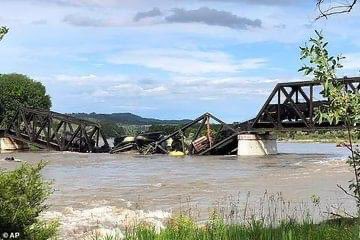
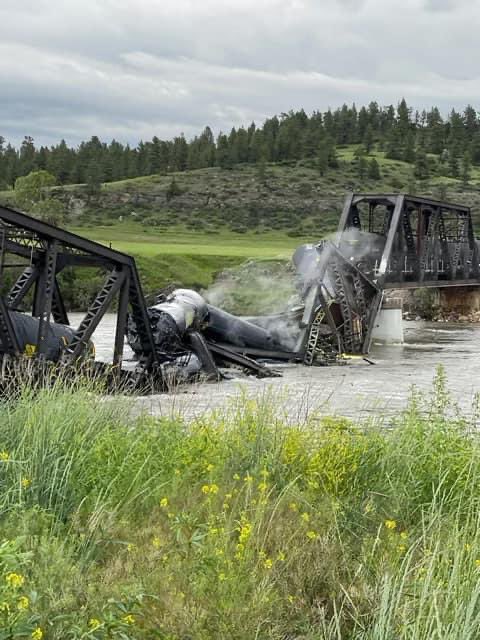
Water intakes along the Yellowstone River have been shut off, following the collapse of a rail bridge, which sent several cars full of asphalt and sulfur into the water. Photos show crumpled, steaming tanker cars, and what appears to be bright yellow stuff roiling in the water. Pictures from Rawsalerts on Twitter:

The image is taken from the river banks downstream of the wreckage. Grass and shrubs in the foreground, then muddy, turbulent river water. The bridge and train run across the middle, and in the center, you can see yellow-white froth, where sulfur seems to be leaking into the water. In the background, forested hills under a partly cloudy sky.

The image is taken from the river banks downstream of the wreckage. Grass and shrubs in the foreground, then muddy, turbulent river water. The bridge and train run across the middle, and in the center, you can see yellow-white froth, where sulfur seems to be leaking into the water. In the background, forested hills under a partly cloudy sky.

The image is taken from the riverbank, near one end of the ruined rail bridge. You can see grass and yellow flowers in the foreground, with the river, bridge, and train in the middle. The tanker cars are twisted and crumpled, with steam hovering over them. If you look closely, you can see yellow in the water near the wreckage. In the background, a forested hill, under gray clouds.

The image is taken from the riverbank, near one end of the ruined rail bridge. You can see grass and yellow flowers in the foreground, with the river, bridge, and train in the middle. The tanker cars are twisted and crumpled, with steam hovering over them. If you look closely, you can see yellow in the water near the wreckage. In the background, a forested hill, under gray clouds.


This will keep happening, until the US government can stop kissing capitalist asses long enough to actually do its job, and overhaul the infrastructure of the whole damned country. The rails need to be nationalized, with profits from their use re-invested in maintaining, improving, and expanding the network. It seems that Montana’s had enough rain recently, that the stuff pouring into the river is pretty diluted, so cleanup workers are supposedly not at any risk. I have my doubts, obviously, but that’s what’s being reported:

COLUMBUS, Mont. — A bridge that crosses the Yellowstone River in Montana collapsed early Saturday, plunging portions of a freight train carrying hazardous materials into the rushing water below.

The train cars were carrying asphalt and sulfur, said David Stamey, Stillwater County’s chief of emergency services. Officials shut down drinking water intakes downstream while they evaluated the danger. An Associated Press reporter witnessed a yellow substance coming out of some of the tank cars.

However, Stamey said there was no immediate danger for the crews working at the site, and the hazardous material was being diluted by the swollen river. There were eight rail cars in the river or on the part of the bridge that collapsed.

The train crew was safe and no injuries were reported, Montana Rail Link spokesman Andy Garland said in a statement.

Railroad crews were at the scene in Stillwater County, near the town of Columbus, about 40 miles (about 64 kilometers) west of Billings. The area is in a sparsely populated section of the Yellowstone River Valley, surrounded by ranch and farmland. The river there flows away from Yellowstone National Park, which is about 110 miles (177 kilometers) southwest.

“We are committed to addressing any potential impacts to the area as a result of this incident and working to understand the reasons behind the accident,” Garland said.

In neighboring Yellowstone County, officials said they instituted emergency measures at water treatment plants due to the “potential hazmat spill” and asked residents to conserve water.

The cause of the collapse is under investigation. The river was swollen with recent heavy rains, but it’s unclear whether that was a factor.

Oh yeah, that’s the other thing – unless the US takes this seriously, climate change is going to keep putting more stress on its already-crumbling infrastructure. I don’t think climate change is the biggest factor here, given the overall neglect of the nation’s roads, rails, and bridges, but it’s more of a factor every year, and there’s no good excuse for not working to keep ahead of it.

I’m glad Yellowstone National Park won’t be directly affected, but while it’s a lovely place, all the other ecosystems along the river, including the river itself, also merit our concern. Obviously, there will be some human costs associated with this spill, but it’s hard for me to predict those at this stage. If you live downstream from this, along the Yellowstone river, or the Missouri river downstream of where the Yellowstone joins it, it’s probably a good idea to stock up on water, if you haven’t already.