REMAIN INDOORS
I am REMAINING INDOORS and working on a post that’s going more slowly than I’d like, so something more substantive will be up tomorrow, and in the meantime, REMAIN INDOORS and donate to my patreon.

I am REMAINING INDOORS and working on a post that’s going more slowly than I’d like, so something more substantive will be up tomorrow, and in the meantime, REMAIN INDOORS and donate to my patreon.
While humanity argues over how to respond to the changes we’re causing in our climate, and in some cases argues over whether the climate is changing at all, the rest of life on the planet is already on the move. Some species are in decline, some are spreading, and some are simply moving to new locations, fleeing changes in temperature or in precipitation. We knew these changes were coming, and many of them have been detectable for over a decade, but other than shifts in things like the range of disease-carrying mosquitoes, most coverage of climate change has ignored them.
Some of the changes have been obvious to people whose lives require them to interact with wildlife, some have been harder to detect, but it’s happening everywhere. The climate of the entire planet is warming in a way that has never happened in the history of our species – possibly ever – and all around us, life is on the move.
Since pre-industrial times, the world’s oceans have warmed by an average of one degree Celsius (1°C). Now researchers report in Current Biology on March 26th that those rising temperatures have led to widespread changes in the population sizes of marine species. The researchers found a general pattern of species having increasing numbers on their poleward sides and losses toward the equator.
“The main surprise is how pervasive the effects were,” says senior author Martin Genner, an evolutionary ecologist at the University of Bristol. “We found the same trend across all groups of marine life we looked at, from plankton to marine invertebrates, and from fish to seabirds.”
The new study builds on earlier evidence for a prevailing effect of climate change on the distributions, abundance, and seasonality of marine species. Based on those findings, Genner’s team reasoned that marine species should be doing well at the leading (poleward) edge of their ranges but poorly at their trailing (equatorward) side. They also realized that existing databases of global species distributions could be used to test this hypothesis.
Based on a thorough search of available data in the literature, the researchers now report on a global analysis of abundance trends for 304 widely distributed marine species over the last century. The results show that — just as predicted — abundance increases have been most prominent where sampling has taken place at the poleward side of species ranges, while abundance declines have been most prominent where sampling has taken place at the equatorward side of species ranges.
The findings show that large-scale changes in the abundance of species are well underway. They also suggest that marine species haven’t managed to adapt to warmer conditions. The researchers therefore suggest that projected sea temperature increases of up to 1.5°C over pre-industrial levels by 2050 will continue to drive the latitudinal abundance shifts in marine species, including those of importance for coastal livelihoods.
“This matters because it means that climate change is not only leading to abundance changes, but intrinsically affecting the performance of species locally,” Genner says. “We see species such as Emperor penguin becoming less abundant as water becomes too warm at their equatorward edge, and we see some fish such as European seabass thriving at their poleward edge where historically they were uncommon.”
The findings show that climate change is affecting marine species in a highly consistent and non-trivial way. “While some marine life may benefit as the ocean warms, the findings point toward a future in which we will also see continued loss of marine life,” Genner says.
The long-term data included in the study primarily represent the most well-studied regions of the world. The researchers say that more work is needed to understand how climate change has affected marine life in all regions of the world in greater detail.
“We aim to get a better understanding of precisely how marine climate change drives abundance shifts,” Genner says. “Is this mainly related to the physiological limits of the species, or instead due to changes in the species with which they interact?”
Unfortunately, a lot of people have recently gotten a refresher course in how exponential growth works. With the various feedback loops present in our climate system, and without a real, global effort to reduce greenhouse gas emissions, it is likely that the speed of the warming will increase in the coming decades, and the changes we see around us will become much more dramatic. That’s still something we can influence, but just as the two-week incubation period for the COVID-19 pandemic means that social isolation doesn’t show its effects immediately, there’s a lag time in the climate between when CO2 is emitted, and when the planet’s temperature reaches an equilibrium for the new amount of insulation. If we were to freeze at the current level of greenhouse gas concentrations, the planet would still continue warming for another 10-20 years.
These changes will affect a lot of things. Marine changes are going to affect both access to places like the Arctic Ocean, and the meaning of various fishing treaties and policies, as the fish change where and when they are active. I’m guessing changes on land will be most noticeable through things like crop yields, pest populations and the insect-born illnesses I mentioned earlier. Many of the changes probably won’t directly affect human life, but some of them definitely will. As with the pandemic, we’ve known this was coming for a while, we have a good idea what kind of things to prepare for, and even action taken late is better than doing nothing and hoping for it to blow over.
Hey everybody, I am once again asking for your assistance. I really need help paying my bills and keeping a roof over my head. Patreon.com is a way for you to help with that, even if it’s just a little bit, and get some perks and extra content in return. You control how much you give, and how long you give it, and every little bit really does help. When lots of people pitch in, it can make a huge difference. Please help if you’re able, and share my work with others. Thank you!
One of the first things I learned about domestic violence is that the abuser often follows a pattern of controlling behavior. Using various justifications, they limit the target(s) of their violence to fewer and fewer “acceptable” behaviors, and fewer “acceptable” interactions with other people. Those struggling to survive the abuse often find themselves growing increasingly isolated, and their range of safe activities and expressions of emotion increasingly narrowed as they try to avoid “antagonizing” their abuser. Physical and behavioral isolation is a very real part of this. It means the abuser doesn’t have to worry as much about being caught, because there aren’t people to see the bruises on the survivor, and the changes in behavior.
Social isolation is necessary to slow the spread of the COVID-19 virus, and reduce the death toll, but it is also putting a large number of people in a very dangerous situation. Just as single people are vulnerable to being overlooked, so too are those suffering abuse at the hands of the people they live with, and seeking help can be difficult and dangerous when the blanket expectation is that people won’t leave their homes. At the same time, most of the ways survivors could normally escape – planes, buses, and cross-country trains – are unavailable right now. Carolyn Bick at the South Seattle Emerald writes:
For most people, being stuck inside –– though at times tedious –– isn’t a life-or-death situation. The biggest risk for the majority of people sheltering in place right now is the novel coronavirus, the reason for the state’s current stay-home order, which Gov. Inslee extended until at least May 4. The order is meant to combat the spread of the virus, which causes COVID-19, the disease that has killed 262 people as of April 1, according to the state Department of Health coronavirus page.
For domestic violence survivors, the situation is different. Though they are at risk if they leave their homes, their wellbeing can be in just as much jeopardy if they stay inside. The problem is compounded in places like South Seattle and South King County as a whole, which don’t have as many or as comprehensive a selection of resources, when compared with wealthier areas of Seattle, said Doris O’Neal, who leads the area’s YWCA domestic violence services, in addition to other related programs.
This article also has numerous resources for people seeking help in their struggle to survive, and for friends and family of survivors (or abusers, for that matter) who want to help. I strongly recommend checking out the article, and looking at the materials linked at the end, whether or not you yourself are being attacked or controlled by someone you live with. The more everybody understands the problem, the warning signs, and how to help, the better we’ll be able to provide support for survivors.
All over the world, people who work to help survivors of domestic violence are trying to mitigate the harm that will be done by the current isolation. In France, women are being encouraged to use code words at pharmacies to get help:
In Nancy, a woman went to her local pharmacy on March 28 to report the violence. “The pharmacist had then informed the police by phone, thus triggering immediate intervention by the police,” François Pérain, the Nancy prosecutor, told ABC News.
Asked about the policy on national broadcaster France 2, Christophe Castaner, the Interior Minister, said that the lockdown put in place since March 17 in France to stem the COVID-19 pandemic had resulted in an increase in domestic violence.
In the area of the Paris police prefecture—which covers Paris and three surrounding suburbs—Castaner said it had increased by “36% in one week.”
On March 27, the Interior Minister had put a strategy in place with the president of the Pharmacists’ Guild that pharmacists would be a first port-of-call for victims of domestic violence.
The code word “mask 19” can be used by the victim if she is accompanied by her spouse, he had suggested. The use of a code is a system already implemented in Spain.
Sadly, domestic violence is a problem in all human cultures, as far as I’m aware, and the patterns are often the same. This means that regardless of where you live, mass social isolation is putting people at risk. Check out the resources from the South Seattle Emerald article – many of them have advice on what to do, in addition to country or region-specific outreach tools, and look up information on what options are available where you live (here’s one for my fellow UK residents, and a reddit post from a survivors forum with some useful stuff) The purpose of this isolation is to save lives, so let’s do what we can, in that spirit, to reduce the harm done in the process.
Hey everybody, I am once again asking for your assistance. I really need help paying my bills and keeping a roof over my head. Patreon.com is a way for you to help with that, even if it’s just a little bit, and get some perks and extra content in return. You control how much you give, and how long you give it, and every little bit really does help. When lots of people pitch in, it can make a huge difference. Please help if you’re able, and share my work with others. Thank you!
The current state of lockdown is necessary, but it’s isolating. There are good parts to that, but there also bad parts. It’s been mentioned before that modern life works against the creation and maintenance of communities, and that’s doubly true right now. That means that some people are at risk of falling through the cracks of social isolation. Many of us live with other people – parents, house/room mates, significant others, spouses – we have people to look out for us and take care of us when we’re sick. We have people who will call for first responders if something goes wrong and we can’t do so ourselves.
A lot of people are not in that situation. By choice or by chance, a lot of people live alone, and while that can have its upsides, it also comes with a degree of vulnerability. A friend of mine who works in healthcare recently articulated the problem in a way I think is useful:
Y’all, I FIGURED OUT WHAT I WAS AFRAID OF.
I’ve been terrified that I’ll catch this thing at work (it’s gotta be at work because I am scrupulous outside of work), become incapacitated at home (I was close to incapacitated by plain old flu A a couple of years ago)—
—and then no one will come check on me and feed my cat and make sure I have food and water and clean sheets and fresh pajamas and Tylenol. Because “you have to love people at a distance” and “no exceptions” and “flatten the curve” and “no contacts outside the household” and “this means you.” And I’ll be lying in an awful fever dream too sick to care for myself but not sick enough to go to the hospital.
That’s it. That’s the fear.
I feel much better now because one person promised that they won’t let that happen to me, but hey, PLEASE check on your single friends, and maybe offer to be that person for them. And as I have said in way too many Facebook posts now, PLEASE, I beg of you, check your rhetoric for how it might sound to a single person who lives alone. Especially if that person cannot “just stay at home.”
This is spot on. Check in on your acquaintances who are single or living alone. You don’t have to break your own isolation to communicate and make sure they’re OK. COVID-19 is a debilitating illness for some, as are many other ailments, and the way things are right now, some people may have things go wrong, and nobody will notice, because we’re not supposed to be seeing people around. Now is the time to engage in the praxis of community. Check up on each other. Stay in contact. Reach out if you feel that you need someone to check up on YOU. It’s always OK to ask for help.
Hey everybody, I am once again asking for your assistance. I really need help paying my bills and keeping a roof over my head. Patreon.com is a way for you to help with that, even if it’s just a little bit, and get some perks and extra content in return. You control how much you give, and how long you give it, and every little bit really does help. When lots of people pitch in, it can make a huge difference. Please help if you’re able, and share my work with others. Thank you!
Times are tough, unemployment is high, and a lot of people who were already living paycheck to paycheck are worried about being able to make their rent payments. A lot of people need a lot of help.
To that end, I’ve put together a list of different resources for people who are struggling to make ends meet right now. This is a mix of both ways to seek help, and ways to give help to those in need. I will update and re-post this at least once a week while the pandemic and associated economic fallout continue. This is currently mostly focused on the U.S., with some UK resources, but I want to expand it to cover anyone needing help anywhere if possible. If anyone has resources I’ve missed, please include them in the comments and I’ll add them in to the next round.
https://www.mutualaidhub.org/ – a map of mutual aid projects and requests around the United States. FYI, McAffee flagged this site as somehow worrisome. I’m not sure why.
https://mutualaiddisasterrelief.org/ – Mutual Aid Disaster Relief – solidarity, not charity. This is an opportunity to help, for now. If I find a way to ask them for aid, I’ll update.
It’s Going Down is a digital community center for anarchist, anti-fascist, autonomous anti-capitalist and anti-colonial movements. They have a list of mutual aid efforts focusing on the COVID-19 pandemic across the United States as well as some in Canada.
This is a US-based google doc with a huge amount of resources linked, from guides, to counter-propaganda, to existing aid efforts. Tactics and info are relevant across the board, most of the linked aid efforts are centered in the US.
Coronavirus resource list “This kit is a collectivized document that will be updated as more mutual aid projects and resources appear online. Recognizing that not everyone will have access to great internet to access some of these, I encourage you to apply these offline as well as online.”
COVID-19 Mutual Aid UK – Mutual aid resources in the United Kingdom
For those interested, Amy Goodman of Democracy Now did an interview with Dean Spade, who created Big Door Brigade.
The Human Network Initiative is a collaboration between Harvard Medical School and Brigham and Women’s Hospital. They have put together this collation of local and state resources
Likewise, the Massachusetts Jobs With Justice group has put together this collation of resources and mutual aid groups
The Asian American Resource Workshop has created a wider ranging sheet of resources and mutual aid groups. It includes a lot of information on how to combat prejudice and xenophobia in this unprecedented situation
A Facebook group titled “COVID-19 Greater Boston (mutual aid and resources)” has been set up
The folks behind the news site Boston.org have set up the Boston Helps network
A neighborhood group has been organized for Jamaica Plain and Roxbury, with similar groups in many Boston neighborhoods
The staff, faculty, and students of Tufts have created their own mutual aid group for their community, as have other schools
Just outside of the city, communities like Cambridge have also seen mutual aid groups being set up
With the physical and financial help of at least 15 other people, including the neighbor who offered the strip of space in front of his house to create the garden on 33rd Avenue South in South Seattle, Miller has started up a community garden on her block. Like the rest of the nation, Miller’s neighbors and friends have been affected by the COVID-19 outbreak, and she wants to help support those in need, during what’s proving to be a difficult and frightening time for many.
As part of the TAA’s broader commitment to supporting or most vulnerable and precarious, we have set up a Mutual Aid Fund where graduate student employees can request aid to respond to an urgent financial need. This fund has been seeded with contributions from three incredible members who wanted to see the TAA act to relieve immediate financial needs for its members.
If you are able, please consider donating to this fund to ensure that our colleagues, co-workers, friends, comrades in financially uncertain times can be supported.
And any UW grad student can apply for funds at http://bit.ly/TAAmutualaid.
DCH1 Amazonians United is an organization of mostly Black and Latino workers at an Amazon warehouse on the southwest side of Chicago. The majority of us are women, and many of us work multiple jobs while taking classes, raising our children, and supporting our elderly family members. We are organizing to permanently improve the conditions at our warehouse and for all Amazon workers. And we are working hard through this pandemic to keep our city supplied- please support us!
Wildcats want to say a huge THANK YOU to everyone who has supported us so far! With your solidarity, we have raised just enough to take care of the basic needs of all 80 graduate student workers who were recently fired for grade withholding. Thanks to you, we have been able to rest assured that our rent, food, and other needs will be covered. Your donations also fed thousands of strikers and our allies on our month-long picket line and covered medical and legal expenses of those who were violently arrested by University of California police. This fund continues to be the foundation for our ongoing fight for a cost of living adjustment (COLA).
MAP staff are already doing all we can to support local medical services who are serving Palestinian communities living under occupation and as refugees. We have already provided emergency hygiene supplies to 1,200 vulnerable Palestinians living in Gaza. We anticipate further need for an emergency medical response in the weeks and months ahead. Please help us be there for Palestinians during this crisis with a donation today.
Your donation can help pay for:
- Hygiene Kits
- Antiseptics
- Personal Protective Equipment (PPE)
- Medicines and medical supplies
The WhyHunger Hotline refers people in need across the U.S. to food pantries, soup kitchens, summer meals sites, government nutrition programs and grassroots organizations, especially those that provide access to nutritious foods and nutritional support services.
The chancellor’s announcement now helps millions of hospitality workers, but sadly still so many are not protected by this as they don’t have contracts, were paid off pay roll or dismissed by employers before the announcement. We decided to take action to help those that are still hurting. We have the technology, contacts & understanding to make a difference quickly.
We have created ‘The Hospitality Workers Emergency Fund’ to allow the kind hearted, altruistic & caring UK public to donate to an emergency fund to help the most vulnerable & in need in our sector during this time. Our mission was always to champion hourly paid tipped workers, we never imagined in this way…
Here are just a few other places to donate that I’ve seen floating around. There are likely more local efforts where you live.
Nationwide: Cinema Worker Solidarity Fund
Nationwide: UNITE HERE’s fund for impacted workers
Nationwide: Coronavirus Care Fund for domestic workers
NYC: Emergency COVID Relief for Sex Workers in New York
DC: Coronavirus Worker Relief Fund
And some of the resources from this and other videos:
Co-op store was broken into and robbed, and needs help recovering
Chester County COVID assistance network (Facebook)
musicalartists.org/membership/relieffund
NYC DSA mutual aid/relief fund
Mutual aid efforts in Australia
Fund to help housekeepers and day laborers
Thinklab list of gofundme efforts
Career Onestop on finding government help in the U.S.
AFL-CIO federal and state resources for workers (U.S.)
Info on applying for Medicaid and CHIP (U.S. healthcare assistance)
I’ll keep updating this as I find new stuff, and as always, let me know if you come across things I’ve missed, and please consider donating to my patreon!
Thanks to the COVID-19 outbreak, layoffs have increased, job interviews have been indefinitely postponed, and many places aren’t hiring new workers. All of that means I really need help paying my bills and keeping a roof over my head. Patreon.com is a way for you to help with that, even if it’s just a little bit, and get some perks and extra content in return. You control how much you give, and how long you give it, and every little bit really does help. When lots of people pitch in, it can make a huge difference. Please help if you’re able, and share my work with others. Thank you!
Last time I told the story of His Holiness, Saint Ray the Cat, and how he came to be in our lives. Today I present the senior non-human member of the household, Raksha. Waaay back in 2007, I had just graduated from college and was working as property manager for my school’s biology department. I was living with my then-girlfriend in Richmond, IN, and we had decided that we absolutely could not afford a dog. My Significant Other was volunteering at an animal shelter. It was the standard affair, full of stressed cats and loud dogs, and when I went to pick her up one day, there was this scrawny little puppy with great big ears who was the only one in the whole shelter that wasn’t barking. We re-assessed our finances, and brought Raksha home not long after. Raksha was timid, but very eager to please, and easy to train.
She found most things terrifying, and when confronted with other dogs, she would hide under the nearest table, car, or bush. Because she had a vaguely wolfy look, and I grew up reading Rudyard Kipling, I named her after the she-wolf who adopted Mowgli in The Jungle Book. At the time, I thought Raksha meant “demon” in Hindi (obviously with different connotations from the Christian usage of the term), and it wasn’t until some time later that I was corrected. It turns out that demon is actually “rakshas”, and my vicious hound was, in reality, named “defense” in Hindi, or “protect” in Bengali.
In time, she grew into her ears, learned how to get along with other dogs, and even overcame her intense separation anxiety and stopped howling every time I left the apartment. She kept her quiet habits, and only barks when someone knocks on the door. She has shared her home with cats at various points in time, and after the first one, quickly learned not to chase them. The first cat I had with Tegan, a tragically short-lived tiger cat named Erwin, fixated on her to a possibly unhealthy degree, to the point where he would have a meltdown every time we took her for a walk. At first the two of them would cuddle – Erwin would curl up between her front paws and fall asleep. In time, however, Erwin ruined that. He would start cleaning her ears, and then move from that to biting them. Raksha lost her trust, and ended up slinking away any time Erwin got too cuddly. Erwin, alas, had a heart condition that took him from us after just a couple years. His Holiness joined us a little under a year after Erwin’s death.
His Holiness was afraid of Raksha in the beginning, like any semi-intelligent street cat, but he was too sick to actually run away. Raksha continued not eating him, so he got over his fear, and they now maintain an amicable co-existence, usually at an arm’s length. Both of them have thrived in Scotland, enjoying the cool climate, and the great big window in the living room. Their favorite part of the day is when we open the window, and they can stick their heads out, watch passers-by, and sniff the breeze.

His Holiness, Saint Ray the Cat observes the world from his sun-washed balcony.
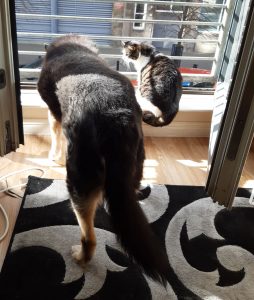
His Holiness turns to observe Raksha’s approach to the grand balcony.

The two noble beasts observe the landscape from their lofty vantage point. The cool breeze carries fascinating scents to them, the sun warms their fur, and the people and birds are fascinating to watch.

The alley and its breezes provide regular entertainment.

His Holiness and Raksha examine each other. His Holiness is realizing that perhaps his personal space has been invaded more than he’d like.
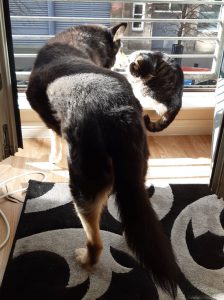
Yes, it is time. His Holiness has concluded his business on the balcony, and wishes to put some distance between himself and the endlessly sniffing snoot of the dog.

Raksha resumes her inspection of the outside world, as His Holiness slowly recedes from the balcony, walking a little bit under his large, shaggy companion.

Raksha continues her vigil as His Holiness retreats into the interior of the apartment.

His Holiness basks in the sun coming through the now-closed window. The dog has left, leaving him in undisturbed tranquility.

His Holiness curled up on the couch

Raksha waiting for me to let her out. Life is hard for an old dog.

Bonus Picture! This is my pandemic shopping outfit. I went out today to pick up antidepressants and some groceries from the nearby Tesco.
Help us feed and medicate these noble animals! Sign up to be a patron at my Patreon page, so that we can afford rent, keep a roof over our heads, and keep the vicious beasts from eating us in our sleep!
A while ago I started writing a few science fiction stories about life after The Gauntlet. The basic premise was that the 21st century – particularly toward the end – became a time of harrowing hardships. Climate change fueled an era of famine, disease, and warfare during which human civilization as we know it today more or less ended. It wasn’t a complete breakdown but more a breaking apart. With every continent ravaged by conflict and climate disasters, the capacity for international aid more or less went away, and humanity shrank back into a set of regional communities, all focused on their own problems. Technology survived, but was adapted to new conditions, and society was largely shaped by the hazards of local environments.
Running the gauntlet is a form of corporal punishment that has been used as a way to brutalize wrongdoers, and as a rite of passage. The basic premise is that the victim must run between two rows of people, usually armed with some form of blunt weapon like a rod. The rows of people forming “the gauntlet” attack the victim, and continue to do so as long as he is within their reach, until he makes it out the other end. In my climate metaphor, humanity is both the victim, attempting to get from one place to the next, and we are our tormentors, supplying the violence and pain that makes the whole process into an ordeal. Because of the actions of those in the past – pollution, old grudges, concentrations of power, and so on – many of the hits that are coming our way cannot be avoided. Just as the COVID-19 virus outbreak could not be stopped, once it began, so too will certain climate-fueled disasters happen no matter what we do at this point.
I don’t know whether we’ve entered an era like that or not, but at the moment it’s not hard to feel as if we have. I think that, within a year, maybe two, we will emerge from the COVID-19 crisis to a different world. We will be grieving those lost. We will be assessing what remains. We will be reaching out to those we love, and trying to strengthen the bonds we feel are important. We will also be re-examining what was done during the crisis, as we have already been doing from in the middle of it. Laws have been passed, rules have been changed, expectations have been adjusted, and power grabs have been made. All of that will continue in the days, weeks, and months ahead, and we are still in the beginning of this crisis.
This is a preview of an article for my patrons who give $10 per month or more. You can read the rest by signing up to be a patron at Patreon.com/Oceanoxia.
Since November of 2016, I’ve heard a lot of people wondering out loud about how we got to this point. How did we end up with Trump as president? How did we end up with so much inequality, and distrust, and division? How is it that the supposed “richest country in the world” has so few material resources to respond to this pandemic?
None of this stuff is simple, and there’s never going to be just one answer, but this video from The Michael Brooks Show tells part of the story:
Thanks to the COVID-19 outbreak, layoffs have increased, job interviews have been indefinitely postponed, and many places aren’t hiring new workers. All of that means I really need help paying my bills and keeping a roof over my head. Patreon.com is a way for you to help with that, even if it’s just a little bit, and get some perks and extra content in return. You control how much you give, and how long you give it, and every little bit really does help. When lots of people pitch in, it can make a huge difference. Please help if you’re able, and share my work with others. Thank you!
On this day, I think the primary way I can help is to use my platform, such as it is, to amplify trans voices, news, and resources. As with all the lists of resources I post, this is not meant to be comprehensive or “everything you need to know”. Reality is complex, as are all issues relating to humanity. Hopefully these resources will be useful to some people in learning about our friends and family who don’t identify with the gender assigned to them at birth.
To start with, a bit of sad news from the ongoing COVID-19 pandemic:
The ‘Mother of the Trans Latinx community’ in Queens, Lorena Borjas, tragically passed away at the age of 59 on Monday morning, March 30th, after being diagnosed with COVID-19.
Legendary trans activist, Lorena Borjas, has left a lasting impression upon her hometown of Queens. Throughout the past 30 years, she advocated for transgender, sex worker and immigrant communities. She would home women who were stigmatised and exiled by their families in her apartment until they were able to support themselves.
Borjas set up a HIV-testing program for trans sex workers, launched her own legal fund to assist Latinx LGBT+ community members, and served as a counselor for the Counselor for the Community Healthcare Network’s Transgender Family Program in Queens. She became known in the area as the ‘Mother of the Trans Latinx community.’
Disasters tend to teach us a lot about our fellow humans, both through the actions of the people who live through it, and in the life stories that are told of people who don’t. It’s a sad way to learn, but an important reminder of the people among us who spend their lives making the world a better place for others.
Human Rights Campaign has a solid set of resources for people who want to learn both about trans issues, and about trans people who are working to change the world for the better.
Transgender people come from all walks of life. We are your coworkers, family and neighbors. We are 7-year-old children and we are 70-year-old grandparents. We are a diverse community representing all racial and ethnic backgrounds, as well as faith backgrounds.
International Transgender Day of Visibility is honored every year on March 31 and is a time to celebrate transgender people around the globe and the courage it takes to live openly and authentically, while also raising awareness around the discrimination trans people still face.
Check out the link above for more from HRC.
Natalie Reed, who left freethoughtblogs before I joined, provided most of my initial education about trans issues. She still links to her old blog on twitter, and I think her writing remains very useful. I highly recommend her work, especially if you’re a cis person looking for broader understanding.
Natalie Wynn at Contrapoints played a big role in my own understanding of issues surrounding trans and nonbinary people.
“The World Professional Association for Transgender Health […] is a 501(c)(3) non-profit, interdisciplinary professional and educational organization devoted to transgender health.” Currently they seem to be focused on Europe and the United States.
Trangender Map by Andrea James seems to be a huge collection of information and resources for trans people, would-be allies and supporters, and anyone else looking to learn or help. Check it out of any of the following looks interesting, useful, or important to you.
This free website shows how to make a gender transition.
It tells about gender identity and gender expression, as well as the social, legal, and medical ways to make a transgender transition.
It has lists of people who can help. You can learn how to pay for transition.
There is also help for young people and their families.
People who are not transgender are also welcome here! Please choose a link below:
- For people who are trans or gender diverse
- For people questioning their own gender identity
- For people who want to help our community
- For anyone else who wants to learn more
Or just use this site map, or the search and translate options below, or the menus at the top and bottom of each page.
Times are tough all over right now, and trans folks generally face more social and economic barriers than cis people. That remains true during this pandemic, just as in day to day life. If you have the resources, please consider looking for a charity or mutual aid group that helps trans people, and giving them a little. Through collective effort, we can work toward a world where a plea like this is no longer necessary.