
The Probability Broach, chapter 13
Deejay and Ooloorie, the human and dolphin (respectively) scientists who built the Probability Broach, fill in the details that Win Bear was seeking about how they came to be in contact with Vaughn Meiss, the murdered scientist from his own universe.
They explain that they wanted to establish contact with Win’s world. They needed help from someone on the other side to do it, because (obligatory technobabble!) “power consumption would fall ten thousandfold if we could establish a resonant field”.
However, they had some misgivings about this. From their perspective, Win’s world was populated by “primitives [who] will gladly murder anyone desiring independence from a coercive state”. Worse, as Oolorie says, “Your culture is ahead of ours only in its ability to wage nuclear war”.
The only exceptions they came across were Vaughn Meiss and his allies in the Propertarian Party, whom Win met early on in the book. Recognizing Meiss as a kindred spirit, they sent him a manuscript explaining the basics of the Probability Broach. Meiss, who’s a libertarian and therefore a supergenius, began constructing his own version.
There was one other thing that Deejay and Ooloorie worried about: namely, what happens if “the field collaps[es] on an occlusion”. To show Win and his friends what they mean, they demonstrate with a desktop-sized classroom model:
POP! A blue flash at the center of the contraption reminded me of high-school tricks with hydrogen. “What you saw,” Ooloorie lectured, “was a few air molecules interpenetrating the theoretical junction between two worlds. When the interface ceases to exist so do they—or try to.”
In other words, if the portal closes while something is halfway through, you don’t get a portal cut, as is common in sci-fi. You get an explosion. And the more mass there is in the portal, the bigger the bang. (Obligatory foreshadowing!)
But, again, they set safety considerations aside and continued their work. Meiss progressed with his experiments, and they were expecting to hear from him—until their side of the portal unexpectedly blew up.
That was due to Win’s interference, as they figure out. While he was examining Meiss’ lab as part of investigating his murder, the (obligatory!) jackbooted government thugs burst in with guns blazing. In the struggle, Win accidentally switched on the machine and stumbled through the portal. But when the goons tried to come after him, the field overloaded and collapsed.
That was the explosion that flung Win into the North American Confederacy, bloody and concussed. But Deejay and Oolorie have unwelcome news for him:
“And recall, my brilliant colleague,” said the fishbowl in the wheelchair, “that the effect is not symmetrical!”
Deejay paled. “Ooloorie, I hadn’t thought of that at all!”
“What are you talking about?” I demanded…
“Oh, Win, you were afraid your world might not still exist. Ooloorie’s saying that the force of the explosion isn’t symmetrical, it depends on the distribution of the interrupting mass… the little bang that tossed you over the hedge was part of a much bigger bang on the other side!”
Win, reasonably, demands to know just how much bigger. They do the math on what would happen if the Broach closed while a person was midway through. They say it depends on how much of his body was on which side of the portal:
“Suppose… it was just his feet?”
“About the same as our explosion here, one to five microtons—about two ounces of pistol powder,” Ooloorie estimated.
“And—uh—if only his head made it through?”
“A thousand megatons, possibly more.” Perhaps her thrashing was a sign that she was upset, too. If the original explosion hadn’t done the job, certainly NORAD would have interpreted it as an attack: World War III, the end of the Earth I knew.
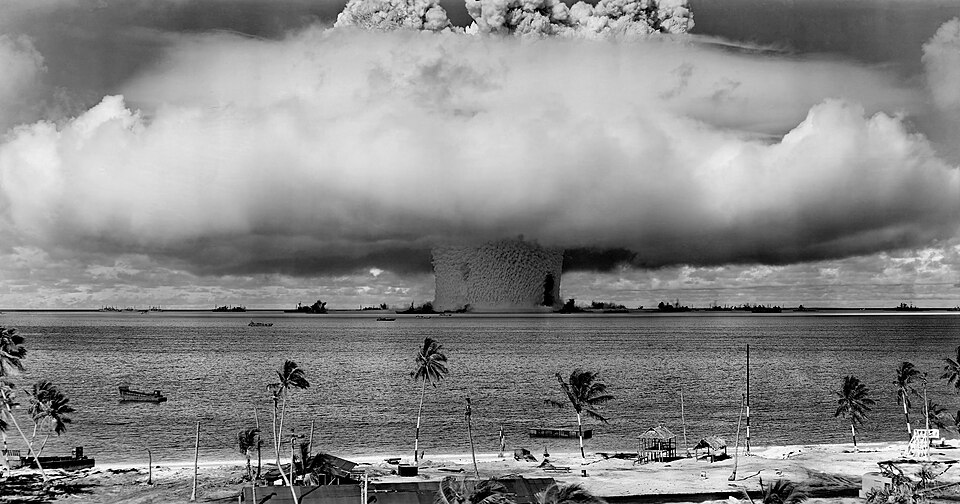
A thousand megatons. For reference, Tsar Bomba, the biggest thermonuclear bomb ever detonated, had a yield of fifty megatons.
The Probability Broach isn’t a bridge for traveling between worlds. It’s a weapon of mass destruction.
The Manhattan Project to enrich uranium for the first atomic bomb was the biggest industrial operation in human history up till that point. It cost billions of dollars and required the labor of over 100,000 people. Even today, coordinated industrial effort on this scale is beyond the capabilities of most countries.
For purposes of his fiction, L. Neil Smith is postulating a far more destructive weapon. And not only is it one that a single individual can build by himself, it’s one that’s easily set off by accident.
This begs a question which Smith never considers: Shouldn’t there be someone whose job it is to be concerned about stuff like this?
Deejay and Ooloorie have built a civilization-ending doomsday device in their lab with zero oversight. Whoever’s funding their research either doesn’t know or doesn’t care. No one asks any questions about what they’re doing, no one raises any concerns, no one tries to stop them. No board of ethics is convened to decide what should or shouldn’t be done with this technology. No safety inspector checks if they’re being appropriately cautious, or if they’re cutting corners. (The only thing that does concern the higher-ups, apparently, is how much it costs to run.)
In our world, if you try to build a homebrew nuclear reactor in your backyard, very serious people are going to show up and ask some questions. In the NAC, there’s no government, so there’s no federal agency that can swoop in to shut you down if you’re doing an unacceptably dangerous experiment. Nor are there any laws dictating how something so destructive should be handled.
Apparently, the Broach is considered the property of the scientists who built it, and they can dispose of it how they see fit. If they want to sell it to the highest bidder, they can. If they want to hand out the blueprints to hobbyists and dilettantes who may or may not be able to copy it safely (which is essentially what they did), they can do that too.
I suspect L. Neil Smith just didn’t think through the implications of this, but it’s unintentionally fitting for his anarcho-capitalist world. In the North American Confederacy, anyone can build a WMD and do whatever they please with it. You can cook up chemical weapons, brew biological warfare agents, assemble pocket nukes, or cobble together mad-science superweapons.
Because there’s no oversight and no law enforcement, you just have to trust that everyone has only good intentions, knows what they’re doing, won’t compromise their ethics, and won’t make any serious mistakes. To which I say, have you met humans? It’s only by the grace of the author that this society hasn’t blown itself back to the stone age.
New reviews of The Probability Broach will go up every Friday on my Patreon page. Sign up to see new posts early and other bonus stuff!
Other posts in this series:
This makes me think of that Ayn Rand scene where all the untermenschen are on the train as the tunnel collapses and They Get What They Deserved (or the malevolent glee the Left Behind books take in the suffering of the clueless fools who didn’t get right with Jesus). Annihilating our world of moochers (as Smith sees it) makes me think of him standing there laughing (“You fools refused to listen! I said government would destroy you — now behold!”).
How is the explosion a quadrillion times bigger if only the head makes it through? Something seems off here.
I suspect they’re calculating how much mass was left in the interface. If that inference is correct that means when they say suppose it was just his feet, those were all that was left in the interface that was all that caused the explosion. But when they say what if only his head made it through the majority of his body was still in in the interface.
The math is still wrong. Assuming 100 kg (we’ll say his was a beefy guy for round numbers) and complete mass to energy conversion it gives 2.148 Gigatons of TNT for explosive energy so that’s actually rightish. If it’s just his feet (say 2kg because those are some sturdy jackboots) that’s still 43 Megatons or 3 times more than Castle Bravo and more than 2800 times more than Fat Man so it’s their low end that’s WAY off. It starts at city killer and goes up to nation killer. Hard to say because none of the online resources go over 100 megatons
Used https://www.omnicalculator.com/physics/emc2 for the mass to yield calculations.
Are you practicing English Understatement? If so, old chap, you’re almost bang-on!
Asymmetry. 1 unit of mass on the target site: boom. 1 unit of mass on source: Ka-Boom. So if 20% mass on target and 80% on source: Earth-shattering kaboom on the source.
Tzar bomba was an airburst. So a ground level gigaton explosion would leave a huge crater. When I looked up asteroid impacts, not as big as chixculub or ries, but larger than meteor crater.
Your title makes me wonder if there’s ever been any nuclear blackmail efforts in Earth-Confederacy. They have nukes, anyone can own one or build one, so why not? The tech isn’t going to be classified, people can (I assume) buy plutonium on the open market …
@2, I was wondering that as well. Is this like the disability compensation charts? E.g. lose a foot, you get X, lose your leg, get 3X? Portal version: lose your foot, X, lose your head, 3X?
Even without weapons applications, this device seems like a great justification for governmental safety rules. *Anyone* can build this device and if they are careless, cause immense damage? Yikes.
This begs a question which Smith never considers…
Oh, please – it raises a question which Smith never considers…
THANK YOU!
A depressingly large amount of my time is spent yelling at my phone/podcast/video/monitor that no, it doesn’t “beg the question”!!
(It means “assumes the answer to the question” NOT “raises the question”.)
Thanks for still being one of few remaining civilised people. X-D
“Begs the question” is a questionable translation of a questionable translation and uses an otherwise long-obsolete definition of the word “begs” which is not used in present-day English other than that one phrase. Just say “tautology” or “circular logic/reasoning”, whichever is more relevant to the situation. Let people use the more commonly used, actually more sensible definition of the phrase, which has been included in dictionaries for many years at this point, instead of engaging in toxic pedantry, no matter how much the ‘misuse’ might irk you personally.
I recognize that it’s still a legal term of art, but legal language is full of artifacts drawn from obscure and often long-dead technical sources. Just because the words and phrases in ordinary everyday speech often differs in meaning from technical jargon doesn’t make either use incorrect.
“The fishbowl in the wheelchair?” IANAE, but I really don’t think a dolphin would be at all comfortable stuck in a “fishbowl,” or able to function or do anything like actual work in any dry-land environment/workplace.
Also, if fifty megatons is too much to be appropriate in any real-world war scenario, one thousand would probably leave our entire East Coast uninhabitable, at the very least. (And no, the blast effect on the other side would not be a mere pop. Half the city would be a crater and all those happy hippy anarchists sunbathing in the park with their guns would be either dead or in a blind panic with no clue what had happened or who they should shoot in self-defense.)
How does such lazy stupid dreck even get published? I’m guessing some rich libertarian(s) paid the whole cost, just to get SOMETHING out there in the “libertarian fiction” category. And if that’s the best those rich libertarian(s) could get for their money, that says a lot about the intelligence of libertarians and libertarianism.
Alas, libertarian science fiction is definitely a thing: my second link, f’rinstance, includes over a hundred sf novel titles (though some are actually anarchist – and others not just novels but series).
Ouch… just spotted on this list:
The polity series by Neal Asher?
The Dispossesed? Anarchist for sure, but libertarian?
@ Pierce R. Butler: Indeed, libertarian SF is such a thing that L. Neil Smith created an award for best such libertarian novel of the year. And then awarded it to himself like the wannabe tyrant he is.
@ KeineAhnung: Smith has a habit of intentionally conflating propertarianism with anarchism, but only when it is convenient for him. Do not expect him to ever acknowledge that anarchism and capitalism are incompatible and that this is the reason why anarchists do not consider his kind their allies. Once he starts appropriating the likes of Lysander Spooner and Peter Kropotkin, and sovietically pretending that they were pro-capitalist and disregarding their actual words, I will have plenty to say about his dishonesty.
Clarification — was this an actual award that had nominees and candidates or did he simply make up the award, then give it to himself? The latter would bother me less as I find it amusing huckstering where the first feels more unfair.
Missed spotting Cecelia Holland on the list. That book was my first encounter with ancap world models. Her world did show the drawbacks in full consequences – the protagonist’s flute gets stolen, fenced off and no police to help her. So she resorts to employ the drug addict thief to intimidate the instrument shop in selling the flute back. IRC the ancap Earth was the smallest faction in the solar system and got quite obliterated in the end.
Hardly.
I’ve seen Sarah Hoyt listed as a libertarian and I’ve never known her as anything but an extreme right-winger/
I was being a little bit facetious. Smith created the award, but he had no say in who won it; it is awarded by a committee just like any other book award. It’s actually a significant thing, and the committee seems to define libertarian as just being against authority, since both propertarians and anarchists have won the award.
https://en.wikipedia.org/wiki/Prometheus_Award
Anarres is referred to in-book (by the Terran ambassador) as an experiment in “libertarian communism”.
Sorry, I thought my comment about Anarres would appear directly below the comment from KeineAhnung to which it was a response. Anarres is the anarchist planet in The Dispossessed.
In The Dispossessed, by Ursula LeGuin, as KG said, people on Anarres live in an anarchist-communist society. I guess you could say the book favors such a society, but it doesn’t sugar-coat its very serious flaws; nor does it pretend such a society could withstand encroachment by the high-tech, militarized states (capitalist, socialist and failed-state hellholes) of their sister-planet Urras. That’s why the Anarresti totally have a cow at the idea of allowing anyone to travel from one planet to the other in either direction (they’d kept to themselves but IIRC something happened that forced them to consider making contact with Urrasti). I suspect the novel was written as sort of a thought-exercise/discussion of propertarian vs. communist societies, how one group of people might get a communist society to work, what that would entail, and how they might (not?) hold their own with propertarian states nearby. Definitely worth reading, and far better (and more honest) than Smith’s dreck.
Your memory of The Dispossessed is not quite accurate. Urras and Anarres orbit the star we call Tau Ceti as a “double-planet”, both with life, but Urras is far more fertile. In the 170-ish years since Anarres was inhabited – as a result of a kind of “draw” in a revolutionary uprising, the anarchist-communist settlers have indeed strictly limited contact: there is trade through a single landing site. In that time, humans from outside the Tau Ceti system have arrived by NAFAL (Nearly As Fast As Light) ship. In Le Guin’s universe, Earth is not the original home planet of humans, a planet called Hain is, the Hainish have rescued a dying Earth, and both Hain and Earth have sent ambassadors, but the anarchist “managers” (hmm.. hints of a crypto-government here??) refused to let them land, classifying them along with the Urrasti as propertarian outsiders. In the course of the book, there’s a (natural) famine on Anarres, they survive but it’s tough. The hero, Shevek, is a theoretical physicist, who finds he needs to visit Urras (which is not explicitly forbidden, but no-one has ever done it since the settlement) to interact with a larger physics community. Some of the Anarresti try to stop him, as part of a wider move toward covert “majority rule” authoritarianism, but he manages to go. While there, he makes a breakthrough which he knows will make possible an “ansible” – an instantaneous communication device. But he also gets involved in a renewed revolutionary upsurge.
/tbc
That libertarian fiction list also includes Cecelia Holland’s Floating Worlds, which has an anarchist episode but to my mind reads as a warning against same (the anarchists face an invasion by a much smaller force, and lose). They also cite Terry Goodkind’s works, which should count as fantasy-squared.
The libertarians seem, unsurprisingly, quite willing to appropriate anything they can get their hands on and not have them beaten off – quite Stephen Millerish, and not a good way (since no such way exists).
For the truly masochistic, note that the artforliberty.com list linked above also includes mystery/thriller, historical faction, graphic novels, and (shudder) satire sections, and they unironically steer readers towards sources for all the above for free. On the positive side, they haven’t posted anything since 2020.
Terry Goodkind was an Objectivist and his Faith of the Fallen includes a looooong and tedious Ayn Randesque section on Individual vs. Collective.
And his Pillars of Creation opens with a dedication to the intelligence community who “have valiantly fought to preserve life and liberty, while being ridiculed, condemned, demonized, and shackled by the jackals of evil” Well, he’s entitled to his opinions even if they’re wrong.
I see I never made good on my /tbc above. If anyone wants me to, let me know.