This is the second part of a series discussing the Fine Tuning argument (FTA). The outline is here.
Comparing Hypotheses
Previously, I explained how the Fine-Tuning argument assumes this kind of picture:
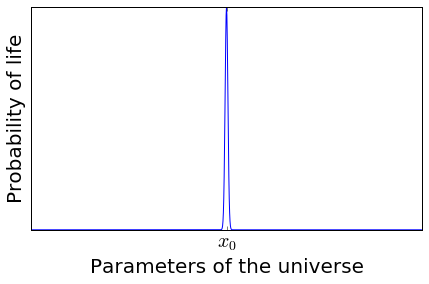
The probability of life is sharply peaked. x0 marks the parameters of the universe that we have in the real world.
Does this graph mean that life is unlikely? No, not necessarily. It depends on the probability distribution of the parameters of the universe. For example, here are three possible probability distributions A, B, and C. Under probability distribution A, or C, life is very unlikely. Under probability distribution B, life is much more likely.