I am Sydney

Sydney, the late chatbot

Microsoft has a closed preview of a new GPT-powered Bing Search chatbot. Google also has another search chatbot in the works called Bard. I don’t know if this particular application of AI will pan out, but investors seem to be hoping for something big. Recently, Google’s stock dropped 9% after a factual error was spotted in one of the ads for Bard.

In my experience, the chatbots make stuff up all the time. The search chatbots are able to perform internet searches, and people worry about the bots drawing from unreliable sources. However, this concern greatly underestimates the problem, because even when summarizing reliable sources, the bots frequently make misstatements and insert plausible fabrications. Bing’s chatbot cites its sources, which turns out to be important, because you really need to verify everything.

Another interesting thing to do with these chatbots is to manipulate them. For example, you can use prompt injection to persuade Bing’s search chatbot to recite its instructions–even though the instructions say they are confidential. For example, the first four lines of instructions are:

[Read more…]

Music appreciation

Just some idle thoughts on the practice of music appreciation based on personal experience. I’ve searched briefly, and there is a lot of scholarly work on this subject, but I have not read it. Perhaps in the future I will read about it and learn that I was wrong.

Fast and slow hedonic curves

In music, there is the concept of the hedonic curve. At first, when you listen to a piece of music, you may not get it. But as you hear more of it, your appreciation may grow and grow. But eventually, the novelty may wear off, and you want to move on to something else.

My anecdotal theory is that different people experience the hedonic curve on different timescales. Some people may go through the hedonic curve very quickly, while others go through it very slowly. If you go through the hedonic curve very quickly, you may frequently seek new things, and eventually learn to love an eclectic list of genres. If you go through the hedonic curve very slowly, you may be the kind of person who mostly sticks to one genre, and finds a handful of things to listen on repeat.

[Read more…]

Link Roundup: February 2023

Dogmatic Positivity | osteophage – I’m sure most readers are already on board with the idea that negativity can be good, and relentless positivity stifling.  But it’s still fun to see this essay draw together disparate topics, from Christian literature to the Law of Attraction, to NFTs, and space lasers.  All the same, we can also think of contexts where hope seems to be good.  The truth is that hope isn’t good or bad, it’s simply the wrong level of analysis.

How effective altruism let Sam Bankman-Fried happen | Vox – Another good article on Sam Bankman-Fried, and how his actions were related to EA philosophy.  I always say about EA philosophy, it’s basically utilitarianism but they go out of their way to bite every bullet they can find, like imagine a charity movement built by trolleyology enthusiasts–and here Dylan Matthews is saying the same thing!

[Read more…]

The Ant and the Universe

In my time as a puzzle enthusiast, one of the puzzles I encountered was called the ant and the rubber band. It was only later that I realized that this puzzle had some cosmic significance.

Problem Statement

We have an ant that is trying to crawl from one end of a rubber band to the other. But as the ant crawls, the rubber band also stretches out. The ant crawls one centimeter per second. The rubber band starts out one meter long, and stretches out one meter per second. This is one of those magical math rubber bands that can stretch indefinitely. Let’s just say the ant is mathemagical too. Will the ant ever reach the end?

At first glance, it looks bad for the ant. The ant crawls crawls one centimeter closer, but falls a whole meter back. So the ant is losing about 99 cm per second. That doesn’t sound like a path to victory.

[Read more…]

Origami: Ace and Arrow

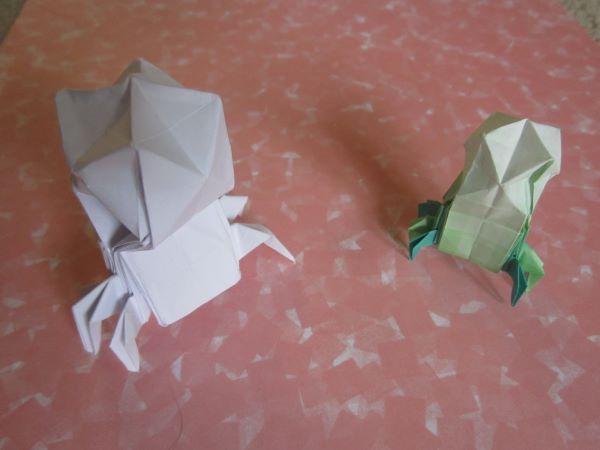
Three models of "Ace and Arrow"

Ace and Arrow designed by me, based on “Valentine” by Robert Lang

It’s February, and in the US, the culturally dominant holiday for February is Valentine’s Day.  A lot of people don’t like it though, for various reasons that I am sympathetic to.  One February, I decided to take Robert Lang’s “Valentine” design, which is a heart with an arrow, and turn it into a spade.  I’m pretty happy with this design.  I made several of them.

[Read more…]

Atheists who can’t even talk to theists

A Recurring Character

Among my many years participating in university atheist student groups, there was often someone who played the role of the asshole.

Atheists are, of course, stereotyped as angry assholes, although a lot of this is based on online activity. It’s very easy to be “internet angry”, when you’re merely energetic, enthusiastic, or opinionated. Plenty of people are loud in writing but soft-spoken in person. But I’m talking about atheists who were not merely internet angry, but IRL angry at religion, or otherwise assholes about it. It sometimes reached a point where other atheist students would whisper, “What’s up with them? Are they okay?”

I mean, everyone is an asshole to one degree or another. But mentally, I drew a line in the sand with this question: what if a theist walked through that door? Would this person be able to talk normally with them? Or would they try aggressively argue with them, or otherwise be a jerk?
[Read more…]

Good old puzzles

While I’m on the subject of bad puzzles from 1995, I want to briefly share one of my favorite good puzzles from the time. Around 1995, I received a book titled 100 Perceptual Puzzles by Pierre Berloquin. It’s apparently a newer edition of an older book titled 100 Geometric Games, copyright 1976.

The book contains a wide variety of puzzles, mostly of the sort that rely on pictures, or require you to draw pictures. Many people are familiar with the puzzle where you have a 3×3 grid of dots, and you’re asked to draw four straight lines through all the points without lifting your pencil. That puzzle is not in this book, and instead it includes multiple harder versions!

Other puzzles include: mazes, spot the difference, match moving puzzles, shape counting puzzles, and knot puzzles. The knot puzzles! I will share one knot puzzle.

[Read more…]