A need for atheism 101?

I often find myself arguing with people about what I see as basic points about atheists and the atheist movement. And a big problem is that I find these points to be extremely obvious, and can only discuss them with scorn or snark. I often want to tell people that it’s not my job to educate them, and they can educate themselves.

Unfortunately, there isn’t any good place to refer people. Despite the vast online presence held by atheists, decent atheist 101 resources are lacking.

I can speculate why: most introductory atheist materials address the adversarial relationship between atheism and religion. “Atheism 101” seems to consist of going over basic arguments for theism, and explaining why they’re wrong. And then there are a few extras, like why atheism doesn’t imply a lack of morality, and a lot of hairsplitting over agnosticism vs atheism.

Maybe the issue isn’t a lack of resources, but that the available resources simply aren’t to my satisfaction. When I want 101 resources, I often want them to explain “Yes, there is an atheist movement, no it is not a religion, why is this so fucking hard?” or “No, not every context is appropriate to argue about religion, but you’re effectively telling atheists to shut up,” or “Yeah some atheists are angry, and why shouldn’t they be?” Only, say it nicer than I would.
[Read more…]

Paper: First observation of gravitational waves

This is a repost from February, when LIGO reported its first observation of gravitational waves.  This is relevant because last month LIGO reported its second observation, also resulting from inspiraling black holes.

Today, the Laser Interferometry Gravitational-Wave Observatory (LIGO) reported the first observation of gravitational waves. You can read about it in The New York Times (warning: autoplay), on Sean Carroll’s blog, or in comic form. I went straight to Physical Review Letters.

As an undergrad, I did some work on LIGO. Specifically, I was a data analyst looking for exactly the kinds of gravitational waves here observed. Anyway, I’m happy to play the role of your local expert, providing some context and answering any questions.

[Read more…]

Linkspam: July 11th, 2016

First, some blogging network news, FtB has added a handful of new bloggers.  You can follow FtB News to keep up to date on that sort of thing.

Also, last month Richard Carrier resigned from FtB last month amidst allegations of sexual harrassment, and here’s FtB’s official statement on the matter.  In case anyone is wondering about FtB’s governance structure, at the moment it’s an anarchy, but we’re aspiring towards more concrete policies.

Without further ado, here are a few links from the past month:

Erasing LGBTQ Muslims & Islamic Homophobia – Heina addresses the Orlando Nightclub shooting from a queer ex-Muslim perspective.

Sometimes, I think about this issue by making an analogy from Muslim/queer to atheist/woman. The sexism in atheist communities doesn’t justify anti-atheist hate, nor does it mean that “atheist woman” is a contradiction. At the same time, the topic of atheist sexism is one that needs addressing.

BTW if you haven’t figured it out by now, I almost never blog about current events. I don’t enjoy it.

[Read more…]

Non-binary people who aren’t trans

As it says on the sidebar, one of my most important activist projects has been analysis of ace community demographics. More specifically, I volunteer expertise for the AVEN Community Census. As far as activism goes, it isn’t as glamorous as blogging, but IMHO the glamour of survey analysis is way underrated.

Anyway, let’s talk about the results on gender from 2014:

gender history

This figure was originally published here, but I made a slight revision. The width of each line is proportional to the percentage of the ace community. The color of each line indicates how many people in that subgroup identify as trans or unsure. “Other” refers to people who indicated that they were neither men nor women, but throughout this post I will refer to this group as non-binary.*

Within this figure is a cross-section trans politics. The biggest surprise to me was how few non-binary people identify as trans. But I should first offer brief comments about other features of the data.
[Read more…]

Illustrating the Higgs mechanism, Part 2

Part 1 is a prerequisite to this post.

Global gauge symmetry

Previously, I talked about the “direction” of the Higgs field, but what does that even mean? It doesn’t refer to a direction in space. There’s hardly any meaning to the direction at all. In fact, I could go ahead and change all the directions and it wouldn’t matter at all.

Two rows of circles. In the top row, labeled A, the Higgs field is pointing to the upper right. In the bottom row, labeled B, the Higgs field is pointing down.Figure 6.
[Read more…]

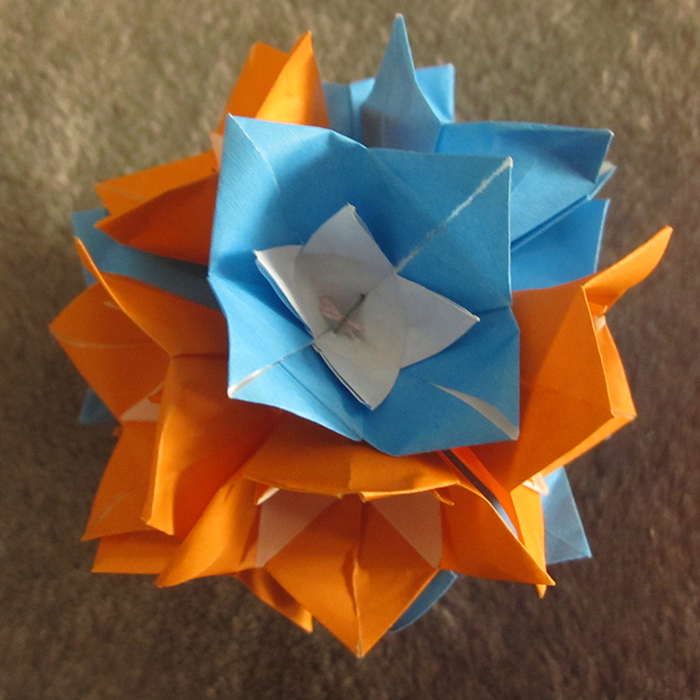
Origami: Snub Cube

IMG_0679 (small)
Snub Cube with Windows, from Unit Origami: Multidimensional Transformations by Tomoko Fuse.

The snub cube is one of those fancy Archimedean solids, for when you’re bored with the Platonic solids.  Each vertex lies at the intersection of one square and four triangles.  All together, there are 24 vertices, 60 edges, 32 triangular faces, and 6 square faces.  And can you imagine, it’s only made of 12 sheets of paper? [Read more…]

Illustrating the Higgs mechanism, Part 1

Most people are probably aware of the Higgs boson, long predicted, and recently observed by the Large Hadron Collider in 2012. The Higgs boson is was predicted by the Higgs mechanism, which is a theory that endows certain particles with mass.

Now, you might be wondering why I, a researcher in superconductivity, am talking about particle physics. In fact, the Higgs mechanism started out as a theory of superconductivity, and was soon imported to particle physics. I leave the historical details to your encyclopedia of choice.

To understand the superconductor/particle physics connection, consider the question: For which particles does the Higgs mechanism generate mass?

In particle physics, the Higgs mechanism generates mass for the W and Z particles, the mediators of the Weak force. The reason it’s called the Weak force is because it’s so short range, which is a consequence of the W and Z having mass. To my understanding, other elementary particles derive their mass from their interaction with the Weak force. (not quite correct, although link is correct.  See comments for details)

Transcript: There are four fundamental forces between particles: (1) Gravity, which obeys this inverse square law: F= G m1 m2 over d squared. (2) Electromagnetism, which obeys this inverse-square law: F = k q1 q2 over d squared and also Maxwell's equations (3) The Strong nuclear force, which obeys, uh... well, umm... it holds protons and neutrons together. It's strong. And (4) the Weak force. It [mumble mumble] radioactive decay [mumble mumble]--And those are the four fundamental forces!
From xkcd. Hover text: “Of these four forces, there’s one we don’t really understand.” “Is it the weak force or the strong–” “It’s gravity.” Accurate.

In superconductors, the Higgs mechanism generates mass for the electromagnetic field. This causes the electromagnetic field to be short range. Thus, if you apply an external electric or magnetic field, it will not penetrate into a superconductor of any appreciable size. The zero magnetic field is called the Meissner effect; the zero electric field leads to zero resistance current.

That’s the short explanation of what the Higgs mechanism does, but I wanted to explain how it works. Also, I wanted to try out this new doodling software…
[Read more…]