My games of the year 2025

I play 50+ video games every year, so why not make a list of the best ones? People like listicles, right?

Personally, I don’t have much interest in Game-of-the-Years.  Usually, the games at the top of these lists are games I already heard about, because people had been talking about them!  So for my list, I’m doing things differently.

  • I’m only including games I played in 2025. That disqualifies Expedition 33, Silksong, and Hades 2! Older games are eligible if I happened to play them in 2025.
  • I am presenting the list in reverse order, with the top games first.  The top games are already widely recognized.  But a bit further down the list is where it gets more interesting, as I talk about obscure games that appealed to me personally.  I’d like to talk about these games without trying to claim that they’re actually the best games ever.

[Read more…]

Estimating true ratings

If you take a rating website, say IMDB, or Goodreads, and you sorted items purely by review scores, the stuff that would float to the top would be pretty obscure. That’s because the easiest way to maintain a perfect score is to have a very small sample size.

So, a math question: what is the statistically “correct” way to handle this?

In this analysis, I will assume there exists a “true” average review score, and we are trying to estimate it. The “true” average is the average that would be attained if there were a sufficiently large sample of reviewers. We’re not imagining that everyone in the world is reviewing the same book (for example, we don’t expect book reviews to reflect the opinions of people who don’t like reading books period). But we could imagine, what if there were a billion identical yet statistically independent Earths, and we averaged all their review scores.  Obviously it’s very hard to come across a billion identical yet statistically independent Earths, and that’s why we use math instead.

This premise may be fairly questioned. I once discussed the philosophical problems with review scores, including questioning the very idea of taking averages. But here, I’m just focusing on the math for math’s sake.  And, I really mean it, it’s hardcore math.  If you don’t want math, just skip to the last section I guess.

[Read more…]

Margaret, the hoarder

This is a true personal story, although not quite true, and not quite a story. I have mixed in some lies to give people some privacy, and to shave off some technical details.

Margaret is a hoarder. She maintains a household full of junk. Mountains of clothing, overflowing cabinets of food, bags full of bags, blocked closets full of nobody-knows-what. The top layer is a thin coating of decorative tchochkes. The bottom layer is a collection of packed cardboard boxes, untouched since the house repairs that occurred 15 years ago.

The kitchen has no counter space, and much work is done on a pull-out cutting board, which blocks the utensil shelf directly beneath it. The dining table is unusable, forcing people to set up a temporary table in the space that the front door would open into. There are not one but two expensive television sets, one in front of the other, and the second one partially obscured by other junk. The house is composed of a series of single-lane walkways; people must back up and step aside to let others pass by, and wear close-toed shoes to avoid injury.

[Read more…]

Link Roundup: January 2026

This month, the ace journal club discussed a quoiromantic manifesto, translated from Japanese!  Probably not the easiest read if you don’t have prior familiarity, but we thought it was great stuff.

The World of Pride and Prejudice is Not the World of Purity Culture | Tell Me Why the World is Weird – Christian purity culture frames itself as a continuation of centuries-old practice, but if you look back at history there are many differences.  This is a pretty insightful look at the idiosyncrasies of purity culture, by way of comparison to Jane Austen’s famous 1813 novel.

Exposing a $10,000,000,000 Debt Industry | Coffeezilla (video, 16 min) – Hey, I know a bit about the debt settlement industry.  When someone is having trouble with debt, a debt settlement company will offer to step in between the lender and debtor, and negotiate to pay only a fraction of the debt (maybe about half).  In return, the debt settlement company takes a cut.  It ruins your credit score, but could in theory reduce your debt.  But I wasn’t familiar with the abuses and scams in the industry.  That’s something that should be pursued by the consumer financial protection bureau (CFPB) as a violation of UDAAP oh wait

[Read more…]

Experience with AI coding

In the past year, myself and many other people who program for a living started using AI coding assistance. I’m just going to plainly discuss my experience, and ramble about some related issues.

This explanation is primarily for the benefit of people who do not code professionally, and thus have little idea what’s going on. If you code professionally, then you already know, and have formed your own opinion about it, which you are welcome to keep. But it’s worth noting that lots of different kinds of people code for a living. It’s not just software engineers, you know. I code on a daily basis but I’m a data scientist. The reader should be cautious about generalizations because what’s true of one profession may not be true of another.

[Read more…]

Origami: Free pleating

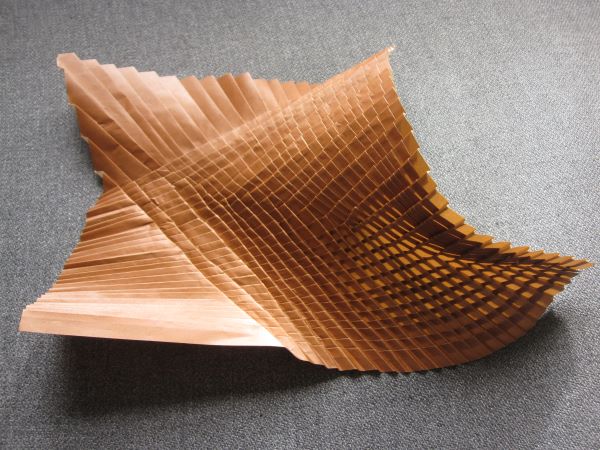
Free pleating

A free pleating model, made in a workshop with Goran Konjevod

I made this a couple months ago in an origami workshop with Goran Konjevod.  The subject of the workshop was how to pleat paper without pre-creasing.  It’s an improvisational technique where you don’t worry about making folds equally spaced or parallel.  You just approximate, and watch how it distorts the paper.  And since you’re approximating, you can do stuff like making the lines slightly non-parallel.

My style generally involves more careful planning and precreasing, but I like this technique too!  I imagine if you do it enough, you gain some ability to predict how it will turn out.