Abstinence Only. Again.

Attribution: PittNews/CC.

Attribution: PittNews/CC.

Several years ago, David Wiley, a professor of health education at Texas State University, was discussing human papillomavirus in one of his classes. The virus, known as HPV, is the most common sexually-transmitted disease. Often it is harmless and infected individuals aren’t even aware they have it. But it can also cause cancer, including of the cervix.

Wiley was discussing all of this with his students — the different types of HPV, the connection between HPV and cervical cancer, and its prevalence; “you know, just an intro, lower-level course,” he recently recalled — when a male student raised his hand with an earnest question: What was his risk of contracting cervical cancer?

“And I don’t know what’s sadder,” Wiley told The Intercept, “that he asked that question or that really nobody in the classroom even laughed because they didn’t know either.”

[…]

The federal government began funding so-called Abstinence-Only Until Marriage programs in 1981 as a way to encourage “chastity” and “self-discipline.” Since then, the feds have poured more than $2 billion into this strategy — commonly known as “ab-only” — without any proven positive effects, like delaying sexual activity or avoiding unintended pregnancy. In recent years, that funding had been in decline, in part because research — and practical experiences like Wiley’s — shows that the programs do not work. But in an ironic twist, they’re now making a comeback. Trump, an alleged serial adulterer who has bragged about sexually assaulting women and has been accused of such behavior close to two dozen times, has asked that abstinence funding be increased. And in the budget deal he signed last month, he got his wish, enough to bring total spending on abstinence up to $100 million for 2018.

[…]

Under Obama, funding for ab-only programs decreased as new emphasis was placed on using science to develop evidence-based sexuality and reproductive education strategies. But the Trump administration is trying to reverse course. Along with the return to Bush-era funding levels to push the ab-only message, Trump has appointed anti-abortion, anti-birth control, and pro-ab-only advocates to positions within the Department of Health and Human Services and has yanked funding for a successful evidence-based teen pregnancy prevention strategy.

[…]

Among the biggest proponents of ab-only programs — and their rebranding — is Valerie Huber, a Trump appointee to HHS. Huber started her career promoting ab-only programs in her son’s school before moving on to manage the ab-only program at the Ohio Department of Health. She became the president of the National Abstinence Education Association in 2007. (The advocacy organization has also rebranded itself. It’s now known as Ascend.) Huber acknowledges that the term “sexual-risk avoidance” was taken from public health, but insists it was appropriately chosen. “I bristle at the terminology ‘abstinence only,’ because our programs are so holistic,” she told Focus on the Family’s magazine “Citizen,” and address “a whole battery of different topics that surround a young person’s decision whether to have sex or not.”

This is, of course, exceedingly bad news. If you’re a parent who prefers their child to be prepared and safe, best to tackle comprehensive sex-ed at home, or an outside of school class. This will affect some states much more than others, so it’s important to find out just what the sex-ed in your child’s school is like. Ab-only also cuts out all queer students, and teaches girls that being assaulted or raped is their fault, emphasising dress and behaviour.

The Intercept has an in-depth article about this mess, recommended reading.  As the Tiny Tyrant has a vested interest in giving the lunatic evangelicals whatever they want, and they want a whole lot, you might want to have a click over to Religious Dispatches to read about Project Blitz. That’s enough to scare anyone silly.

Word Wednesday.

Panache

Noun.

1: an ornamental tuft (as of feathers) especially on a helmet.

2: dash or flamboyance in style and action: verve.

[Origin: Middle French pennache, from Old Italian pennacchio, from Late Latin pinnaculum small wing, related to pinnacle.]

(1553)

“Potential enemy?” Ponce de Leon made a face. “It lacks panache. I prefer to be called ‘rogue’ or ‘outlaw’.” – Unbound, Jim C. Hines.

Indian Country Today Is Back!

Who Will Be Our First Founding Member? The new Indian Country Today is launching a membership drive and an auction. Top bid will be forever known as Indian Country Today’s: “First Founding Member.”

Who Will Be Our First Founding Member? The new Indian Country Today is launching a membership drive and an auction. Top bid will be forever known as Indian Country Today’s: “First Founding Member.”

Indian Country Today is back! The NCAI has taken over, and this is grand news.

From September through February I have heard about the importance of saving Indian Country Today. So many people across Indian Country had the same idea:

What if … What if we all contribute?

What if I step up to make certain Indian Country has solid, accurate, fair reporting?

Is it worth it to save this voice? A national media platform for Indian concerns?  And how much will it take?

Yes. Yes. And the answer is a lot  — or perhaps a few tax-deductible dollars if we all contribute together.

We are building a new Indian Country Today on a public media model. We will have some advertising, but most of our resources will come from members, tribes, enterprises, and non-profits.

We need you.

We are launching a membership drive and an auction.

The membership drive will solicit help from our “members” as $100 Founding Members, $500 Sustaining Members, and $1,000 for Premier Members.

Unlike public media we don’t have nifty gifts as a thank you. No t-shirts. No coffee mugs. Just a better news report. We want to use the money to build our news operation, a multimedia reporting platform about what’s going on across Indian Country. We’ll stretch your dollars by partnering with other organizations, and amplify our reporting by letting others repurpose our editorial content.

We will serve.

This is great news, but to work, ICT needs help from people. If you can drop a few dollars into the fund, please do, and if you can’t do that, please, please, spread the word, get it out everywhere! You can read more by Mark Trahant at Indian Country today, or go straight to the membership drive. This is so very important, it’s vital for Indigenous peoples to have a voice.  Also, be sure to check out the new edition, there’s all manner of interesting reading!

ETA: I should point out that it’s possible to donate $5.00 to the membership drive, which is all I can manage right now, but I’ll be dropping more fives each week.

Word Wednesday.

Crotchet

Noun.

1: obsolete a: a small hook or hooked instrument b: Brooch.

2a: a highly individual and usually eccentric opinion or preference b: a peculiar trick or device.

3: quarter note syn, see caprice.

[Origin: Middle English crochet, from Anglo-French crochet, croket.]

{14th Century).

“It had occurred to Jakob that he’d left his beloved tobacco back at the house. A few puffs would perhaps have helped his mood a bit, but then he remembered, Johann Lechner, despised tobacco. If Schongau had not been a Catholic town through and through, the secretary could have been viewed as a crotchety, pleasure-hating Protestant.” – The Play of Death, Oliver Pötzsch.

Word Wednesday.

Meretricious / Vapid / Poppycock

Meretricious

Adjective.

1: of or relating to a prostitute: having the nature of prostitution, meretricious relationships.

2a: tawdrily and falsely attractive. b: superficially significant: pretentious.

-meretriciously, adverb.

-meretriciousness, noun.

[Origin: Latin, meretricius, from meretric-, meretrix prostitute, from merēre to earn.]

(1626)

“I’ll say you’re right,” said Mark. “Unfortunately, Miss Marple, we didn’t realize that. We wondered what the old boy saw in that rather insipid and meretricious little bag of tricks.”

Vapid

Adjective: lacking liveliness, tang, briskness, or force: Flat, Dull.

-vapidly, adverb.

-vapidness, noun.

[Origin: Latin vapidus flat-tasting; akin to Latin vappa flat wine and perhaps to Latin vapor steam.]

(1656)

“His face grim, Conway Jefferson lay remembering and thinking. Before his eyes he saw again the pretty, vapid face of Ruby.”

Poppycock

Noun: empty talk or writing: nonsense.

[Origin: Dutch dialect pappekak, literally, soft dung, from Dutch pap pap + kak dung.]

(1865)

“And she didn’t care tuppence for Mr. Jefferson. All that play of affection and gratitude was so much poppycock.”

All quotes from The Body in the Library by Agatha Christie.

Behind the Iron Curtain Part 2 – Education

These are my recollections of a life behind the iron curtain. I do not aim to give perfect and objective evaluation of anything, but to share my personal experiences and memories. It will explain why I just cannot get misty eyed over some ideas on the political left and why I loathe many ideas on the right.


I was born towards the end of summer, which effectively means I was almost a year younger than many of other kids who were supposed to go to school that year. This has led to concerns whether I will be mentally mature enough to cope so I was brought in for preliminary evaluation in the spring prior to my first school year. I do not remember almost anything of it, only that it was a pleasant conversation with some old lady whom I did not know.

After I was deemed eligible, the education started. It was pretty normal as an education anywhere else at that time. Children sitting in rows in cheap, uncomfortable chairs behind small tables. Teacher standing in front of the class talking. Don’t talk unless asked, raise your hand if you want to say something or ask.

The regime had somewhat ambiguous attitude to education. On one hand it has recognized that knowledge is empowering and completely ignorant and uneducated populace is useless. Therefore eight years of elementary school were compulsory and the regime took pride in nearly universal literacy and numeracy.

On the other hand it has also recognized that educated and well-informed people are harder to control because they have that unpredictable tendency to be critical of the information presented to them and reach their own conclusion. which has proven correct, since the velvet revolution was initiated by massive student protests.

So the higher education was theoretically available to anyone who was capable, but there were caveats that had nothing to do with capability and everything to do with how much one was perceived to be a threat.

Ever since childhood I was recognized as a university material. I was top of the class and despite year-long health problems that impeded me significantly for a few years I did not need to repeat classes. My father was a member of the communist party and of Peoples Militia, and he was working class. This was considered a good thing in my yearly evaluations and was always mentioned together with my good notes. However one of my uncles was a political dissident who has emigrated to USA and was in the employ of US government. This was considered a bad thing although I was never told this and I only learned about this later on. Further, by a twist of destiny, my father, the communist, was the only one from the family who remained on good terms with his dissident brother. So there was always a big question mark about my future education and whether I will be allowed to pursue either my love of science or my passion for painting.

The regime seems to have had some sort of poorly thought out and poorly formulated concept of hereditary sin. Children and even grandchildren of aristocrats or bourgeois or anyone really even remotely related to dissidents were treated as a threat and were put under close scrutiny. As I grew older I learned about this and I have tried to understand it but I never did. It did not make any logical sense to deny someone higher education just because their grandfather was a bourgeois factory owner. They are not factory owner, they live in this wonderful socialist country where everyone is equal just like everyone else. They did not do anything wrong, their grandfather did. Where is the logic in this?

That way I learned there is another iron curtain in addition to the corporeal one in the forests. An invisible social barrier creating a tangled maze nearly impossible to navigate, because the rules were never clear and were subject to the whims of the powers that be. There was only one sure way to higher education, and that was being a relative of a high party affiliate. Everyone else could be denied for reasons they will never fully learn.

Luckily for me when I was a the end of elementary school, the regime fell and the Iron Curtain was torn down. And with it fell the artificial barriers that might prevent me from getting adequate education. There were other barriers still and new ones emerged, but that is a different story.

Word Wednesday.

Crepuscular

Adjective.

1: of, relating to, or resembling twilight: Dim.

2: occurring or active during twilight: Crepuscular insects.

[Origin: Latin crepusculum, from creper dusky.]

(1668)

“The Arcadian hated this time of day. That crepuscular transition between the dying day and the not-yet-born night. It was the heavy trudge home, the missed opportunities of the day, the optimism that had arrived with morning now transformed into failure and sadness. Or maybe it was just him. Maybe everyone else liked it. Thought it contained the possibility of fun, adventure. Looked forward to seeing what the night brought.

Maybe.” – The Doll’s House, Tania Carver.

New Game: Foundation.

Foundation is a grid-less, sprawling medieval city building simulation with a heavy focus on organic development, monument construction and resource management.

The game features in-depth resource management akin to the Anno (Dawn of Discovery) series, expertly mixed with city building elements from SettlersSimCity, and Pharaoh all topped with narrative encounters inspired by Crusader Kings II to create the ultimate medieval ant-farm simulation!

In this strategy city-builder economy simulation game, players must create a prosperous settlement as the newly appointed lord of a region untouched by man.

Setting to redefine the city-builder genre, Foundation puts the emphasis on the organic aspects of urbanism in the cities of old, powered by Polymorph Games’ in-house game engine, Hurricane, which allows for full mod support and is optimized for the thousands of moving parts that come with building humongous cities.

Among other things, the engine provides the player with robust building tools to create countless unique monuments that can then integrated into your settlement.

With medieval architecture and urbanism at the forefront of its design, Foundation’s vision is to allow players to recreate cities of that period as they envision them or even as they really were.

You can read and see more about Foundation at Medievalists, or just head straight to the Kickstarter, which has garnered much more than the initial ask.

Word Wednesday.

Synonymous

 
Adjective.

1: having the character of a synonym; also: alike in meaning or significance.

2: having the same connotations, implications, or reference.

-synonymously, adverb.

(1610)

“I had decided that if there was a God, he was a cruel sonofabitch to allow the things he allowed. Especially since he claimed his name was synonymous with love. It seemed to me that he was little more than a celestial Jack the Ripper, offering us, his whores, rewards with one hand, smiling and telling us he loved us, while with the other hand he held a shiny, sharp knife, the better with which to disembowel us.” – The Complete Drive-In, Joe R. Lansdale.

Word Wednesday.

Mordant

 
Adjective.

1: biting and caustic in thought, manner, or style: incisive.

2: acting as a mordant.

3: burning, pungent.

-mordantly, adverb.

[Origin: Middle French, present participle of mordre to bite, from Latin mordēre; perhaps akin to Sanskrit m dnāti he presses, rubs.]

(15th Century)

Mordant, noun:

1: a chemical that fixes a dye in or on a substance by combining with the dye to form an insoluble compound.

2: a corroding substance used in etching.

(1791)

Mordant, transitive verb: to treat with a mordant.

(1836)

“Neither of us was pleased to leave Bancroft behind. There was always a chance that he might decide he’d recovered sufficiently to be interviewed while our backs were turned. Maitland, of course, didn’t have an evening with Maeve as consolation, and he was mordant company all the way back to the nick.” – The Reckoning, Jane Casey.

The Medieval Method of Cooking Octopus.

Grilled octopus – photo by Alpha / Flickr.

Grilled octopus – photo by Alpha / Flickr.

“This is a vile fish of no value; therefore cook it the way you want.” ~ Liber de Coquina, a 14th century cookbook.

I’ll admit upfront that I’m a fan of octopuses, when they are alive. I don’t care for them in the least when dead, regardless of the cooking method.

Platina’s Right Pleasure and Good Health, a 15th-century work from Italy, offers these thoughts:

On octopus – The polypus has been named because it has many feet. It uses its gills as feet and hands, and its tail, which is two-pronged and is pointed, while mating. They are very pleased with smell, and they eat the flesh of shellfish. They carry everything into their house and then separate the shells from the red meat. It hunts the small fish which are swimming near the shells. You season a cooked octopus with pepper and asafetida.

Platina also has this to add: Whatever way you cook it, you will say it is bad. Doesn’t seem to much point with such a conclusion.

Meanwhile, The Book of Sent Sovi, a 14th-century Catalan text, gives this recipe:

To Stuff Octopus – If you want to stuff octopus or squid, take the octopus and wash it well, boil it, cut off the arms, and take out what is inside. Chop the arms all together with parsley, mint, marjoram and other good herbs. You can chop another kind of fish if the tentacles are not enough. Put in the best spices that you can find. Make sure that the octopus is cleaned well. Put in the stuffing, and put in raisins and scalded garlic and fried onion. Then make almond milk with the broth that has boiled the fish, and put it in a bowl or a casserole together with the octopus; in the milk you can put a little verjuice and good spices, the best you might have, and oil. You can cook it in the oven or on iron trivet with live coals beneath.

If you’re just dying for medieval cooked octopus, that sounds like an interesting recipe to work out.

Via Medievalists.

In exciting news, the Newberry has opened up access to 1.7 million historical images!

The Newberry has announced a major revision to its policy regarding the re-use of collection images: images derived from collection items are now available to anyone for any lawful purpose, whether commercial or non-commercial, without licensing or permission fees to the library.

You can read much more here.

Medieval Courses Online.

There is now a unique range of medieval and Tudor courses which can be downloaded or followed online, complete with the full text from www.medievalcourses.com – once registered students have unlimited access to study at their own pace, and can complete online quizzes at the end of each module. The courses are professionally produced in thirty minute lessons and include up to 11 hours of teaching, plus bonus materials, reading lists and links to other resources. The tutors are all established experts in their field.

The courses are all very reasonably priced. You can read much more, including a summary of the offered courses here.

Word Wednesday.

Penumbra / Brio / Multifarious / Inexorable

 
Penumbra, noun. Plural -brae.

1 a: a space of partial illumination (as in an eclipse) between the perfect shadow on all sides and the full light. b: a shaded region surrounding the dark central portion of a sunspot.

2: a surrounding or adjoining region in which something exists in a lesser degree: fringe.

3: a body of rights held to be guaranteed by implication in a civil constitution.

4: something that covers, surrounds, or obscures: shroud.

-Penumbral, adjective.

[Origin: New Latin, from Latin paene almost + umbra shadow.]

(1666)

The allure and glamour of radical surgery overshadowed crucial developments in less radical surgical procedures for cancer that were evolving in its penumbra.

Brio, noun.

1: enthusiastic vigor: vivacity, verve.

[Origin: Italian.]

(1734)

Yet, even lacking such targets, Frei and Freireich had cured leukemia in some children. Even generic cellular poisons, dosed with adequate brio, could thus eventually obliterate cancer.

Multifarious, adjective.

1: having or occurring in great variety: diverse.

-multifariousness, noun.

[Origin: Medieval Latin multifarius, from Latin multifariam in many places.]

(1593)

The biological characteristics of tumors were described as so multifarious as to defy any credible organization. There seemed to be no organizing rules.

Inexorable, adjective.

1: not to be persuaded, moved, or stopped: relentless.

-inexorability, noun.

-inexorableness, noun.

-inexorably, adverb.

[Origin: Latin inexorabilis, from in– + exorabilis pliant, from exorare to prevail upon, from ex– + orare to speak.]

(1542)

For an oncologist in training, too, leukemia represents a special incarnation of cancer. Its pace, its acuity, its breathtaking, inexorable arc of growth forces rapid, often drastic decisions; it is terrifying to experience, terrifying to observe, and terrifying to treat.

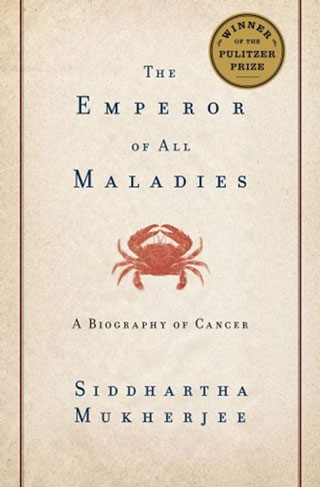
All quotations from The Emperor of All Maladies by Siddhartha Mukherjee.