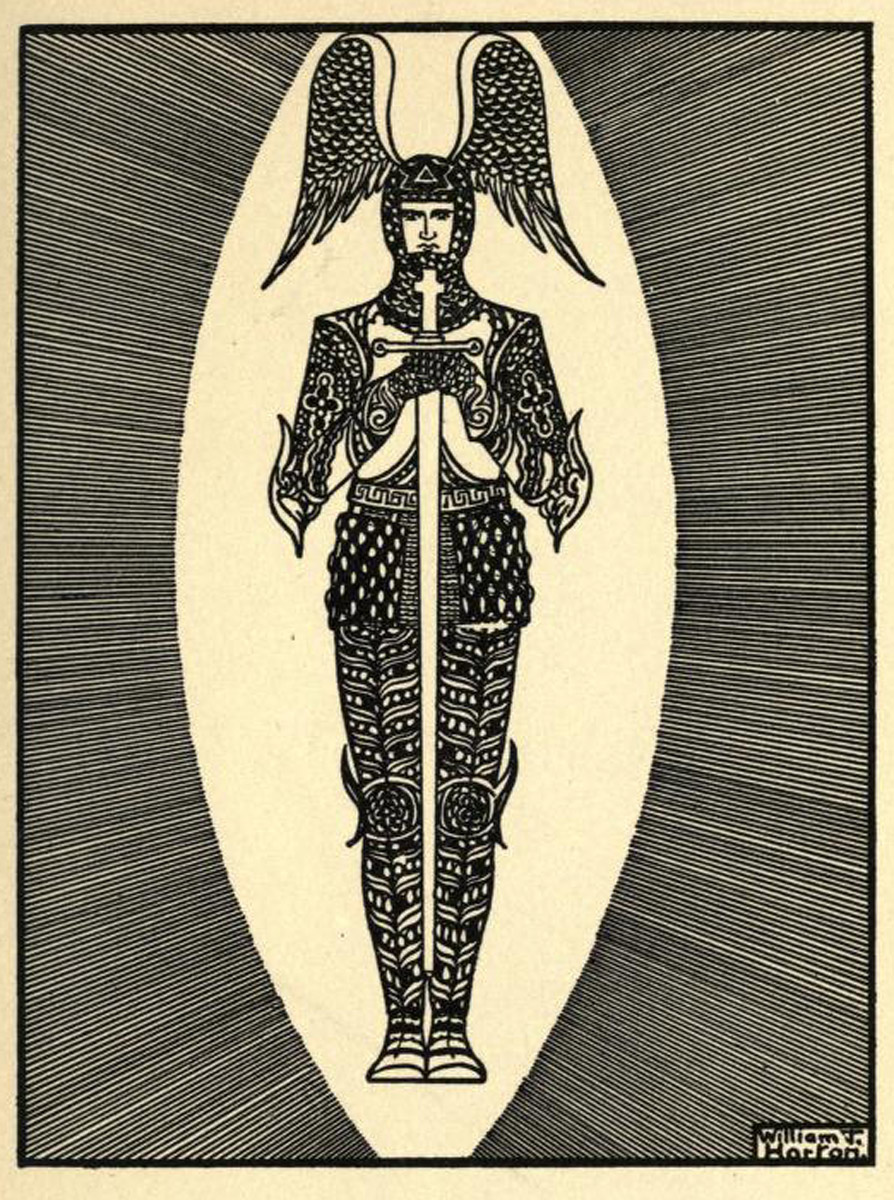
The Twelve Types of Drunkenness.

Oswald von Wolkenstein – Portrait from the Innsbrucker Handschrift, 1432.

In three sections of the poem “Und swig ich nu,” Oswald lets us read (or hear) just how much experience hanging around drunk people he has accumulated over the years.

Often a person believes himself to be so wise
and believes to gain highest fame thereby,
when the juice of the grapes has affected him negatively.
The next one believes that he is so rich
that even the emperor might not be an equal to him.
The third appears like an extremely hungry horse,
so no one can push enough of fresh or rotten food
into the ever open mouth.
The fourth one screams cries over his heavy sins,
and his heart is passionately in flames out of deep repentance
for strange reasons that no one can comprehend.

The fifth one desires to do unchaste actions,
to which he is dedicated day and night,
once he has become addicted to the power of wine.
The sixth has a miserable practice:
He condemns the soul through [false] oaths
so that she will be entirely exhausted when facing God.
The seventh is ready to fight, he growls like a dog
held by a chain and who barks all the time;
its round head is ready for a fight.
The eighth becomes so happy out of drunkenness
that he is ready to sell his honor, property, wife, and children;
the evilness of drunkenness shows in him.

The ninth helplessly becomes crazy,
everything what he knows, sees, or hears,
he presents openly to everyone.
The tenth fights against sleep.
The eleventh sings wild songs
and screams totally uninhibited both in the evening and in the morning.
The twelfth becomes so drunk from heavy drinking
that he feels the alcohol already at the top portion of his throat
and voluntarily pays a tribute to the innkeeper.

(trans. Albrecht Classen, The Poems of Oswald von Wolkenstein)

You can read more about Oswald von Wolkenstein here.

See also:

The Anatomy of Drunkenness, by Robert Macnish, fifth edition; 1834; W.R. M’Phun, Glasgow.

The expanded fifth edition of Robert Macnish’s The Anatomy of Drunkenness, a work by the Glaswegian surgeon, first published in 1827, and based on his doctoral thesis of a year two years earlier. The book examines inebriety from a wide range of angles: although that caused by alcohol is the main focus, he also explores use of opium (popular at the time), tobacco, nitrous oxide, and also other various poisons, such as hemlock, “bangue” (cannabis), foxglove and nightshade. Included in his examination are some wonderful descriptions of the different kinds of drunk according to alcohol type, methods for cutting drunkenness short, and an outlining of the seven different types of drunkard (Sanguineous, Melancholy, Surly, Phlegmatic, Nervous, Choleric and Periodical). The seventh chapter of the book examines the phenomenon of “spontaneous combustion” which apparently tends to strike drunkards in particular.

You Can’t Free My Slaves!

Steve Prattor, Sheriff of Caddo Parish in Louisiana, addresses reporters (Screen cap).

Apparently, Sheriff Steve Prattor is not the least abashed in hollering out his displeasure over non-violent convicts being released early.

Steve Prattor, the Sheriff of Caddo Parish in Louisiana, is not a fan of his state’s new criminal justice reforms that will free many prisoners convicted of nonviolent offenses earlier than they had been scheduled to be released.

In a press conference held this week, Prattor said that keeping some of the “good” prisoners in jail was necessary for the prisons to keep functioning because they could provide needed labor that you couldn’t get out of more violent and dangerous prisoners.

“The [prisoners] that you can work, the ones that can pick up trash, the work release programs — but guess what? Those are the ones that they’re releasing!” Prattor fumed in his attack against criminal justice reforms. “In addition to the bad ones… they’re releasing some good ones that we use every day to wash cars, to change the oil in our cars, to cook in the kitchen… well, they’re going to let them out!”

My, my, you’re going to lose your slaves, what a pity. Perhaps you should learn to wash your own cars, how to change the oil in them, and strap an apron on, Sheriff, and get your arse to work.

Via Raw Story.

Bible Logick.

Bryan Fischer has come up with a novel case for being pro-death penalty: hey, good for the environment!

While making what he claimed was a biblical case for the death penalty on his radio program yesterday, Bryan Fischer said that executing criminals is something that environmentalists should support because that is the only process through which the land can be cleansed of “pollution.”

Citing Numbers 35, Fischer declared that “the land is polluted and defiled by murder; when innocent blood is shed, the land is polluted.”

As per usual with christians, one verse is selected while ignoring the larger context. Numbers 35 is all about building cities, and how murderers can flee to said cities and find refuge, until they are properly judged for their act and the revenger (nearest kin to the murdered person) is allowed to kill them. There’s a whole lot about how only the revenger can be the one to administer capital punishment. Basically, this is a chapter detailing the rules and manners of being bloodthirsty, and where you are allowed to spill blood, and where you aren’t. Miss Manners for killers.

Also, Mr. Fischer doesn’t seem to be overly concerned by the difference between literal and figurative. One particular definition of pollution does not automatically apply to the other definitions. I’d urge you to look at a dictionary, could be right helpful.

“If you’re an environmentalist and you care about the pollution of the land of the United States of America, then you want to see murder stopped and you want to see murder avenged,” Fischer said. “You want to see justice done in the case of murder because Moses says in verse 33, ‘No atonement can be made for the land for the blood that is shed in it except by the blood of the one who shed it.’ So if we want to see our land cleansed from the pollution of the shedding of innocent blood, it’s not just enough to lock people up for the rest of their lives.”

Well, if all it takes to clean up the environment is to condemn all those who have spilled blood, that’s an outright condemnation of every human on the planet, given our constant wars and all; not one society has ever stood up and said “nope, we refuse. no war.” Going by biblical standards, just being unhappy with wars isn’t enough, so we all need to die. Granted, that would do wonders for the environment. Let’s agree that’s not a great solution though, especially as you wouldn’t be able to get everyone on board with that idea.

If you’re going to stick with Numbers, then only the closest kin of those murdered can carry out executions, and those executions must be done in specific cities, at specific times. Good luck with that one, Mr. Fischer. If you want to insist on this spilt blood is the worst pollution ever, and you believe in Jehovah, then your target is clear: kill that fucking god of yours, because as killers go, it would be one of the worst.

I’ve lost track of how many times I’ve recommended Drunk With Blood by Steve Wells, but if you haven’t read it, please do. If you’re a christian, don’t be afraid of it, nothing but bible in it (KJV too), with a bit of clarifying commentary. What it will do is drive home the sheer awfulness of this god, the absolute lack of consistency anywhere in the bible, and the sheer delight this fiendish creation of a god takes in being a bloodthirsty psychopath with all the restraint of sugar-loaded toddler.

Via RWW.