Sunday Facepalm.

Synonyms for rough language: obloquy, scurrility, vulgarity, revilement, abuse, invective, ribaldry, abusive language, reviling, scurrilousness.

Oh, there’s no end to the defenders of the Great Vulgarian™. This time around, it’s Mary Colbert, who makes the case for the Tiny Tyrant’s rough language.

Colbert said that Christians who oppose Trump because of his use of “rough language” must also “have a problem with Jesus because he spoke to the Pharisees and Sadducees and said, ‘You vipers, you snakes.’ He referred to Herod as a fox and then there is the account of the woman he called a dog. So if you want to find offense, you’ll find offense in anything.”

Oh look, someone in the bible isn’t consistent, what a shocker. Yes, Jesus was often an asshole, and easily irritated, to say the least. That shouldn’t make being an asshole an admirable thing. From Mark 7:

7:25 For a certain woman, whose young daughter had an unclean spirit, heard of him, and came and fell at his feet:
7:26 The woman was a Greek, a Syrophenician by nation; and she besought him that he would cast forth the devil out of her daughter.
7:27 But Jesus said unto her, Let the children first be filled: for it is not meet to take the children’s bread, and to cast it unto the dogs.
7:28 And she answered and said unto him, Yes, Lord: yet the dogs under the table eat of the children’s crumbs.
7:29 And he said unto her, For this saying go thy way; the devil is gone out of thy daughter.

That’s right shitty behaviour, but it’s also not “grab them by the pussy”, and it certainly doesn’t justify Trump in any way.

Colbert said that Trump “is a man of his word, he says what he means and he means what he says.

No. Just no. Trump is not a “man of his word” at all, in any fashion. He spews shit, turns right around and denies spewing shit, spews different shit, lather, rinse repeat. Trump is also quite well known for going back on his word when it comes to things like paying employees or his bills. Trump doesn’t mean what he says, he doesn’t have the slightest idea of what he means, he just brays, and if he thinks at all about what he said, it’s after he’s vomited words all over the place. As for “means what he says”, is that like the whole healthcare and wall business? Because he didn’t get very far with that nonsense, did he?

Well, what character does that imitate? Who is that? God. God says what He means and He means what He says, so I believe that God saw in the character of Donald Trump a fighter.”

:chokes on tea: Jehovah is one of the most awful, evil, psychopathic characters ever invented. The Tiny Tyrant is an awful, evil, amoral narcissist. Yeah, okay, it’s a good fit, but that doesn’t make it right. Trump is not ‘god’, and he’s not emperor, and he’s not specially chosen.

“The church has had its butt kicked for the last 100 years,” Colbert said, adding that God chose a brawler like Trump because He knew that America could not survive with a “mamsy-wamsy, love and peace kind of a president.”

The ‘church’ needs its collective arse kicked a whole lot more. Seems to me that uStates could really do with a mamsy-wamsy, love and peace kind of a president. A real president, one who knows how to do the job, and doesn’t think pursuing peace, inclusivity, and justice is stupid. I’d be good with that. I’d certainly be happier with that than a madman always eyeballing nukes.
The full story and video is at RWW.

Guess Me.

Guess Me, a curious collection of enigmas, charades, acting charades, double acrostics, conundrums, verbal puzzles, hieroglyphics, anagrams, etc. Compiled and arranged by Frederick D’Arros Planché; 1879; Pott, Young and co. in New York.

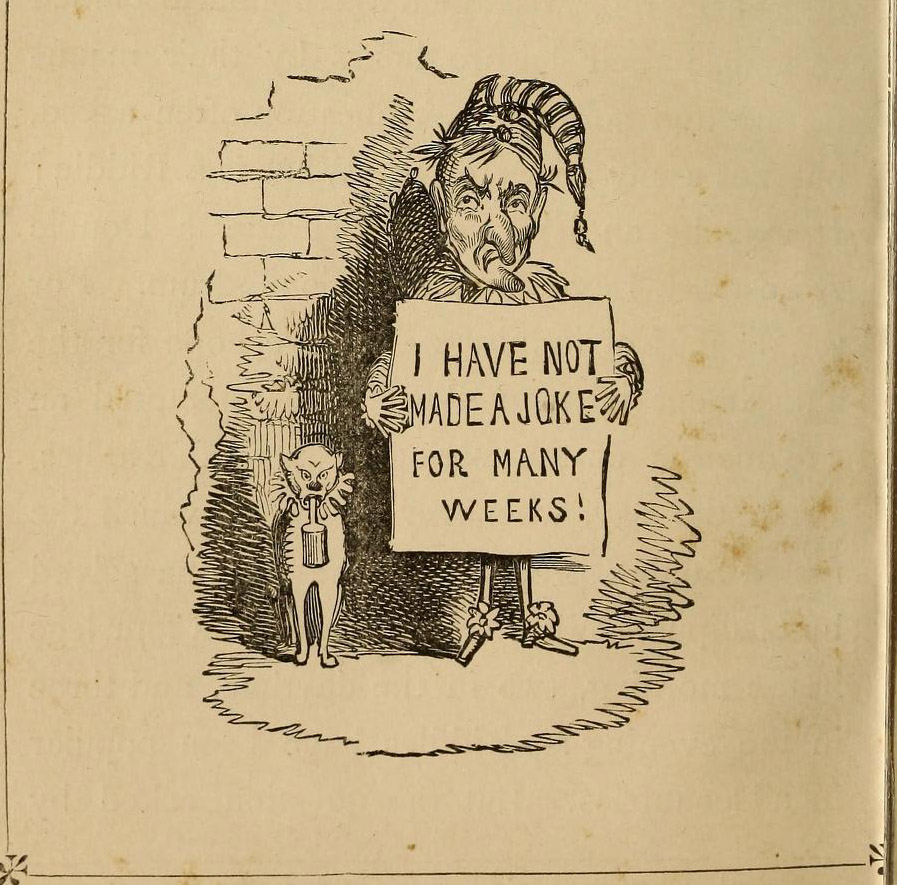
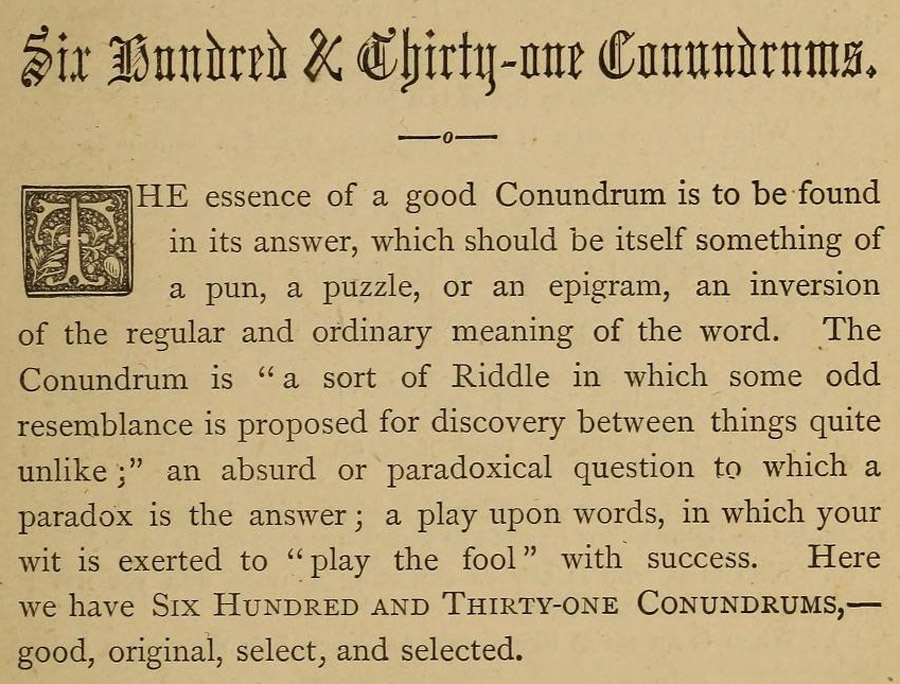
Illustrated by George Cruikshank among others, this example of good old-fashioned and wholesome entertainment offers a collection of enigmas, conundrums, acrostics, “decapitations”, and a series of incredibly tricky rebuses. The preface explains that an enigma can have many solutions whereas a conundrum only has one, and that “The essence of a good conundrum is to be found in its answer, which should be itself something of a pun, a puzzle, or an epigram, an inversion of the regular and ordinary meaning of the word.”

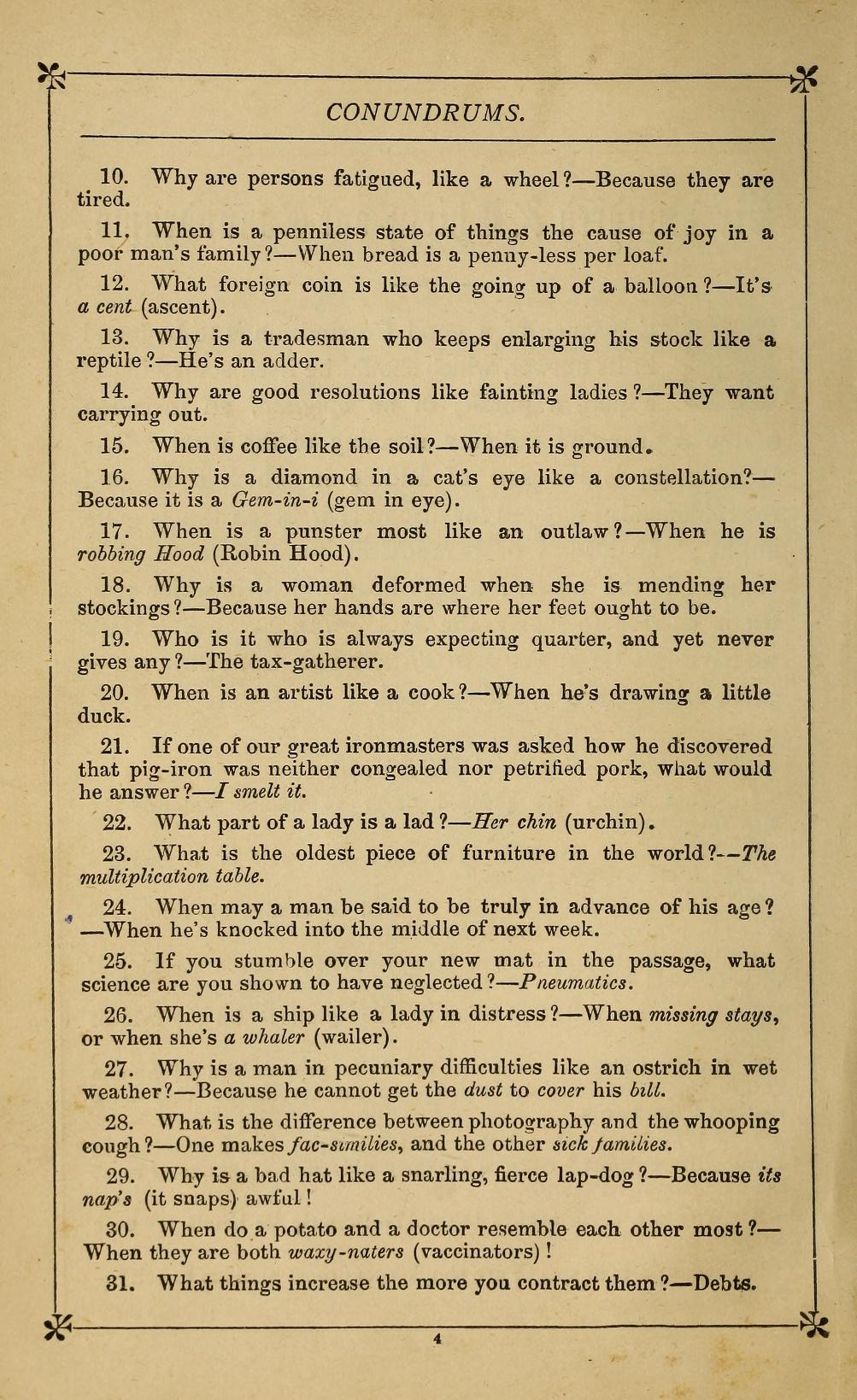
There are 631 conundrums:

A sample, click for full size:

Oh, these are awful, and quite wonderful, well, some of them. There’s quite a bit of casual racism and misogyny to be found, too. Via The Public Domain, or you can just click right over to the book.

“It’s Okay To Be White.”

(Screenshot/4Chan.org).

All us lefties are going to start foaming at the mouth, wilt, and just give up in the face of It’s Okay To Be White. Odd, but I don’t feel a swoon coming one, and my monocle is unpopped.

In right-wing internet message boards, users are encouraging one another to print and hang posters that state simply “It’s OK to be white” with the goal of exposing what they claim is anti-white racism in liberal communities and on college campuses.

Creators of the signs were first inspired by a news report that police were investigating fliers hung at Boston College that depicted Uncle Sam and the text, “I want you to love who you are” and “Don’t apologize for being white.” Reporters noted that the signs were posted near the planned location of an anti-racism rally on campus.

Earlier this week, 4chan users called on one another to hang fliers in their own communities with a more succinct spin on the Boston signs, making the statement “It’s Okay To Be White” in large easy-to-read font with no other context. One post detailing the plan explained the goal was to make liberals go “completely berserk” and ruin their credibility, marking a “massive victory for the right in the culture war.” [The linked post actually says media will go berserk.]

The campaign also urges participants to use adhesives that are non-permanent in order to avoid violating any laws and to conceal the signs’ connections to “racists or the alt-right.” One campaign graphic reads: “The simplicity is the point. It’s working.”

Right-wing YouTube creators have also taken notice, including Infowars editor-in-chief Paul Joseph Watson and white nationalist Paul Ramsey. Alt-right video bloggers James Allsup and Nick Fuentes even launched their own spin-off of the signs that read “Make your ancestors proud. Never feel guilty for who you are,” and solicited donations to produce and distribute their posters.

Oooh, be proud of your ancestors! Okay, I am. Funny how my pride amounts to “you stupid Indians, shut up! Pipelines are good!” and the like. That’s the problem with white pride, it excludes everyone else. Of course, exclusion is what white colonial pride is all about: “white people masters, everyone else, lay down to be trodden on.” This little campaign is hardly different from all the other shite supremacy, so it’s not a shock, it’s not even a surprise. White people being suuuuuper assholes simply has zero shock value.

There’s more to the story, RWW has it.

Digital Humanities.

,

First, What Is Digital Humanities?

Humanity (and not just the humanities) mediated through the largest extant body politic. A global vehicle (and personal prosthetic) for containing what it is to be human and humanist–within and without the academy.Robert Long.

Digital Humanities: the creation and preservation of extensible digital archives to document, and tools to interact with, material culture.Robert Whalen, Northern Michigan University.

A fluid term to describe a variety of practices applying and theorizing the intersection of technology and humanities questions.Amy Earheart.

There’s more. Much more.

Introduction: In the decades following the onset of the Index Thomisticus project, medievalists were often early adopters of the digital, and continue to play an important role in the development of a broader field, which came to be called digital humanities. This field took other forms and names during its emergence and subsequent development: humanities computing, humanist informatics, literary and linguistic computing, digital resources in the humanities, eHumanities, and others.

These competing alternatives, among which “humanities computing” had long been dominant, have only recently made place for the newly canonical term “digital humanities,” which today is rarely contested. “Digital humanities” is generally meant to refer to a broader field than “humanities computing.” Whereas the latter is restricted to the application of computers in humanities scholarship and had narrower technical goals, the former also incorporates a “humanities of the digital,” including the study (potentially via traditional means) of digitally created sources, such as art and literature.

DH is therefore profoundly multidisciplinary and attracts contributions from scholars and scientists both within and outside the humanities and the humanistic social sciences. Digital humanists have taken care to define themselves in an inclusive rather than exclusive manner. As a result, the term “digital humanities” connotes a greater sense of integration than the diversity of approaches that are sheltered within the “big tent” of DH and that are also reflected in the contents of this supplement.

You can read more at Medievalists, and that article led me to a full open access issue of Speculum! Some very good reading there, including The Digital Middle Ages: An Introduction.