Russia – The Kremlin

The word kremlin translates to fort and there are many historic kremlins in Russia. There is, however, only one The Kremlin and it is in the heart of Moscow. It’s beginnings date to the 1150’s when it was a wooden fort known as the “grad” of Moscow. At that time it housed the entire city within its walls. This fort was later destroyed by the Mongols and then rebuilt in the 1300’s when the word Kremlin first came into use. In the 1500’s under the rule of Ivan the Great the current stone walls were built. The fortress was enlarged at this time and Ivan imported master architects and stone masons from Italy to build the new city. It was during this period that most of the cathedrals and palaces were built.
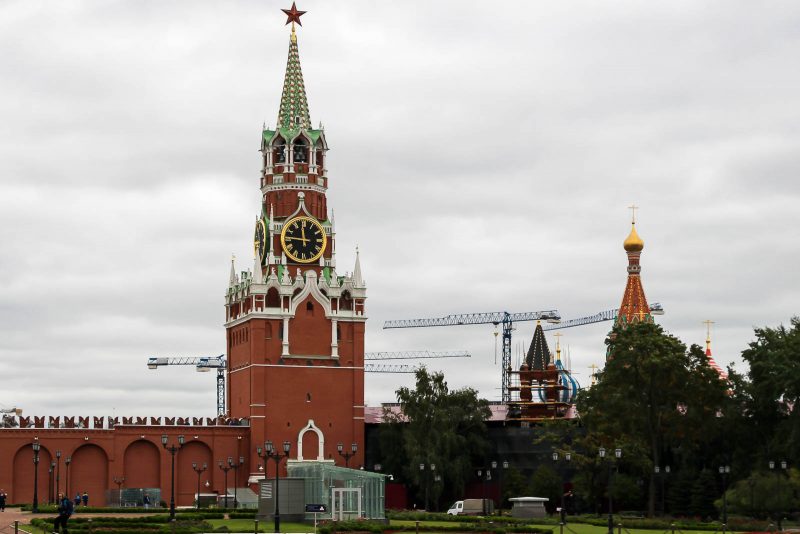
Kremlin clock tower

Kremlin clock tower

The Kremlin is a vast compound, more than 27 hectares, and for centuries has been the seat of Russian political power, machinations and intrigue. The fortified stone wall surrounding it contains 18 watch towers, the tallest being the Spasskaya (Savior) tower with its 4 huge clock faces. These clocks are connected underground to the Institute of Astronomy and are the most accurate time pieces in the country. The Spasskaya tower was the entrance of the Tsars and also used for important dignitaries and religious processions. The 5 sided stars of the soviet era were added to the towers in 1937 by Stalin who molded his political career at the Kremlin. During the soviet years many churches and cathedrals were destroyed across the country. Today, within the Kremlin walls 4 Grand Cathedrals and 3 smaller churches remain.

The Cathedral of the Annunciation

The Cathedral of the Annunciation sits on the crest of Borovitsky Hill, the original of the 7 hills of Moscow. It was built in 1484 by Ivan the Great. It was closed in 1918 under the Bolsheviks and now operates as a museum.

The Cathedral of the Assumption

The Cathedral of the Assumption is the most important church in The Kremlin being the seat of the Russian Orthodox Church. It is here that the Patriarchs (highest clerical rank) and bishops were consecrated and it was here that Tsars were crowned.  The current building was erected in 1472 by Ivan the Great. During soviet times the church was closed and its treasures taken by the Bolsheviks. It reopened to the public in 1990.

The Cathedral of the Archangel

The Cathedral of the Archangel was also commissioned by Ivan the Great, but finished after his death. It has undergone expansion and renovation several times. It is notable as the burial chamber for 46 members of the Imperial family, including Ivan the Great and all the Tsars of the 14th to 17th centuries. This church was also closed during soviet times and since 1955 has operated as a museum.

The Cathedral of the Twelve Apostles in the Patriarch’s Palace

The Cathedral of the Twelve Apostles in the Patriarch’s Palace was built in the 17th century. As with the other Kremlin churches it was shuttered during Soviet times and now operates as the Museum of 17th Century Life and Applied Art.

Ivan the Great Bell Tower

In addition to the cathedrals there are a number of other significant buildings in the Kremlin. The tallest building in the Kremlin is the Ivan the Great Bell Tower at a height of 81 meters. The Bell Tower was commissioned by Grand Prince Vasily III in 1505 as a tribute to his recently deceased father Ivan the Great. It was situated next to the construction site of the new Cathedral of the Archangel which had been commissioned by Ivan as part of his grand plan to update the Kremlin. For 400 years the Bell Tower was the tallest building in Russia. There are 21 bells in the tower and belfry, the largest weighing 70 tons. The last Easter service in the Kremlin took place here in 1918 and then the church was closed. In the 1950’s restoration work was done and an exhibition hall was added which is still in use today.

Great Kremlin Palace behind Assumption Cathedral

The Great Kremlin Palace was built in 1849 by Emperor Nikolai. This 700 room palace became the Moscow residence of the Tsars. After the October Revolution, the Soviets used the building as The Seat of the Supreme Soviet of the USSR. Today the building is a museum that juxtaposes Tsarist treasures with Soviet military might.

The Arsenal at the Kremlin

The Arsenal was commissioned by Peter the Great in 1702, but took many years before completion. In 1812 it was blown up by Napoleon’s troops (along with many other Kremlin buildings) and was not reconstructed until 1828. Today the building is used as a barracks and houses a large collection of military hardware.

The Tsar Cannon

The Tsar cannon sits in front of The Arsenal and is one of the largest cannons ever built. It is more than 5 meters long and weighs 39 tons. It has a calibre of 890 millimetres and each cannon ball weighs 1,000 kg. It has never been fired because of logistical problems. Mostly it serves as a symbol of Russian power.

The Tsar Bell

The Tsar Bell also sits outside The Arsenal and like the Tsar Cannon it has never been used. It is the largest bell ever cast and it weighs almost 202 tons. It stands more than 6 meters high and has a sad history. It was poured in 1735, but cracked during cooling and an 11 ton piece came loose. It was only in 1836 that it was finally dug up and placed on exhibit.

Senate Building, Kremlin

The Senate Building  was built in the late 1700’s. It is a triangular building with a central rotunda 27 meters high and 25 meters in diameter containing 24 windows. It currently serves as the official residence of the President of the Russian Federation. The current president Vladimir Putin has updated the complex by installing a helipad for his private use.

I know this has been a long post and I thank you for reading this far. Future posts will be much shorter. The Kremlin was really a lot to take in. I’ll leave you with one final photo. This is a 60′ statue of St. Vladimir the Great that overlooks the Kremlin. It was commissioned by Vladimir Putin and erected in 2016 to the consternation of many Muscovites. The photo was taken from a moving bus so the quality isn’t great, but our guides had a great deal to say about it. I can see why.

Statue of St. Vladimir, Moscow

©voyager, all rights reserved

April 12/18

This post has been edited to correct 2 errors. Thanks to Bruce who pointed out that it was Stalin and not Lenin who added the stars to the Kremlin wall in 1937. They are called Lenin’s stars, but Lenin himself died in 1924. Thanks also to Lumipuna who noticed an error in the date for the construction of the Ivan the Great Bell Tower. It was built in the early 1500’s, not the mid 1500’s as originally noted.


Link to previous post – Russia – Red Square


Jack’s Walk

Right now it’s a balmy 4° here, so things have gotten a bit warmer. The sky remains overcast, though, and rain is expected for the next 3 days. While it was still dry, Jack and I decided to go to the forest. We were hoping to find some sign of new life, but nothing is in bud yet. Nothing. So instead of a pretty picture of flowers or leaf buds, today you get to see Jack. He was the only ray of sunshine I could find.

dog

Jack

©voyager, all rights reserved

The Amazing Egg Dance: Peasants to Politics.

Contrast between Carnival and Fasting (ca. 1550–99), artist unknown — Source.

Contrast between Carnival and Fasting (ca. 1550–99), artist unknown — Source. Click for full size.

Whoever the artist of the above piece was, I’d say they had been most impressed with Hieronymus Bosch. The Egg Dance, from village revelry to romance to politics. This is a wonderful piece of history, which demonstrates several cultural shifts throughout the centuries.

The egg dance was a traditional Easter game involving the laying down of eggs on the ground and dancing among them whilst trying to break as few as possible. Another variation (depicted in many of the images featured here) involved tipping an egg from a bowl, and then trying to flip the bowl over on top of it, all with only using one’s feet and staying within a chalk circle drawn on the ground. Although, as shown in many of its depictions in art, the pastime is associated with peasant villages of the 16th and 17th century, one of the earliest references to egg-dancing relates to the marriage of Margaret of Austria and Philibert of Savoy on Easter Monday in 1498.

[…]

This blindfolded version of the egg dance features in Goethe’s novel Wilhelm Meister’s Apprenticeship (1795). … According to some scholars Goethe’s mention gave birth to the phrase “einen wahren Eiertanz aufführen” (to perform a true egg dance) which refers to moving carefully in a difficult situation. This particularly association of the egg dance with navigating danger was expressed time and time again in political cartoons of the 19th-century: various political figures, from Bismarck to Disraeli, precariously trying to make there way about a floor strewn with potential upsets.

Democracy’s Disastrous Egg-dance, (1884), Joseph Keppler. A woman labeled “Democracy” wearing a blindfold labeled “Stupidity” is pushed by Samuel J. Randall toward a chair labeled “Presidenti[al] Chair”, with several eggs in the way on the ground, they are labeled “Honest Naval Appropriation, Civil Service Reform, Honest River – Harbor Appropriation, Economy, Anti-Silver Coinage, National Banking System, Tariff Reform, [and] Prompt Legislation”, two of the eggs are broken; among a group of men laughing, in the background on the right, are John Logan, John Sherman, and William D. Kelley. — Source.

Democracy’s Disastrous Egg-dance, (1884), Joseph Keppler. A woman labeled “Democracy” wearing a blindfold labeled “Stupidity” is pushed by Samuel J. Randall toward a chair labeled “Presidenti[al] Chair”, with several eggs in the way on the ground, they are labeled “Honest Naval Appropriation, Civil Service Reform, Honest River – Harbor Appropriation, Economy, Anti-Silver Coinage, National Banking System, Tariff Reform, [and] Prompt Legislation”, two of the eggs are broken; among a group of men laughing, in the background on the right, are John Logan, John Sherman, and William D. Kelley. — Source.

The Journalistic Egg Dance (ca. 1840), Andreas Geiger. A caricature of press censorship before the 1848 revolution in Austria. During the Restoration after the defeat of Napoleon in 1815, the European powers, led by Austrian Chancellor Clemens von Metternich (1773-1859), restricted the freedom of speech and expression to contain any kind of critical, nationalist or anti-authoritarian movement — Source.

The Journalistic Egg Dance (ca. 1840), Andreas Geiger. A caricature of press censorship before the 1848 revolution in Austria. During the Restoration after the defeat of Napoleon in 1815, the European powers, led by Austrian Chancellor Clemens von Metternich (1773-1859), restricted the freedom of speech and expression to contain any kind of critical, nationalist or anti-authoritarian movement — Source.

You read and see much more at The Public Domain Review.

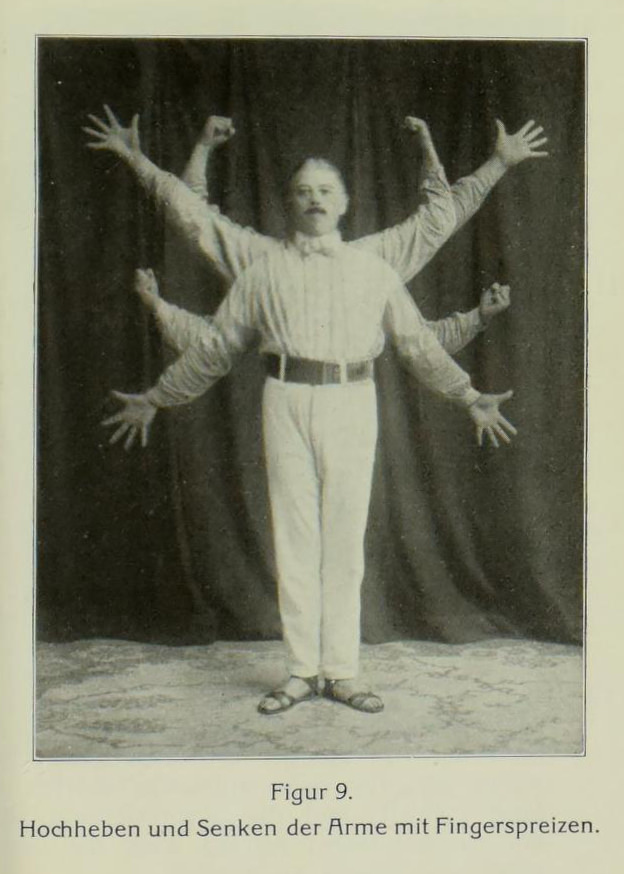
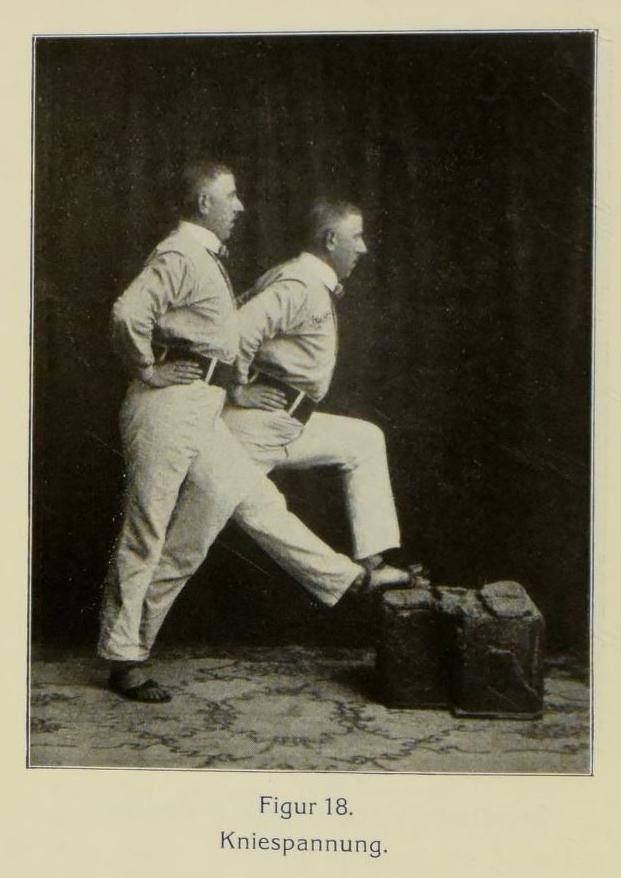
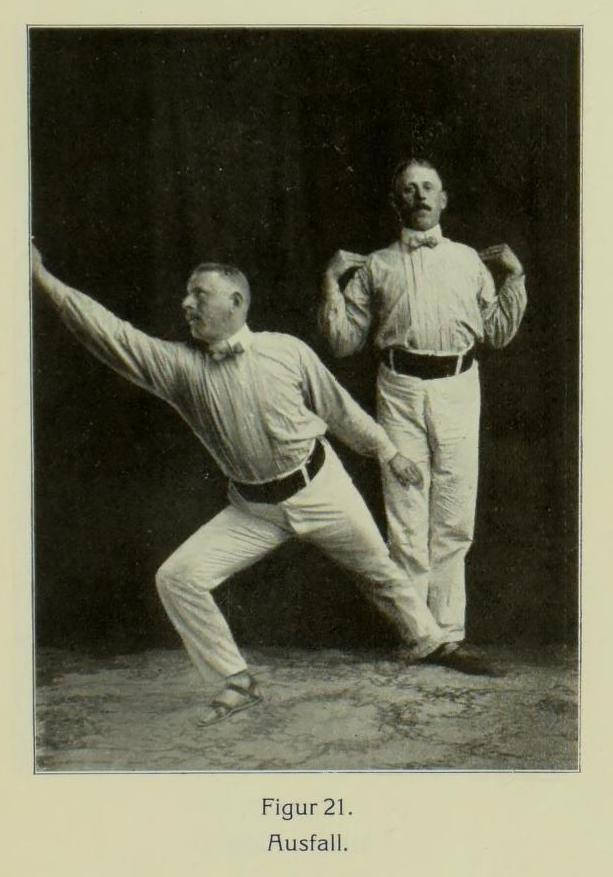
Swedish House-Gymnastics (1913).

These exercises and the photographic illustrations are splendid! Exercises anyone can do, without taking up much time, and can be done conveniently at home.

These wonderful photographs, which make such innovative use of multiple exposure, are from a 1913 German book titled Schwedische Haus-Gymnastik nach dem System P.H. Ling’s by Theodor Bergquist, Director of the Swedish Gymnastic Institute in the Bavarian spa town of Bad Wörishofen. As the title tells us, this style of “Swedish house-gymnastics” demonstrated by Bergquist (and his mysterious female colleague) is based on a system developed by Pehr Henrik Ling (1776–1839), a pioneer in the teaching of physical education in Sweden. Inventor of various physical education apparatus including the box horse, wall bars, and beams, Ling is also credited with establishing calisthenics as a distinct discipline and is considered by some as the father of Swedish massage.

I think I could choose a series to do each day from these, without over exertion, and it might really help to be a bit more flexible these days. You can see much more at The Public Domain Review.

P Is For Pörhistää.

Pörhistää.

Pörhistää is Finnish for fluffing or puffing out feathers or hair. This picture is from Xmas Eve afternoon in 2017 and the place is the passage to Kaivopiha inner courtyard, just across the street from the Helsinki Central Railway Station, a very central location. At some other time it would have been much more crowded with humans, but at that time the pigeon couple were quite free to claim the place.

Click for full size!

© Ice Swimmer, all rights reserved.

Anatomy Atlas Part 3 – Upper Limb Skeleton

Human hand has always fascinated me and its skeleton is truly a marvel. Modern industrial robots still lose a lot to its flexibility (hands have seven degrees of freedom of movement, robots have one to six) and versatility (a hand can have a secure grip on almost anything from an egg to an axe).

Upper limb bones

©Charly, all rights reserved. Click for full size.

For learning and examination we did not have a plastic skeleton mounted on a stand in the corner of the class. We had a box in which the real prepared bones of a man who committed suicide at a relatively young age were stored. So each bone could be taken out and examined separately.

One of the scary stories circulating about Professor Kos was relating to this fact. Small bones, like carpal and metacarpal bones, were stored in little pouches so they do not get lost or too mixed up with the rest. It was said that Professor Kos’s favourite way of examination in his former job at medical university was to shake up the pouch, pull one carpal bone out of it and ask which one it is. Any aspiring physician who failed to give prompt and correct answer was fired.

He did not do this to anyone of us that year, but we always felt he might to.

“Its Rightful Position.”

Howard Chandler Christy's Scene at the Signing of the Constitution of the United States.

Howard Chandler Christy’s Scene at the Signing of the Constitution of the United States.

Jerome Corsi has been opining about how overwhelmed he is, it’s just so much work exposing non-existent satanic pedophiles and “red-pilling” people. In the midst of his rant, I was caught by one odd thing. Odd to me, at least.

“The corruption, the evil of devoting yourself to Lucifer ends up in satanic sacrifices, children abused, human rights kidnapping, just incredible human torment, torture, snuff films,” Corsi said. “The evil depths and corners of this are so abhorrent to me, and should be to every right-thinking American, that we need to expose this, we need to bring it out, we need to show it the light of day despite how many people it’s going to be disturbing to.”

“Those of us who are going to know every aspect of it are ourselves going to have to pray to God that we come out not so damaged that we become somewhat dysfunctional,” he added. “We are going to have to make sure that we pray and approach this with the light of God and the help of God in order to get through this crisis.”

“These days, I am overwhelmed with hundreds of emails and I barely have time to function,” Corsi said, wearily. “But I can’t sleep thinking that there may be one more radio show, one more opportunity to get the word out, one more mind to red pill. That’s what drives me is the desire to serve God and to have the Constitution of the United States restored to its rightful position.”

Personally, I think Corsi is already dysfunctional. Anyroad, what caught me was the line about having the constitution restored to its rightful position. It has a position? What might that position be? It’s very strange to be talking about a document as if it were a person…is there a little constitution throne somewhere? A nice, little flat crown? Asshole christians and conservatives already damn near worship the thing, they talk about it constantly, or at least bits of it. I’ll admit, I’m a bit confused about just what this rightful position might be.

RWW has the whole story.

Jack’s Walk

Jack and I visited the park this morning and this Canada goose followed us around for a bit. I think he was looking for a handout, but visitors are not allowed to feed the birds. They have a keeper who comes every morning to feed them a proper avian diet. We kept a respectful distance anyway because these birds are big and often aggressive, especially during nesting season which should start soon.

Canada Goose

Canada Goose

©voyager, all rights reserved

Cancer Chronicles 16: I Just Don’t Care.

hg

Herein is a litany of complaint. If you could do with less whine in your life, skip this one.

Friable. That’s me. I have reached the I just don’t fucking care point.  I feel so beaten down, and each beating is worse than the last, and like any beaten animal, I just wait with dulled eyes for the next blow to land. Part of this is the chemo, but it’s the pegfilgrastim (aka neulasta) which last strawed me. I had been told about bone pain, and possibly flu like symptoms with the neulasta. I did get random bone pain, but that wasn’t really bothersome. What happened in my case was all my back muscles seized up and went into full cramp. Then they stayed that way. Still that way. Imagine your whole back being one big charley horse. I talked about some of this in this thread, it’s hard to describe, but it makes moving seriously painful. The motor problems from the oxali haven’t gone away, and the neulasta seems to have done some amplifying, along with giving me a very bad shake. All of which are not good when it comes to drawing and painting. I can’t even turn a brush anymore, a life long habitual movement. On top of everything, the butt pain has come back, and I doubt that’s any kind of good sign.

The chemo brain is worse, too. My startle response is through the roof, because I’m not making the connection from sound to recognition. Usually, you hear a sound, auto-recognise it, and consign it to background or investigation. Everything I hear now has me jumping out of my skin. I’ve been saying all the wrong things to people,  ended up being thoughtless and stupid, and while I never meant that in any way, intent isn’t magic, and I got responses I fully deserved.  My ability to parse social cues, never what you’d call brilliant, is almost completely gone. Every time I fuck things up, I spend days on end crying and basically falling the fuck apart, and when I try to apologize, I manage to make it all worse. I figure it’s perhaps best to not say much these days. At least that way I won’t upset anyone.

Then there are all the little weird things. On Friday, I stepped out on my back deck to take a photo, and was sitting on a step. I shifted, and found myself screaming because it felt like I’d been stung by a wasp, even while a tiny, still functional part of my brain recognised there’s still snow all over, so no wasps. I checked my foot, it was fine, it had made fleeting contact with a piece of fucking ice. Ice, and I’m outside, screaming. It’s all so damned absurd.

And the fatigue. I can’t even characterise it. What’s levels past bone deep? I sleep, it’s never enough. Constantly, thoroughly chilled these days, even walking into another room in my house. I can’t stay long, and have to get back in front of a space heater. And it won’t stop snowing here. Sometimes, a person can get the feeling that Fate is having a good time fucking them around. My hair has gotten very thin indeed, and I’m losing a fair amount of it. That’s not helping.

On Tuesday, I get round 5 of chemo and pegfilgrastim on Thursday. Usually, the week before the next cycle is a good one, because you’ve mostly recovered from the chemo; not happening this time. I feel like shit, and back we are to I just don’t fucking care. I don’t care what anyone wants to do, just fucking do it so I can get the fuck out of this.

I do realize that none of this is remotely encouraging to anyone who is going into treatment, but my experience so far is just that, mine. Everyone is different, and there’s no way to tell what side effects might hit you the hardest, or what agents for that matter. The pegfilgrastim is a much meaner agent in me than the 5-fluorouracil or oxaliplatin. It’s quite likely it’s the other way around for a lot of people in treatment. Treatment is Sisyphean in nature, you shove that effing boulder up and up, and there’s someone at the top to send you tumbling down again, until the day you get to the top, and you get to stay. It’s that day you have to focus on. After tomorrow, three more cycles, then I get to move on to radiation. This is going to be one long year.