The Healing Arts: A Man Mid-Wife.

An interesting piece, addressing what was a great controversy, with people hotly on one side or another, as male physicians encroached on the world of childbirth. Additional information and sources under the image. Click for full size.

A Man Mid-Wife, Isaac Cruikshank, Etching coloured, 1793. Subject: John Blunt (pseud. S.W. Fores), Midwives, Surgical Instruments, Forceps.

A Man Mid-Wife, Isaac Cruikshank, Etching coloured, 1793. Subject: John Blunt (pseud. S.W. Fores), Midwives, Surgical Instruments, Forceps.

The text reads:

“A Man-Mid-Wife, or a newly discover’d animal, not Known in Buffon’s time; for a more full description or this monster, see, an ingenious book, lately published, price 3/6 entitled Man-Midwifery dissected, containing a variety of well-authenticated cases elucidating this animals Propensities to cruelty & indecency sold by the publisher of this Print who has presented the author with the above [illustration] for the Frontispiece to his Book.”

From the same source:

Summary

This etching illustrated a book criticizing (male) physician birth attendants–“man midwives”–today’s obstetricians. The etching shows a figure that is male on one side, female on the other. The male half stands on a plain wood floor next to a large mortar and pestle, holding an instrument labeled a “lever” in his hand, which is pressed against his thigh. The background seems to be a shop, with shelves lined with vials, bottles, and frightening looking instruments labeled “forceps,” “boring scissors,” and “blunt book.”

In contrast, the female half of the figure stands in a homey room on a decoratively carpeted floor; in her outstretched hand she holds a small cup. Behind her, a fire burns in a grate.

Commentary

This etching was made in 1793, at a time when middle-and upper-middle class English women were being attended by physicians rather than midwives at the births of their children. Midwives were left to attend the beds of birthing women too poor to afford the services of physicians.

At the time, however, criticism was leveled at physicians who chose to demean themselves by doing “women’s work,” with some suggestion that their only motivations must be prurient ones. (This latter accusation is hinted at by one of the bottles on the shelves of the man half of the man-midwife; it is labeled “love water.”).

Today, while few would accuse male ob-gyns of perversion (although male medical students who choose this specialty probably still raise eyebrows in some corners), questions about the proper place, methods, and attendants at childbirth still are debated. Only in the past three decades, for example, has the presence of fathers at childbirth been considered proper, and we still argue about home vs. hospital births, the use of midwives, training for midwives, and the place of technology and medication in normal births.

You can read a fair amount of what was written in the 18th century by people on both the pro- and anti- sides here.

Historian Ruby has an excellent rundown of the great controversy, where once again we encounter the scandal of Mary Toft in this excerpt:

Hugh Chamberlen, as well as being a physician, was also a speculative businessman, and when his proposed business dealings failed, his creditors forced him to flee abroad.  With his credibility damaged, he was lampooned in verse in 1699 in Hue and Cry After a Man-Midwife, Who has Lately Deliver’d the Land-Bank of their Money.  It was noted that ‘great belly’d ladies have mighty respect for’ the man-midwife, demonstrating that the fashion for men-midwives commenced in the seventeenth century and was not just an eighteenth century phenomenon.  The verse also alluded to the outrage that was displayed in some quarters by opponents of men-midwives, ‘Among his profession he’s fam’d as a topper, By some call’d a midwife, by others a groper,’ hinting at sexual improprieties that the man-midwife could commit once alone with vulnerable females.

Public suspicion of the medical profession ran deep in the eighteenth century, in part due to the non-secular society believing that decaying bodies tainted the men who practiced medicine, but also, medicine was considered the least prestigious of the professions and the physicians’ failure to cure illness and stave off death impacted the public’s perception of them.  The man-midwifery profession was further disparaged after several eminent London men-midwives supported Mary Tofts, who in the 1720s claimed to have given birth to a litter of rabbits.  The absurdity of their support of Tofts in her fraudulent claim led to professional ridicule.  Not only were the men of the medical profession considered asinine for agreeing with Tofts’ wild claims, there was a growing suspicion of the practitioner as a ‘corrupter of morals, a threat to female modesty and even as a libertine.’

Blunt’s book, Man-midwifery dissected ; or, the obstetric family-instructor : In fourteen letters, is available to read at the Internet Archive. You can also see the above image properly coloured as the frontispiece of the book.
A Sad History of Monopoly.

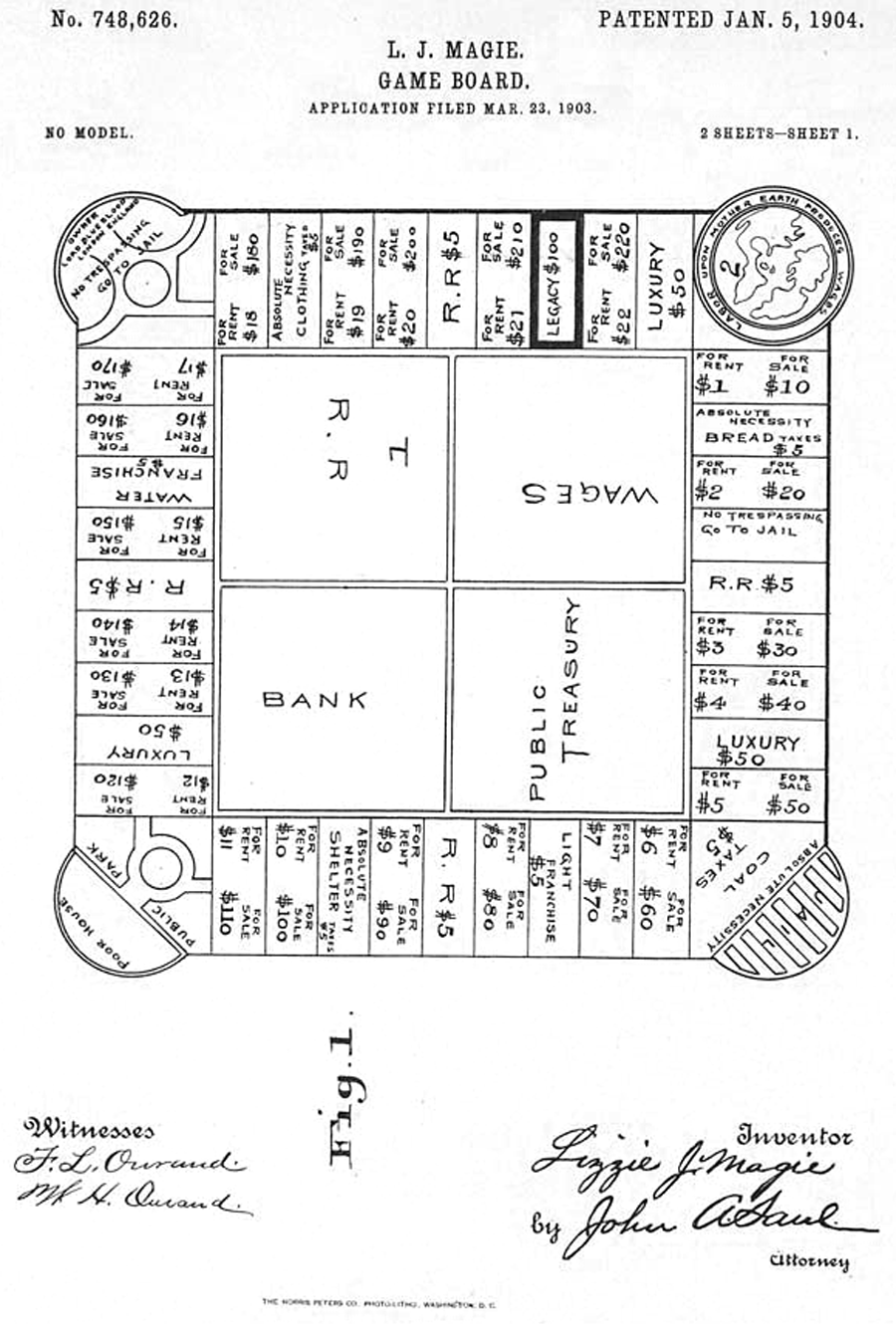
Elizabeth Magie's 1904 board design.

Elizabeth Magie’s 1904 board design. Source and Credit. Click for full size.


Source.

It’s a right pity that Monopoly didn’t turn out the way Elizabeth Magie envisioned. Just goes to show that greed always wins. (I couldn’t get the twitter video to play; if you also have such problems, head to Required Reading, and scroll down to the bottom. That one works fine for me.

X Is For Xerophyte and Xerófito.

Xerophyte. Xerófito.

Xerophytes are drought-adapted plants, commonly found in environments where water is scarce.  An example is the cactus Opuntia ficus-indica. The fruits, seen here, are delicious but harvesting and peeling them can be quite tricky because of all the small spines, it is almost guaranteed that at least one will find its way into your skin no matter how careful you are (speaking from experience here). Bonus wasp!

The wasp looks so tiny! Click for full size.

© Nightjar, all rights reserved.

The Daily Bird #712.

Black-headed Grosbeak, click for full size. It’s always a joy to see the Grosbeaks arrive. Around here, the males are notoriously cautious and shy; they’ll usually fly off if they spot the slightest movement from me. Happily, this fellow was an exception to the rule. He didn’t care that I was leaning on the windowsill, very close indeed, and making all that clicking. He just kept on eating with enthusiasm. The last shot was his first checking out the feed situation, from there, he flew to the top of the tray hook, then on to food!

© C. Ford.

Jack’s Walk

Jack and I found a few rare white and green trilliums today. The green tint on the blooms is caused by a mycoplasma infection that will eventually stop the plant from reproducing. They occur in a few areas around Ontario, including our favourite forest trail where they’re a common sight.

©voyager, all rights reserved

May Is Mental Health Month: What To Read.

For a list of good reading having to do with mental and emotional health, head over to Rumpus. I’m not big on special days or months, they rarely penetrate most people’s skulls, but this is a timely reminder to be more mindful to others. In that vein, I’ll leave you with this video by The Amity Affliction. It’s harsh, but it’s a damn good reminder to make every effort not to be an oblivious ass. (Added the follow up song.)

The Amity Affliction -All Fucked Up.

The Amity Affliction – I Bring the Weather With Me. (Lyrics below the fold.)

[Read more…]

Behind the Iron Curtain part 7 – Racism

These are my recollections of a life behind the iron curtain. I do not aim to give perfect and objective evaluation of anything, but to share my personal experiences and memories. It will explain why I just cannot get misty eyed over some ideas on the political left and why I loathe many ideas on the right.


In this particular case, much of what I know now I did not even remotely see or experience as a child and I only learned about it later on. Further, I must first state my bias.

My experiences with Romani people were overwhelmingly negative throughout my life, behind the Iron Curtain as well as afterward. I am in no way an objective and dispassionate observer on this matter.

First experience was at the age of approximately 10 years when the merry-go-rounds were in town. I have met a slightly younger Romani boy who was totally downcast because he did not have money for any of the attractions. I offered to lend him 10 crowns (which was a lot). We agreed that he will give me the money back one crown at a time whenever he gets pocket-money and we went on and had loads of fun together that day. He only returned the first crown and his mother has seen him doing so. I have seen her to tell him something very loudly afterwards, but I did not hear what it was. However, next time he only offered threats of violence. After he pulled out a knife on me, I stopped politely asking and avoided him altogether. It was first time someone has betrayed my trust and I could not make sense of it.

(That same boy has tried later to rob a newspaper stand, was caught by police and subsequently beaten by his mother. Allegedly not for trying to steal, but for being caught, which given my experience I unfortunately find believable. At the age around thirteen he attempted to rape a woman near a disco club who fended him off. I have no idea what became of him afterward, I have never heard about him since.)

Second instance was the age of twenty-five. Not having learned my lesson, when a Romani employee at the company I worked for asked me if I would be so kind as to lend him some money for he had run out and he needs to buy diapers for his children, I obliged. On payday, when he was due to give the money back as agreed, he offered me threats of violence.

Third instance, at the same employer, was a conflict with Romani fork-lift driver whom I caught drunk on the job. I tried to be nice and told him politely that he cannot drive fork-lift in this state and should go home to sleep it off. He started to get agitated, my attempts at de-escalating the situation totally failed and he assaulted me. Afterward I was being told that it was all my fault for not being nice enough to an aggressive drunkard. My today position is that I should have called police straightaway and not try to pussyfoot around someone breaking the law.

And there were the all too common instances of Romani people being drunk in public and having shouting matches that can be heard for hundred meters no matter the time of day.

To be clear, I have plenty of negative experiences with plenty of people of different nationalities too. I try my best to not leave these above mentioned experiences to cloud my judgement, but I am wary around Romani people. This has to be mentioned up front for the sake of honesty.


The only people of color present in any meaningful numbers in Czechoslovak Socialist Republic were Romani and Vietnamese. An average Czech only knows other people of color from TV. An average Czech was, and is, also unfortunately very racist, as is typical of people who grow up isolated from outside world. Which makes othering an easy thing to both being deliberately done by politicians and emerging amongst the people themselves.

The official stance was that everyone is equal and racism is bad. Case closed, right? No, of course not. The Romani people were widely disliked and there was a lot of casual racism towards them. Somehow I have managed to not meet this racism until fairly late age (thus my willingness to lend money to a Romani boy), but it was there and eventually I have seen it. The mentions that I was an idiot for lending money to a G∗y, to a N∗r. The mentions how their dark skin is dirty by default and that they are disgusting no matter how well washed. The mentions how they are inherently untrustworthy and treacherous.

The regime did actually try to address the problems on both sides, but did so completely wrong. As with many other things, the regime did not approach the issue by evaluating what the situation is and trying to devise the best way to deal with it. It approached it as many other things with having an answer up front and trying to force everyone into that answer.

Nobody asked Romani people what they want. Nobody asked them how they would like to live, what they have to offer and what their needs are. The regime had all the answers remember? In this case – the best thing to live is in urban settlements and working at a factory. Therefore Romani people have been forced to abandon their nomadic life-style and were forced to live in urban settlements and work in factories. And Czechs were told that from now on everything is hunky-dory and everyone will live together in a happy ever-after. Which of course did not work.

For a societal change of this magnitude to happen first it is necessary to change people’s minds. The attitudes then follow. That takes time and cannot be done by decree, an actual work needs to be done over decades, even generations. But that is not how totalitarian regimes function, so a decree was made and it was expected of everyone to obey.

So Romani people were forced to live in communities with which they had no experience living in, and a lifestyle they did not know how to live. They were not used to eight hours work days so their work morale was terrible. They did not know how to care for an apartment. They were not financially literate so they did not know how to manage a big income once a month instead of many small incomes throughout. The communities inevitably became ghettos in an abominable state of disrepair and skyrocketing crime rates. This in turn instead of weathering down the prejudice of Czechs strengthened them, because they only saw (and see) the Romani as leeches abusing the social safety net.

The regime also knew that an ideal family has only a few children. So some Romani women were sterilized without their knowledge and their consent. An inexcusable violation of bodily autonomy if I ever saw one.

The one thing where the regime had the best chance to get a good handle at things, it bungled it too completely. As it almost always is with such things, education is the key. But Romani people were denied that too, although allegedly not completely deliberately.

Part of the problem was that many Romani children did not learn Czech at home and were not sent to kindergarten. And because the ghettos were very isolated when the time came for them to go to school, they were not able to communicate with teachers and other children properly and were behind other children. Which was of course misconstrued as a lack of intelligence and therefore Romani children were overwhelmingly concentrated in special schools whose purpose on paper was to help to educate children with special needs (mentally and/or physically handicapped). So even in this regard the regime totally failed to break the self-reinforcing cycle that kept Romani people poorly educated and socially isolated. There are Romani individuals who manage to break that cycle for themselves, but they have to beat incredible odds working against them to do so – they get obstacles on both sides of the cultural barrier, with Romani communities not wanting to let them go and Czechs not wanting to accept them.

Unfortunately with the fall of the Iron curtain the situation did not get any better. If anything, it has gotten worse and I think it will not get better during my lifetime. Czechs have proven to be way too much racist and easily manipulated with racist fear mongering, and when Romani people ceased to be a convenient scapegoat, Muslim refugees took their place as convenient boogeyman. As with many other things, the most effective Iron Curtain runs through people’s brains, not through the countryside.