Maps

This post has been planned since late last summer, before I fell off the map (har har) for a while. It’s slightly out of date, as it were, but here goes – before posting the new content, I’ll clear up all the (two!) posts I had planned previously.

Anyway.

Not a new story, but (via the CBC):

Canadian Geographic has created a giant floor map, and an accompanying Indigenous Peoples Atlas of Canada, to change the way kids — and adults — look at this country.

“We hear so much about truth and reconciliation and what does it mean in reconciling our understanding and knowledge,” said Charlene Bearhead, an education advisor for the map and the Indigenous Peoples Atlas of Canada.

Unreserved host Rosanna Deerchild sits on the Indigenous Peoples Atlas of Canada floor map, which is the size of a gymnasium. (Stephanie Cram/CBC)

The map does not contain provincial boundaries, names of provinces, or many of the current names of cities and towns. Instead, it outlines the different Indigenous communities found across the country, the languages spoken, and the treaties signed with the Crown.

[…]

“For the most part Indigenous people walk on the map and it makes sense and they are like, ‘I know where this is, I know the story of this place for my people,'” said Bearhead.

“Non-Indigenous people walk onto the map and have this blank look on their faces,” a reaction Bearhead recognizes once they realize there are no provincial boundaries drawn on the map.

After a bit of confusion, Bearhead said what often follows are lengthy discussions of Indigenous histories and experiences.
Story in full at the link.
And in addition to that, here’s another one:

“People always say that mapping is a colonial tool, or a tool of colonialism, and it certainly has been used in that way, but I think the power of mapping is that there is so much power in it. It doesn’t necessarily have to be oppressive,” said Annita Lucchesi, a doctoral student in the cultural, social, and political thought program at the University of Lethbridge.

“It can be liberating. It can be healing. It can be empowering, especially when it’s being used by people who have been historically oppressed.”

The Southern Cheyenne cartographer is creating an atlas of missing and murdered Indigenous women and girls across Canada and the U.S. So far, Lucchesi has helped document over 3,000 cases, some reaching as far back as 1900.

[…]

“The beauty of maps is we can share as much or as little as we like and it still makes sense. We get to decide where those boundaries are. We get to decide what colours to use, what symbols to use, we can put cultural ideas on them. They’re so flexible and there’s so much freedom in that that it’s really a liberating form of storytelling.”

Lucchesi said she hopes that through her work with Indigenous mapping, new relationships between Canada and Indigenous peoples can be created.

“Through mapping we’re able to tell stories to each other that help us to build better relationships, help us to understand one another a little bit better so that we can respect the sovereignty of Indigenous peoples.”

Story at the link.

For more maps of Turtle Island, see here, with other links, too:

Native Land is a Google Map of the territories and languages of the indigenous peoples of the United States and Canada. The map consists of two main layers, one showing the ‘territory’ of First Nation and Native American tribes and the other showing the geographical spread of indigenous languages.

[…]

Natives of North America is another interactive map of the Native American Nations. Obviously one of the biggest problems in mapping Native American territories is that official boundaries between the Nations did not exist and these territories were constantly shifting.

[…]

The Invasion of America is a fascinating map of Native American land cession between 1776 and 1887. During this period the United States seized over 1.5 billion acres from the Native Americans.
“It is just a flu” Should Never be Comforting Phrase in the First Place

I do not know whether this applies to the anglophone world, but in Germany, and to the same extent in CZ, “flu” and “cold” are treated as more or less synonymous. And because the common cold is, well, common, most people when they say they came down with flu, what they really want to say is they had/have a bad case of the common cold.

One of my former colleagues thus thought that flu is something trivial and she always disparaged me when I said that flu is a serious illness and not something to be flippant about. I do not know how she managed to live for over thirty years and get herself a kid without encountering real flu, but she was among the lucky ones in this regard I guess. A healthy, strong woman in her thirties.

But in 2008 her luck ran out. In the morning she came to work as normal, but just mere two hours later she began to have fever and chills and got a splitting headache. She excused herself from work at noon and went home and did not return for two weeks.

When she came back, a rare thing happened – she acknowledged that she was wrong and I was right in our previous discussions about this. She just had a case of real flu and for a few days during that time, she actually feared for her life, because there were times when the fever made her see double and she was barely able to go the loo.

It is a sad reality that some people – I dare say many people – actually, really need to experience some hardship first hand to be able to believe it is real. Be it flu, or poverty, or discrimination.

When some people were saying that Covid-19 is just another flu in a derogatory and dismissive way, I rolled my eyes so hard I nearly strained them. Even if Covid-19 were just a new strain of flu, a new strain of flu would be terrifying. Even old and established strains of flu can be terrifying when they encounter an unvaccinated person who never got flu before.

“It’s just another flu” should have been a call to arms, not a placating head pat, even if it were true.

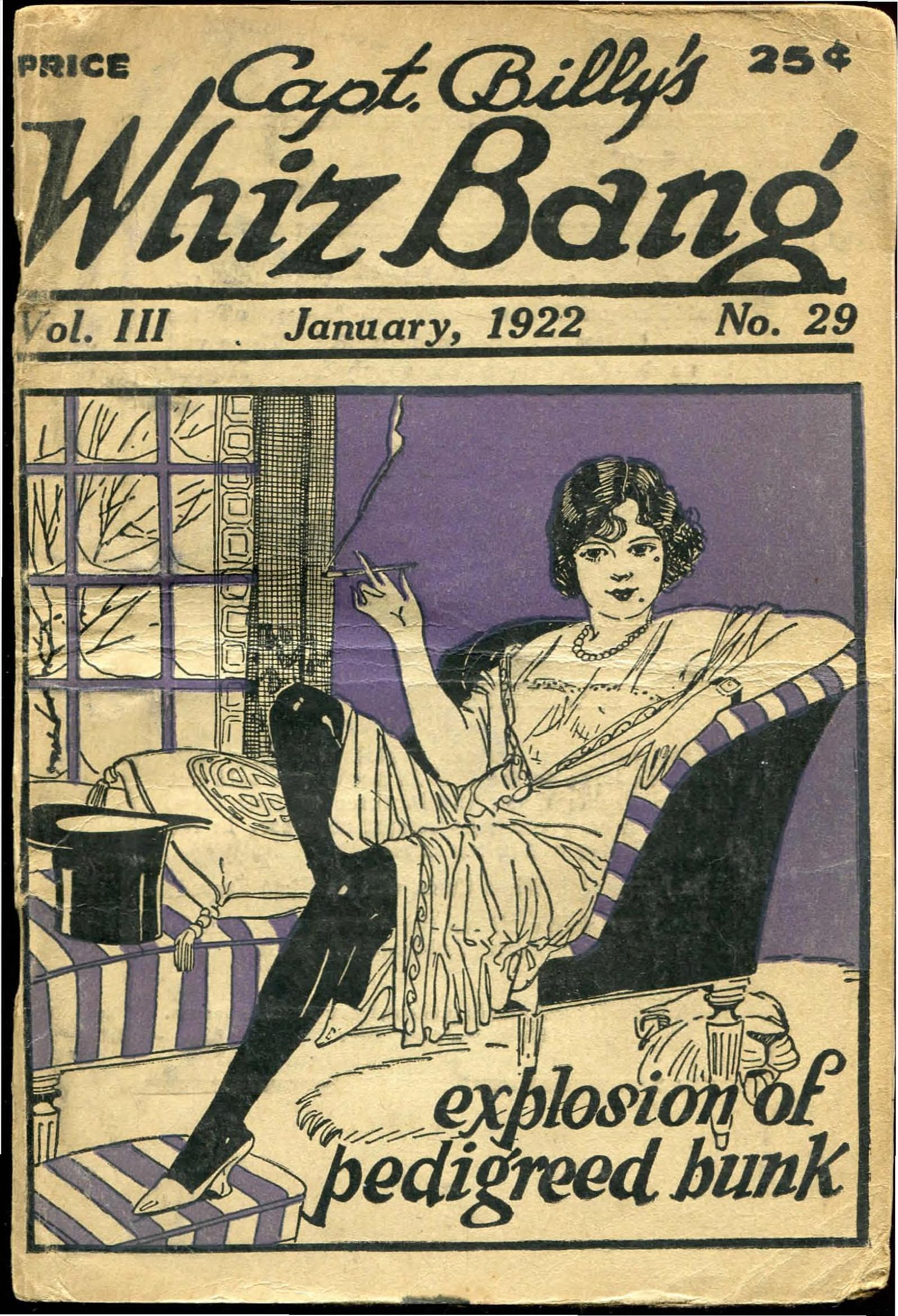
The Art of Book Design: Capt. Billy’s Whiz Bang

Wilber Hamilton Fawcett. Capt. Billy’s Whiz Bang, January 1922.

Welcome to pulp week at The Art of Book Design. Capt. Billy’s Whiz Bang was first published in October of 1919, and became incredibly popular during the 1920s, despite outcries that the magazine was immoral and corrupt. At one point, the magazine was selling up to 425,000 copies per month, but with the onset of the depression, people had less discretionary money, the light-hearted humour of the magazine went out of fashion, and the magazine folded in 1934.

via: The Pulp Magazine Archive, at the Internet Archive


Hi Again

Well hello there strangers and not-so-strangers. It’s a new world out there, or so I’ve been told – who really knows what’s actually going on out there?

It’s been a while, and I apologize for that (but in a ‘sorry to inconvenience everyone because I’m a polite Canadian’ way, not because there’s anything I should be apologizing for). The past several months have been a whirlwind of personal issues and deaths in the family and a few other things I could think of if I bothered, but long story short, I’m healthy, the kids are healthy, I’m still in a relationship, and work is hell. I’ve actually talked about quitting out loud a few times by now, which is a pretty big thing because of how much I (usually) love what I’m doing, but after being thrown under the bus a couple of times, the shiny parts ain’t so shiny no more. I feel a bit like:

(original here)

Plus now the state of emergency means I could become a frontline worker at any time (depending on how things go down). Life, eh?

Anyhoo, enough about that.

In the meantime, I’ve collected like a bajillion (no exaggeration) links about art and other things that I’d like to clear out of my gmail drafts, so in this time of quiet contemplation and creative inspiration that working from home provides us with (please, I’m looking on the bright side), I will try to get some of that content out to you. Plus maybe some photos of my own from time to time.

I am a bit more active on twitter these days (@andtheunicorn, if anyone’s interested), where I try to post a different photo every day or three, plus I like to pretend I’m interacting with the world.

So, today is a ‘hello again’, next two posts are two I’ve had lined up since last August, and we’ll see what happens after that.

Stay healthy, everyone, wash your hands, and best wishes to you all! Special shout-out to all you teachers, shop workers, delivery people, mail persons, and others previously not appreciated but now deemed essential services – most especially to all those in the medical field. ♥ like crazy for you all.

The Art of Book Design: Pussy-cat Town


Marion Ames Taggert. Pussy-cat Town. Illustrated by Rebecca Chase. Boston, L.C. Page & Company, 1906.

I was a cat person long before I became a dog person, and I still have a soft spot in my heart for felines, so when I saw this book I knew I had to feature it. The book is full of sweet drawings and there are many more than I’m sharing here. I’ve included all of the full-page illustrations, but there are multiple smaller black and white drawings on many of the pages. I hope you enjoy the book as much as I did. [Read more…]

Corona Crisis Crafting IV: Face Masks

Around the world hospitals are asking for volunteers to sew masks and I started already for my sister and her colleagues, as well as the relatives who care for her elderly patients.

I’m using this pattern and it’s super easy. Time needed is probably 15-20 Minutes per mask, so grab your fabric stashes and start sewing (finally you have the justification for keeping all those letter sized fabric pieces).

BTW, I guess that some protection nobody could measure in their experiments is that wearing them really keeps you from touching your face.

©Giliell, all rights reserved

I’ll also hand out instructions with them that read as follows:

Hello,

I’m a washable cloth mask. I am not a medical product and should not be mistaken for one. I am especially no substitute for other measures like washing hands and staying at home. Please wash me before you first use me and after each use. I’m 100% cotton and can be washed at 60°. Caressing me with a hot iron is a good idea as well. I’m free. If you want to say thanks please stick to the guidelines put forward by the authorities. But if maybe you have some elastic lying around, that would be nice, so many more masks can be distributed.

Best wishes and take care


Jack’s Walk

©voyager, all rights reserved

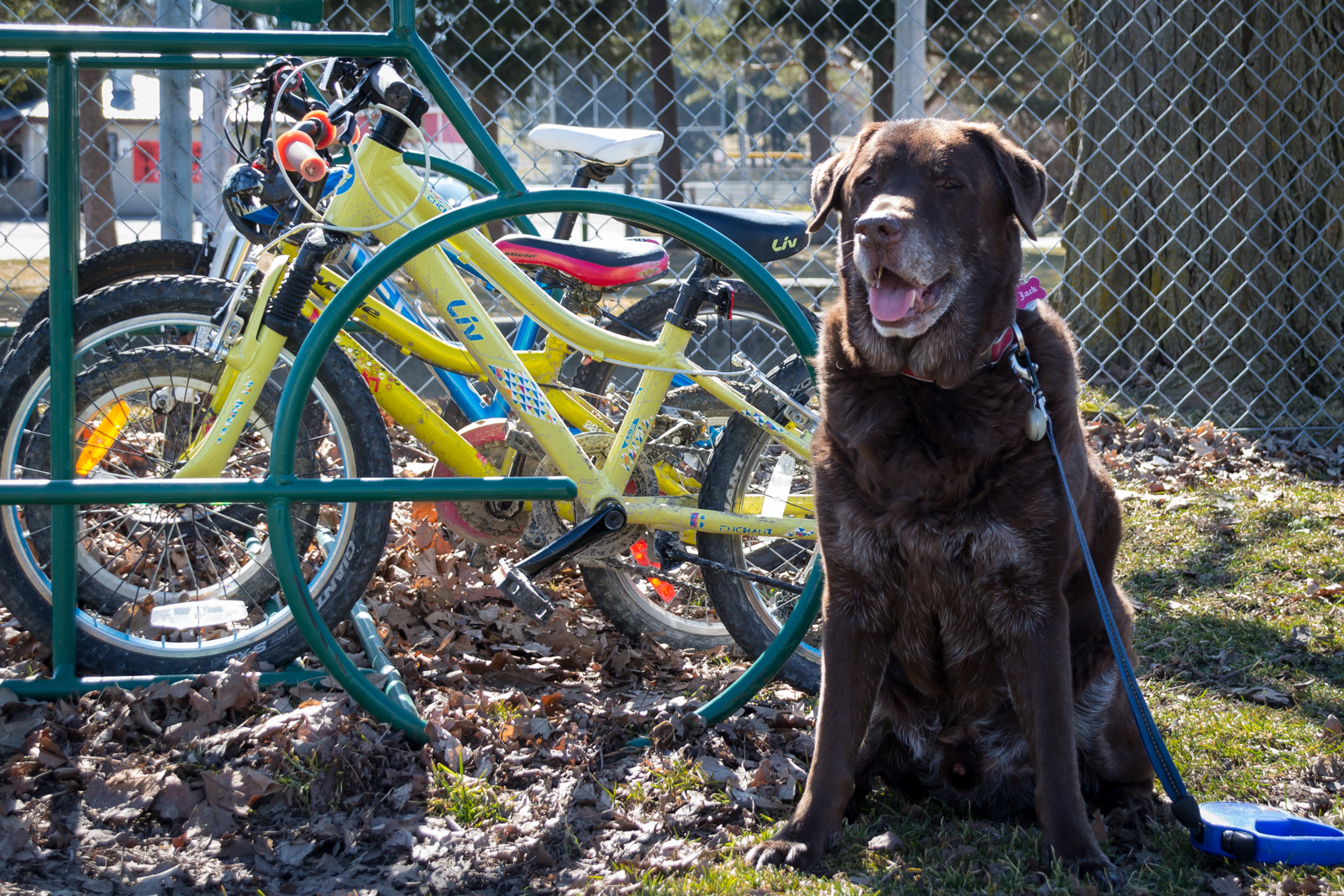
Nearly every day, Jack and I walk up the street to the high school around 11:30 in the morning. It’s when the kids get out for lunch and Jack likes to greet as many of them as possible. He’s well-known among the crowd, and as we approach, people will begin to call out his name. Jack wades in amongst them and works the crowd like a pro. He looks up and tries to make eye contact with everyone, moving slowly through the tangle of legs, stopping for an ear mushie here and a bum scratch there. He loves it when someone bends their face to his and always rewards them with a drooling, sloppy kiss. But this week, no matter how slowly Jack walks past the school, or how longingly he gazes, the kids don’t appear.

This morning, instead of another painfully slow walk past the school,  I took Jack to the park, figuring that the antics of the ducks and geese would catch his interest for a while. I was wrong. Jack wasn’t the least bit interested in the politics of the pond today. No, he wanted to go to the playground where there were a few children on the swings and climbing equipment. We walked around the edges of the area, and no one wandered over to say hello. I explained to Jack that it’s because of coronavirus, but Jack’s feelings were hurt. Before we left, he took a seat by the bicycle stand, and I could see that he was reluctant to leave. He gave his best smile to the crowd and one little girl pointed at him and asked her mother if she could pet the doggy. Her mom said yes, and hand in hand, they walked over. We kept our social distance, but Jack slowly padded over to the child and stuck his big nose in her small hand and she laughed. Jack lit up like Christmas and nosed her again, and the two of them spent an enjoyable few minutes just being a kid and a dog having fun. It was a delightful bit of normal in these very abnormal times. Thanks, Bubba.

Bobbin Lace Moth

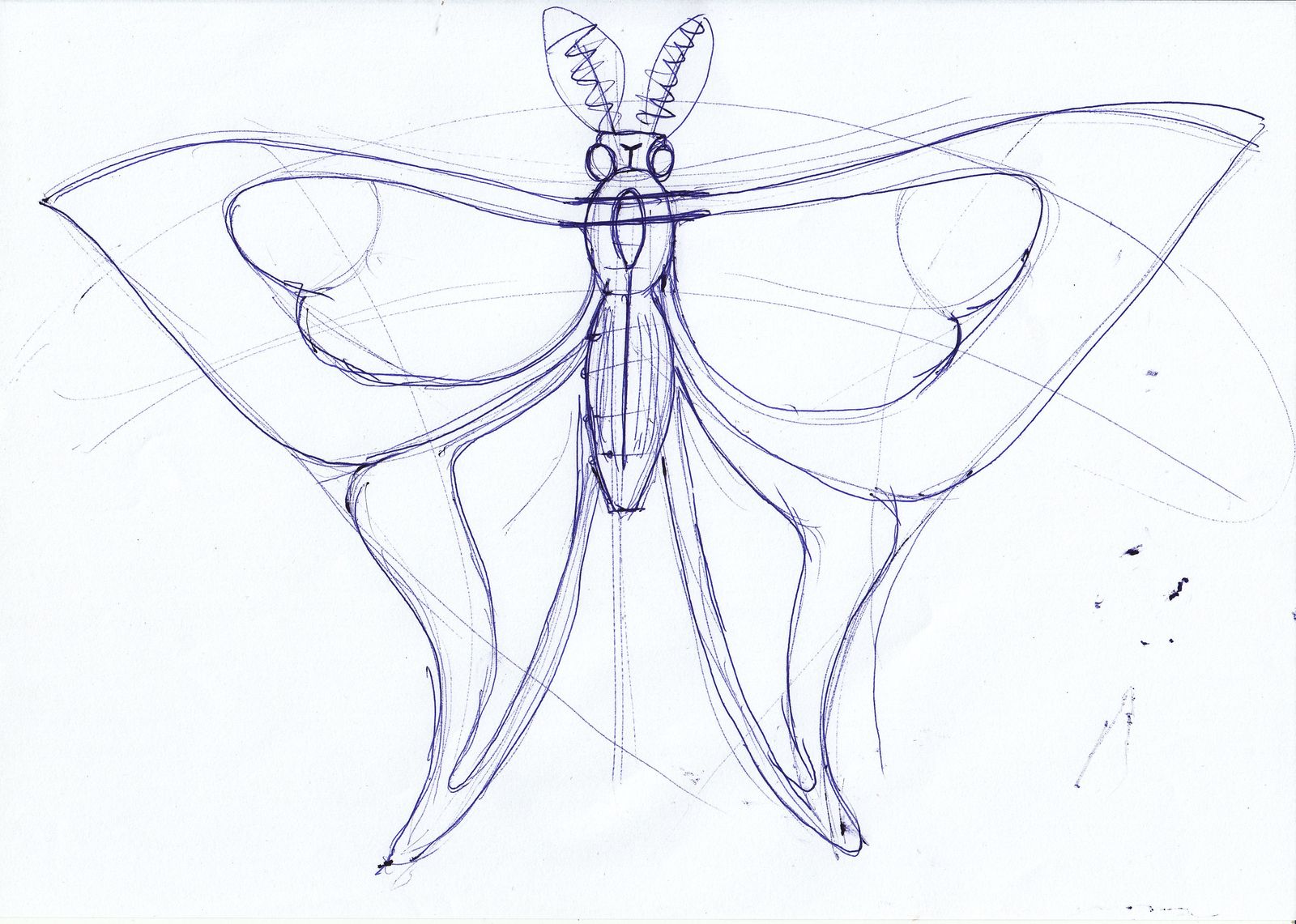
Go big or go home. I have drawn and then made a bobbin lace moth of a little advanced design.

First I browsed the net for inspiration and I looked at especially the beautiful saturniid moths and then I made a sketch, with a biro on paper.

© Charly, all rights reserved. Click for full size.

I scanned the sketch and in Photoshop I went through several modifications and experiments with color. In the end, I have drawn a template which I subsequently printed out. I forgot to draw in the positions for pins this time, so hopefully, I won’t forget next time, because it was a pain in the ass to get the pins symmetrically.

© Charly, all rights reserved. Click for full size.

The next step was, of course, the work itself. I did not time it precisely, but I worked on it this whole week from Monday till today, so I estimate it at somewhere around 30 hours. The outer parts of the wings were very time consuming, each side took me about 8 hours. It is 20 bobbins lace after all. Here you can see the work in progress, as it was today a few hours before the finish line.

© Charly, all rights reserved. Click for full size.

The last step was to frame it. We do not have too many fabrics that could be used for background, but from those that we do have a shiny grey worked best.

© Charly, all rights reserved. Click for full size.

Corona Crisis Crafting III: Tools

Yes, I didn’t only stock up on resin, but also on tools, though admittedly I’d have bought them anyway.

The first one is a tiny foldable workbench. I still don’t have a workshop and if this lasts long enough for us to clean up the cellar we’ll also be busy digging up the garden and planting potatoes. Anyway, shaping resin mechanically makes a hell lot of dirt, so I prefer doing it outside anyway.

©Giliell, all rights reserved

The top plates can be moved together or apart and the little plastic thingies are cramps you can use to hold your stuff.

©Giliell, all rights reserved

Works surprisingly well. For the next part I removed the cramps and unpacked item #2: a plate to fix the jigsaw to:

©Giliell, all rights reserved

Oops, it looked better in the thumbnail. But you get the principle. This is so I can cut some larger pieces of resin. In the end I will get a bandsaw some day, but for now this will have to do. First object: a wannabe dragon egg.

©Giliell, all rights reserved

It’s got a piece of burl at the bottom and some gold flakes in the resin. As a container I reappropriated a milk box.

©Giliell, all rights reserved

I figured that every bit of resin I could remove with a saw would safe a lot of sanding later and girl was I right. It worked OK. As expected the vibrations were bad, especially when the angle at which I cut got small and of course holding the piece with two hands was not always possible. I will also add that I’ve got a very, very good jigsaw and the blade was new. Still a success.

©Giliell, all rights reserved

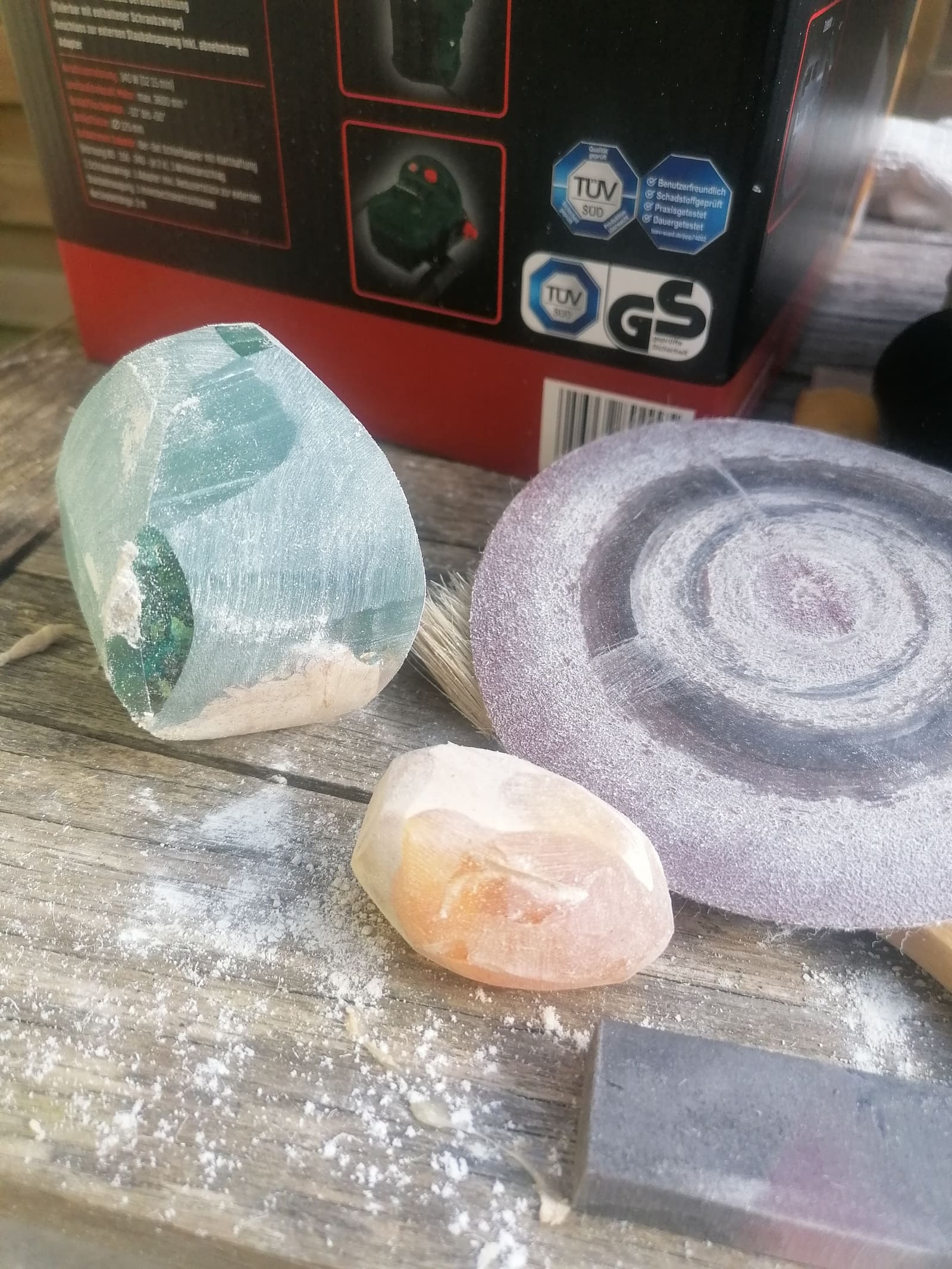
Today I unpacked another toy, eh tool, a plate grinder. I only have a belt grinder that is meant to be handheld and therefore a pain in the ass. This is something completely different and seriously makes sanding so. much. easier.

So here’s the remaining pieces before and after sanding:

©Giliell, all rights reserved: Bog oak and red resin

©Giliell, all rights reserved “Old something” and nails

©Giliell, all rights reserved: Burl and resin

BTW, if you ever want to ruin some sanding paper quickly, try having hot glue on your work piece:

©Giliell, all rights reserved

And, finally:

©Giliell, all rights reserved

The eggs aren’t perfect, but I’m happy with them. The one with the nails was hell to sand because they would heat up and burn your fingers on the other side of the piece…

Now for my favourite (cough, cough) part: sanding and polishing…


You Need a Steady Hand To Do This

Kestrel has decided to enter a painting competition for a micro mini model horse and she’s bringing us along on the journey.

There is a novice model horse painter contest coming up and I want to enter. The contest is specifically for the category of “micro mini” resin model horses – this is 1/64 of live size, and these little horses are made by a sculptor who then either casts or 3D prints them, depending on who is producing them. I’ve painted only 4 of these micro minis and I’m going out on a limb here – this horse is not done, so I have no idea at this point how he will turn out. I need to hurry though – entries close the last day of March! 

©kestrel, all rights reserved

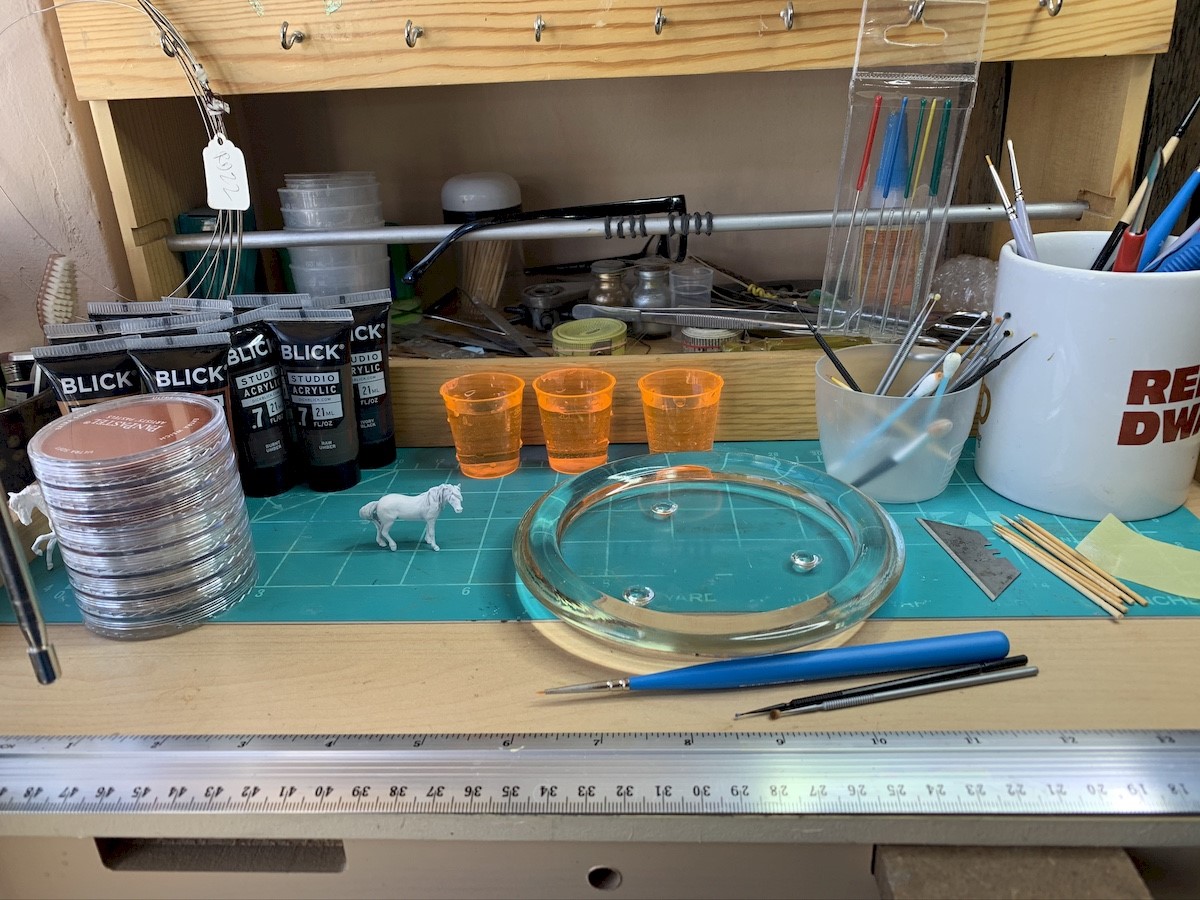
Here is my painting area cleaned up and ready. I have pastels, acrylic paints, the model I’ll paint, some water, my glass palette, various brushes, a tiny piece of flexible sanding paper, a blade to clean the palette and toothpicks, which I use the way some would use a palette knife. 

©kestrel, all rights reserved

Now for safety! People are supposed to breathe air, not pastel dust or paint fumes, so here is my respirator and a pair of gloves. I also wear a visor on my head that goes down over my eyes, and glasses under all that. Hopefully no one comes to the door while I’m so accoutered… The model has to be scrubbed down with something like Comet. Paint won’t stick to finger prints, grease, or dirt, so from now on I won’t touch this model with my bare hands, I’ll always be wearing gloves until I put the final finish on him. 

©kestrel, all rights reserved

My model is already “prepped and primed”. The little donkey resin is not; he has holes and flaws in the casting, seams and rough areas, and all of that has to be filled in, filed down and fixed so that he has a perfectly smooth surface for painting. After the prepping, I spray the model with primer, in this case I used white primer. 

©kestrel, all rights reserved

I’m using this horse as my reference for how the markings will look on the finished model, although I’ll paint the marking as she is in the summer, all shed out and slicked off, not all hairy and dirty like she is here in the spring. Fortunately she lives right here at my house, so if I get stuck on how exactly a marking goes, or the right color, I can just go outside and look. (Plus I have about a million pictures of this little horse on my computer!) It’s very important to use a reference photo or photos. People show these models, once they’re finished, and the judges know very well how a horse should look. If I just made something up, I might accidentally put markings on a horse that are genetically impossible, and that would get marked down in the show ring.

I can’t take photos while I’m painting, so just imagine me putting the first layer of pastel on the model.

©kestrel, all rights reserved

Now I go to my spray booth, to put a layer of fixative on that first layer of pastel paint. The spray booth has a super powerful motor that pulls air through the filter, up through the hose on top and out the window. That way I don’t have paint all over inside the house, there are no fumes inside the house, and I can paint even when it’s cold or snowing/raining outside. The reason the model is on a piece of tape is because these tiny little things don’t weigh much at all, and as gently as I puff the fixative on the model, it will blow right over, possibly messing up the paint I’ve so painstakingly applied. You can see the white primer I used on the filter of the spray booth. I truly am a novice painter; this will be the 5th model horse I’ve ever painted, and that spray booth is brand new.

©kestrel, all rights reserved