
I first wrote about facial recognition back in 2017, shortly after starting this blogue. (stderr) Then, (stderr) I discovered to my complete lack of surprise, that there is a lack of proper paranoia about the topic, and – I suppose that’s justified because climate change is likely to wipe us out, while having no more personal privacy, won’t. I guess we’re arguing about “insult to injury” which is a great way of spicing up your injuries. Add it to heirarchical storage and, whups, things look bad. (stderr) It seems like just the other day I was laughing at people who were implementing poorly-planned “data lakes” but it seems that, miracle, AI actually has stepped in to help with the problem.
So, one thing you need to understand about all those heat-spewing data centers: they are being built that way because it’s the lazy way to do it. That’s another issue, entirely, but it all comes down to being able to reliably select a bunch of stuff from a database. Back when I used to teach classes on that kind of stuff, I remember telling my students that the key was to find an “oracle” – a source of corroberation or correlation that is either incredibly accurate, or predictably accurate. (If your oracle is only predictably accurate, you simply assemble a panel of them into a voting architecture). There are still tons of ways of jamming the system’s input but the designers of the system have placed themselves across the vital pathways of modern civilization: you cannot use your credit card unless your face matches, you cannot board a plane unless your face matches. Add to that about a bazillion parking garages and basically anything that gets paid with a credit card, and you can correlate the payment information to a quick photograph. As I predicted, capitalists rapidly mooted any data privacy protections by simply offering lookup as a “cloud” service: an organization that can’t populate and train its own AI to swim in its own data lake, can just go to one of many companies that sell that information, no questions asked. “Who is this?” I guess, is the only question.
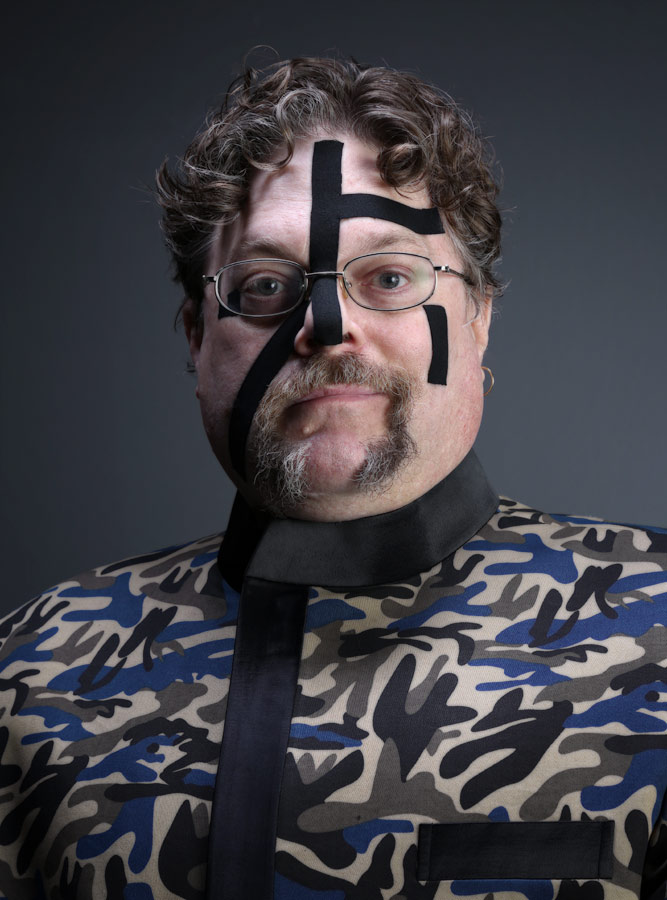
self-portrait 2017
When you hear the ICE goons brag about “we have a little database, too” what they are talking about is a massive cache of identity information. Here is how it goes: a bunch of face images are collected at a protest. Now, someone at an FBI-run “data fusion center” uploads the pictures and scrubs them for rapid identity. Basically, anyone who has already been to a protest and been photographed, will just be confirmed as still looking more or less the same. That starts a thread building in Palantir, looking for clusters of images that match repeatedly in different circumstances – aha, that guy who appears with Marcus frequently is his buddy, [redacted] who drives a Subaru and lives in the outskirts of DC. The presence of the Subaru is confirmed by tollbooth cameras. The parking lot cameras confirm that Marcus’ Toyota is also in the area. We now know, also, that drones are in use to monitor citizens – drones that can generate identity-capable images from miles away; that all goes into the data lake. The data lake becomes a cache – it’s all the people that the system has ever looked up, and all the places and times they have appeared. Mike and Tom, who have not appeared at a protest, do not appear in the data lake, either. Back in the day, when I was teaching people how to build these systems, I always explained it as a pyramid. The more layers you have, the more distilled and refined the data become, so you don’t have to search the whole data lake, or go to someone’s facial identification database, you’ve already got the distilled data. My guess is that, seriously, the system engineers who are building most of the systems out there never took any of my classes, so they don’t know about Bloom Filters or K-D trees or any of the really impressive techniques that you encounter past the heat-death of CS-101. I remember when people used to say “these systems are not real-time enough to be a threat.” Ha, ha, ha, they know who you are within less than a second, and the data returned includes a link to a complete dossier.
What’s really interesting, to me, about a lot of this stuff, is that it illustrates a paradigm in intelligence that I have discussed before – namely, the “retro-scope effect.” All this stuff can predict who may show up at the next protest, at best but not who’s going to throw a petrol jar. Yet. The AIs would certainly be able to scrub through a list of all the dossiers present at a given protests, and search for indicators in their private social media messages and texts that they are planning on bringing a weapon. How do we defeat this? We don’t. That battle is lost. The next battle is to make effectuating the information useless. How do we do that? Well, we need to get some people inside the system, I’m afraid. It wouldn’t be hard – get a job working at Palantir or FBI, NSA, or CIA. Sure, they’re going to do background checks, so that just means you can’t be someone they already have a dossier on. The East German Stasi had massive files on everyone and agents provocateurs out in the population, as well. Did any of it work? Nope. It snagged a few individuals, but probably ones that were being stupid. Let me use an example based on current events: you should not applaud it as a great break-through if your security process identifies Chud the Chud Whatever as a “possible trouble-maker.” Especially now, as he has made some trouble! There’s a slightly subtle point there, which is that if you ask an AI “Who is most likely to cause trouble at a rally?” you’re going to have to weed out a few answers that are 100%. OK, where do you stop weeding?
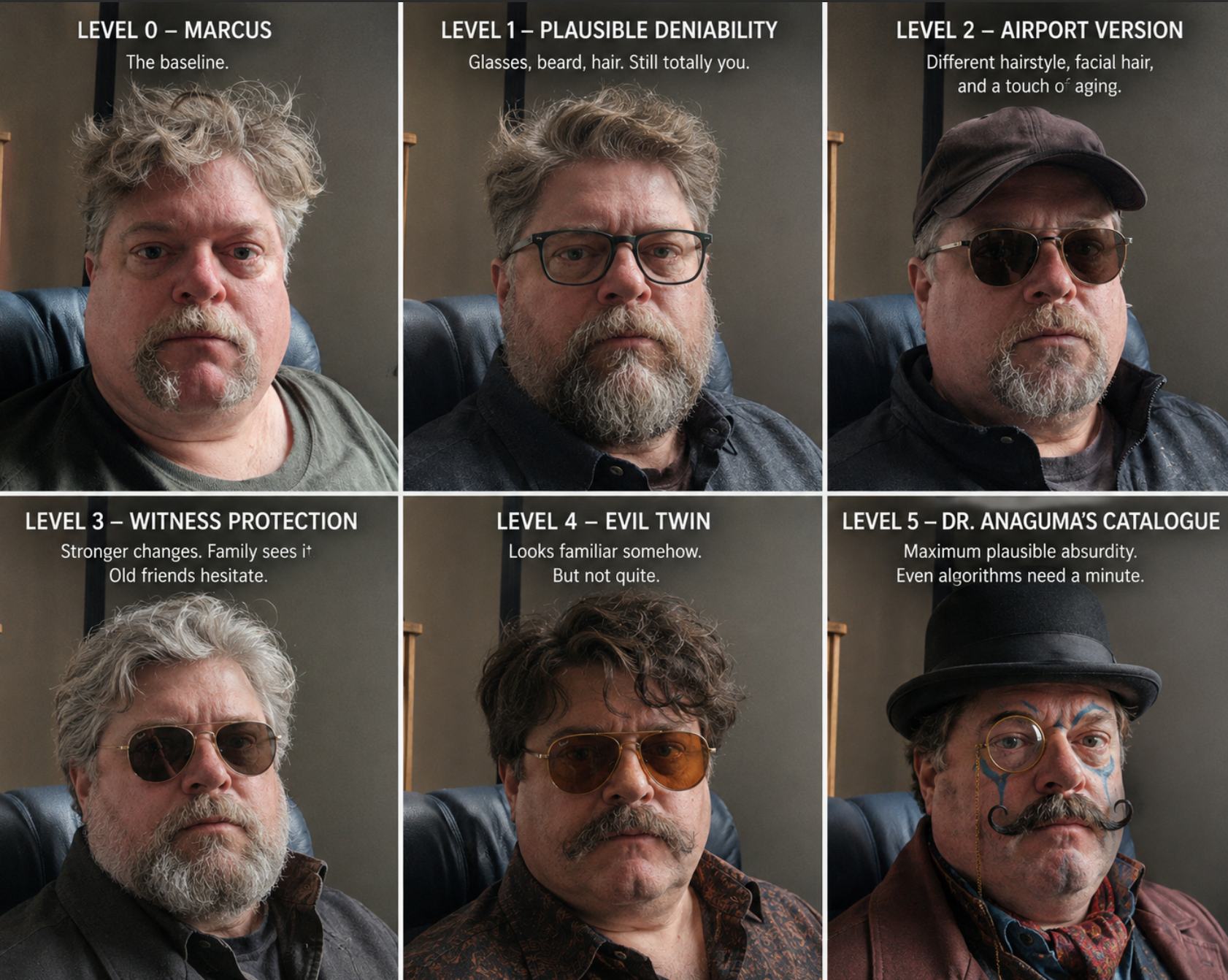 [I asked GPT to generate a succession of increasingly less likely to be recognized images, based on what it knows of what parameters the current face recognition software looks for]
The way to fix all this crap is to just wait for the state to topple from its own incompetence. It all boils down to variations of the force protection problem: the police will insist on being able to beat protesters without recrimination, which means that now you need to peel off some of the military to protect the police, and then how do you protect the military? The insurgent’s problem is to attack the roots of the supply chain and the roots of personnel management. For databases, you need to feed them false data. Some hero of the revolution has to get a job at one of the fusion centers and start back-feeding photos of congresspeople into the watch-lists. You maybe don’t need to be at a fusion center; based on my experience of how bad government security around computers typically is, a janitor in a DHS office or a fusion center could pretty easily access the system. Here’s another hint: airport consoles are totally ignored during non-office hours; sneak around and add keystroke loggers to the DHS scanning stations. I have investigated this likelihood several times at several airports. But, honestly, it’d be more fun to get a job working for DHS, get paid $50,000/year and get free training on the software, medical plan, vacation, etc. The current generation of kids are going to have to learn to be stainless steel rats, creeping in the walls of the system and giving it a bellyful of chicken with a little poop stirred in.
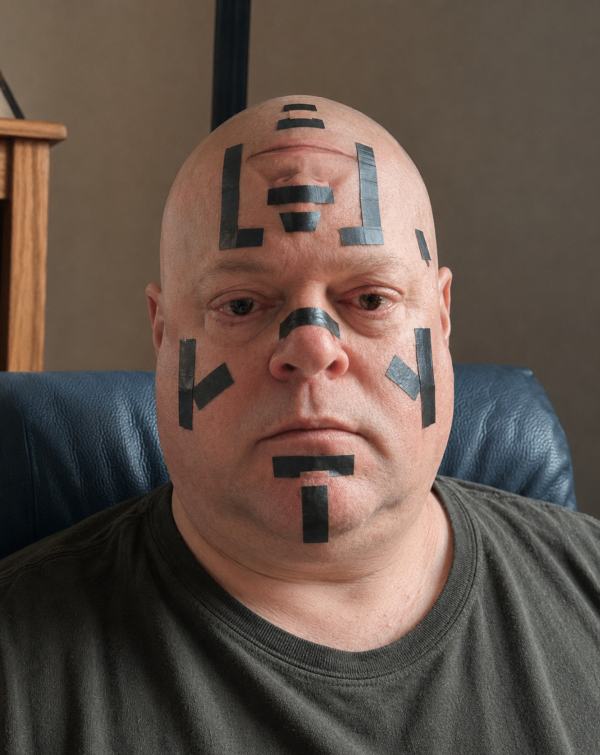 [what is really scary is the realization that moderately overweight bald white guys aged around 60, look very much the same when bald. Think about that: it tells you something about the weight our own algorithm puts on hair.
I asked GPT to make me an updated version of my early effort with tape, except designed to error out the recognizers.]
I guess my view of these things is leaning toward expecting the current generation to be prepared to fight for its life. And the only thing I think I have learned, from years of thought and study, is that the way to defeat systems is by becoming part of the system. If you want to, consider the republicans’ efforts at taking over the government to be a case study in exactly what I am talking about. Just remember that they are interested in destroying institutions, where as in the future our project will be to drive them insane.
the one with the petrol bomb is the fed.
the upside down face freaks me out!
as to the point of the article, real shit, comrade. true facts.
The fundamental problem with all of these schemes is that they run into exactly the same challenges as screening for rare diseases: the false positive rate is higher than the true incidence rate, so the overwhelming majority of hits are false positives. That just falls out of the arithmetic.
As I believe I’ve said here before, it’s a mistake to think that if you want to find a needle in a haystack, the first step should be to build the biggest possible haystack because a bigger haystack should contain more needles.
The question then becomes: do the authoritarians and their goons care whether the overwhelming majority of hits are false positives, or are they perfectly happy with that outcome? Are they actually trying to identify risky individuals, or are they just trying to intimidate the entire population by essentially random acts of terror? And if it’s the latter, how stable is that situation?
The model here is not 1984, where the Party has infallible surveillance of all dissidents and god-like insight into their specific individual psychological quirks… It’s Brazil, where the wrong man gets tortured to death because of a typo on a form, but his family still gets the bill for the electricity used to do it, and the instigating crime that triggered the whole chain of events is fixing somebody’s air-conditioning without the proper paperwork.
I identify Level 3 as John Candy. Yes, the hair has a big influence.
Or maybe it was Mark Hamill… I’m really not that good at names and faces.
I’ve just run all of those faces through the first AI face comparison tool I found that actually worked, and even the one with the bald head and the tape comes back as a 98.5% match for the Level 0 baseline. All of the others are over 99% – the 2017 one is 99.9%, despite the tape and the intervening years. Looks like you need to try harder.
Interestingly, the tool was able to give a 100% match for two photos of me, despite one being face-on and the other being a profile. Possibly helped by the same suit and tie, but still, that seems pretty clever.
ACLU Sues After Facial Recognition Falsely Identifies Florida Man As a Child Abductor
… expecting the current generation to be prepared to fight for its life.
That the whippersnappers will have to fight for their lives seems ineluctable.
But why do you, in 2026, expect them to be prepared for this?
Yeah, hair does make a big difference, just because it’s one of the more variable things in people’s appearances, and most people don’t significantly change it themselves all that often. Facial recognition algorithms still have to deal with many of the same problems as the human versions of the algorithms, one of which is basically the ‘caricature’ problem: nobody actually remembers a face, they remember the deviations from some idealized generic face (because that’s a lot less data to store), and have a ranked list of those. So if somebody’s usual most notable feature (which often is their hair) is hidden, then suddenly there’s a lot more work that needs to be done double-checking the next set of features down the list with less predictive power that have to all add up together to make a match.
And, as Dunc notes above, the even bigger issue is that, given the low percentage of ‘dangerous’ individuals in the population (unless you count ‘anybody who doesn’t applaud Dear Leader’ as a dangerous individual, which Trump probably would), any mistakes are more likely to mark innocent people as dangerous than they are to miss actual dangerous people. That sort of mistake, of course, is one of the easier ways to create radicals like Luigi Mangione. Or Thomas Crooks. So, no, the situation isn’t stable, because when you have a base motivated by grievance, assumptions of unfairness, and conspiracy theories, it doesn’t always take a lot of work to convince someone who’s just been an accidental target of the regime that he supported that, perhaps, the conspiracy went even deeper and that they have already got to the big boss and something needs to be done about it…
Have the facial recognition thingies solved their problems with … complexion?
I have a dizzying collection of wigs, masks, makeup and sunglasses for this (and other subversive purposes)… yet I nevertheless found myself at two different Occupy Wall Street protest sites without any of them.
ID10T error.
chigau@#9:
Have the facial recognition thingies solved their problems with … complexion?
Why would they do that?
Joking aside, I believe the current algorithms are based on a bunch of things including complexion, but primarily eye-to-eye distance, length of mouth, eye-to-mouth, etc. The opportunities for system jamming are replete.
There is probably a great research project to figure out what the minimum changes are, to get the AI to reliably identify a chosen person. Then, you’d get a makeup map and maybe some stickers, and you could do something embarrassing at an airport, Representative Lauren Bobert.
Pierce R. Butler@#7:
But why do you, in 2026, expect them to be prepared for this?
I don’t think they will be. I don’t think that they’re inclined to jump in the direction that maybe needs to be jumped. I was thinking about this the other day. In March 1943, a normal day for a guy just out of high school might be flying to the Ruhr and dropping a bunch of bombs on some factories then a white-knuckle ride home trying to fend off aircraft. It blows my mind to think that was “normal” but it was, it really was. They learned fast because that’s what humans do. One thing I learned quickly from studying military history is that if you threaten humans, there is a really good chance you won’t even see what’s coming.
Right now, the situation looks remarkably familiar. An out of touch would-be monarch, who has a slippery grip on the reins of power, who is bringing economic chaos to a population. Then, because apparently just to be a dick, he starts militarizing things. When some playful locals start throwing playful rocks at some troops and get shot, it’s called “The Boston Massacre” and things go down hill fast from there. Such things have their own inevitability. Perhaps they should, I don’t know.
Back in the day I taught a class called “Secure communications over open networks” which was basically a simple manual for how to set up cell structures for people who were interested in role-playing terrorists. The Ukrainians have dramatically surpassed my humble efforts but that was mostly because I was extrapolating from cold war KGB playbooks. Learn how to build and program drones. They’ll need software without the GPS callouts the US Government made the drone manufacturers put in, so they can tell where the drones are (not by asking the drones, by asking the logs of the GPS server). Learn how to social engineer. Learn how to defeat interrogation so you can recognize if you’re being interrogated by an expert, or just a rando thug.
Learn from the Vietcong. Be prepared to have a lot of your friends die horribly. By the time they grow up, maybe the Palestine situation will be resolved. If it is, it will be because the Palestinians and Hezbollah finally looked at the Ukrainians and said, “huh?” and someone said, “they’re using Vietcong techniques.” Make sure kids know about the Battle of Algiers, and Dien Bien Phu. Teach them that they will have to decide if they want to become awful people, be killed by awful people, or figure out some way of disposing of awful people without becoming awful themselves. That’s the hardest of the 3, so just learn to become awful people.
Learn not to go to a protest at ground level. Learn that when the police appear in a shielded line, you can drop shit on them from the 9th floor. A little girl with a cinderblock can obliterate a police formation. Learn to flank shielded lines. Of course, learn to shoot, but that’s almost secondary to having a good strategy. Back to the Vietcong. What would they do? Well, the police would appear in formation and from the 9th floor would sail two dozen bottles of petrol with burning rags in them. The people who threw them would be di di mau.
The American revolutionaries did a shit job. If they hadn’t had Napoleon distracting the British they’d have been carnage. The King sent his third string and it showed. etc. I could go on, but…. The main thing is that, if you want to be able to jump the right direction when something happens, you need to think about the possibility that thing might happen. Then think about what you do, and be prepared. What do you do when there’s a mass shooting? (break contact and go for distance) etc.
Jenora Feuer@#8:
And, as Dunc notes above, the even bigger issue is that, given the low percentage of ‘dangerous’ individuals in the population (unless you count ‘anybody who doesn’t applaud Dear Leader’ as a dangerous individual, which Trump probably would), any mistakes are more likely to mark innocent people as dangerous than they are to miss actual dangerous people. That sort of mistake, of course, is one of the easier ways to create radicals like Luigi Mangione.
It’s one of the reasons that such systems need to be channel-stuffed to make them less valuable. I don’t know how to do this because it requires a level of access I don’t know about. But if the system can create an entry for “Representative Marjorie Taylor Green” if I hold up a picture of Che Guevara in front of the camera, the hounds of hell are baying to be let out. Because the next play is to put a picture of Marjorie Taylor Green up and enter it as Che Guevara.
Dunc@#5:
I’ve just run all of those faces through the first AI face comparison tool I found that actually worked, and even the one with the bald head and the tape comes back as a 98.5% match for the Level 0 baseline. All of the others are over 99% – the 2017 one is 99.9%, despite the tape and the intervening years. Looks like you need to try harder.
I am sitting here thinking how horrifying that is.
Prompt: a photo re-assessment of me with “mar a lago face” – plumped lips, buccal fat liposuction, face lift, and fabio hair extensions.
Ah, now that’s done the trick – that’s showing as a 0% match.
I think what this is telling us is that AI facial comparison is not looking at faces in anything like the way we do. I mean, I guess that should be obvious if you think about it, but it’s hard to internalise just how different these systems are from anything we are used to, and just how useless that makes all of our experience and assumptions. Truly, they are shoggoths amongst us.