Dangerous times in Brazil

Brazil holds its elections on Sunday and the most significant position is that for the presidency that pits the incumbent right wing extremist Jair Bolsonaro against leftist former president Inacio Lula Da Silva. Bolsonaro is very authoritarian and is currently behind in the polls but has said, like Trump, that he can only lose if there is cheating and that he will not leave office quietly. His supporters are saying that they will not accept any other result than a Bolsonaro victory. If no candidate gets an absolute majority on Sunday, there will be a run-off election on October 30th.


Bolsonaro is in many ways like Trump but while I wrote that it was always unlikely that the US military would go along with any attempted coup by Trump after he lost, that is not the case in Brazil. Bolsonaro is a former officer and has maintained his ties to the military and has, like Trump, given ex-military people important positions in government. Brazil had a US-backed military coup in 1964 and the military stayed in power until 1985. This history of military rule means that the concept of a military takeover is not unthinkable. Bolsonaro during his presidency also greatly relaxed gun ownership laws and that has led to a very large number of people now owning weapons. He also, like Trump, has a hard core of fanatical supporters who believe his outlandish claims, and might be perfectly willing to unleash violence if Bolsonaro urges them on, like Trump’s followers on January 6th.
[Read more…]
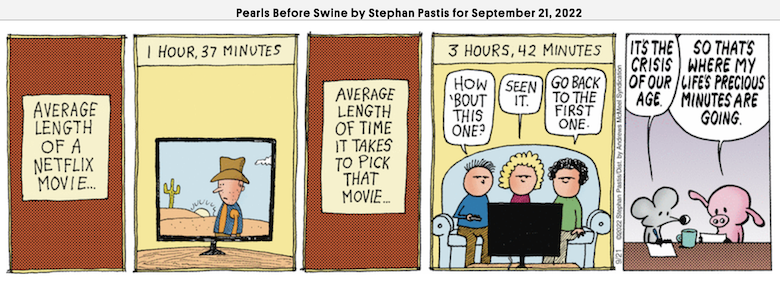
Choosing films to watch

This comic strip will strike a chord with many readers who have spent a long time idly skimming through the streaming options trying to find something to watch. It can be difficult even if one is alone and there are no competing views.

(Pearls Before Swine)

I have pretty much given up on searching through the catalog as a way of finding films. It is very rarely that I stumble across anything that I think is worthwhile to spend a couple of hours on. When I do find something, it is a title that I had heard about before and made a mental note of as possibly interesting and then forgotten about it. What I do now is maintain a list of films that I would like to see based on reviews or recommendations, and then wait until they become available in some format.
[Read more…]

Covid superdodgers

About 95 million people (close to 25% of the US population) have got Covid so far. That is the official number. The actual number, if one includes unreported and undiagnosed cases, will be higher though how much higher is unknown. I think all of us have either had covid or know several people who did, so ubiquitous has it become.

I have not had it so far and have put it down to luck, though it is true that I am cautious and try to avoid situations where the risk of contagion is high. I do know people who have not got it even though close family members have got it on several different occasions. Have they also just been lucky? Or is there something else that might be enabling them to avoid getting infected?
[Read more…]

On objectivity in art criticism

George Bernard Shaw is best known as a playwright but he was also, especially early in his career, a critic of plays and operas that he wrote for newspapers and periodicals. He tended to favor the avant garde. As a theater critic, he did not think much of Shakespeare and was an early advocate of the playwright Hendrik Ibsen, at a time when Ibsen’s work was not fully appreciated in the UK. As a music critic (where he wrote under the pseudonym Corno Di Bassetto), he was an early advocate of Wagner

His reviews were fun to read and as a boy in Sri Lanka I enjoyed reading them even though they had been written long before I was born and he was writing about plays and operas that I knew nothing about, had never seen, and likely would never see. They would often make me laugh out loud. That is a sign of a good writer.
[Read more…]

Political developments in the UK and Italy

I did not know much about Liz Truss who was elected as the new leader of the UK Conservative party, replacing Boris Johnson and thus becoming the prime minister. Jonathan Pie says that she is the most right-wing ideologue to occupy the premiership, even more so than Margaret Thatcher, and that is saying something. And she has started off by doing what right-wingers love to do, and that is give a massive tax cut for the wealthy.

Pie thinks that the right-wingers are going for broke, trying to give away as much as they can to their rich friends as long as they remain in power.
[Read more…]

Cynically exploiting human beings

The current Republican party seems to have just one policy and that is to ‘own the libs’, whatever the cost to real, live people. The appalling publicity-seeking stunt by Florida governor Ron DeSantis in luring Venezuelan asylum seekers from Texas to Martha’s Vineyard in Massachusetts, has aroused widespread condemnation as a cruel and cynical example of such thinking, that having to deal with asylum seekers would make liberals reconsider their humane approach to desperate people seeking better lives. Texas governor Greg Abbott has done something similar, sending busloads of asylum seekers to Washington, DC. However, the residents of those areas have responded by helping out the arrivals.

This idea of sending people to other places to ‘teach the residents of those places a lesson’ has a sordid antecedent in the ‘Reverse Freedom Rides’ of the civil rights era, where white segregationists in the south sent busloads of poor black people, especially women and children who were likely to need public assistance, to Northern states, luring them to accept the rides by promising them all manner of good things. The southern segregationists were hoping to change northern opinion against desegregation. It seems like DeSantis and Abbott see no shame in looking like the segregationists of a previous era. It is part, I suppose, of their goal of returning the US to the 1950s, which they bizarrely see as some sort of golden age ideal.
[Read more…]

Betray friends or betray country?

In his 1938 essay What I Believe that can be found in the collection Two Cheers for Democracy, E. M. Forster wrote the following:

I do not believe in Belief. But this is an Age of Faith, and there are so many militant creeds that, in self-defence, one has to formulate a creed of one’s own. Tolerance, good temper and sympathy are no longer enough in a world which is rent by religious and racial persecution, in a world where ignorance rules, and Science, who ought to have ruled, plays the subservient pimp. Tolerance, good temper and sympathy – they are what matter really, and if the human race is not to collapse they must come to the front before long.
[Read more…]

Was there a coup in the last days of Trump’s administration?

During the period of turmoil just before and after the 2020 election, when an increasingly belligerent and angry Trump kept insisting that he could only lose if there was cheating and would not state that he would go along with the peaceful transfer of power if he was declared the loser, there was increasing alarm that he would try and stage a coup rather than leave office. I personally thought that this was unlikely and said so in June before the election and in November just after the election.

The reason for my skepticism was that in order to carry out a coup, Trump would need the support of the military and I could see absolutely no upside for the US military to get involved in such an attempt. Other than so-called palace coups where a group of insiders edge out a leader by some means and replace them with another insider, most coups require actions by the military to seize the major organs of power and the media, arrest opposition leaders, and patrol the streets to quell any nascent opposition. A simple cost-benefit analysis would tell the top US military brass to steer clear of any such move. The potential cost is very high, since if the coup attempt failed, all the officers would be charged with treason. The potential benefits are nowhere close to being worth the cost since the US military already does very well in terms of broad public support. The top military brass get treated very well and have all manner of desirable perks. Both major parties fall over themselves to see who can be more generous in funding the military, sometimes giving them even more than they ask. Why would they risk a very cushy gig by breaking all prior norms and coming down on one side, especially when that side is led by an utterly erratic, irrational, and narcissistic person like Trump? This situation is quite different from that in countries where successful coups have taken place, where the military thinks it has much to gain by taking over the government or aiding a politician in taking it over.
[Read more…]

Film Review: The Story of Film: An Odyssey (2011)

This British documentary directed and narrated by Mark Cousins looks at the history of film making around the world starting from 1888, looking at them from the point of view of the social context of films, the times in which they were made, what they were trying convey, their innovations, the techniques that were used, and how they influenced each other. The scope of the documentary is of the entire history of film over the entire globe, and includes explorations of the work of lesser-known (to me at least) directors, including those in Asia, Africa, and Latin America.

The documentary lasts 15 hours in total that are spread over 15 episodes. It is interspersed liberally with clips from many films in order to make its points. Despite its length, some selectivity is of course essential. Cousins focuses on the creative aspects of films and thus the work of directors and, to a lesser extent, screenwriters and cinematographers. Cousins is clearly partial to the realist school of filmmaking and to those directors who took risks and made experimental films that pushed the boundaries of the craft or showed their societies in a realistic and hence unflattering light and thus risked repercussions from their governments. Such directors are less well-known outside the cognoscenti because their films were usually not box office hits. You will find few mentions of the big Hollywood blockbusters unless they used some innovative techniques or are used to contrast with more realistic depictions.

The documentary is presented largely chronologically, except when jumping from one era to another in order to show connections. I think that the more attuned you are to the aesthetic of cinema, the more this will appeal to you. Even though I am somewhat of a low-brow film viewer, I still found the documentary engrossing.

Here’s the trailer.