Proof from Transcendence (2)

Scanners

No doubt, this seems like I’m stretching. How can spiritual transcendence be the same as the non-spiritual kind? The two seem very different.

In the past two decades, a new term has sprung up: neurotheology. Scientists armed with brain scanners have begun using them on the devout, looking for any interesting patterns. Unfortunately, most approach this from the theological side, either taking the existence of a god as fact or explicitly stating they are uninterested in its existence. This tends to colour their interpretations of the data.

Still, there are interesting nuggets to be found. For instance, Andrew Newberg has compared the minds of believers while they meditated to those of atheists doing the same thing, and found no difference between the two. In study after study, this pattern holds:

When we look at how the brain works, it has a limited set of functions. So if one has a feeling of euphoria — whether one gets that through sex or religion or watching your team win the championship — it’s probably going to activate similar areas of the brain. There’s a continuum of these experiences. […]

Are we really capturing something that’s inherently spiritual? This is a big philosophical question. If the soul or the spirit is really non-material, how does it interact with us? Of course, the human brain has to have some way of thinking about it. Perhaps the most interesting finding I could have would be to see nothing change on the brain scan when one of the nuns has an incredible experience of transcendence and connectedness with God. Maybe then we really would capture something that’s spiritual rather than just cognitive and biological.

(Andrew Newberg, interviewed by Steve Paulson for Salon. Sept 20, 2006. http://www.salon.com/books/int/2006/09/20/newberg/print.html )

If there were some legitimate difference between believers and non-believers, we’d expect some difference in the brain itself. Instead, it seems that behaviour is far more influential than belief; by merely repeating the same actions, we see the same patterns across both categories.

Note that this is not disproof against a god by itself. Others have used the very same observations to claim that everyone has a spiritual connection, even those that don’t believe in it. This is a valid interpretation, but it doesn’t line up with the claims of believers. People who don’t believe or are in the wrong religion are fundamentally different from those in the right religion, since only the last has true contact with the real god or gods. We should see this difference reflected somewhere. Secondly, it depends on the existence of a god to make sense. This is a problem, since the alternate explanation does not depend on the existence any god, it only discounts that the brain has a special channel to the gods, but the theory is otherwise agnostic about them. We can begin sharpening Ockham’s Razor.

But first, there’s more evidence to ponder. The Pentecostals, a Christian sect, believe that “speaking in tongues” is the highest form of worship. Also known as glossolalia, it’s a sort of spoken gibberish, sometimes while writhing around on the floor, and is claimed to be the sign of God speaking through those people. This makes an interesting test case, since both prayer and glossolalia attempt to contact the same god through different behaviours. If both have the same brain activation patterns, this would be clear proof that a deity was involved; if the brain and body were material things, different external behaviour must correspond to a different internal state.

Newberg’s studies show that the brain states are different. He’s catalogued the regions of the brain involved in both activities:

  • thalamus: linked to processing the senses. More active than usual in both prayer and glossolalia.
  • temporal lobes: linked to processing our emotions. More active in both.
  • frontal lobe:[167] linked to our ability to concentrate and focus. More active in prayer, but inactive in glossolalia.
  • parietal lobe: linked to feelings of self, and how it relates to the world. Less active in prayer, no effect during glossolalia.

Interesting, isn’t it? When people pray, they focus on losing their sense of self and the external world, feeling an emotional lift they think is a real experience; at the same time, the corresponding areas of the brain fire up or shut down, according to need. Meditation has roughly the same effect, and roughly the same brain patterns. When people speak in tongues, losing their focus (but not their sense of self) to an emotional lift that feels very real, the brain also changes accordingly. The areas of their brain responsible for language do not light up, and linguists studying the sounds uttered during glossolalia can find no evidence of linguistic structure. Note that every activated region is not reserved for religious use, but one that we discovered being used by some secular activity.

This pattern is exactly what we’d expect if the brain was purely material, and the feelings attributed to religion were just existing ones put to a different use. This pattern is not what we’d expect if a divine being were beaming those feelings directly into our minds.

Still, this is not a dis-proof of the gods; I can find no studies that checked if the feelings of transcendence came before the brain activity, for instance, which could have provided evidence for the theist side. It’s quite possible that a god grants us these feelings by tugging on the appropriate portions of the brain. On the other hand, if we said this pattern were the actions of a god we’d be assuming a god existed, while if we claimed it was purely material we’d make no such assumption. Ockham’s Razor says we should go with the material theory, rendering the gods irrelevant yet again.

Precision from the Non-Precise

There’s an odd hypocrisy to this proof.

Have a careful look at the two squares, and tell me which one is lighter:Adelson's checker shadow illusion.
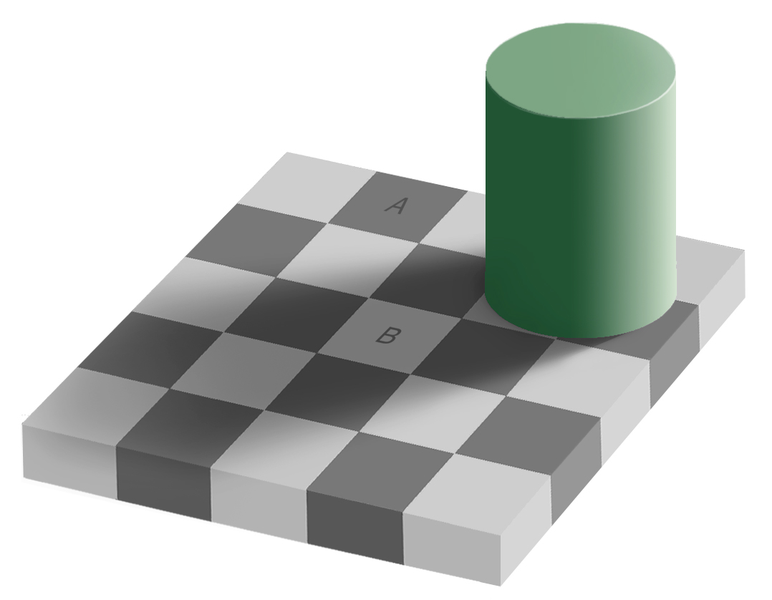
Sorry, that was a trick question: both squares have the same tone.

Are you feeling any anger at your senses? I doubt it, we’re happy to admit they lead us astray. That goes doubly so for the religious, because it allows them to dismiss a lack of physical evidence and invoke the Transcendence Proof.

[FUTURE HJH: I left this bit incomplete. My basic plan was to link to Descarte’s invocation of God as a fundamental belief. This website provides a basic sketch.]

Why, though, are we so content to accept this inaccuracy? We rely on our senses to an astonishing degree, after all. I think it’s a safe assumption that you’re absorbing this text through your senses. Was any part of it blocked by a malfunctioning sense? Did you have to repeat certain passages, because the words kept changing on you? Did the page suddenly zip away or flip upside down? Think of all the possible moments, and all the possible ways, this text could have been screwed up by your senses, and total up how many of them have happened so far. For most people, I’m sure, that total is comfortably close to zero.

Now total up the number of moments that went right. Are they near zero? Or substantially higher?

Let’s say you’re one of the unlucky few. Pretend that on average, one out of every ten words you absorb were not written by me. Does that make this book unreadable? Certainly not. If you scan each passage twice, the odds of a word being wrong both times drop are one in a hundred. Three readings pushes the odds down to one in a thousand, and the more readings you’re willing to do, the more confident you can be that you’re reading what I wrote.

What if we don’t know the odds? Fortunately, the English language has roughly 200,000 words, so there are far more ways to be wrong than right. The odds of the same wrong word being picked twice in a row are roughly one in 200,000, so if you read the same word twice you can be quite confident it’s the right one. Switching to a language with a ridiculously small vocabulary still doesn’t stop you from moving forward, it just requires more scanning.

We don’t fret over unreliable senses because it’s trivially easy to make them reliable enough. Consider the colour puzzle; in that case, multiple samples will never lead you to conclude both squares are the same shade. However a simple mask, cut out of paper, will quickly make the truth obvious. When you start to employ multiple senses, and use or augment them in multiple ways, you can be quite sure they haven’t led you astray.

What about our feelings, though? Can they be fooled, like our other senses? It would be very odd to claim that easily verified senses like vision are unreliable, and yet fuzzy, non-specific feelings are perfectly reliable.

If they can steer us the wrong way, then how can we trust them without putting them to the test? How can we rely on them to tell the truth, without looking for and ruling out alternate explanations first?


[167]  From one ear, draw around the front of your head at eyebrow-level to the other ear, then return by going over the very top of your head. You’ve just outlined the boundaries of your frontal lobes.
Russian Hacking and Bayes’ Theorem, Part 1

I’m a bit of an oddity on this network, as I’m pretty convinced Russia was behind the DNC email hack. I know both Mano Singham and Marcus Ranum suspect someone else is responsible, last I checked, and Myers might lean that way too. Looking around, though, I don’t think anyone’s made the case in favor of Russian hacking. I might as well use it as an excuse to walk everyone through using Bayes’ Theorem in an informal setting.

(Spoiler alert: it’s the exact same method we’d use in a formal setting, but with more approximations and qualitative responses.)

[Read more…]

Proof from Transcendence (1)

In the span of your life, you’ve probably experienced a lot of highs and lows. Sometimes, things are going so well that you completely forget yourself; sometimes, things are so bad that you are desperate for any sort of help.

Did you ever stop to think where those feelings were coming from? Perhaps they are little hints from a deity, wee stone markers placed on a giant mountain that whisper “I’m here.” Just like a pebble hitting the top of an unsteady slope, these little nudges could trigger much greater changes within you. Maybe it can pick you up when you’re down, or even save your life:

Travis Barker’s ex-wife, Shanna Moakler, told US Weekly that she was supposed to be aboard the private jet that crashed in South Carolina on September 19, injuring Barker and DJ AM and killing four others, but she changed her plans at the last minute because she had “a bad feeling.”

“I was supposed to go with [Travis] to South Carolina, and at the last minute, I had this gnarly feeling and said, ‘I don’t think we should fly together anymore,’ ” she told the magazine in its October 17 issue, which hits stands Friday. “God forbid something ever happened … our kids wouldn’t have both parents. Instead of flying a commercial flight back home, they decided to take a private jet. He e-mailed me pictures of the plane and wrote, ‘It’s really small and scary.’ I had a bad feeling, but didn’t want to sound strange, so I said, ‘Be safe.’ “

(a news article for MTV.com, by James Montgomery, dated October 16th, 2008.  )

It could explain why we’re so curious about deities. What if we all have a concept of the gods built into us, one that will only bubble up if we let it?

The most frequently mentioned barrier to a personal relationship with God is never having experienced God’s presence. “If only I felt something,” some Catholics have told me, “then it would be easier to pray.” “If only God made his presence known,” say seekers, “then I could start down the path of faith.” Even agnostics like my friend-as well as atheists-seeking intellectual proofs for God’s existence admit that if they saw a glimmer of God, maybe they’d consider believing.

(“More than a feeling: A desire for God,” by James Martin. U.S. Catholic, July 2010, Vol. 75, No. 7)

Older than Dirt

I suspect this proof is one of the oldest, if not the first. For one, it doesn’t need any sort of logic or language to make. Simply feeling a wonderful feeling is enough, and we have every reason to think emotions pre-date human beings. Fear, for instance, has been linked to our thalamus, one of the most “primitive” portions of the brain.[164] Paul Ekman has found that some facial expressions, our external signal of emotion, are nearly universal across all human cultures and thus likely pre-date humans.[165]

For two, we know human beings have been searching for feelings of transcendence for some time. Some tribes of North America sent their children on a vision quest, which usually consists of a multi-day fast and constant meditation in the wilderness, sometimes helped along by narcotics or sleep deprivation. The goal is to find their life’s purpose via the spirit world. Some people experienced actual visions, complete with a guardian animal; others just got a feeling of transcendence. The Bhagavad Gītā, a key holy text of the Hindu religion, discusses transcendence at some length.

[When] the yogī engages himself with sincere endeavor in making further progress, being washed of all contaminations, then ultimately, achieving perfection after many, many births of practice, he attains the supreme goal.

A yogī is greater than the ascetic, greater than the empiricist and greater than the fruitive worker. Therefore, O Arjuna, in all circumstances, be a yogī.

And of all yogīs, the one with great faith who always abides in Me, thinks of Me within himself, and renders transcendental loving service to Me — he is the most intimately united with Me in yoga and is the highest of all. That is My opinion.

(Chapters 6.40-6.47, translated by A. C. Bhaktivedanta Swami Prabhupada)

Notice that both accounts describe much more than feelings, though. Krishna is also talking about his Vishvarupa, or “Universal Form:”

Arjuna saw in that universal form unlimited mouths and unlimited eyes. It was all wondrous. The form was decorated with divine, dazzling ornaments and arrayed in many garbs. He was garlanded gloriously, and there were many scents smeared over His body. All was magnificent, all-expanding, unlimited. This was seen by Arjuna.

If hundreds of thousands of suns rose up at once into the sky, they might resemble the effulgence of the Supreme Person in that universal form.

At that time Arjuna could see in the universal form of the Lord the unlimited expansions of the universe situated in one place although divided into many, many thousands.

Then, bewildered and astonished, his hair standing on end, Arjuna began to pray with folded hands, offering obeisances to the Supreme Lord.

Arjuna said: My dear Lord Krishna, I see assembled together in Your body all the demigods and various other living entities. I see Brahmā sitting on the lotus flower as well as Lord Śiva and many sages and divine serpents.

(Chapters 11.10-11.16, translated by A. C. Bhaktivedanta Swami Prabhupada)

 That sounds suspiciously like proof by Witness. Prayers can also bring feelings of transcendence, yet are frequently tied to proof by Miracle as well:

Although everyone was puzzled about my condition, even me, I knew that the one thing for sure was that God, my Lord and savior was in control of my life. As I laid there in that hospital bed day and night, I prayed, meditated and spoke to God reflecting on my life, trials and tribulations.I believe I had an out of body experience with a peaceful bright light pure moment. I made up in my mind that I was going to let go and let God! I started making peace and preparation mentally to God that if it was my time to go in his plan, I will trust him.

That being said, I knew my life had purpose and that he wasn’t through with me yet. When I let God have total control, I started to make progress and improve. Giving God high praise for His grace and mercy for me. All the prayers from family, friends the medical staff and complete strangers helped throughout this ordeal.

I don’t know why I suddenly became so ill that year, and doctors not giving me a diagnosis, but I trust God’s plan because I never would have made it without him and his son Jesus! There’s a saying that “God works in mysterious ways and he’s a miracle worker”. I know because I’m a living testimonial miracle, thank you God, thank you Jesus!

(“C.R.” from Tennessee, retrieved June 6th 2011)

To clear up this tangle, I’ve set up borders around each proof:

  • Miracle proof: A deity makes a change to the universe for multiple people, directly through the senses.
  • Witness proof: A deity makes a change to the universe for one person, directly or indirectly through the senses.
  • Transcendence: A deity changes a person without involving the senses.

By the above definitions, “hearing voices” or “seeing visions” is the domain of the Witness proof, even if the person experiencing them claims they were entirely internal. I don’t limit the senses to the traditional five, either, so your ability to sense how your limbs are positioned or how hungry you are count just as much.

That doesn’t leave a lot left for Transcendence. We have logic, our method for exploring the external world and our internals via conscious effort, and emotions, which are a representation our internal unconscious state. The first part’s already been covered by the Logic proof, which leaves us to consider emotions.

Hooked on a Feeling

Emotions are… a lot of things.

They can bring us to action. For seven weeks in 1904, Upton Sinclair took several jobs at meatpacking plants. He wanted to write a novel that would explore the plight of new immigrants, by showing the harsh conditions they were forced to work under. Sinclair filled the book with vivid tales of con men and corruption, but it was the descriptions of those meatpacking plants that caught the public’s imagination. Bowing to the public’s feeling of disgust, the U.S. Government and Teddy Roosevelt passed the “Meat Inspection” and “Pure Food and Drug” Acts, which began regulating the food industry.

Emotions can paralyse us. Depression is a persistent feeling of sadness, by far the most common psychological problem in humans. Most of us will go through it at some point in our lives, and feel a little of its paralytic sting. An unlucky few have it to such an extreme that their paralysis is almost literal; they rarely get out of bed, spend most of the day sleeping, and need to be taken care of by others.

Emotions are somewhat independent of conscious thought. The brain structures are in quite different places, and the key emotional centres are close to the brain stem and other ancient structures. This makes a lot of sense: not all food is created equal, for instance. Fats contain more calories per unit than sugars. An organism that was better at seeking out fat would do better than one that did not in the long term. An organism that was given a reward for eating fat might do better still. And a happy feeling certainly counts as a reward.

Similar reasoning applies to running. A little while ago, we only ran to escape being eaten or to catch food. Afterwards, our bodies would begin to repair any damage received. As part of the process, it would dull the sensation of pain and inadvertently give us another high. Not only would that encourage us to run again in future, but we’d be far more likely to run while playing with others. This “exercise” would prepare them for a future encounter, increasing their odds of survival.

Having said that, consciousness can exert some control over emotion. In modern times, humans usually run for “fun.” More accurately, our reasons to exercise aren’t directly linked to survival; we jog to look more attractive to the opposite sex, or for the social atmosphere a group provides, or to enjoy the challenge of training, or to take advantage of the feelings exercise triggers within us. Exercising has become a more conscious decision, yet the boost to our mood remains.

We also control our feelings more directly. Cognitive behaviour theory holds that your thoughts about the world effect your emotions. By challenging the negative views you hold and substituting neutral or positive ones instead, CBT claims it can cure mild to moderate depression. The science seems to back that up; CBT is the most successful verbal therapy in the psychologist’s toolkit, and out-performs most medicine- or surgery-based therapies.[166]

I would place more credence in the transcendence argument if the only people who experienced it were from a specific religion. This isn’t the case; Jains and Buddhists both feel that divine touch, for instance. In particular, Jainism does not attribute that to a god, instead claiming it as proof that someone is getting in “touch” with the universe. I myself have experienced this feeling several times, and in each case it’s been triggered by the material world, with no sign of divine prompting.

So how can something that is normally linked to a god also appear in the god-less? It must be caused by something other than a deity.

Suppose you have a group of people chanting passionately and enjoying themselves. Human beings are social critters, so we try to read what other people are thinking. We’re hoping to exploit this, either directly by lying or indirectly by forging closer ties that might save our bacon later. Mirroring other people is a good way to get close to someone, since it shows they’re not alone. If they appear sad, we feel sad; if they’re happy, we feel happy as well. It also saves precious brain resources, by allowing some cells to do double-duty and respond to other’s emotions as well as our own.

If you’re within this group, then, their emotions will have a strong influence on your emotions. Lacking a connection to someone could lead you into conflict, in the worst case; having a conflict with a group can be somewhat unhealthy! So if there’s a state of euphoria or transcendence in the air, you’ll pick it up. The entire process is so basic that it’s been built into us by evolution, and is largely unconscious and automatic.

Now suppose you’ve been told those feelings are due to a god. Because this process is automatic, you might not realize why those feelings are bubbling up in the first place. Feelings are primitive, older than rational thought, so you can’t easily use the other to examine the one. With no clear cause to be found, it would be easy to convince yourself those feelings are due to a deity. If the god-transcendence connection is hammered into your head repeatedly, you become conditioned to think it automatically, to the point where you can consciously trigger those feelings by thinking of the deity.

And so, a desire for pleasure becomes a desire for pleasure through the gods.

[You] feel lifted up, or likewise, a sense of exaltation or happiness. Different from longing to know what it’s all about, you feel that you are very close to, or are about to meet, the object of your desire. You may even feel the warmth of being near God, though you may be reluctant or embarrassed to define it as such.

Each of these feelings, by the way, may overlap. And there’s no need to identify them precisely. Sometimes the feelings that are the most difficult to describe are those that are the most personal, the most tailored to your own situation. Here God may be speaking more clearly than anywhere else. Just because you can’t describe it doesn’t mean it’s not real.

(“More than a feeling: A desire for God,” by James Martin. U.S. Catholic, July 2010, Vol. 75, No. 7)

Likewise, a desire for learning becomes a desire for learning about a god.

A desire for fulfilment becomes a desire for fulfilment with gods.

A desire for security becomes a desire for security within the god.

Suppose instead this chanting group was at a concert or party. Again you’d feel transcendent, but the blame for that would fall elsewhere. It might transfer to the band, making you a fan. Listening to a recording of their work, or even thinking about that night would bring back those feelings. It might transfer to the friends by your side, which would strengthen your social ties further. It might get associated with what you’re drinking, or parties in general. Or it might be a combination of these, or none of them.

Those feelings have a non-spiritual origin, but can be associated with spirituality or anything else you like. Adding the supernatural does not change those feelings in any way, nor does it offer proof of the supernatural.

Because feelings are just another sense, only about your internal state instead of the external world. The fact that you can’t point to what triggered your sensation, unlike most other senses, doesn’t rule out a natural explanation.


[164]  Picture your brain as a lollipop, with your spine as the stick. The thalamus is right at the top of that stick, deep within the brain. We call it “primitive” because it’s in nearly every animal with a spine, so it must have evolved early in order to be so widespread.

[165]  “Constants across cultures in the face and emotion,” Paul Ekman, Wallace Friesen. Journal of Personality and Social Psychology 17 (2), 1971.

[166]  Antidepressant drugs, long thought to be about as effective as CBT, have been called into question for mild-to-moderate depression recently; for one example, see “Antidepressant Drug Effects and Depression Severity,” Jay C. Fournier et al, JAMA. 2010; 303(1):47-53. Electroconvulsive or shock therapy is on a comeback, but only for the most severe cases. Transcranial magnetic stimulation is used when shock therapy fails.

Journal Club 1: Gender Studies

Last time, I pointed out that within the Boghossian/Lindsay kerfuffle no-one was explaining how you could falsify gender studies. As I’ve read more and more of those criticisms, I’ve noticed another omission: what the heck is in a gender studies journal? The original paper only makes sense if it closely mirrors what you’d find in a relevant journal.

So let’s abuse my academic access to pop open the cover of one such journal.

Gender & Society, the official journal of Sociologists for Women in Society, is a top-ranked journal in sociology and women’s studies and publishes less than 10% of all papers submitted to it. Articles analyze gender and gendered processes in interactions, organizations, societies, and global and transnational spaces. The journal publishes empirical articles, along with reviews of books.

They also happened to be at the top of one list of gender studies journals. I’ll go with their latest edition as of this typing, volume 31 issue 3, which is dated June 2017.

[Read more…]

Proof from Fine-Tuning (2)

Do Androids Dream of Anthropic Sheep?

I doubt that will feel like a satisfying answer. Even if the universe is not perfect for us, the fact that we’re even here seems too good to be true. Isn’t it more likely that unintelligent life should be here instead of us? Why is there something instead of nothing?

I think I can answer that through a series of questions.

What would this universe look like if it was inhospitable to life? This is clear nonsense, since there’d be no life around to ask the question, let alone answer it. We can use our theories of the universe to guess, but as pointed out above we’d need to assume they can be tuned, guess what settings we could change, and then via some assumptions rank their friendliness to life. This leads to an important point: life can only bloom in a universe that is compatible for life, and only life can ask questions.

What would this universe look like if it didn’t allow intelligent life? This is an equally silly question, for the same reasons. Because we can ask it at all, our universe must be compatible with intelligent life.

Time for a tricky one: How can we tell a compatible universe from a tuned one? If we’re lucky, the answer will be buried in either the initial state or the laws of the universe. If not, we could check if we’re in the best possible universe, and argue that’s unlikely to happen by chance. Failing that, we’ll have to tally up the tunings better than ours, calculate the odds of our particular tuning, and decide if it’s sufficiently unlikely to happen by chance.

In all three cases, we’re not only dependent on the missing information I pointed out earlier, we may need to add more, like the odds of a specific tuning happening. Worst of all, in one case we’re forced to consider when we transition from “unlikely to happen by chance” to “impossible to happen.” Even if the odds were a million to one against something happening, it could still happen by chance. It’s like a lottery winner claiming they were destined to win the lottery, because the odds of anyone winning the lottery are so low that no-one should have been able to win it.

Faced with so many unanswered questions in the way, both believers and unbelievers have simply made up answers to the compatibility problem. And when the answers are invented, the conclusion is predictable:

Design advocates argue that the universe seems to have been specifically designed so that intelligent life would form. These claims are essentially a modern, cosmological version of the ancient argument from design for the existence of God. However, the new version is as deeply flawed as its predecessors, making many unjustified assumptions and being inconsistent with existing knowledge. One gross and fatal assumption is that only one kind of life, ours, is conceivable in every conceivable configuration of universes.

However, a wide variation of constants of physics leads to universes that are long-lived enough for life to evolve, although human life need not exist in such universes.

(“IS THE UNIVERSE FINE-TUNED FOR US? ”, Victor J. Stenger , Emeritus Professor of Physics, University of Hawaii)

Stenger attempts to show that our universe isn’t really fine-tuned by showing that long-lived stars are not unusual. He fails for five reasons. 1.) He gets his formula wrong, and in so doing ignores an important case of fine-tuning. 2.) He fails to consider the effect of altering the strength of gravity. 3.) He “cherry-picks” a very favourable fine-tuning example to suit his purposes. 4.) His probability claims are vacuous, following trivially from his unjustified hidden assumptions. 5.) He rightly exhorts us to consider varying multiple parameters at once, but commits the opposite mistake: he fails to consider multiple life-permitting criteria. Even if he were right about long-lived stars, it doesn’t follow that life-permitting universes do not need to be fine-tuned. I conclude that Stenger’s claims are worse than mistaken; they are misleading.

(“No Faith In MonkeyGod: A Fine-Tuned Critique of Victor Stenger (Part 2),” Luke Barnes, Postgraduate Researcher at the Institute for Astronomy at ETH Zurich, in Letters to Nature, April 18, 2010)

A compatible universe can look like a tuned one, if you invent the proper answers. Refuse to do so, and all you can conclude is that the universe is compatible with intelligent life, because intelligent life exists.[163]

Carts and Horses, Meet Cranes and Skyhooks

There’s one more assumption floating around behind this pseudo-proof: the universe is tuned for life.

Is that really the case, though? In the Design proof, I discuss evolution and how it works. Specifically, I pointed out that the products of evolution are tuned to the environment around them by the environment itself. Life, from all indications, is a product of evolution.

Thus, life tuned itself to the universe, and not the other way around. This explains why the two seem unusually compatible: life has adjusted to the challenges thrown down by the universe, altering itself appropriately. If it had not, you wouldn’t be around to ask why the two seem so compatible.

Douglas Adams compared the Fine Tuning pseudo-proof to a puddle:

It’s rather is if you imagine a puddle, waking up one morning and thinking hmm this is an interesting world I find myself in, an interesting hole I find myself in, it fits me rather neatly, doesn’t it. In fact it fits me staggeringly well, must have been made to have me in it!

This is such a powerful idea that as the sun rises in the sky and the air heats up and, as gradually the puddle gets smaller and smaller it’s still frantically hanging onto the notion that everything’s going to be all right because this world was meant to have him in it, was built to have him in it. So the moment he disappears catches him rather by surprise. I think this maybe something we need to be on the watch for.

Indeed, lest we push a proof that isn’t one at all.


[163]  Notwithstanding the old astronomy joke about searching for intelligent life in the universe.

About Damn Time

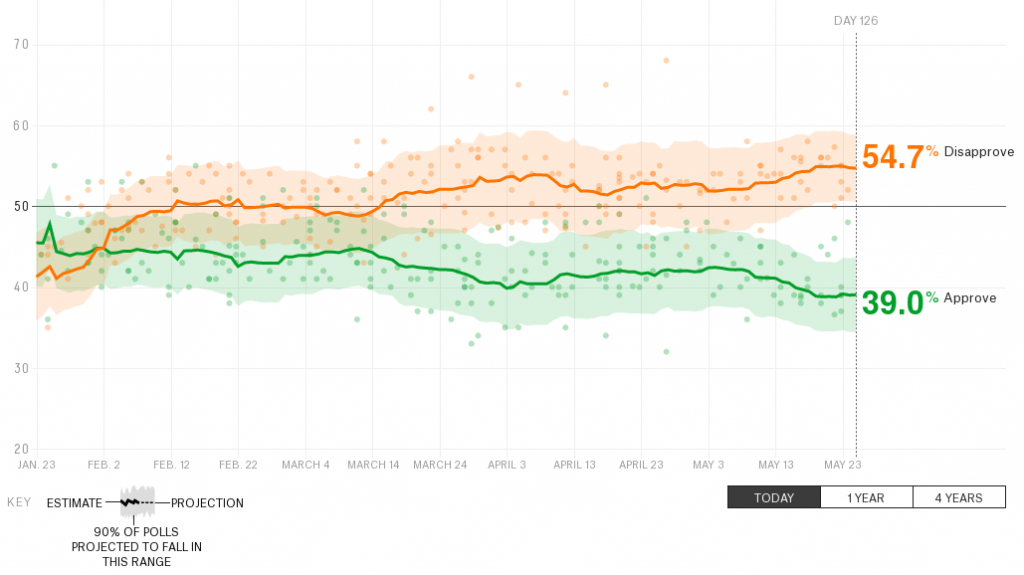
Ask me to name the graph that annoys me the most, and I’ll point to this one.538's graph of Trump's popularity, as of May 25th, 2017.

Yes, Trump entered his presidency as the least liked in modern history, but he’s repeatedly interfered with Russian-related investigations and admitted he did it to save his butt. That’s a Watergate-level scandal, yet his approval numbers have barely changed. He’s also pushed a much-hated healthcare reform bill, been defeated multiple times in court, tried to inch away from his wall pledge, and in general repeatedly angered his base. His approval ratings should be negative by now, but because the US is so polarized many conservatives are clinging to him anyway.

A widely held tenet of the current conventional wisdom is that while President Trump might not be popular overall, he has a high floor on his support. Trump’s sizable and enthusiastic base — perhaps 35 to 40 percent of the country — won’t abandon him any time soon, the theory goes, and they don’t necessarily care about some of the controversies that the “mainstream media” treats as game-changing developments. […]

But the theory isn’t supported by the evidence. To the contrary, Trump’s base seems to be eroding. There’s been a considerable decline in the number of Americans who strongly approve of Trump, from a peak of around 30 percent in February to just 21 or 22 percent of the electorate now. (The decline in Trump’s strong approval ratings is larger than the overall decline in his approval ratings, in fact.) Far from having unconditional love from his base, Trump has already lost almost a third of his strong support. And voters who strongly disapprove of Trump outnumber those who strongly approve of him by about a 2-to-1 ratio, which could presage an “enthusiasm gap” that works against Trump at the midterms. The data suggests, in particular, that the GOP’s initial attempt (and failure) in March to pass its unpopular health care bill may have cost Trump with his core supporters.

At long last, Donald Trump’s base appears to be shrinking. This raises the chances of impeachment, and will put tremendous pressure on Republicans to abandon Trump to preserve their midterm majority. I’m pissed the cause appears to be health care, and not the shady Russian ties or bad behavior, but doing the right thing for the wrong reason is still doing the right thing. It also fits in nicely with current events.

According to the forecast released Wednesday by the nonpartisan Congressional Budget Office, 14 million fewer people would have health insurance next year under the Republican bill, increasing to a total of 19 million in 2020. By 2026, a total of 51 million people would be uninsured, roughly 28 million more than under Obamacare. That is roughly equivalent to the loss in coverage under the first version of the bill, which failed to pass the House of Representatives.

Much of the loss in coverage would be due to the Republican plan to shrink the eligibility for Medicaid; for many others—particularly those with preexisting conditions living in certain states—healthcare on the open marketplace would become unaffordable. Some of the loss would be due to individuals choosing not to get coverage.

The Republican bill, dubbed the American Health Care Act, would also raise insurance premiums by an average of 20 percent in 2018 compared with Obamacare, according to the CBO, and an additional 5 percent in 2019, before premiums start to drop.

So keep an eye on Montana’s special election (I’m writing this before results have come in); if the pattern repeats from previous special elections, Republicans will face a huge loss during the 2018 midterms, robbing Trump of much of his power and allowing the various investigations against him to pick up more steam.

Finding Her Voice

Have you ever heard of a cool scientific paper, went out to find yourself a copy, and been frustrated to find no trace of it? I’ve been there for years for one particular paper, until I got lucky.

Cutler, Anne, and Donia R. Scott. “Speaker Sex and Perceived Apportionment of Talk.” Applied Psycholinguistics 11, no. 03 (1990): 253–272.
I’m sure you’ve heard the stereotype that women talk excessively. A number of studies have actually sat down and counter total talking time, only to find that men tend to be the blabbermouths. What gives?
An alternative suggestion is more complex and may rely on a difference in content between men’s and women’s speech. Kramer (1975) and Spender (1980) suggested that women are undervalued in society, and as a consequence women’s speech is undervalued – female contributions to conversation are overestimated because they are held to have gone on “too long” relative to what female speakers are held to deserve. Preisler (1986) similarly argued that evaluation of women’s speech is a function of (under)evaluation of the social roles most usually fulfilled by women.
The former explanation suggests that overestimation of women’s conversational contributions is a perceptual bias effect that should be reproducible in the laboratory simply by asking listeners to judge amount of talk produced by male and female speakers, even if content of the talk is controlled. [pg. 255]
So Anne Cutler and the other authors tested that by having the standard reference human listen to excerpts from plays, where both speaking roles said about the same number of words. The sex was varied, of course.
In single-sex conversations, female and male first speakers received almost identical ratings (49.5% and 50%, respectively), but in mixed-sex conversations, female speakers were judged to be talking more (55.2%), male speakers to be talking less (47.8%). Although the number of words spoken was identical for each column, listeners believed that in mixed-sex conversations, females spoke more and males spoke less.

In fact, three of these mean ratings are actually underestimates, since the true mean first speaker contribution across all four dialogues was 53.7%. ….

The interaction of speaker sex with whether the dialogue was mixed- or single-sex was significant in both analyses … There was also a main effect of speaker
sex, with female speakers’ contributions being overestimated, but male speakers’ contributions being underestimated relative to the actual number of words spoken. [pg. 259-260]
What’s interesting is that when people were asked to guess the sex of each role, handed nothing more than the script, men and women sometimes differed.
When a part was not particularly sex-marked (Dialogue 1), females speaking it were judged to have said more than males speaking it. When a part was marked as female for male and for female subjects alike (Dialogue 2), the same effect was found. When, however, a part was marked as female for male subjects only (Dialogue 3), only male subjects showed the effect; and when a part was marked as female for female subjects only (Dialogue 4), only female subjects showed any effect. [pg. 268]
Unfortunately, this muddied up the conclusions a bit. And I do have other issues with the paper, primarily in their use of p-values, but I think the findings rise above it. They also fit nicely into the existing body of work on sexism and speech.
These behaviors, the interrupting and the over-talking, also happen as the result of difference in status, but gender rules. For example, male doctors invariably interrupt patients when they speak, especially female patients but patients rarely interrupt doctors in return. Unless the doctor is a woman. When that is the case, she interrupts far less and is herself interrupted more. This is also true of senior managers in the workplace. Male bosses are not frequently talked over or stopped by those working for them, especially if they are women; however, female bosses are routinely interrupted by their male subordinates.

What can we do to raise women’s voices? Maybe technology can help.

Gender Timer is the app that measures the talk times between the sexes. It is used to raise awareness and generate discussion about how airtime looks in practice. The aim is to ultimately develop your organization and its meeting culture.

Available on Android and iPhone.

Proof from Fine-Tuning (1)

You are alive.

This may not seem like much, but consider the other options. Our planet could have been a little closer to our sun, near enough to boil off all the oceans and prevent life from forming. Alternatively, it could have been too far away for liquid water to persist and thus a lifeless ice-ball.

It could have orbited a more massive star, which are quicker to swell into a red giant. From there it could have either expanded and consumed our planet with its scorching plasma, or gone nova and blasted all life on this planet from existence. Smaller stars are actually worse; all stars throw a tantrum during their early years, frying all but the most distant comets with radiation, and the less a star weighs the longer this rebellious phase lasts. We could have been closer to our galaxy’s black hole (death by radiation and random debris), or further away (lack of material and more inter-galaxy cosmic rays). We could have been in a binary system, like nearly all stars out there, and been hurtled into the frigid darkness by the resulting gravitational ballet.

And what if gravity wasn’t as strong? Suns would not have collapsed enough to properly create the higher elements, preventing life from forming. Too strong, and stars would go from “crunch” to “bang” too fast for life to grab a tentacle-hold. Or the entire universe would have reversed its expansion and popped back out of existence before an eye could have blinked.

There are much, much fewer ways to exist than to not exist. And yet here we are, nicely placed around a well-behaved star in a quiet galaxy, in a universe that’s comfortable and gives us a great view.

The odds against our very existence make even the most well-documented miracle seem  inevitable. This is clearly one of god’s fingerprints.

Coming Out of Retirement

As the references to biology imply, the Fine-Tuning proof is closely related to the proof from Design. The difference is largely one of emphasis; Design concerns itself with the patterns in biology, while Fine-Tuning points to the patterns within the world that permit biology.

Aristotle’s First Mover is an early example. While Plato’s “Form of the Good” is defined in terms of justice and intelligence, and implied to take an interest in human affairs, the First Mover does not meddle. It merely acts like the pendulum or battery of a clock, ensuring the entire machine runs smoothly. Some other deity does the more personal things. Another ancient Greek philosopher named Cicero puts it better:

When you see a sundial or a water-clock, you see that it tells the time by design and not by chance. How then can you imagine that the universe as a whole is devoid of purpose and intelligence, when it embraces everything, including these artifacts themselves and their artificers?

(De Natura Deorum, ii. 34)

When Nicolaus Copernicus published De Revolutionibus Orbium Coelestium from his deathbed two thousand years later, a new line of argument began to open up. The planets and stars did not circle the Earth, as everyone thought, but instead twirled around the Sun. It didn’t take long for other thinkers to examine the evidence, and reluctantly agree Copernicus was on to something. The structure of the heavens was starting to disagree with the assertions of the ancients and the religious, which prompted questions of how much their elders really knew. The same thing was happening to biology; De Humani Corporis Fabrica, by Andreas Vesalius, was one of the first books to honestly take apart the human body, and revealed there weren’t as many magical bits as previously thought.  Instead, our bodies were just messy hunks of meat, with few signs of clear design.

But while biology was getting much more complicated, cosmology was cleaning up its act. The old Ptolemeic system of the heavens was a messy and arbitrary collection of circles moving in circles. The new system, hinted at by Johannes Kepler and fully fleshed out by Isaac Newton, had the universe running according to fewer and much simpler rules. Everything ticked along smoothly, like a precision clock, and there was far more everything than we could comprehend.

In contrast, the simple, perfect body designs we saw from a distance were becoming ridiculously complex plumbing. Even when the simple laws finally showed up, all they described was the overall pattern instead of the detail.

Heading into the 1900’s, the smart money was giving up on biology, and looking to the heavens for evidence of design.

The bet quickly paid off. Scientists were still going along with Plato and Aristotle’s assertion of an infinite, eternal universe at that time. Ironically, the rationale most gave was that it dodged around the infinite chain of the Cosmological proof that was pushed by both ancient Greeks. Most religions, in contrast, were very clear that the universe had a beginning and weren’t willing to give that up.[161] They didn’t have to; in 1929 Edwin Hubble and Milton Humason peered at distant galaxies, did some math, and discovered the universe was running away from us. This matched up with the work of Alexander Friedmann and Georges Lemaître, who noted that General Relativity implied the universe would collapse unless it was expanding. Scientists were grudgingly forced to agree with the old creation stories; the universe had a beginning, after all.

Stay Tuned

But before we can properly begin this chapter, I need to answer one simple question first:  Could the universe be tuned at all?

If there’s only one way to create a universe, there’s no way for the gods to tune it. Try pulling the knobs off a radio then changing the station, if you doubt me. And the only way to know if the universe can be tuned is to know exactly how it began and how it developed.

Surprisingly, the only people who fess up to having this information are the religious. Astronomers have been formally studying the universe for centuries, informally for at least ten millennia, and it’s only in recent times that they’ve made progress. When the first fictional spacecraft entered the public’s mind around 1860, astronomers had measured the distance to a second star and the speed of light, and discovered a new element from a hundred million kilometres away. By the time we’d tossed a human to the moon in such a capsule in the late 1960’s, we knew how the elements were formed, how stars and the universe “evolved,” and suspected that most of the matter in the universe is invisible. These are all basic facts about how the universe is structured, without which we couldn’t even start to guess how it was formed, let alone if it could be formed another way.

Thanks to particle accelerators, cosmologists can create hotter temperatures than we’ve ever observed in the universe, which simulate the universe a fraction of a second after it began, and the theories we have extend to within a hair’s breadth of the beginning.[162] Neither can reach time zero, though. Any tip that could get physicists that last step would be rewarded with a Nobel Prize and a permanent spot in physics textbooks.

I find it surprising that theologians, who claim to hold a key piece of the puzzle about the early universe, would stay silent and turn down these riches. Still, I have to either give them the benefit of doubt, or end the chapter right here.

But if I grant that one exception, I’m quickly forced to concede more. It doesn’t matter if the  universe can be tuned, if all the possible tunings are equally comfortable for life. For instance, there are about 26 settings related to sub-atomic particles that could be tweaked, but most of them control exotic forms of matter that we never deal with outside of a particle accelerator. Little to nothing would change if they did. To answer the question, we also need to know what settings can be tuned, and by how much.

This proof isn’t just asking for a universe that’s compatible with life, though. It’s claiming the current settings are the best possible. To properly show that, you have to explore all other possible tunings and demonstrate that they don’t cut the mustard. There may be an infinite number of tunings to select from, and there may be radically different kinds of life in wildly different universes that need to be judged against our own; without answering all the questions I’ve just asked, we’ll never be sure.

Few theists have even started this, and yet the Fine Tuning proof depends on their answers. As mentioned in the introduction, you need evidence to have a proof. Since Fine-Tuning has no evidence, it’s more of a hope than a proof. Believers and critics alike are forced to invent the missing pieces to make it a proof at all:

More specifically, the values of the various forces of nature appear to be fine-tuned for the existence of intelligent life. The world is conditioned principally by the values of the fundamental constants a (the fine structure constant, or electromagnetic interaction), mn/me (proton to electron mass ratio, aG (gravitation), aw (the weak force), and as (the strong force). When one mentally assigns different values to these constants or forces, one discovers that in fact the number of observable universes, that is to say, universes capable of supporting intelligent life, is very small. Just a slight variation in any one of these values would render life impossible.

(“THE TELEOLOGICAL ARGUMENT AND THE ANTHROPIC PRINCIPLE,” Dr. William Lane Craig, retrieved May 29, 2011)

[…] the most important quantities that determine stellar properties — and are allowed to vary — are the gravitational constant G, the fine structure constant α, and a composite parameter C that determines nuclear reaction rates. Working within this model, we delineate the portion of parameter space that allows for the existence of stars. Our main finding is that a sizable fraction of the parameter space (roughly one fourth) provides the values necessary for stellar objects to operate through sustained nuclear fusion. As a result, the set of parameters necessary to support stars are not particularly rare.

(“Stars In Other Universes: Stellar structure with different fundamental constants”, Fred C. Adams, Journal of Cosmology and Astroparticle Physics, August 2008)


[161]  Notable exceptions include Jainism, which proposes an eternal universe, and some branches of Hinduism, which propose an eternal cycle of universe creation.

[162] Actually, that’s not a fair analogy. A hair is about a hundred microns across, or 10-4 metres, while our theories are helpless only in the Planck epoch, which ranged from time zero to 10-43 seconds after the Big Bang.

Daryl Bem and the Replication Crisis

I’m disappointed I don’t see more recognition of this.

If one had to choose a single moment that set off the “replication crisis” in psychology—an event that nudged the discipline into its present and anarchic state, where even textbook findings have been cast in doubt—this might be it: the publication, in early 2011, of Daryl Bem’s experiments on second sight.

I’ve actually done a long blog post series on the topic, but in brief: Daryl Bem was convinced that precognition existed. To put these beliefs to the test, he had subjects try to predict an image that was randomly generated by a computer. Over eight experiments, he found that they could indeed do better than chance. You might think that Bem is a kook, and you’d be right.

But Bem is also a scientist.

Now he would return to JPSP [the Journal of Personality and Social Psychology] with the most amazing research he’d ever done—that anyone had ever done, perhaps. It would be the capstone to what had already been a historic 50-year career.

Having served for a time as an associate editor of JPSP, Bem knew his methods would be up to snuff. With about 100 subjects in each experiment, his sample sizes were large. He’d used only the most conventional statistical analyses. He’d double- and triple-checked to make sure there were no glitches in the randomization of his stimuli. Even with all that extra care, Bem would not have dared to send in such a controversial finding had he not been able to replicate the results in his lab, and replicate them again, and then replicate them five more times. His finished paper lists nine separate ministudies of ESP. Eight of those returned the same effect.

One way to attack an argument is to merely follow its logic. If you can find it leads to an absurd conclusion, the argument must have been flawed even if you cannot find the flaw. Bem had inadvertently discovered a “reductio ad absurdum” argument against contemporary scientific practice: if proper scientific procedure can prove ESP exists, proper scientific procedure must be broken.

Meanwhile, at the conference in Berlin, [E.J.] Wagenmakers finally managed to get through Bem’s paper. “I was shocked,” he says. “The paper made it clear that just by doing things the regular way, you could find just about anything.”

On the train back to Amsterdam, Wagenmakers drafted a rebuttal, to be published in JPSP alongside the original research. The problems he saw in Bem’s paper were not particular to paranormal research. “Something is deeply wrong with the way experimental psychologists design their studies and report their statistical results,” Wagenmakers wrote. “We hope the Bem article will become a signpost for change, a writing on the wall: Psychologists must change the way they analyze their data.”

Slate has a long read up on the current replication crisis, and how it links to Bem. It’s aimed at a lay audience and highly readable; I recommend giving it a click.

So You Wanna Falsify Gender Studies?

How would a skeptic determine whether or not an area of study was legit? The obvious route would be to study up on the core premises of that field, recording citations as you go; map out how they are connected to one another and supported by the evidence, looking for weak spots; then write a series of articles sharing those findings.

What they wouldn’t do is generate a fake paper purporting to be from that field of study but deliberately mangling the terminology, submit it to a low-ranked and obscure journal for peer review, have it rejected from that journal, based on feedback then submit it to an second journal that was semi-shady and even more obscure, have it published, then parade that around as if it meant something.

Alas, it seems the Skeptic movement has no idea how basic skepticism works. Self-proclaimed “skeptics” Peter Boghossian and James Lindsay took the second route, and were cheered on by Michael Shermer, Richard Dawkins, Jerry Coyne, Steven Pinker, and other people calling themselves skeptics. A million other people have pointed and laughed at them, so I won’t bother joining in.

But no-one seems to have brought up the first route. Let’s do a sketch of actual skepticism, then, and see how well gender studies holds up.

What’s Claimed?

Right off the bat, we hit a problem: most researchers or advocates in gender studies do not have a consensus sex or gender model.

The Genderbread Person, version 3.3. From http://itspronouncedmetrosexual.com/2015/03/the-genderbread-person-v3/

This is one of the more popular explainers for gender floating out on the web. Rather than focus on the details, however, I’d like you to note this graphic is labeled “version 3.3”. In other words, Sam Killermann has tweaked and revised it three times over. It also conflicts with the Gender Unicorn, which has a categorical approach to “biological sex” and adds “other genders,” and it no longer embraces the idea of a spectrum thus contradicting a lot of other models. Confront Killermann on this, and I bet they’d shrug their shoulders and start crafting another model.

The model isn’t all that important. Instead, gender studies has reached a consensus on an axiom and a corollary: the two-sex, two-gender model is an oversimplification, and that sex/gender are complicated. Hence why models of sex or gender continually fail, the complexity almost guarantees exceptions to your rules.

There’s a strong parallel here to agnostic atheism’s “lack of belief” posture, as this flips the burden of proof. Critiquing the consensus of gender studies means asserting a positive statement, that the binarist model is correct, while the defense merely needs to swat down those arguments without advancing any of its own.

Nothing Fails Like Binarism

A single counter-example is sufficient to refute a universal rule. To take a classic example, I can show “all swans are white” is a false statement by finding a single black swan. If someone came along and said “well yeah, but most swans are white, so we can still say that all swans are white,” you’d think of them as delusional or in denial.

Well, I can point to four people who do not fit into the two-sex two-gender model. Ergo, that model cannot be true in all cases, and the critique of gender studies fails after a thirty second Google search.

When most people are confronted with this, they invoke a three-sex model (male, female, and “other/defective”) but call it two-sex in order to preserve their delusion. That so few people notice the contradiction is a testament to how hard the binary model is hammered into us.

But Where’s the SCIENCE?!

Another popular dodge is to argue that merely saying you don’t fit into the binary isn’t enough; if it wasn’t in peer-reviewed research, it can’t be true. This is no less silly. Do I need to publish a paper about the continent of Africa to say it exists? Or my computer? If you doubt me, browse Retraction Watch for a spell.

Once you’ve come back, go look at the peer-reviewed research which suggests gender is more complicated than a simple binary.

At times, the prevailing answers were almost as simple as Gray’s suggestion that the sexes come from different planets. At other times, and increasingly so today, the answers concerning the why of men’s and women’s experiences and actions have involved complex multifaceted frameworks.

Ashmore, Richard D., and Andrea D. Sewell. “Sex/Gender and the Individual.” In Advanced Personality, edited by David F. Barone, Michel Hersen, and Vincent B. Van Hasselt, 377–408. The Plenum Series in Social/Clinical Psychology. Springer US, 1998. doi:10.1007/978-1-4419-8580-4_16.

Correlational findings with the three scales (self-ratings) suggest that sex-specific behaviors tend to be mutually exclusive while male- and female-valued behaviors form a dualism and are actually positively rather than negatively correlated. Additional analyses showed that individuals with nontraditional sex role attitudes or personality trait organization (especially cross-sex typing) were somewhat less conventionally sex typed in their behaviors and interests than were those with traditional attitudes or sex-typed personality traits. However, these relationships tended to be small, suggesting a general independence of sex role traits, attitudes, and behaviors.

Orlofsky, Jacob L. “Relationship between Sex Role Attitudes and Personality Traits and the Sex Role Behavior Scale-1: A New Measure of Masculine and Feminine Role Behaviors and Interests.” Journal of Personality 40, no. 5 (May 1981): 927–40.

Women’s scores on the BSRI-M and PAQ-M (masculine) scales have increased steadily over time (r’s = .74 and .43, respectively). Women’s BSRI-F and PAQ-F (feminine) scale  scores do not correlate with year. Men’s BSRI-M scores show a weaker positive relationship with year of administration (r = .47). The effect size for sex differences on the BSRI-M has also changed over time, showing a significant decrease over the twenty-year period. The results suggest that cultural change and environment may affect individual personalities; these changes in BSRI and PAQ means demonstrate women’s increased endorsement of masculine-stereotyped traits and men’s continued nonendorsement of feminine-stereotyped traits.

Twenge, Jean M. “Changes in Masculine and Feminine Traits over Time: A Meta-Analysis.” Sex Roles 36, no. 5–6 (March 1, 1997): 305–25. doi:10.1007/BF02766650.

Male (n = 95) and female (n = 221) college students were given 2 measures of gender-related personality traits, the Bem Sex-Role Inventory (BSRI) and the Personal Attributes Questionnaire, and 3 measures of sex role attitudes. Correlations between the personality and the attitude measures were traced to responses to the pair of negatively correlated BSRI items, masculine and feminine, thus confirming a multifactorial approach to gender, as opposed to a unifactorial gender schema theory.

Spence, Janet T. “Gender-Related Traits and Gender Ideology: Evidence for a Multifactorial Theory.” Journal of Personality and Social Psychology 64, no. 4 (1993): 624.

Oh sorry, you didn’t know that gender studies has been a science for over four decades? You thought it was just an invention of Tumblr, rather than a mad scramble by scientists to catch up with philosophers? Tsk, that’s what you get for pretending to be a skeptic instead of doing your homework.

I Hate Reading

One final objection is that field-specific jargon is hard to understand. Boghossian and Lindsay seem to think it follows that the jargon is therefore meaningless bafflegab. I’d hate to see what they’d think of a modern physics paper; jargon offers precise definitions and less typing to communicate your ideas, and while it can quickly become opaque to lay people jargon is a necessity for serious science.

But let’s roll with the punch, and look outside of journals for evidence that’s aimed at a lay reader.

In Sexing the Body, Gender Politics and the Construction of Sexuality Fausto-Sterling attempts to answer two questions: How is knowledge about the body gendered? And, how gender and sexuality become somatic facts? In other words, she passionately and with impressive intellectual clarity demonstrates how in regards to human sexuality the social becomes material. She takes a broad, interdisciplinary perspective in examining this process of gender embodiment. Her goal is to demonstrate not only how the categories (men/women) humans use to describe other humans become embodied in those to whom they refer, but also how these categories are not reflect ed in reality. She argues that labeling someone a man or a woman is solely a social decision. «We may use scientific knowledge to help us make the decision, but only our beliefs about gender – not science – can define our sex» (p. 3) and consistently throughout the book she shows how gender beliefs affect what kinds of knowledge are produced about sex, sexual behaviors, and ultimately gender.

Gober, Greta. “Sexing the Body Gender Politics and the Construction of Sexuality.” Humana.Mente Journal of Philosophical Studies, 2012, Vol. 22, 175–187

Making Sex is an ambitious investigation of Western scientific conceptions of sexual difference. A historian by profession, Laqueur locates the major conceptual divide in the late eighteenth century when, as he puts it, “a biology of cosmic hierarchy gave way to a biology of incommensurability, anchored in the body, in which the relationship of men to women, like that of apples to oranges, was not given as one of equality or inequality but rather of difference” (207). He claims that the ancients and their immediate heirs—unlike us—saw sexual difference as a set of relatively unimportant differences of degree within “the one-sex body.” According to this model, female sexual organs were perfectly homologous to male ones, only inside out; and bodily fluids—semen, blood, milk—were mostly “fungible” and composed of the same basic matter. The model didn’t imply equality; woman was a lesser man, just not a thing wholly different in kind.

Altman, Meryl, and Keith Nightenhelser. “Making Sex (Review).” Postmodern Culture 2, no. 3 (January 5, 1992). doi:10.1353/pmc.1992.0027.

In Delusions of Gender the psychologist Cordelia Fine exposes the bad science, the ridiculous arguments and the persistent biases that blind us to the ways we ourselves enforce the gender stereotypes we think we are trying to overcome. […]

Most studies about people’s ways of thinking and behaving find no differences between men and women, but these fail to spark the interest of publishers and languish in the file drawer. The oversimplified models of gender and genes that then prevail allow gender culture to be passed down from generation to generation, as though it were all in the genes. Gender, however, is in the mind, fixed in place by the way we store information.

Mental schema organise complex experiences into types of things so that we can process data efficiently, allowing us, for example, to recognise something as a chair without having to notice every detail. This efficiency comes at a cost, because when we automatically categorise experience we fail to question our assumptions. Fine draws together research that shows people who pride themselves on their lack of bias persist in making stereotypical associations just below the threshold of consciousness.

Everyone works together to re-inforce social and cultural environments that soft-wire the circuits of the brain as male or female, so that we have no idea what men and women might become if we were truly free from bias.

Apter, Terri. “Delusions of Gender: The Real Science Behind Sex Differences by Cordelia Fine.” The Guardian, October 11, 2010, sec. Books.

Have At ‘r, “Skeptics”

You want to refute the field of gender studies? I’ve just sketched out the challenges you face on a philosophical level, and pointed you to the studies and books you need to refute. Have fun! If you need me I’ll be over here, laughing.

[HJH 2017-05-21: Added more links, minor grammar tweaks.]

[HJH 2017-05-22: Missed Steven Pinker’s Tweet. Also, this Skeptic fail may have gone mainstream:

Boghossian and Lindsay likely did damage to the cultural movements that they have helped to build, namely “new atheism” and the skeptic community. As far as I can tell, neither of them knows much about gender studies, despite their confident and even haughty claims about the deep theoretical flaws of that discipline. As a skeptic myself, I am cautious about the constellation of cognitive biases to which our evolved brains are perpetually susceptible, including motivated reasoning, confirmation bias, disconfirmation bias, overconfidence and belief perseverance. That is partly why, as a general rule, if one wants to criticize a topic X, one should at the very least know enough about X to convince true experts in the relevant field that one is competent about X. This gets at what Brian Caplan calls the “ideological Turing test.” If you can’t pass this test, there’s a good chance you don’t know enough about the topic to offer a serious, one might even say cogent, critique.

Boghossian and Lindsay pretty clearly don’t pass that test. Their main claim to relevant knowledge in gender studies seems to be citations from Wikipedia and mockingly retweeting abstracts that they, as non-experts, find funny — which is rather like Sarah Palin’s mocking of scientists for studying fruit flies or claiming that Obamacare would entail “death panels.” This kind of unscholarly engagement has rather predictably led to a sizable backlash from serious scholars on social media who have noted that the skeptic community can sometimes be anything but skeptical about its own ignorance and ideological commitments.

When the scientists you claim to worship are saying your behavior is unscientific, maaaaybe you should take a hard look at yourself.]