We’ve had a little friend staying with us, hanging out in the shower stall. You may recognize it — they love bathrooms, and maybe you’ve got one or a few living with you, too!
Hey! Tonight! It’s the start of the 2020 American Arachnology Society Virtual Summer Symposium, and it’s going to be great.
We’re very excited to launch the AAS 2020 Virtual Summer Symposium TODAY, June 25, 7-9 PM ET with a brief welcome and overview of the symposium, and the keynote address by Martin Ramirez, Senior Researcher at Museo Argentino de Ciencias Naturales, Buenos Aires, Argentina. This talk is honoring the contributions of Norman Platnick to arachnology: “From roots to myriad leaves: the legacy of Norman Platnick on spider systematics”.
So it’s going to start with a discussion of this Platnick.
I anticipate some spicy conversations about cladistics.
Also note, tomorrow is all about social justice.
We also want to share updates and encourage you to join the Forum tomorrow, Friday June 26, 3-5 pm ET where we will host a community discussion of impacts of racism on arachnology and potential actions the AAS can take.
At a science conference?!?? Of course. Smart people care about correcting racial inequalities.
This post features grisly female spider violence, so it may not be to everyone’s taste.
Maybe I’m the only one enthused by it all, but the 2020 American Arachnology Society Virtual Summer Symposium starts the day after tomorrow. Online admission is only $10 if you want to see it! A quick summary of the schedule:
A jolly time will be held by all. It’s more spread out than the usual in-person scientific meeting, which means, I hope, it will be low-stress and a little less exhausting than the usual affair.
We spent a few hours at UMM’s EcoStation this morning. It’s out by the Grue Church, at the end of Grue Church Lane, just off of Grue Church Road. We made sure to visit in daylight — you wouldn’t want to be there after dark. You might get eaten.
Spoiler: We weren’t eaten. It was swarming with insects and spiders, though, which was the whole point — despite the ugly gray weather, we had a grand time lying in the muck and watching the spiders come out to play. And there weren’t too many ticks, and mosquitos didn’t bother us!
I put the rest of the story, including photos of some pretty spiders, in a public post on Patreon.
The other day, I caught a spider I didn’t recognize — this is not at all uncommon, I’m an amateur trying to learn — and I had to post it on iNaturalist to get it identified. It was a Pirate Spider! I’d never seen one before. If you’re not familiar with pirate spiders, they’ve earned their name: they are predators of spiders that board other spider’s webs and kill the owner and loot her of her life, arrrr.
Pirate spiders are members of the spider group that includes all the “orb weavers” – those that make the prototypical, circular webs we are all familiar with – but they do not make webs.
In fact, they have lost the ability. They can still produce silk, which they use to build egg sacs and wrap prey. But they are anatomically incapable of spinning a web. The number of silk “spigots” on their spinnerets is dramatically small compared to their relatives.
Instead, they invade the webs of other spiders, in a bid to lure and then kill the hapless architect. Gently, they pluck the strings of the web, enticing the host to approach.
Once the host spider has ventured close enough, the pirate makes its move.
First, it encloses its duped prey within its two enormous front legs. These are fringed with massive spines, called “macrosetae”, which they use to trap the host within a prison-like basket.
Then, the final move: the pirate bites its prey and uses its fangs to inject a powerful venom that instantly immobilises it.
I include my photo below the fold.
The newly discovered spider below the fold has been given a distinguished name: Thunberga greta. I don’t know who should be more flattered.
Full name: Larinioides, AKA the Furrow Orb Weaver.
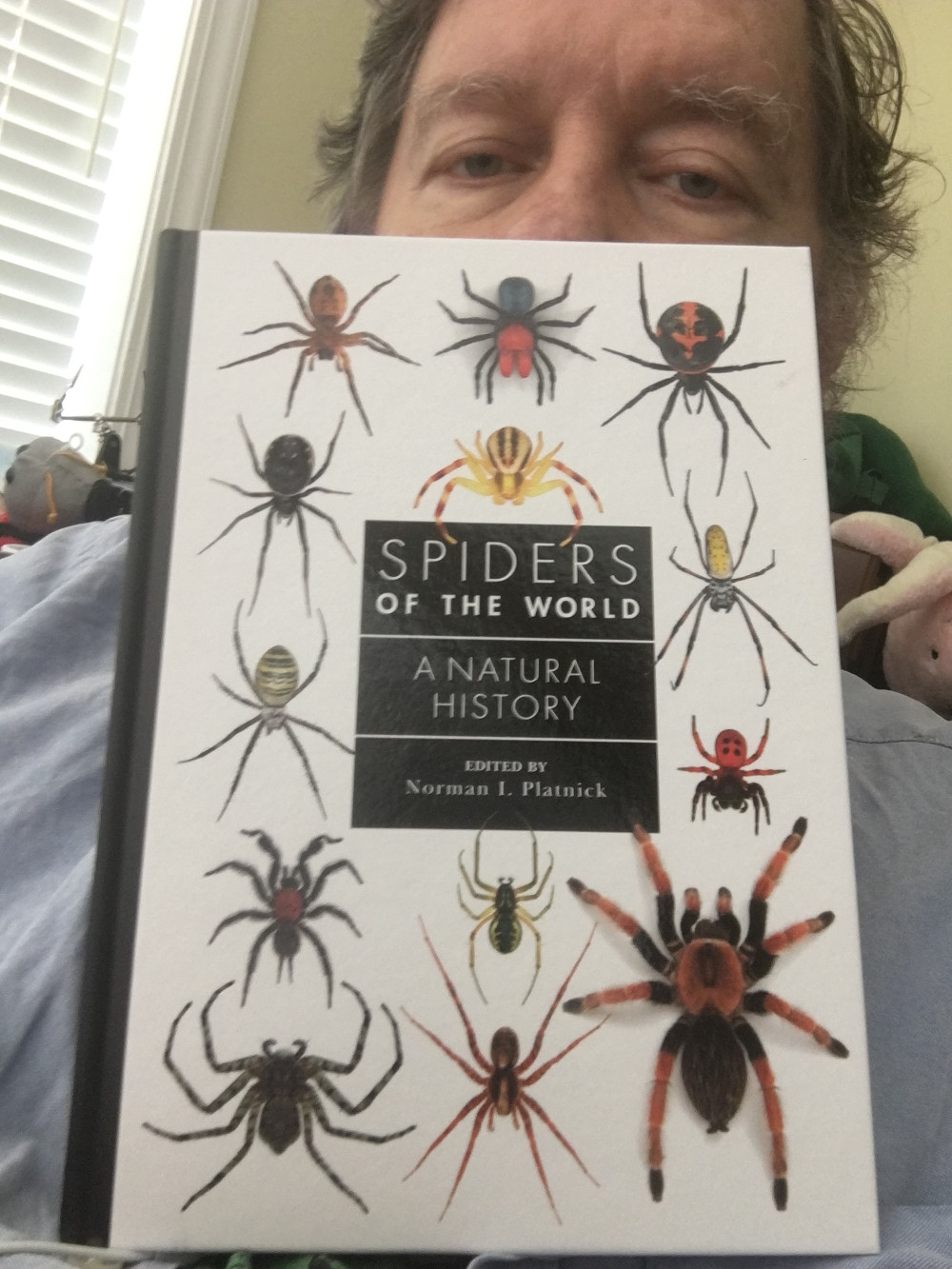
My copy of Platnick’s Spiders of the World arrived today! Bye!
I’m reading Tea Francis’s story, and wow, that’s me, except I waited until I was 60 to get into spiders. I wasted so much time! (Well, not really, I do have a family and a career, so I can’t complain about that.)
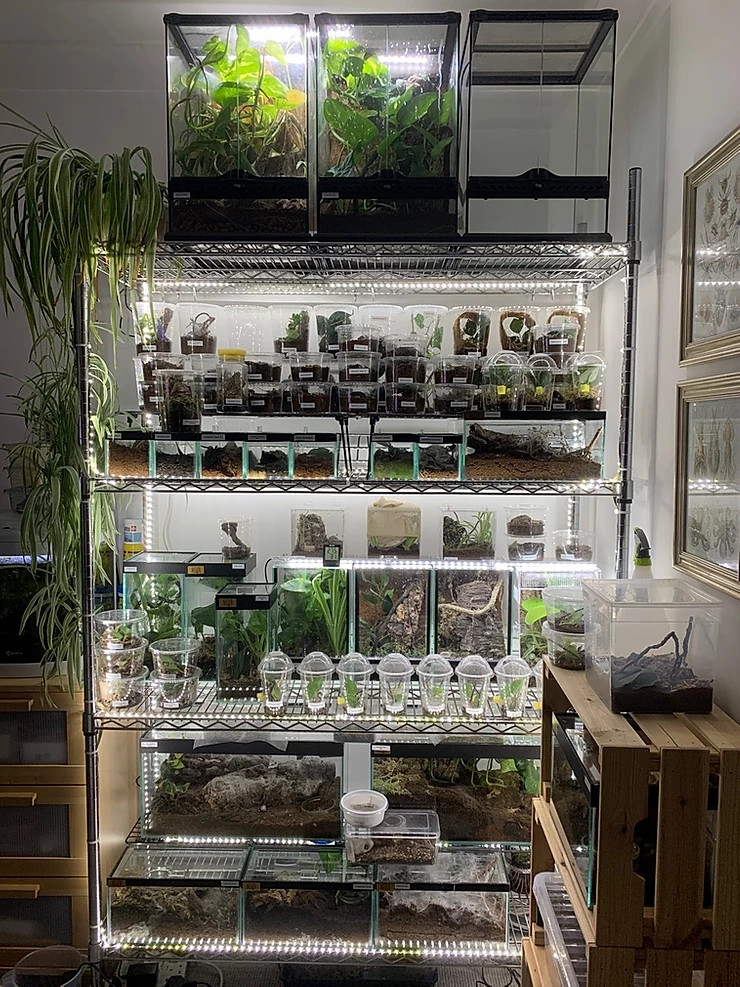
I have kept spiders for almost 20 years now, sometimes just one tarantula, sometimes lots of different types of spiders, but they’ve been present in some capacity ever since I was 17 or 18. After moving somewhere with more space at the beginning of last year, my collection had expanded significantly to almost 200 spiders of all different types. I decided to start an Instagram account to post about my spiders as whenever I posted anything to do with them anywhere else, I got a load of the usual ‘kill it with fire’ responses which I find grating, to say the least. I started to focus my attention on studying them a lot more closely. I invested in my very first DSLR and macro lens and set about learning how to use it. That in itself unlocked a whole new level of appreciation for them and I quickly became hopelessly, irretrievably obsessed. With new photos popping up on my Instagram feed every day, sometimes multiple times a day, they seemed to be gaining rather a lot of interest from other enthusiasts, photographers, keepers and even arachnophobes who were consciously working on overcoming their fears. This was a bit of a revelation for me & definitely a motivation to do more! I took it to Twitter as well and began posting there too, where I ended up meeting a lot of arachnology folk who were either studying towards or already active in the field I had always quietly dreamed of being involved in myself. Actually working with and researching spiders.
Then look at her lovely spider nook! It’s like fantasy land!
I’m not too jealous, though. I look at that and see a heck of a lot of maintenance work, and also sadness — most spiders aren’t that long-lived, so there’s always death among the beloved horde. Also, this would be a terrifying time to be at the start of a science career. Stay strong, Ms Francis!