Scientology’s views on evolution

historyofman

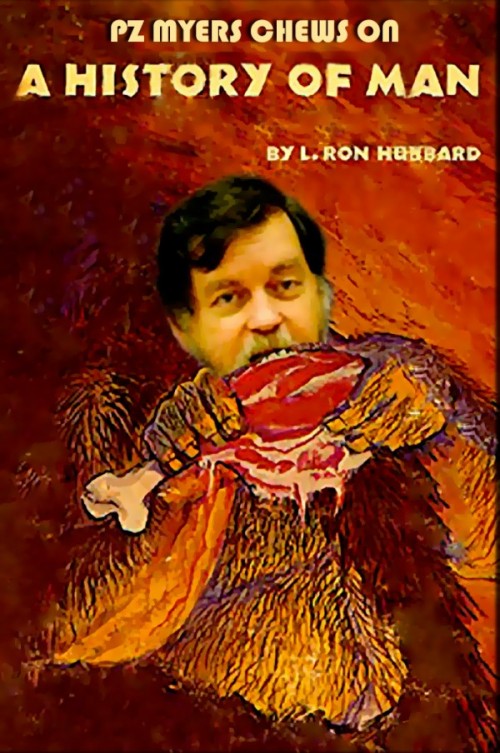
I had a conversation with Tony Ortega about L. Ron Hubbard’s book, A History of Man: Antediluvian Technology. He is the author of a blog, Tony Ortega on Scientology, and he had cruelly sent me a copy Hubbard’s book specifically to inflame my already enlarged outrage gland.

The post there emphasizes everything Hubbard got wrong about evolution, but let me tell you: there isn’t much evolution or history of Man in History of Man. The bulk of this book, written in the preening style of a pretentious fourth-grader, weebles on and on about his tech and how it can cure cancer, illuminated with little anecdotes about sending gullible victims back along their history track to the time when they were clams. It was appalling drivel, like all religious stories.

The most revealing moment for me was when he confidently announced that he had seen his ideas confirmed by medical science in their best source…Reader’s Digest. That’s L. Ron Hubbard’s mind in a nutshell.

Repudiating scientism, rather than surrendering to it

When I heard that Steven Pinker had written a new piece decrying the accusations of scientism, I was anxious to read it. “Scientism” is a blunt instrument that gets swung in my direction often enough; I consider it entirely inappropriate in almost every case I hear it used.

Here’s the thing: when I say that there is no evidence for a god, that there’s no sign that there is a single specific thing this imagined being has done, I am not unfairly asking people to adopt the protocols of science — I am expecting to judge by their own standards and expectations. They are praying to Jesus in the expectation of a reward, not as, for instance, an exercise in artistic expression, so it is perfectly legitimate to point out they aren’t getting anything, and their concept of Jesus contradicts their own expectations. When I mock Karen Armstrong’s goofy deepities praising her nebulous cosmic being, I’m not saying she’s wrong because her god won’t fit in a test tube or grow in a petri dish, but because she’s doing bad philosophy and reasoning poorly — disciplines which are greater than and more universal than science.

Science is a fantastic tool (our only tool, actually) for probing material realities. Respect it for what it is. But please, also recognize that there’s more to the human experience than measurement and the acquisition of knowledge about physical processes, and that science is a relatively recent and revolutionary way of thinking, but not the only one — and that humans lived and thrived and progressed for thousands of years (and many still do, even within our technological culture!) without even the concept of science.

Scientism is the idea that only science is the proper mode of human thought, and in particular, a blinkered, narrow notion that every human advance is the product of scientific, rational, empirical thinking. Much as I love science, and am personally a committed practitioner who also has a hard time shaking myself out of this path (I find scientific thinking very natural), I’ve got enough breadth in my education and current experience to recognize that there are other ways of progressing. Notice that I don’t use the phrase “ways of knowing” here — I have a rigorous enough expectation of what knowledge represents to reject other claims of knowledge outside of the empirical collection of information.

It’s the curse of teaching at a liberal arts university and rubbing elbows with people in the arts and humanities all the time.

Which is why I was disappointed with Pinker’s article. I expected two things: an explanation that science is one valid path to knowledge with wide applicability, so simply applying science is not the same as scientism; and an acknowledgment that other disciplines have made significant contributions to human well-being, and therefore we should not pretend to be all-encompassing.

And then I read the first couple of paragraphs of his essay, and was aghast. This was unbelievable hubris; he actually is practicing scientism!

The great thinkers of the Age of Reason and the Enlightenment were scientists. Not only did many of them contribute to mathematics, physics, and physiology, but all of them were avid theorists in the sciences of human nature. They were cognitive neuroscientists, who tried to explain thought and emotion in terms of physical mechanisms of the nervous system. They were evolutionary psychologists, who speculated on life in a state of nature and on animal instincts that are “infused into our bosoms.” And they were social psychologists, who wrote of the moral sentiments that draw us together, the selfish passions that inflame us, and the foibles of shortsightedness that frustrate our best-laid plans.

These thinkers—Descartes, Spinoza, Hobbes, Locke, Hume, Rousseau, Leibniz, Kant, Smith—are all the more remarkable for having crafted their ideas in the absence of formal theory and empirical data. The mathematical theories of information, computation, and games had yet to be invented. The words “neuron,” “hormone,” and “gene” meant nothing to them. When reading these thinkers, I often long to travel back in time and offer them some bit of twenty-first-century freshman science that would fill a gap in their arguments or guide them around a stumbling block. What would these Fausts have given for such knowledge? What could they have done with it?

Hooooly craaaaaap.

Look, there’s some reasonable stuff deeper in, but that opening…could he possibly have been more arrogant, patronizing, and ahistorical? Not only is he appropriating philosophers into the fold of science, but worse, he’s placing them in his favored disciplines of cognitive neuroscience, evolutionary psychology, and social psychology. Does the man ever step outside of his office building on the Harvard campus?

Descartes and Hume were not evolutionary psychologists. He’s doing great violence to the intellectual contributions of those men — and further, he’s turning evolutionary psychology into an amorphous and meaningless grab-bag which can swallow up every thought in the world. The latter, at least, is a common practice within evo psych, but please. Hume was a philosopher. He was not a psychologist, a biologist, or a chemist. He was not doing science, even though he thought a lot about science.

I probably know more about the biological side of how the brain functions than Pinker does, with my background in neuroscience, cell biology, and molecular biology. But I have no illusions. If I could travel in time to visit Hume or Spinoza, I might be able to deliver the occasional enlightening fact that they would find interesting, but most of my knowledge would be irrelevant to their concerns, while their ideas would have broader applicability and would enlighten me. When I imagine visiting these great contributors to the philosophy of science (Hume and Bacon would be at the top of my list), I see myself as a supplicant, hoping to learn more, not as the font of wisdom come to deliver them from their errors. Alright, I might argue some with them, but Jesus…they have their own domains of understanding in which they are acknowledged masters, domains in which I am only a dabbler.

He’s committing the fallacy of progress and scientism. There is no denying that we have better knowledge of science and engineering now, but that does not mean that we’re universally better, smarter, wiser, and more informed about everything. What I know would be utterly useless to a native hunter in New Guinea, or to an 18th century philosopher; it’s useful within a specific context, in a narrow subdomain of a 21st technological society. I think Pinker’s fantasy is not one of informing a knowledgeable person, but of imposing the imagined authority of a modern science on someone from a less technologically advanced culture.

It’s actually an encounter I’d love to see happen. I don’t think evolutionary psychology would hold up at all under the inquisitory scrutiny of Hume.

I tried to put myself in the place of one of my colleagues outside the sciences reading that essay, and when I did that, I choked on the title: “Science Is Not Your Enemy: An impassioned plea to neglected novelists, embattled professors, and tenure-less historians”. How condescending! I know there are a few odd professors out there who have some bizarre ideas about science — they’re as ignorant of science as Pinker seems to be of the humanities — but the majority of the people I talk to who are professors of English or Philosophy or Art or whatever do not have the idea at all that science is an enemy. They see it as a complementary discipline that’s prone to a kind of overweening imperialism. I get that: I feel the same way when I see physicists condescend to mere biologists. We’re just a subset of physics, don’t you know, and don’t really have an independent history, a novel perspective and a deep understanding of a very different set of problems than the ones physicists study.

Just as biologists freely use the tools of physics, scholars in the humanities will use the tools of science where appropriate and helpful. They do not therefore bow down in fealty to the one true intellectual discipline, great Science. I have never known a one to reject rigor, analysis, data collection, or statistics and measurement…although they can get rather pissy if you try to tell them that the basic tools of the academic are copyright Science.

And, dear god, Pinker tells this ridiculous and offensive anecdote:

Several university presidents and provosts have lamented to me that when a scientist comes into their office, it’s to announce some exciting new research opportunity and demand the resources to pursue it. When a humanities scholar drops by, it’s to plead for respect for the way things have always been done.

Oh, fucking nonsense. Humanities scholars are just as interested in making new discoveries as evolutionary psychologists, and are just as enthusiastic about pursuing ideas. What I’ve seen is that university presidents and provosts are typically completely clueless about what scholars do — does anyone really believe Larry Summers had the slightest appreciation of the virtues of knowledge? — so it’s bizarre in the first place to cite the opinions of our administrative bureaucrats. What this anecdote actually translates to is that a scientist stops by with an idea that needs funding that will lead to big grants and possible patent opportunities, and president’s brain goes KA-CHING; humanities scholar stops by with a great insight about French Impressionism or the history of the Spanish Civil War, asks for travel funds (or more likely, pennies for paper and ink), and president’s brain fizzles and can’t figure out how this will bring in a million dollar NIH grant, so what good is it? Why can’t this deadwood get with it and do something with cancer genes or clinical trials?

Perhaps I would have been more receptive to Pinker’s message if I hadn’t sat through a meeting this afternoon with an administrator from the big campus in Minneapolis/St Paul. It was a strange meeting; he’s clearly got grand plans that are of benefit to us, he’s supportive of science, but this was a meeting attended by research faculty in all of the campus disciplines: science, humanities, social sciences, the arts. It was odd to hear all the talk that was focused on a purely science-oriented strategy, when there were all these people around me who are doing research that doesn’t involve equipment grants, NIH funding, and patent opportunities. One of my colleagues spoke up and mentioned that he seemed to be treating the humanities as supporting infrastructure for biology or chemistry, rather than as a respectable scholarly endeavor in its own right.

I was feeling the same way. I’m a biologist, but I do biology because it’s beautiful and I love it and it inspires students. This was all about doing science because it brings in big money to the university. What was in my head was this quote from D’Arcy Wentworth Thompson:

“The harmony of the world is made manifest in Form and Number, and the heart and soul and all the poetry of Natural Philosophy are embodied in the concept of mathematical beauty.”

Substitute “Science” for “Natural Philosophy” (a perfectly reasonable replacement, given what Thompson understood the phrase to mean), and you’ve got a rebuttal to scientism. Heart, soul, poetry, beauty are not grist for the analytical mill of science, but they really are the core, and if you don’t appreciate that, the breadth of your education is lacking.

I’ve been harsh to Pinker’s claims, but you probably shouldn’t see it as a disagreement. Read further into his essay, if you can bear it, and you’ll discover that rather than rejecting scientism he proudly claims it for his own. To accuse him of scientism is no insult, then; it’s only the term for what he happily embraces.

I don’t think I’ll join him in that isolation tank, though.


Dammit. It used to be that I was the guy with a reputation for vehemence, but I’ve got nothin’ on this.

The Incomplete Map of the Cosmic Genome

If you’re one of those privileged people who has an iPad, and if you’re also one of those quality people who appreciates the brilliant Robin Ince, take a look at the The Incomplete Map of the Cosmic Genome for iPad on the iTunes App Store.

Now you might be wondering what it is. I’ve got it, and I still am. It’s one of those thingumabobs that fits words like “eclectic” and “ooooh” and “oh, what a colossal time sink”. It’s a…well, it’s a…OK, it’s a miscellany of enthusiastic science presentations.

It’s also kind of like a good science programming channel (you know how those have vanished from cable) with Infrequent/Mild Profanity or Crude Humour. If that helps. Download it yourself and try it and explain it to me.

They keep stuffing things in there, and you open it up and tap on something and there’s Brian Cox telling you how wonderful the universe is, or Steve Jones talking about Alfred Russel Wallace, or…ooh, an appreciation of Jacob Bronowski. I didn’t see that last time I browsed it. Excuse me, I have to vanish for a little while.

ENCODE has its defenders!

You know I was really pissed off at the crap ENCODE was promoting, that the genome was at least 80% functional and that there was no such thing as junk DNA. And there have been a number of better qualified scientists (like W. Ford Doolittle and Dan Graur and many others) who have stood up and registered their vehement disagreement with that nonsense. But there are some who agree that the genome must be largely functional, like John Mattick. Larry Moran reminds me that Mattick is the author of this infamous chart, however, which is best known as the original Dog’s Ass Plot.

Worst evolution diagram ever

That is so misleadingly dishonest it takes my breath away — Mattick cherry-picked genome sizes to fit his curve. One of my cell biology labs involves teaching students how to properly construct a simple graph, and I think I’m going to include this figure as a bad example.

Well, Mattick has done it again. He has published a paper (how do these things get through peer review?) disputing the existence of large quantities of non-functional DNA, which is largely an attempted rebuttal of Graur’s paper. It’s a short paper, but painful in its contortions and extraordinarily poor arguments. Larry Moran has done an excellent job of tearing it apart — I think he needs to polish it up and get that published.

The worst part of the paper, though, is the concluding paragraph — you know, where most of us try to put the most important message of the work.

There may also be another factor motivating the Graur et al. and related articles (van Bakel et al. 2010; Scanlan 2012), which is suggested by the sources and selection of quotations used at the beginning of the article, as well as in the use of the phrase “evolution-free gospel” in its title (Graur et al. 2013): the argument of a largely non-functional genome is invoked by some evolutionary theorists in the debate against the proposition of intelligent design of life on earth, particularly with respect to the origin of humanity. In essence, the argument posits that the presence of non-protein-coding or so-called ‘junk DNA’ that comprises >90% of the human genome is evidence for the accumulation of evolutionary debris by blind Darwinian evolution, and argues against intelligent design, as an intelligent designer would presumably not fill the human genetic instruction set with meaningless information (Dawkins 1986; Collins 2006). This argument is threatened in the face of growing functional indices of noncoding regions of the genome, with the latter reciprocally used in support of the notion of intelligent design and to challenge the conception that natural selection accounts for the existence of complex organisms (Behe 2003; Wells 2011).

I’m sure the Discovery Institute staff are dancing in pirouettes of joy at getting a neutral or possibly favorable mention in a legitimate journal. It’s not clear exactly what Mattick is trying to do here (lack of clarity is also a sin in science writing, let me remind you): either he’s trying to pre-emptively slander his critics by impugning them with an ideological motive, or he’s granting credence to Intelligent Design creationism. I’m inclined to think it’s both; he’s clearly trying to argue with the motives of Graur and others, but also, he’s claiming, as the creationists do, that evidence of function for the highly variable component of our genome is a de facto argument for a purpose for that variation, and that evolutionary theory does not support the idea of a functional purpose for variation in the sequence of most satellite DNA, for instance.

But I would not argue that ubiquitious functionality is unlikely because it has consequences for our theories; it’s wrong because of all the evidence that has been marshaled that most DNA is not there to serve a specific, selectable purpose for us humans.

Prime snide kookrant

I was surprised when I read the excerpt from the sneering letter to the editor-in-chief of Science magazine — it’s someone patronizingly chiding the little woman with the big job at a science journal in decline. It’s bad enough that it’s so condescendingly goofy, but it’s also complaining that Science has foolishly jumped into the “debate” about global climate change. There is no debate; it’s happening, there is a substantial anthropogenic component, and the science is rather firmly settled, so what would be then inappropriate is refusing to address an important environmental issue.

But then I read the full letter, and learned two things that made it even more laughable: 1) it’s an open letter published on the wacky denialist website, What’s Up With That, which means it’s going to be instantly ignored by any credible scientist, as Marcia McNutt is, and 2) it goes on and on and on and on. It’s absurdly preachy and unprofessional, and tells me that the author has no idea what kind of letter would be published by the magazine.

Further, McNutt is a professor of marine geophysics at Stanford, and what impresses the kook who wrote that letter?

McNutt is a NAUI-certified scuba diver and she trained in underwater demolition and explosives handling with the U.S. Navy UDT and SEAL Team.

The comments are also delusional. People are opining that Science is a dying journal. Really?

Climate change denialists are just about as out-of-touch and clownish as evolution denialists.

Although…I would endorse “Christ Hunting”

Yesterday, I was sent a link to an appalling photograph: one of those standard trophy shots of a group of grinning idiots standing over the corpse of an elephant they’d sportingly murdered with their great big manly guns. There’s a whole gallery of cheerful assassins, if you want to see; I don’t recommend it. It’s basically a lot of rich white people who have paid to be coddled for a week while they safely point a high-powered rifle at a large, relatively rare and fragile creature and destroy it.

provider_for_christ_banner

But one thing caught my eye. It is a small thing, but it added an additional frisson of disgust to the page. It was this banner:

Yep, it’s the Provider for Christ Hunting Adventure. They’ve taken a revolting act of senseless destruction and made it even more repugnant by justifying it with Jesus. For the low price of $2395 you get to fulfill this goal:

Goal: To Support the creation of new and more energized Providers for Christ, and the families of men and women based on Biblical principals [sic].

Oh. Biblical principles. So they hunt wildebeest and Cape Buffalo with bows and spears, possibly from the deck of a chariot? That would be a fair fight, and I would encourage more Christians to demonstrate their courage and battle lions with an assegai.

Wait, no, that’s not what it is: they’re still using great big guns to execute the local wildlife. What makes it Christian is that they get doped up on sanctimony by including local ministers who harangue the participants in seminars, and then they give the meat from the animals they kill to orphans at a squatter’s camp. Which does lead me to wonder what’s done with the meat on non-Jesusy safaris; it’s left to rot?

I have a suggestion: camera safaris. Support conservation organizations. Promote economic fairness and political stability, rather than palliation by numbing people with god. Don’t give more money to rich people with helicopters who are exploiting the environment.

How about putting the Christ Hunting Adventure out of business? I know, that won’t happen — there are far too many Christian assholes out there.

The Great Troll War of 2013

The internet is taking an interesting tack: there’s increasing concern about doing something about trolls. I think it’s a bit of backlash, because really, they’ve gone far, far overboard — the volume of raw hate and stupidity in some of the worst places on the net is appalling — and I also think internet culture is changing as it expands beyond its early population of nerds.

We’re all still trying to figure out what to do about the troll infestations, though. Lindy West has her personal answer: don’t ignore them, feed them ’til their idiocy is a matter of public mockery. And it’s all because the trolls are reaching new lows in their efforts to silence people, especially women.

Cumulatively, the sheer volume of hate that we’re expected to shoulder, in silence, every day, is wearing a lot of people out and shutting down rational discourse. Female bloggers are being hounded off the internet. Teenage girls are being hounded off the earth. There’s no good solution, but we have to do what we can to stop these people—unmask them, shame them, mock them, cement their status as social pariahs—for our own sanity and for those whose armor isn’t so thick (upgrade yo greaves, son).

Unmasking trolls, as we’ve seen, can produce some tangible and satisfying results. And I don’t mean just in a punitive way, I mean in a changing-the-larger-culture kind of way. People need to understand and internalize that online harassment, violent hate speech, rape threats, slut-shaming little girls until they hang themselves, and so on, are express violations of the social contract. They will not be tolerated and they will result in real-life consequences. That’s a long way off, and probably a bit of a pipe dream, but it might be our only hope for cleaning up this shitshow.

Here’s another example of the troll blight: Amanda Berry, the woman who’d been kidnapped and held prisoner in Cleveland for ten years, went to a concert and danced last weekend. Normal people can appreciate how great that must have felt, to be free at last and to be able to just have fun for an evening.

Not the trolls.

On CNN over the weekend, Nelly told Erin Burnett, “What stuck with me most was that she had a smile on her face. That’s one of the most impressive things to me, considering everything she had been through … I thought, wow, that was special.” But Burnett was too busy being amazed that “She looked totally normal.”

Burnett’s concerned astonishment was charitable compared to what the lowest form of opinion generators – Internet commenters – had to say about Berry’s newly reignited social life. “It’s just odd given the years of abuse she suffered. Normally she would not have that kind of trust or comfort. I’m sorry, but it doesn’t make sense,” wrote one concerned ABC News commenter, while another more bluntly decided, “It seems to me she was enjoying it and is gonna use her ordeal to cash in.” Many were concerned that she appeared with a man who stood behind her and warmly put his arm around her and kissed her neck while she was onstage. Or, as some of the ABC commenters decided, he was a “dirt bag hanging all over her,” who “groped” and “pawed” her. A CBS News commenter more generously decided she looked “pretty hot.” And 645 comments later on NBC, Berry had plenty of well-wishers but also comments about her eyebrow piercing, and how she doesn’t look like “a real victim….lol.” And of course, if you want to plumb the absolute bottom of the barrel, there’s YouTube, where Berry is being accused of “milking everything she’s getting.”

You don’t expect much beyond a gaping, misspelled void when you stare into the cold dark place that is Internet comments. But what’s appalling – if not entirely surprising – is realizing that the judging and shaming that rots the soul of online community goes that deep. It goes all the way down to picking on a woman who spent a decade being abused, because she had the nerve to go outside and be happy.

Yeah, it’s time to fight back.


Whoa. A commenter linked to a tumblr where a game developer dumps the hate mail he got after changing the stats on a gun in Call of Duty. You can’t read that without realizing there is a deep sociological problem here.

You know, if I’d known about that behavior back when I had kids at home who were playing those games and others online, there are a few things I would have done. I would not have told them they don’t get to play; nor would I have taken their internet connection away. But I definitely would have sat them down to read that site and I would have told them, “Don’t be that asshole. I would be ashamed if you had such a poor sense of perspective.”

I think that’s where it has to begin. Don’t engage in such behavior yourself, but also tell your friends, your relatives, and the people you encounter in those games that they are being terrible people. Don’t spare your boyfriend or your daughter or your mother, either, it shouldn’t matter how close they are to you…except maybe that the closer they are, the more you should care about their behavior. If you find yourself playing against people who say such things, report them, block them if the game allows you, and just stop playing with them.

You are not more manly when you lose an online game and think you can recoup some honor by threatening to rape your opponent. You are more pathetic.