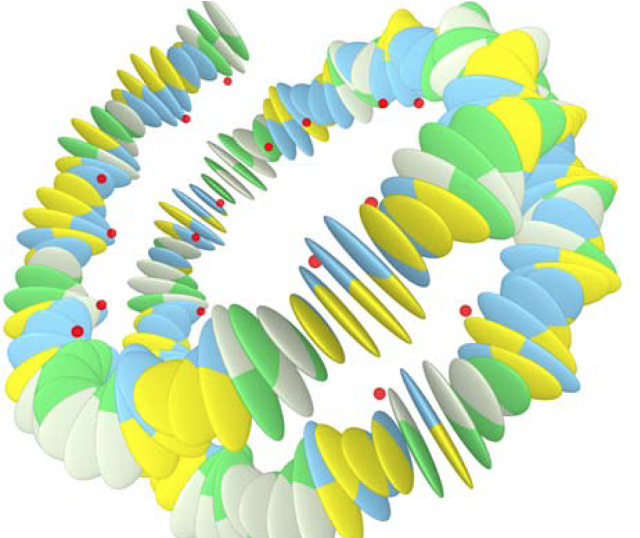
Since form is a consequence of differential growth of tissues, and since different tissues grow at different rates, one of the ways evolution can shape morphology is through changes in growth rate, so changes in timing can produce very different forms. There are genes that affect specific tissues discretely; for instance, the gene ASPM regulates mitotic activity in regions of the brain, so mutations in it can produce smaller brains, or microcephaly. There are also global regulators of growth, and just changing the rate of maturation of the organism can produce changes in the proportion of different tissues, because of allometric variation in different regions.
So, for instance, if developmental maturation of the somatic tissues is slowed, while sexual maturation is maintained at the standard rate, individuals retain juvenile characters at reproductive age, a process called neoteny (similarly, you can get a similar effect by maintaining a standard rate of somatic growth, but accelerating the rate of sexual maturation, a process called progenesis.) Note that what’s key here is that different tissues are regulated differently; if you just slow the rate of development of both somatic and reproductive organs, you get individuals with the standard morphology, it just takes longer for them to get there. Everyone who knows anything about development and evolution understands that neoteny/progenesis requires independent regulation of different tissues.
One of the factors thought to play a role in human evolution is neoteny. Compared to other primates, adult humans retain a juvenile morphology: heads large in proportion to our bodies, larger eyes, smaller jaws, etc. This is not particularly controversial, although I’d really like to see more specific identification of the genes involved. Our shape could, after all, alternatively be explained by character by character changes in gene expression. The neoteny hypothesis implies that a large cranium and small jaw are correlated, that is, by changing one regulator of growth you get both effects. It would also be possible that they’re uncorrelated, that (as a simplified example) one gene that generates larger brains evolved, and that a second gene for reduced jaws evolved completely independently.
Neoteny can also be a mosaic process. Big head and small jaws are a retention of a juvenile character, but other features, like our bigger noses and ears as adults compared to babies (creepy visualization: imagine a baby with a nose as big in proportion to its head as an adult’s; all cuteness disappears). Even if the neoteny hypothesis is generally valid, it can’t explain all the features of an adult human, and does not imply that humans are all big babies in every respect. Donald Trump excepted.
That’s the background. Now for the pseudoscientific appropriation of a concept from development and evolution.