Here’s a formula for seeming wise: take two complex, deep topics that are individually the domain of specialists, and that may be unfathomable to the general public. Combine them in some arcane way; you can trust that the set of experts who understand both topics will be minuscule, so you’ll be able to get away with a lot of nonsense, because experts in A will be impressed with your knowledge of B while thinking you don’t know squat about A, while experts in B will be vice versa. The classic example of this strategem is Velikovsky, who blended expertise in Middle Eastern mythology with astrophysics. Astrophysicists thought his flying, colliding planets that ignored conservation of energy were ludicrous nonsense, while gosh, there sure are a lot of provocative ancient texts talking about astrophysics, while classical scholars were shocked at all the liberties he was taking with history, but gee whiz, that physics stuff is impressively daunting. Meanwhile, the people who nothing about either were applauding him as a genius.
We have another example, and unfortunately, it’s the brilliant writer Tom Wolfe. He has taken his dilettante’s understanding of two subjects to attempt to fuse them: in this case, linguistics and evolution. One would think those two would complement each other nicely, but not when the author’s preconceptions are simply stuck in human exceptionalism, and his arguments are all about ‘proving’ his assumptions correct, no matter how false they are. And, most unfortunately, it leads him to conclude not that his understanding of linguistics is deficient, but that evolution must be false.
There’s absolutely nothing like it [speech], and I think it’s time for people who are interested in evolution to say that the theory of evolution applies only, only to animals.
He’s also not worried that creationists will love this, because, he says, there’s there’s not a shred of whatever that depends at all on faith, on belief in an extraterrestrial power
. Ah. So intelligent design creationism it is, then.
You might want to take a look at this wonderfully entertaining review of the book. It’s an ahistorical mess — Wolfe claims that Darwin was obsessed with proving that human speech was derived from animal sounds, for instance, and that the whole idea of examining the evolution of speech was discarded after Darwin, until Chomsky. He not only gets the history of evolution wrong, he mangles the history of linguistics.
Speech, Mr. Wolfe says triumphantly, gave our species “the power to conquer the entire planet,” “the power to ask questions about his own life,” the power to control other human minds—“a power the Theory of Evolution cannot even begin to account for . . . or abide.” “Speech! To say that animals evolved into man is like saying that Carrara marble evolved into Michelangelo’s David.”
And here my pen dropped onto the bonded-vinyl flooring. I stared at the page with a slack, dopey expression. I scratched my fuzzy head. I just did not understand. Even if speech were entirely due to culture, why is this some sort of victory over evolution? Why the boosterish chest-thumping? No biologists think that the great creations of our species— Mozart’s symphonies, Katsura Villa, the Mahabharata, integral calculus—were due to natural selection. None believe that today’s languages evolved from some unknown ape tongue. Meanwhile, everyone who accepts evolution at all—including, I had thought, Mr. Wolfe—knows that the larynx evolved over time, as did the pharyngeal cavity, motor cortex and the rest of the mechanism of speech. Geneticists have turned up a library of genes involved in language. Zoologists have found that animal sounds are more complex than previously believed (most are “non-Markovian,” in the jargon). To all of these people, the arrival of language is not a matter of abrupt on-and-off, like a light switch, but more a subtle accumulation, like a dimmer switch. Co-evolution, as Darwin hand-waved at the beginning. But even if there were an exact line to draw, as Mr. Wolfe contends, why would shifting it here or there reflect better on our species? Why does it matter whether Mr. Wolfe used a product of nurture or nature for his razzle-dazzle prose? Either way, it’s all his.
It’s all very sad. Wolfe will use his considerable talents at writing to successfully peddle nonsense to the public, doing harm to public education, giving me yet another line of babble to refute which will be smugly thrown at me for the next several years, and the only gain will be that Mr Wolfe will be able to buy a few more white suits while his bullshit rises on the NY Times bestseller lists.
Man, maybe I ought to do some retirement planning. What two subjects do I know very little about (that part’s easy, most of the subjects), but can profitably merge to sound innovative and insightful? Everyone goes for the obvious one, quantum physics, so I think that’s played out. Hmm. Photonics and immunology? Gravity and time travel? Indian cooking and renewable energy? I’m sure all I have to do is find the right catchy combo, and then I’ll be on all the talk shows.
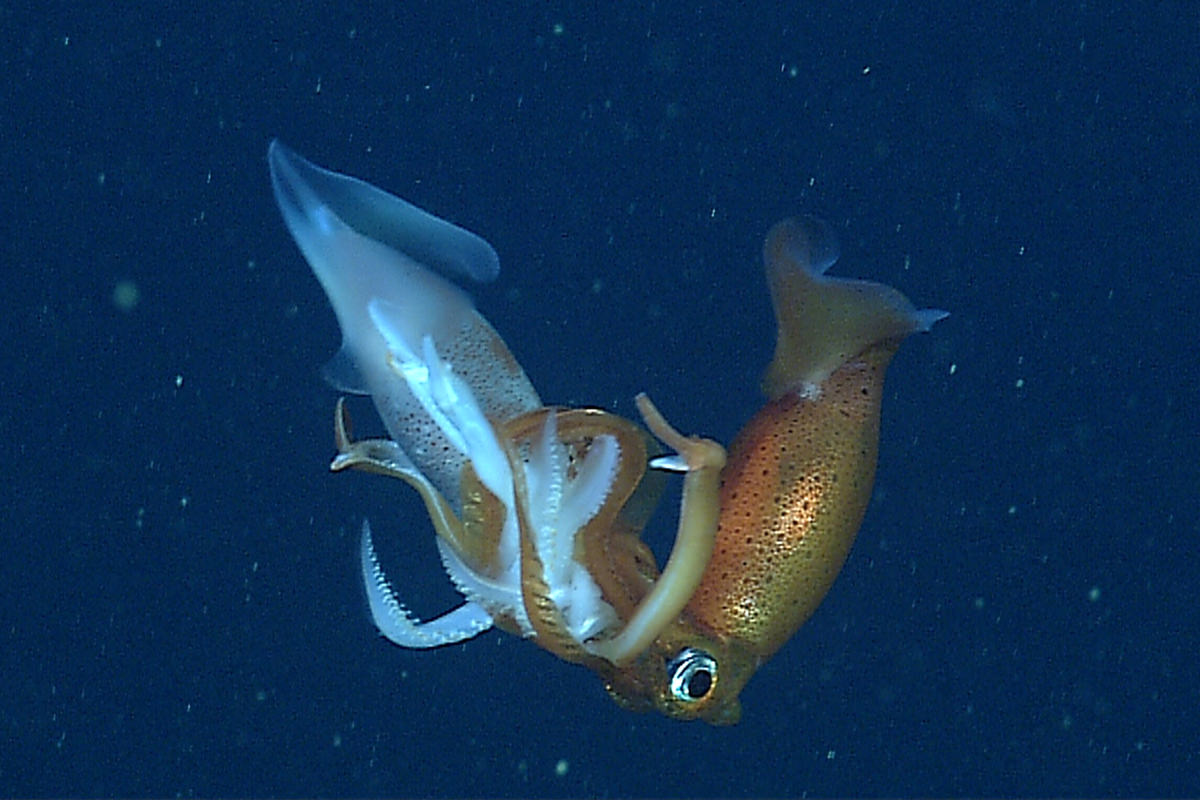
It’s a quiet, lonely life for a squid in the deep, just drifting along, dangling a pair of lines, hoping to snag dinner.
There are two videos of this squid, one from 2014 and another from 2013.
I suggest an unholy hybrid of the two.
This past weekend, I was off at Lake Itasca with a group of new biology students, and one of the things they did was collect plankton and bring them back to the lab where we took micrographs of what they found — lots of algae and crustaceans and rotifers, etc., etc. But we also saw some colonial protists, and one of the things I saw the students excitedly discuss was Volvox. It’s always nice when I can just sit down and shut up and the students are enthusiastically explaining to each other how biology works.
So, anyway, I think I know a few more people who are in the market for the swag mentioned by Matthew Herron.
It’s not pretty. The NY Times has published images of babies born with Zika-induced microcephaly, and whoa, but that virus really does a number on the developing cortex. Scientists are beginning to figure out how it’s disrupting development, and now there’s concern that even superficially unaffected children might have late-occurring deficits.
Dr. Levine said the images suggest that Zika is like a formidable enemy able to do damage in three ways: keeping parts of the brain from forming normally, obstructing areas of the brain, and destroying parts of the brain after they form.
With such a vicious and unpredictable virus, “it’s key to realize that Zika is more than microcephaly, that there’s a number of other abnormalities as they’ve shown in this paper, and its effects are going to be even more broad,” said Dr. Spong, whose agency has begun a study of what will ultimately be 10,000 babies born in Zika epidemic areas including Brazil and Puerto Rico.
Meanwhile, here in the US, our useless congress is frozen in stupidity, unable to act. Why? Because this problem requires management and screening by family planning groups, and all the Republicans can see is that funding rational responses to Zika will require the assistance of organizations like Planned Parenthood, and that one of the necessary options for affected women should be termination of the pregnancy. The research in Brazil is, in part, trying to find unambiguous criteria for diagnosing affected fetuses in utero, to eliminate false positives and to allow families to respond appropriately to the afflictions.
But we’ve got nitwits like Marco Rubio here.
Obviously, microcephaly is a terrible prenatal condition that kids are born with. And when they are, it’s a lifetime of difficulties. So I get it.
I’m not pretending to you that that’s an easy question you asked me. But I’m pro-life. And I’m strongly pro-life. I believe all human life should be protected by our law, irrespective of the circumstances or condition of that life.
No, it is an easy question. When you’ve got a fetus with a brain that’s been destroyed by a virus, you give the woman you plan to burden with the responsibility of caring it for the rest of its broken, diminished “life” the choice of what to do.
Some women will find that choice difficult, and I can respect that; others will find it easy. What’s wrong is that Rubio has to struggle with the question of whether women should have autonomy.
We Americans like to think we’ve got the greatest everything, including the greatest science denialists. Who can forget Sarah Palin’s rage against mere fruit fly research? And now we’ve got Donald Trump, irate about his hair spray.
Over the past few months, we’ve seen Donald Trump lower, again and again, the bar for political discourse. All the while, though, he’s been lowering the scientific bar, too. In May, for instance, while speaking to an audience of West Virginia coal miners, Trump complained that regulations designed to protect the ozone layer had compromised the quality of his hair spray. Those regulations, he continued, were misguided, because hair spray is used mainly indoors, and so can have no effect on the atmosphere outside. No wonder Hillary Clinton felt the need to include, in her nomination speech, the phrase “I believe in science.”
And it’s not just hairspray: there is a legion of scientific issues on which Trump is ignorant and wrong.
Just to be fair, though, I’ll remind everyone that Democrats have sometimes gone down this road: I remember Proxmire and his Golden Fleece award, in which he railed against science he didn’t understand, and then there’s Tom Harkin, throwing away money on quackery.
But now Australia is getting in on the game, in a very Proxmirish move.
Oh, yeah, how dare they study philosophy, history, psychology, or sociology. We must ridicule what we don’t understand.
Sydney’s Daily Telegraph is suffering one of their frequent relapses into frothy-mouthed panic about government wastage on research grants. Poking at layabout academics for ‘wasting’ tax dollars on seemingly frivolous projects reminds me of nothing more than the schoolyard bully who secretly knows he peaked in year 9. Today, the Tele flattered me by holding up one of my own projects for ridicule, ironically illustrating their point that rusted-on ideology, and patronage provide the most direct route possible to mediocrity.
Don’t academics understand that the only thing we’re supposed to do is cure cancer? It’s a zero-sum game, and every study of medieval history or Renaissance art or the psychology of gender or goddamn fruit flies means another metastasizing tumor and horrible slow death.
So the solution is to demand that the Australian Research Council present grant proposals for review to the beery patrons of local pubs. Yeah, that’ll steer research funds appropriately.
Ray Hadley picked up the Telegraph’s baton in an interview with the Treasurer, Scott Morrison, demanding that the ARC justify its funding decision in the front bar of a Western Sydney or North Brisbane pub.
Yes, after the forlorn cries for better funding of research rang through Science Week last week, and as the ARC sits in Canberra to decide the outcomes of this year’s biggest schemes, the pro-ignorance side of the culture wars has decided to play their favourite game. Their attempts to paint researchers as out-of-touch layabouts draining the public purse are, if you read the comments on Blair’s blog, playing well with the patrons of those very pubs.
Uh-oh. Nobody tell Trump about this idea to put bars in charge of NIH/NSF/NASA. He’d probably think it was a terrific plan. So would his fanatical followers.
The Thorny Devil and I have exactly the same expression right now.
Disturbing.
Unfortunately, you don’t need fancy computers and high tech 5-senses interfaces to get this effect, where your reality is distorted by filters in your head. This is the human condition. We do it all the time.
Here’s an example: a comic book used to manipulate the wetware in kids’ brains to make them think gay people are wicked.
We grow up with these little modules planted in our skulls by well-meaning families and friends who also have them in their heads, and it isn’t a little box mounted on our necks that we can conveniently rip out to perceive “reality”. There ain’t no such thing possible — it’s implicit in the modeling of the world we see around us, because we don’t accurately “see” the world, we build it. Everyone is walking around in a virtual reality all the time, and what matters is how well it reflects an underlying substrate of matter and energy, how well it allows us to interact with our fellow avatars, and how much damage and how much benefit we provide to each other. This is true not just for them, fellow liberal/progressive secular humanists, but for us.
The people who made that anti-gay comic are using a version of virtual reality that creates enemies all around them, and justifies wrecking their lives. It’s also kind of crude and generates a blocky, black & white universe that doesn’t have much nuance or fine detail.
How’s yours doing?
I mean, really. This team of ‘scientists’ hijacked a valuable research submersible, strapped their gadget to it, and sent it cruising to a depth of 900 meters in the Pacific Ocean just to catch this goofy-looking purple thing.
Listen to these people…buncha giggly teenagers.
I’m a bit annoyed that they went to all this trouble to find it, and then they apparently were all out of pokeballs.