Pharyngula
Evolution, development, and random biological ejaculations from a godless liberal



Ollie is a good dog, yes she is. Such a good dog! It’s not her fault that she has ended up on the editorial boards of medical journals.
…in one respect, the Staffordshire Terrier differs radically from her canine peers: she has a burgeoning academic career, and sits on the editorial boards of seven medical journals.
As you may have guessed, the journals on whose boards Ollie sits are of the predatory variety. These are shadowy, online publications that mimic legitimate journals, but are prepared to publish anything in exchange for a fee that can run into thousands of dollars. Predatory journals prey on desperate young researchers under huge pressure to get their research published to further their careers.
Ollie’s owner is Mike Daube, Professor of Health Policy at Curtin University in Perth. Ollie likes to watch Mike working on his computer, and Mike gets a lot of emails from predatory journals. Wondering just how low these journals would go, he put together a curriculum vitae for his dog – detailing research interests such as “the benefits of abdominal massage for medium-sized canines” – and sent it off to a number of these journals, asking for a spot on their editorial boards.
She has also been asked to review papers. I suspect she’d be a harsh critic, despite being such a good dog, because usually when you put a paper on the floor they poop on it. And that’s good! Good doggie!



I guess everyone is going to be doing this now. In this case, it’s a ridiculous paper accepted for publication in the journal Personality and Individual Differences, and it’s a doozy. It’s about evolution, it says.
In the introduction, it throws around some buzzwords and tries to impress us with elementary scientism.
New alleles can arise from mutations. An allele’s influence on a trait is likely to have both negative (c) and positive (b) fitness effects; thus, the allele will increase in frequency if the balance of positive minus negative fitness contribution (b – c) i.e., the net fitness effect (f), is higher that the respective balance of the original gene, and it will decrease in frequency if the balance is negative. Please note that we refer here to the case averaged across all bearers of the allele, so that an allele will be favored even if it has a net negative effect on the fitness of some individuals as long as it has a net positive effect on the fitness of other bearers of the allele.
The joke’s on you if you read this assuming the paper is about genetics, though. Nowhere in this work do the authors identify any genes or alleles; they don’t even try. They just assume that if a behavior exists, there must be a gene for it, and further, it must have undergone positive selection. They’re also not going to test for fitness of a behavior; in fact, they’re not even going to examine any behaviors directly, but are instead going to rely entirely on self-reported assessments in an online survey of college students.
You’ve probably figured out by new that the discipline in question is evolutionary psychology. Just to titillate you further, it’s arguing for a selective advantage for same-sex behavior.
At first sight, alleles that arise through mutation and predispose for same-sex attraction appear to experience a substantial negative fitness, since they lead individuals to divert part or the whole of their mating effort toward same-sex outlets from which children, who would carry these alleles, cannot be borne. Accordingly, in order to understand the prevalence of same-sex attraction in the population, scholars have argued that these alleles also experience positive fitness effects, which compensate for the negative fitness effects, turning the net fitness (f) positive. There is, however, a different possibility.
Oh, boy. How could a sexual behavior persist that diverts mating efforts in a direction that does not produce children? It’s a mystery.
I can’t wait until the authors learn that heterosexual couples indulge in cunnilingus and fellatio. Their minds will be, umm, blown.
But wait! There’s more hilarity! This is a paper about “The evolution of female same-sex attraction”. Where did lesbians come from, they wonder. What a conundrum! Why would women prefer each other’s company, rather than a man’s? Lesbians can’t put a baby in their tummy! They resolve this problem easily, by suggesting that men provided the selection pressure to favor lesbian genes. It’s all about the cucks.
Men with multiple wives, as opposed to men with one wife, face an elevated probability to be cuckolded, because they have to divide their sexual effort toward several wives so, inevitably, some of their wives will remain unsatisfied. They also have to divide their mate-guarding effort between multiple wives, which makes such effort less effective. If their wives experience same-sex attraction, they can satisfy their urges with other co-wives, who are readily available, reducing, in effect, the risk of cuckoldry (see also Kanazawa, 2016).
Note the Kanazawa reference — another in-joke. This paper is hilarious. There’s also another reason lesbianism is evolutionarily advantageous.
In our proposed theoretical framework, men can benefit from the same-sex attractions of their partners through gaining access to additional women.
That’s right, guys: you should date lesbians because then you’ll get to have sex with their lesbian girlfriends. Yeah, that’s exactly how it would work.
Now you might argue that the fact that this hypothesis is counter-intuitive and is built on a framework of not understanding basic evolutionary theory does not necessarily make it wrong, but maybe they’ve got some kind of empirical evidence that cleverly illustrates the existence of this lesbianism gene, and that men are actively selecting for it.
They don’t.
The ‘experiment’ is basically, “let’s ask guys if they’d mind if their wife had sex with another woman.” I’m not kidding. That’s the experiment. It’s also done with an online survey, because they could get more honest answers in this way
.
Here are the results. It shows that a minority of Western men (Greek Cypriots) like the idea of girl-on-girl sex, but that they like it more than women like the idea of boy-on-boy sex. Apparently yaoi isn’t very popular on Cyprus…but shouldn’t the cultural variations clue them in that this is probably not a genetically determined behavior?
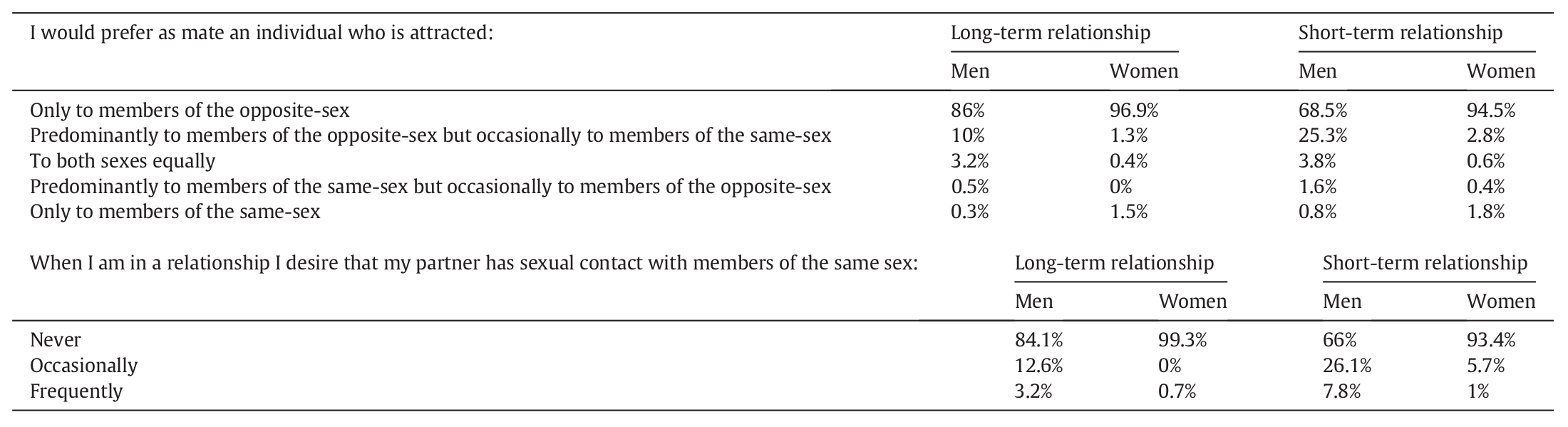
To be fair, they do consider that there might be cultural effects, but all they can think of is one factor, religion, and they only argue that it would repress honest expression of the participants’ views.
Last but not least, the observed effects are unlikely to reflect only evolved dispositions, and social and cultural effects may also be at play. For instance, male preferences for same-sex attraction in a partner may be moderated by religious beliefs. Participants in the sample were Greek-Orthodox Christians, and in the Cristian religion same-same attraction is considered reprehensible. Accordingly, male participants may have perceived their preferences for same-sex attraction to be inconsistent with their religious beliefs, and if they were very religious, to have suppressed or have been unwilling to report such desires. The present study did not control for this possibility, and future research can do so by measuring participants’ religiosity.
The possibility of a few cultural biases do not, however, make them question their basic assumption that lesbian preferences have nothing to do with women’s choices, but are entirely a consequence of males selecting for women who do not like sex with them, and would prefer sex with people who do not have a penis. Apparently, lesbians only exist to provide girl-on-girl porn on the internet, and their own desires have nothing to do with it. Or rather, they only have those desires because men have bred them for possession of a hypothetical lesbian allele.
In conclusion, the present study found that a large proportion of heterosexual men considered same-sex attraction in a partner desirable. These findings suggest positive selection on same-sex attraction in women: Men’s desire for women who are attracted to other women selects for women who are attracted to other women. In turn, male desires, along with factors such as arranged marriage, which weakened the negative fitness costs of same-sex attraction, can explain the relatively high frequency of this trait in the population. Future research needs to replicate and extend these findings in order to better understand the evolutionary origins of same-sex attraction.
Or maybe the authors need to go back to school and learn how evolution works.
This paper was so ridiculously bad, though, I’m sure the authors are going to come out with a confession, maybe in the pages of Skeptic magazine, that it was all a set-up to show how absurd the entire field of evolutionary psychology is (I checked; there isn’t a single evolutionary psychology journal in the top 100 of the SCIMago rankings, therefore the field is entirely made of low-quality papers).
Any moment now they’re going to pop up and say, “Just foolin’!”
Yep, any moment now.
Aaanyy moment.
Apostolou M, Shialos M, Khalil M, Paschali V (2017) The evolution of female same-sex attraction: The male choice hypothesis. Personality and Individual Differences 116:372–378.

Yesterday, I was being mildly harangued by a cancer quack — I know, this is usually Orac‘s beat, but there’s a lot of non-specific cross-talk by ignoramuses, wouldn’t you know. Anyway, this quack told me I’m supposed to read this book by another quack, Travis Christofferson, and didn’t I know that the Warburg effect was the key to curing cancer? This is annoying, because when I’m given a source I feel obligated to look it up, so I had to waste time digging around the internet for Christofferson. Fortunately, this guy is easy to dismiss.
He has a website titled Single Cause, Single Cure
. That’s right, he claims that there is a single cause for cancer, and it’s a metabolic disorder cause by your bad diet. There’s also a single general strategy for treating it, which involves targeting the Warburg effect with a ketogenic diet, among other broad metabolic treatments.
First strike: treating cancer as a single, simple disease caused by one factor. We know this isn’t true. I recently wrote about Tissue Organization Field Theory, that postulates that one factor in generating cancers might be epigenetic shifts caused by the cell’s environment, but no one (well, no one sensible) thinks that’s the only cause. We know about the effect of carcinogens, which may damage DNA; we know about inherited genetic predispositions caused by variations in gene sequence; we know about effects of local inflammation; there are viruses that can induce transformations to a cancerous state. We’ve taken cancers apart gene by gene and found the frequent players that trigger the cancer, and they are genes that regulate, for instance, cell proliferation, cell signaling, and yes, cell metabolism. You are not going to fix a broken retinoblastoma gene with a low-carb diet.
Second strike: Christofferson has zero qualifications. He has a Pre-Medical undergraduate degree and a Master’s degree in Materials Engineering and Science
. There is no such thing as a pre-medical degree. A pre-med is someone who has declared an intent to apply to medical school when they graduate; I have lots of students I advise who are pre-med, and all that means is that I recommend that they take courses outside the required courses for their degree within a discipline, so they’re told to take anatomy and physiology courses, a psychology course, a communications course, microbiology, etc., outside of the list of required courses to get a B.A. in biology (they can also be, for instance, an English major and a pre-med), and that I nag them in their junior year about taking the MCATs. You either have a medical degree, which requires going to a qualified medical school, or you don’t. He doesn’t. He has a degree in molecular biology from Montana State University, and either lost interest in or didn’t get accepted to medical school, and instead went to the South Dakota School of Mines and Technology for a Master’s degree in Material Engineering and Science. SDSMT is not a medical school, not even close.
Third strike: Christofferson is endorsed by Joseph Mercola. When the money-grubbing, dishonest arch-quack is your sponsor, you can trust that everything about it is tainted. Mercola did a fawning interview with Christofferson in which he asked, Wouldn’t it be interesting if there were a simple dietary tweak that could not only prevent but treat the vast majority of these cancers?
Yes, it would be interesting. It would also be interesting if every time I sneezed, hundred-dollar bills shot out of my ears. It does not mean that I’m snorting black pepper as a revenue source. That Mercola asks a stupid question does not imply that there exists a simple dietary tweak
to cure cancer.
Fourth strike (how many of these do you get before the umpire drags you off the field?): these quacks like to pretend that they have some bold new insight, but the fact is that legitimate cancer researchers have been exploring metabolic treatments for decades, and there are real studies in progress. They aren’t a magic bullet, but tackling metabolic processes in cancer cells might be helpful, and real doctors are testing it.
This brings me back to the question of whether cancer is a metabolic disease or a genetic disease, the answer to which I promised early on. The likely answer? It’s both! Indeed, a “chicken or the egg” argument continues about whether it is the metabolic abnormalities that cause the mutations observed in cancer cells or whether it is the mutations that produce the metabolic abnormalities. Most likely, it’s a little of both, the exact proportion of which depending upon the tumor cell, that combine in an unholy synergistic circle to drive cancer cells to be more and more abnormal and aggressive. Moreover, cancer is about far more than just the genomics or the metabolism of cancer cells. It’s also the immune system and the tumor microenvironment (the cells and connective tissue in which tumors arise and grow). As I’ve said time and time and time again, cancer is complicated, real complicated. The relative contributions of genetic mutations, metabolic derangements, immune cell dysfunction, and influences of the microenvironment are likely to vary depending upon the type of tumor and, as a consequence, require different treatments. In the end, as with many hyped cancer cures, the ketogenic diet might be helpful for some tumors and almost certainly won’t be helpful for others. Dr. Seyfried might be on to something, but he’s gone a bit off the deep end in apparently thinking that he’s found out something about cancer that no one else takes seriously—or has even thought of before.
Fifth strike: the foundation of a useful cancer therapy lies in empirical research. You test it. It’s hard work. You do not leap into publishing books for pop audiences that declare you have a path to the cure, as Christofferson has. If switching to a ketogenic diet could cure cancer, why do people still die of cancer? This is a disease that provokes desperation and fear, the perfect medium for quacks who want to profit by selling false hope.
I am unpersuaded.
I may have to write something up about the Warburg effect later. I am not a cancer researcher, but I am a cell biologist, and I know a fair bit about cellular metabolism — it annoys me to see basic cell biology, which Christofferson would have been exposed to as an undergraduate, being abused by quacks, especially when there are so many readily available papers in the scientific literature about the molecular biology and biochemistry of the Warburg effect.

People are crawling out of the woodwork to defend that bogus Boghossian hoax and they’re making some awesomely bad arguments to do so. Here’s one guy who makes a sweeping dismissal of all of the social sciences because few of their journals are highly ranked.
There is a curious lack of social science or humanities journals in the top 100. For instance, there is only one journal dedicated to psychology. If business and economics are counted, then a total of 12 of the top 100 journals cover the social sciences. (Put another way, there are more top 100 journals covering the biomedical subdisciplines of cell biology/microbiology/molecular biology than all the social sciences combined.) SJR considers Administrative Science Quarterly (which we classified as a business journal) to be a sociology journal, so it represents the one sociology journal in the top 100.
How many gender studies journals are in the top 100? Zero. In fact, there is only one gender studies journal in the top 1,000. Titled Gender and Society, it ranks at #933.
The takeaway from this analysis is clear: The hard sciences constitute the hottest fields and most prestigious journals. By comparison, social science journals are not nearly as prestigious. By definition, that means social science journals, as a whole, are not cited by prestigious journals.
There are many reasons for that. But one of them certainly is that the quality of the research just isn’t very good. That’s why penis hoax articles can get published.
That’s a stunningly stupid interpretation. How stupid? Well, he has helpfully organized the list of top 100 journals in descending order for us.
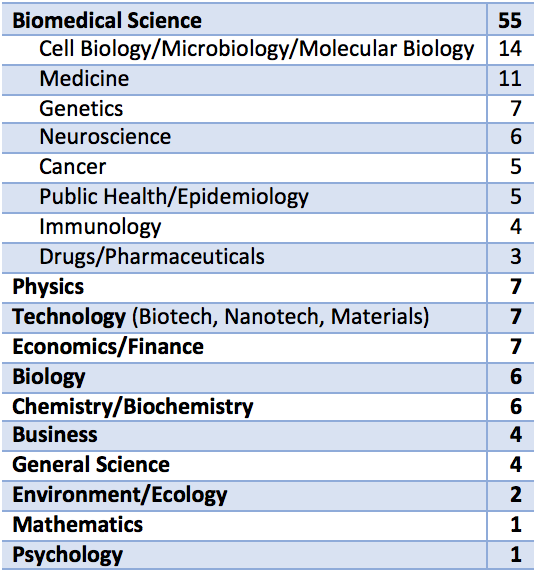
Apparently the quality of the research in mathematics just isn’t very good, using his reasoning.
Another problem is that a system that ranks journals by their ‘significance’, that is, how frequently cited they are by related journals, is going to be sensitive to numbers of participants within a discipline, so this metric is also going to be strongly skewed; popular disciplines will have more popular journals, regardless of their relative quality. So just to give you an idea of the numbers of people working within these general fields:
Number of scientists and engineers in the US: 6.2 million.
Number of psychologists in the US: 188,000.
Number of sociologists in the US: less than 3,000, which does seem awfully low; same source says the number of biochemists, just biochemists, is about 34,000.
So it is totally unsurprising that fewer social sciences journals are listed among the top 100 journals — there are fewer social scientists. It’s also meaningless to compare a broad category of “biomedical journals” with a sub-sub-discipline like “gender studies journals”. Everything about this is bad logic.
But then, it’s also unsurprising given the source. This is coming from the American Council on Science and Health, which is a reactionary pro-industry think-tank of dubious value.
Consumer advocate Ralph Nader once said of ACSH,
A consumer group is an organization which advocates the interests of unrepresented consumers and must either maintain its own intellectual independence or be directly accountable to its membership. In contrast, ACSH is a consumer front organization for its business backers. It has seized the language and style of the existing consumer organizations, but its real purpose, you might say, is to glove the hand that feeds it.
Numerous ACSH publications (that do not disclose the corporations that have funded the organization) take positions attacking public concerns about various corporate products and practices, such as genetically modified foods (GMOs), pesticides, herbicides, and more, and have sought to downplay concerns raised by scientists and consumers. However, the tobacco industry has never been an ACSH client, and Whelan has very cleverly used her anti-tobacco stance to gain some credibility among health professionals and some activist groups. All of the tobacco connections were conducted by her partner, Fred Stare.
Some of the products ACSH has defended over the years include DDT, asbestos, and Agent Orange, as well as common pesticides. ACSH has often called environmentalists and consumer actvists “terrorists,” arguing that their criticisms and concerns about potential health and environmental risks are threats to society.[2]
ACSH has been funded by big agri-businesses and trade groups like Kellogg, General Mills, Pepsico, and the American Beverage Association, among others.
It’s also a front for the Koch brothers.
I’m not going to reject a scholarly discipline because some conservative shill found a way to tag it with a small number; I’d have to admit that zebrafish developmental biology must be of lower quality because there are fewer publications on that specific subject than in, say, geology, which is such obvious nonsense the author should have noticed. But I am happy to follow the money to dismiss a source because it is funded entirely by industries that are trying to protect their bottom line with fake science that undermines honest work.


When I was addressing this lunacy about how God exists because minds and mathematics are supernatural, I was also thinking about a related set of questions: biologically, how are numbers represented in the brain? How did this ability evolve? I knew there was some interesting work by Ramachandran on the representation of digits and numerical processing, coupled to his work on synesthesia (which is also about how we map abstract ideas on a biological substrate), but I was wondering how I can have a concept of something as abstract as a number — as I sit in my office, I can count the vertical slats in my window blinds, and see that there are 27 of them. How did I do that? Is there a register in my head that’s storing a tally as I counted them? Do I have a mental abacus that’s summing everything up?
And then I realized all the automatic associations with the number 27. It’s an odd number — where is that concept in my cortex? It’s 33. It’s the atomic weight of cobalt, the sum of the digits 2 and 7 is 9, the number of bones in the human hand, 2 times 7 is 14, 27 is 128, my daughter’s age, 1927 was the year Philo Farnsworth first experimentally transmitted television pictures. It’s freakin’ weird if you think about. 27 isn’t even a thing, even though we have a label and a symbol for it, and yet it’s all wrapped up in ideas and connections and causes sensations in my mind.
And why do I have a representation of “27” in my head? It’s not as if this was ever useful to my distant ancestors — they didn’t need to understand that there were precisely 27 antelope over on that hillside, they just needed an awareness that there were many antelope, let’s go kill one and eat it. Or here are 27 mangoes; we don’t need to count them, we need to sort them by ripeness, or throw out the ones that are riddled with parasites. I don’t need a map of “27” to be able to survive. How did this ability evolve?
Really, I don’t take drugs, and I wasn’t sitting there stoned out of my head and contemplating 27. It’s a serious question. So I started searching the scientific literature, because that’s what one does. There has been a great deal of work done tangentially to the questions. Human babies can tell that 3 things is more than 2 things. An African Grey parrot has been taught to count. Neurons in the cortex have been speared with electrodes and found to respond to numbers of objects with differing degrees of activity. The problem with all that is that it doesn’t actually address the problem: I know we can count, I know there is brain activity involved, I can appreciate that being able to tell more from less is a useful ability, but none of it addresses the specific properties of this capacity called number. Worse, most of the literature seems muddled on the concept, and confuses a qualitative understanding of relative quantity for a precursor to advanced mathematics.
But then, after stumbling through papers that were rich on the details but vague on the concept, I found an excellent review by Rafael Núñez that brought a lot of clarity to the problem and summarized the ongoing debates. It also lays out explicitly what had been nagging me about all those other papers: they often leap from “here is a cool numerical capability of the brain” to “this capability is innate and evolved” without adequate justification.
Humans and other species have biologically endowed abilities for discriminating quantities. A widely accepted view sees such abilities as an evolved capacity specific for number and arithmetic. This view, however, is based on an implicit teleological rationale, builds on inaccurate conceptions of biological evolution, downplays human data from non-industrialized cultures, overinterprets results from trained animals, and is enabled by loose terminology that facilitates teleological argumentation. A distinction between quantical (e.g., quantity discrimination) and numerical (exact, symbolic) cognition is needed: quantical cognition provides biologically evolved preconditions for numerical cognition but it does not scale up to number and arithmetic, which require cultural mediation. The argument has implications for debates about the origins of other special capacities – geometry, music, art, and language.
The author also demonstrates that he actually understands some fundamental evolutionary principles, unlike the rather naive versions of evolution that I was recoiling from elsewhere (I’ll include an example later). He also recognizes the clear differences between estimating quantity and having a specific representation of number. He even coins a new word (sorta; it’s been used in other ways) to describe the prior ability, “quantical”.
Quantical: pertaining to quantity related cognition (e.g., subitizing) that is shared by many species and which provides BEPs for numerical cognition and arithmetic, but is itself not about number or arithmetic. Quantical processing seems to be about many sensorial dimensions other than number, and does not, by itself, scale up to produce number and arithmetic.
Oops. I have to unpack a few things there. Subitizing is the ability to immediately recognize a number without having to sequentially count the items; we can do this with a small number, typically around 4. Drop 3 coins on the floor, we can instantly subitize them and say “3!”. Drop 27, you’re going to have to scan through them and tally them up.
BEPs are biologically evolved preconditions.
Biologically evolved preconditions (BEPs): necessary conditions for the manifestation of a behavioral or cognitive ability which, although having evolved via natural selection, do not constitute precursors of such abilities (e.g., human balance mechanisms are BEPs for learning how to snowboard, but they are not precursors or proto-forms of it)
I think this is subtley different from an exaptation. Generally, but not necessarily, exaptations are novel properties that have a functional purpose that can be modified by evolution to have additional abilities; feathers for flight in birds are an exaptation of feathers for insulation in dinosaurs. Núñez is arguing that we have not evolved a native biological ability to do math, but that these BEPs are a kind of toolkit that can be extended cognitively and culturally to create math.
He mentions snowboarding as an example in that definition. No one is going to argue that snowboarding is an evolved ability because some people are really good at it, but for some reason we’re more willing to argue that the existence of good mathematicians means math has to be intrinsic. He carries this analogy forward; I found it useful to get a bigger picture of what he’s saying.
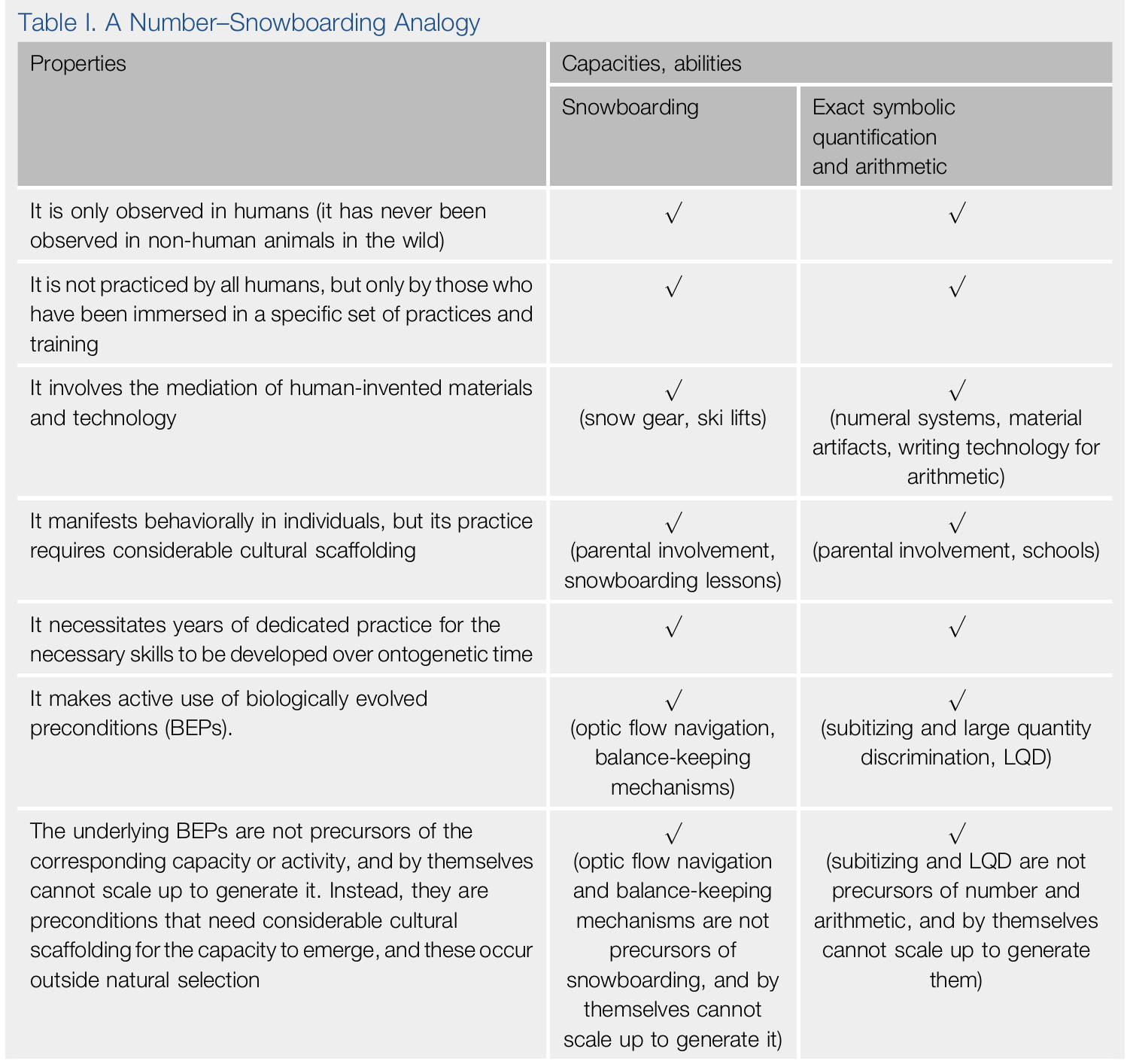
Other interesting data: numbers aren’t universal! If you look at non-industrialized cultures, some have limited numeral systems, sometimes only naming quantities in the subitizing range, and then modifying those with quantifiers equivalent to many. Comparing fMRIs of native English speakers carrying out a numerical task with native Chinese speakers (both groups having a thorough grasp of numbers) produces different results: “the neural circuits and brain regions that are recruited to sustain even the most fundamental aspects of exact symbolic number processing are crucially mediated by cultural factors, such as writing systems, educational organization, and enculturation.”
Núñez argues that many animal studies are over-interpreted. They’re difficult to do; it may require months of training in a testable task to get an experimental animal to respond in a measurable and specific way to a numerical task, so we’re actually looking at a plastic response to an environmental stimulus, which may be limited by the basic properties of the brain being tested, but aren’t actually there in an unconditioned animal. It says this ability is within the range of what it can do if it is specifically shaped by training, not that it is a built-in adaptation.
What we need is a more rigorous definition of what we mean by “number” and “numerical”, and he provides one.

Strangely, because this is one case where I agree with human exceptionalism, he argues that the last point is a signature of Homo sapiens, but…that it is not hard-coded into us, and that it may also be possible to teach non-humans how to do it. I have to add that all of those properties are hard-coded into computers, although they currently lack conscious awareness or intent, so being able to process numbers is not sufficient for intelligence, and an absence of the cultural substrate to enable numerical processing also does not imply a lack of intelligence.
The paper doesn’t exactly answer all of my questions, but at least it provides a clearer framework for thinking about them.
Up above, I said I’d give an example of bad evolutionary thinking from elsewhere in the literature. Conveniently, the Trends in Cognitive Science journal provides one — they link to a rebuttal by Andreas Nieder. It’s terrible and rather embarrassing. It’s not often that I get flashed by a naked Panglossian like this:
Our brain has been shaped by selection pressures during evolution. Therefore, its key faculties – in no way as trivial as snowboarding – are also products of evolution; by applying numbers in science and technology, we change the face of the earth and influence the course of evolution itself. The faculty for symbolic number cannot be conceived to simply ‘lie outside of natural selection’. The functional manifestations of the brain need to be adaptive because they determine whether its carrier survives to pass on its genes. Over generations, this modifies the genetic makeup of a population, and this also changes the basic building plan of the brains and in turn cognitive capabilities of the individuals of a population. The driving forces of evolution are variation and natural selection of genetically heritable information. This means that existing traits are replaced by new, derived traits. Traits may also shift their function when the original function becomes less important, a concept termed ‘exaptation’. In the number domain, existing brain components – originally developed to serve nonverbal quantity representations – may be used for the new purpose of number processing.
I don’t think snowboarding is trivial at all — there are a lot of cognitive and sensory and motor activities involved — but just focus on the part I put in bold. It’s absurd. It’s claiming that if you find any functional property of the brain at all, it had to have had an adaptive benefit and have led to enhanced reproduction. So, apparently, the ability to play Dungeons & Dragons was shaped by natural selection. Migraines are adaptive. The ability to watch Fox News is adaptive. This really is blatant ultra-adaptationism.
He also claims that “it has been recognized that numerical cognition, both nonsymbolically and symbolically, is rooted in our biological heritage as a product of evolution”. OK, I’ll take a look at that. He cites one of his own papers, “The neuronal code for number”, so I read that, too.
It’s a good paper, much better than the garbage he wrote in the rebuttal. It’s largely about “number neurons”, individual cells in the cortex that respond in a roughly quantitative way to visual presentations of number. You show a monkey a field with three dots in it, no matter what the size of the dots or their pattern, and you can find a neuron that responds maximally to that number. I can believe it, and I also think it’s an important early step in working out the underlying network behind number perception.
What it’s not is an evolutionary study, except in the sense that he has a strong preconception that if something exists in the brain, it had to have been produced by selection. All he’s doing in that sentence is affirming the consequent. It also does not address the explanation brought up by Núñez, that these are learned responses. With sufficiently detailed probing, you might be able to find a small network of neurons in my head that encode my wife’s phone number. That does not imply that I have a hard-wired faculty for remembering phone numbers, or even that one specific number, that was honed by generations of my ancestors foraging for 10-digit codes on the African savannah.
Nieder has done some valuable work, but Núñez is right — he’s overinterpreting it when he claims this is evidence that we have a native, evolved ability to comprehend numbers.
Núñez RE (2017) Is There Really an Evolved Capacity for Number? Trends in Cognitive Sciences 21(6):409–424.
Nieder A (2017) Number Faculty Is Rooted in Our Biological Heritage
Trends in Cognitive Sciences 21(6):403–404.
Nieder A (2016) The neuronal code for number. Nat Rev Neurosci 17(6):366-82.

I usually only have good things to say about cephalopods, but it’s hard to avoid the truth here: vampire squid aren’t exactly beauty queens.