If you’re arachnophobic, don’t look below the fold, and don’t play the movie. I’m warning you!
Pharyngula
Evolution, development, and random biological ejaculations from a godless liberal

If you’re arachnophobic, don’t look below the fold, and don’t play the movie. I’m warning you!

It’s been burning for almost a week. It’s owned by a “waste management company”, IEI, with a concept of “management” that involves stashing tons of old chemical waste in poorly maintained buildings with almost no documentation for Dupont. It’s basically producing a vast cloud of toxic fumes wafting over the state, and West Virginia is praying that the EPA will save them. Right. Scott Pruitt’s EPA. Although it can’t really be blamed on Pruitt, this is a situation that has been allowed to fester for decades — but you also can’t expect an incompetent know-nothing who favors the kind of laissez-faire corporate management practices that led to this situation to actually do anything about it.
There’s a terrifying collection of photos of the fire.

The warehouse used to be the Ames Factory (I think they made shovels there), but for years has been a dump for things that Dupont can’t legally get rid of. The state doesn’t know what was in there, but there is possibilities of any number of these products being stored there – PVC, Nylon, Carbon black, Titanium dioxide, Fiberglass, Maleic Anhydride TLV 0.1 ppm, Formaldehyde, PTFE (Teflon), Styrene, Acrylonitrile, Polybutylene Terephthalate, and/or Acrylic Sheet all of which are not good things when burned.
Edit: Update from Reddit “There is also an underground storage tank from when it was ames that is full of trichloroethyene, lead, ethylbenzene, and toluene that is leaking. The fire suppression system for the warehouse failed last winter because one of the pipes froze and busted. They never had it fixed.”
Edit 2: Another update from an insider that used to work for Dupont. IEI, who owns the building is a shell company owned by Dupont. Also, from a different insider “Saurabh Naik (Ed Note: The official owner of IEI) has dozens of LLC Shell companies like IEI that he funnels stuff through. He makes everyone that works from him sign an NDA. You’d be Shocked at some of the stuff that gets stored in his warehouses. You get everything from polymers to toxic Dust to drums of acid all thrown into the same sections of buildings. I’ve personally seen warehouses wall-to-wall with this stuff with literally no room to walk around in. If a Fire breaks out in one of his buildings then there is no way to put it out short of letting the entire thing Burn to the ground. Apparently this old AMES building was one of his worst and he’s already received many citations and Warnings about how things are stored and the general maintenance of the facility. Expect shutdowns of satellite warehouses soon and probably a couple bankruptcies declared as Well.”

Once again, West Virginia has gotten the short end of the stick when it comes to our water, air, and land. And because of this, our citizens are suffering and our fire fighters are risking their lives to help fight the fire.

There’s a new company with a dream: Fitbiomics. They aim to make a probiotics sports drink.
FitBiomics™ is a sports biotechnology company spinning out of the Wyss Institute for Biologically Inspired Engineering at Harvard University. We utilize next-generation sequencing to understand what makes elite athletes unique. In particular, we’re sequencing the microbiome of elite athletes to identify and isolate novel probiotic bacteria for applications in sports performance and recovery. We are purifying these novel probiotics and commercializing as ingredients to disrupt the sports nutrition market and cater to the next generation athlete.
Oooh. “Disrupt.” When the revolution comes and we truly disrupt the system, the people who use “disrupt” to describe peddling overpriced water are going to be among the first against the wall.
But hey, here’s a better translation from corporate-speak.
Certain bacteria show up more often in the poop of elite athletes than in the poop of sedentary people. So researchers theorized that a probiotic elixir containing components of elite athlete poop could help boost athletic performance and become the next hot sports drink.
Yeah. That’s going to be fun, selling Poopwater, the drink of champions.
Note, however, that they haven’t actually done any science to back up any claims of benefit. The guts of people who produce lots of lactate through exercise contain bacteria that thrive on lactate does not in any way imply that Dennis Kimetto’s performance is driven by his well-honed, skilled, disciplined poop.
Also, Fitbiomics looks rather dodgy. It doesn’t actually exist.
The Fitbiomics website lists Scheiman as CEO and Church, his mentor, as co-founder. To be more precise, Scheiman could become the CEO… if Fitbiomics gets funded. You see, Fitbiomics is not actually a company, at least not in the eyes of Harvard and the Wyss Institute. I stumbled on that surprise when I asked Mary Tolikas, Wyss Institute Director of Operations, why I couldn’t find any official disclosure of a financial interest on the part of Scheiman or Church (as distinct from their informal personal declarations).
“There is no company. There is no licensing agreement. There are no IP [intellectual property] assets or financial assets,” Tolikas said. She added that if they do seal a deal, they will move their work out of the Wyss Institute. Wyss Institute Administrative Director Ayis Antoniou also told me by email that faculty are required to disclose their financial interests and move their work out of the institute when they execute a licensing agreement with Harvard. “Prior to the financial interest being created, there is no conflict in the research activities under way, and thus no need for disclosures,” Antoniou wrote.
So it’s a placeholder website, with 10 employees, that has no scientific data backing up their premise, but this is apparently what the big name scientists are doing nowadays, corporatizing their results before they’ve got them.

Dang. I’m not a botanist, and I’m honestly a bit weak on all that plant stuff, but I have to give some background on plant anatomy and photosynthesis to give some context for this cool story. Fortunately I was explaining all this to students in cell biology last week, so I can manage!
First, you all know that plants make sugar from carbon dioxide and sunlight. They use photosynthesis in a set of light reactions to produce energy (in the form of reducing compounds and ATP) that are passed on to a pathway called the Calvin cycle, which fixes CO2 into carbon compounds. It does that by adding the carbon in CO2 to a 5-carbon sugar called ribulose bisphosphate, producing a 6-carbon molecule that is immediately split into two 3-carbon molecules, called 3-phosphoglycerate or 3PG. The enzyme that carries out this reaction is called rubisco, and it’s not particularly efficient. In fact, it’s kind of terrible — it works poorly in a low CO2 environment (like modern Earth!), and plants can lose 25% of their energy to a reaction with O2, rather than CO2. The Calvin cycle is thoroughly intertwined with all kinds of reactions in plant biochemistry, though, so it’s pretty much indispensible. There isn’t an alternative, more efficient reaction that can substitute for it.
Evolution has been creating workarounds, though! Some plants have evolved a kind of supercharger for CO2 — they use an alternative enzyme, PEP carboxylase, to fix CO2, adding the carbon to a 3-carbon intermediate, phosphoenol pyruvate, to produce a 4-carbon molecule, oxaloacetate, which is then passed along to other cells where the carbon is cleaved off to form CO2 again, which sounds kind of pointless, I know…except that what it does is create a CO2-rich environment in the destination cells, so rubisco can run much more efficiently. See? A turbocharger for plant sugar synthesis.
These plants also have a specific anatomical organization, called the Kranz (German for wreath) pattern. There is an outer ring of mesophyll cells that specialize in fixing carbon with PEP carboxylase, and they transport the 4-carbon intermediate into an inner ring of cells, the bundle sheath cells, where rubisco re-fixes the CO2 into a 3-carbon intermediate.

Not all plants have this ability. The plants that don’t, that rely entirely on just the bare bones Calvin cycle that produces a 3-carbon intermediate, are called C3 plants. Familiar C3 plants are wheat, rice, and barley. The plants that do have a supercharger and produce a 4-carbon intermediate are called C4 plants. Corn and sugar cane are well-known C4 crops. C4 is better at coping with environments poor in CO2, like everywhere. What if we could transplant that C4 metabolism in crop plants that lack it, like wheat and rice? We’d expect significant improvements in growth.
You might argue against that by noting that the Kranz anatomy is rather specific and detailed…but it turns out that Kranz anatomy is not essential for terrestrial C4 plant photosynthesis. Some plants have the C4 enzymes without the mesophyll/bundle sheath cell arrangement, and they benefit. It may also be feasible to engineer a proto-Kranz arrangement into C3 plants as a first step, and this is being done:
The C4 photosynthetic pathway accounts for ∼25% of primary productivity on the planet despite being used by only 3% of species. Because C4 plants are higher yielding than C3 plants, efforts are underway to introduce the C4 pathway into the C3 crop rice. This is an ambitious endeavor; however, the C4 pathway evolved from C3 on multiple independent occasions over the last 30 million years, and steps along the trajectory are evident in extant species. One approach toward engineering C4 rice is to recapitulate this trajectory, one of the first steps of which was a change in leaf anatomy. The transition from C3 to so-called “proto-Kranz” anatomy requires an increase in organelle volume in sheath cells surrounding leaf veins. Here we induced chloroplast and mitochondrial development in rice vascular sheath cells through constitutive expression of maize GOLDEN2-LIKE genes. Increased organelle volume was accompanied by the accumulation of photosynthetic enzymes and by increased intercellular connections. This suite of traits reflects that seen in “proto-Kranz” species, and, as such, a key step toward engineering C4 rice has been achieved.
Key things to note: they are recapitulating known evolutionary pathways to more rapidly ‘evolve’ a C3 plant to a C4 state. They’ve generated a line of rice with the first step in this pathway, the proto-Kranz condition. This does not, however, mean that they’ve produced a rice plant with higher yields — they have yet to introduce all the other steps in C4 metabolism. They do state that this transition, while not increasing efficiency yet, has also not reduced the yield of the rice plant, which suggests that the initial steps in the evolution of this pathway did not involve a cost to the plant, and also that the morphological changes, which I would have naively thought would be the biggest obstacle, may have been relatively trivial.
The complexity of the anatomical and biochemical changes needed for the C3-to-C4 transition appears seemingly incongruent with the multiple independent origins of the pathway. However, the results presented here suggest that one of the earliest steps in C4 evolution, the transition from C3 to protoKranz, could have resulted from modified activity of a single gene.
Now onward, to radically engineered biological organisms!
Voznesenskaya EV, Franceschi VR, Kiirats O, Freitag H, Edwards GE. (2001) Kranz anatomy is not essential for terrestrial C4 plant photosynthesis. Nature 414(6863):543-6.
Wang P, Khoshravesh R, Karki S, Tapia R, Balahadia CP, Bandyopadhyay A, Quick WP, Furbank R, Sage TL, Langdale JA (2017) Re-creation of a Key Step in the Evolutionary Switch from C3 to C4 Leaf Anatomy. Curr Biol. doi: 10.1016/j.cub.2017.09.040

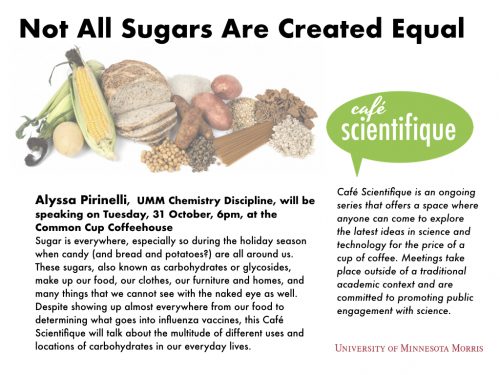
We have Cafe Scientifique on the last Tuesday of every month, which just happens to fall on Halloween this year. So we’re having appropriate content — come to the coffee shop, learn all about carbohydrates from Alyssa Pirinelli, and then go hand out carbs at home!

OMG, babies have thin skulls! They can be pierced!
That’s the kind of nonsense we get in bad popular science articles — a True Fact that is cited as demonstrating a real danger to children. Buzzfeed points to the sensationalist media hype over a terrible article that claims cell phones are warping babies innocent helpless brains.
The journal Child Development published what was described as a “review article” –an assessment of existing literature – by Cindy Sage and Ernesto Burgio. It was titled “Electromagnetic Fields, Pulsed Radiofrequency Radiation, and Epigenetics: How Wireless Technologies May Affect Childhood Development”, and was published in a “special section” of the journal addressing technology risks.
The paper got picked up by the UK national media. An article in the Express, published in May, asked: “Could wireless technology be causing MAJOR health problems in your children?”
It said: “Wireless mobile phones, laptops and tablets could be causing major health problems in children and contributing to autism and hyperactivity, a new study warns,” and said that these devices, “which even include baby monitors, emit radiation and electromagnetic fields that pierce thin skulls, harming memory, learning and other mental skills”.
However, a new paper published in the journal PeerJ by Dorothy Bishop, a professor of developmental psychology at the University of Oxford who specialises in developmental conditions such as autism, and David Robert Grimes, a medical physicist also at the University of Oxford, has issued severe doubts about the study. They said its claims are “devoid of merit” and “should [not be] given a veneer of legitimacy”.
The Child Development paper claimed that phones, Wi-Fi, and other sources of electromagnetic fields (EMFs) “are widely documented to cause potentially harmful health impacts that can be detrimental to young people”.
The actual article in Child Development isn’t quite that sensationalist, but it’s bad in other ways. As is usual in this kind of article about the horrors of electromagnetic radiation, I always wonder if, after they get rid of our cell phones, they’re planning to get rid of that great big thermonuclear-powered source of radiation and electromagnetic fields in the sky — after all, it’s silly to go after the piddling sources of feeble EMR while ignoring the many orders of magnitude greater zapper of rays that is bathing our whole planet in a seething stew of wavelengths and photons and rays and all that sciencey crap.
I wonder what the mechanism might be that causes autism in response to EMFs. This is always the problem with these kinds of ‘studies’ — they’re long on hypotheticals, and weak on the causal links that might be testable and might actually give some substance to the vapor. The Bishop and Grimes paper does a good job on dismantling their arguments there, too, because I was really annoyed when Sage and Burgio trot out their “Plausible Biological Mechanism for EMF/RFR Effects” and it’s…epigenetics. Epigenetics is the new buzzword that gets inserted in place of “magic” nowadays, and it’s getting obnoxious. You have to do real experiments and measurements of epigenetic phenomena to be able to make that claim — and simply noting that DNA repair is slower when your cells in culture are exposed to low-intensity non-thermal radiation, which might make them more prone to cancer, does not imply “epigenetics did it”. I don’t even know what they mean by epigenetics! It seems that whenever they observe an effect for which they have no causal mechanism, they just label it epigenetic and call that the mechanism, as if that explains anything.
Bishop and Grimes summarize it well.
Sage and Burgio make liberal use of epigenetic terminology, but in a nebulous and non-specific fashion, being deployed as an apparent deus ex machina to attribute negative health effects to WiFi in the absence of any evidence. Epigenetics is a term used to refer to the case where environmentally-induced modifications persist across generations, but Sage and Burgio treat it more as a synonym for gene-environment interaction. This usage is common among advocates of complementary and alternative medicine, but unhelpful as it confuses rather than clarifying the role of environmental effects.
Anyway, relax. There is no plausible mechanism for cell phones or WiFi to fry your baby’s brain, so go ahead, pierce their thin little skulls with radiation. I’m a big fan of holding babies close so that the infrared radiation you are emitting from your chest (more wattage than is coming out of your phone!) toasts their little heads with warmth. I think we humans have been doing that for a few hundred thousand years, so it’s probably not harmful. Probably. Studies pending.

I don’t know who Günter Bechley is, but apparently he writes for the Discovery Institute, and he despises me.
I despise the dogmatic and sometimes even fanatical stance of some evolutionists like P.Z. Myers (Pharyngula blog), Laurence Moran (Sandwalk blog), Jeffrey Shallit (Recursivity blog), Jerry Coyne (Why Evolution is True blog), freelance writer John Farrell, the anonymous coward behind The Sensuous Curmudgeon blog, and other infamous web activists against Intelligent Design and religion.
If you follow the link, you’ll discover he’s one of those people who thinks the theory is in imminent danger of collapsing, because scientists keep learning new things, and babbles about new discoveries in hominid evolution. Just two little problems there: the details of the timeline of human history are not the theory part of evolution, and a willingness to accommodate new evidence is a good thing.
I guess he’s just going to have to keep on despising me, but it’s OK when the despisers are so absurdly wrong.

I didn’t like the premiere episode of the new Star Trek at all. I was so repelled that I felt no desire at all to see the second — but I know, other people feel otherwise. Even some scientists are still enthusiastic. For instance, Jeremy Yoder lists all the bad biology in past and present episodes of the show, and still recommends it, even after the galactic fungus and space-hopping tardigrade story, which makes me nauseous to even listen to the video clip explaining it with outrageous technobabble. I guess his ability to suspend disbelief is far more robust than mine.
So, honestly, it’s hard to watch almost any episode of Star Trek without my biology-sense tingling. But here’s the thing: the bio-bollocks is often deeply entangled with what makes Trek great. The episode of Voyager in which two characters are temporarily transmuted into one touches on questions of personhood, and what makes us unique, self-determining individuals. The shape-shifting villains of Deep Space Nine created innumerable opportunities for stories about paranoia and power in wartime and the risks of trading freedom for security. The biological impossibility of Mr. Spock’s parentage makes him a touchstone for anyone who’s lived with dual identities or a sense of alienation from their community. The de-evolution virus … well, okay, that one I can’t justify. But by and large, when Star Trek has stretched and often broken the limits of biological realism, it’s done so to tell stories that are worth the telling — and that inspired many a nerdy kid to stick with science long enough to learn how fictional Star Trek really is.
I agree that the pseudoscience isn’t the point of a Star Trek story. I just feel like, if the writers cared, they could take the time to get the science right, and that good science wouldn’t detract from a good story.

Here we go again — I said I’d try to make a youtube video about developmental biology every week, and I’m keeping that promise. I’m thinking, though, that my last couple of efforts were too big and indigestible, weighing in at 40 minutes each, so I’m going to try instead to present brief introductions to basic biology, and see if those are more interesting to people. I aimed for 10 minutes, but hit 12 instead — sorry, I’m a college professor, wind me up and let me go and I won’t shut up.
Let me know if this format is easier to stomach, and suggestions are welcome.