Pharyngula
Evolution, development, and random biological ejaculations from a godless liberal


If you thought bathrooms were dangerous, you’re going to be terrified by transsexual sharks.
Many fish are switch-hitters: they have the ability to change from male to female, or vice versa, when it’s convenient for reproduction. Not so for sharks and rays, which develop either male or female organs before birth. But off the coast of Taiwan, fishers discovered a shark with a fully developed set of male and female reproductive organs. The animal is one of only a handful of such sharks ever documented, and the first of its species.
Actually, I suspect these sharks would be more tolerant and more interesting than the bro-sharks with their toxic masculinity.
But wait, even bro-sharks just want to be left alone.

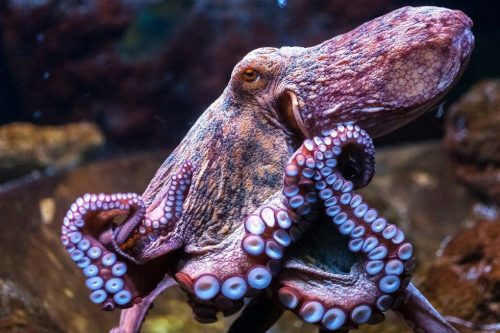
This lovely specimen was highlighted in an article titled Octopuses are taking over our oceans and, yes, it’s time to panic. I don’t get it. It’s about a survey of cephalopods worldwide showing an increase in their numbers. Doesn’t that mean it’s time to celebrate? What is the author’s problem?
I’m reporting his name to our new overlords at the first opportunity.

I’m tinkering with videos again.
I intended to put this up last weekend, but something funny happened: I realized the first version was incredibly boring. I’m not quite in the rhythm of this video game; my first draft started with the same points, but then I started…adding…to it. Oh, this part needs further explanation: scribble up a paragraph of deeper content. Ooops, better qualify this part. Here’s an interesting aside; let’s digress for a bit. I recorded my words, and it was about a half hour long, and then I had to edit it, and it just hit me as pedantic and tedious and not at all in sync with the medium.
So I threw it all away. Extracted a few of the punchier bits, and made a 5 minute summary. It works better. Not perfect, but it’s all part of the process of learning.


Cryptozoologists like to claim that you can’t prove a negative. I respond that 1) scientists don’t deal in proof, and 2) of course, given a specific claim, you certainly can provide evidence that it’s false. If someone is going to make a claim, the onus is on them to provide sufficient specific criteria for the evaluation of that claim.
Here’s an excellent example of how it’s done: Craig McClain dismantles the assertion that the giant shark Megalodon exists. This is a very thorough, point-by-point dissection of the evidence that we should have if there actually were an 18-meter long monster shark prowling our oceans. The evidence shows that, sadly, they all went extinct between 2 and 3 million years ago.
You could make the same sorts of arguments against the existence of a giant hairy ape living in the forests of the Pacific Northwest, or against the Tree Octopus. The True Believers never seem to be dissuaded, though.
It’s hard to make those kinds of arguments against a giant cosmic god, though. Those True Believers have cunningly engineered the properties of their cryptid to be nebulous and evasive; Megalodon at least had specific parameters and predictable properties that allows one to make predictions about what you should see if they existed. Gods have none of that.

Maybe this is a new species: the Frilled Giant Pacific Octopus, which is very similar to the unfrilled and familiar Giant Pacific Octopus.
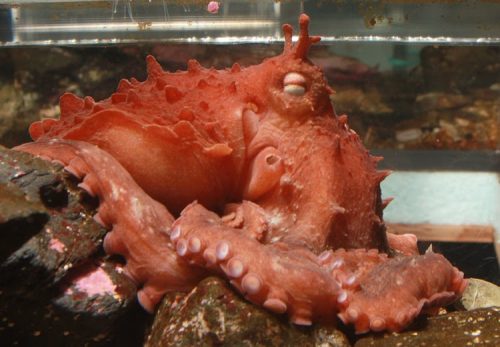
Note the little bumps called papillae around the eyes — it’s an octopus with eyelashes.
I expect you all to party a little harder on Sunday night for the Frilled Giant Pacific Octopus.

Maybe that’s the problem. Maybe it’s a guy who thinks the replicators on Star Trek are real. Maybe it’s another article from the delusional weirdos of the Singularity Hub. Maybe it’s just that I get really annoyed with physicists who think they understand biology. But yeah, Thomas Hornigold believes that we’ll be able to make desktop replicators that will make anything you want.
These tiny factories will be large at first, like early computers, but soon enough you’ll be able to buy one that can fit on a desk. You’ll pour in some raw materials—perhaps water, air, dirt, and a few powders of rare elements if required—and the nanofabricator will go to work. Powered by flexible photovoltaic panels that coat your house, it will tear apart the molecules of the raw materials, manipulating them on the atomic level to create…anything you like. Food. A new laptop. A copy of Kate Bush’s debut album, The Kick Inside. Anything, providing you can give it both the raw materials and the blueprint for creation.
Just copy biology! It’s not physics, it’s got to be easy!
In recent years, progress has been made towards this goal. It may well be that we make faster progress by mimicking the processes of biology, where individual cells, optimized by billions of years of evolution, routinely manipulate chemicals and molecules to keep us alive.
All we need is energy from the solar panels we’ll build with our replicators to power our replicators!
Suddenly only three commodities have any value: the raw materials for the nanofabricator (many of which, depending on what you want to make, will be plentiful just from the world around you); the nanofabricators themselves (unless, of course, they can self-replicate, in which case they become just a simple ‘conversion’ away from raw materials); and, finally, the blueprints for the things you want to make.
Let me just point out some basic biological realities.
Biological machines are not generic synthesize-anything machines. Enzymatic reactions are narrowly specific: they require very specific inputs (not just a bucket of dirt) and they are honed by evolution to produce very specific output — not just a particular molecule, but a particular chiral form of that molecule. There are very few general, ‘programmable’ molecular machines — ribosomes come to mind — but that’s only going to be useful if you want to produce proteins. Proteins are remarkably flexible, but still, they’re not sufficient if you want to make solar panels, or batteries, or a car.
He trivializes the difficulty of making the ‘blueprints’. I presume he’s thinking of genes, which are not blueprints, and that you’ll just be able to feed in the ‘language’ of your replicator, and it’ll build something complex for you. We don’t understand all the processes that build a cell, so that’s a long way off, and you have to consider the nature of what organic processes assemble. Are you going to build a cell phone made of meat, or wood, or chitin?
He’s also trivializing the energy requirements. You’re going to have to provide your bio-replicator with chemical energy — or you’re going to have to include a fairly complex mechanism for transducing electrical or light energy into chemistry. It’s doable, cells do it all the time, but it’s still a rather elaborate process with more energy losses.
And then there are the raw materials. Water & dirt? You mean organic carbon, phosphorus, nitrogen, and oxygen and hydrogen — fertilizer and gases and water. Can you grow a stalk of wheat in your cubicle? If you can’t do that, what are you doing babbling about the far greater task of fitting a whole farm, fields and livestock, plus an electronics factory, plus an IT department, all into a box on your desk, with negligible requirements for energy or feedstocks. And it has to come preprogrammed with the capability of synthesizing anything.
Singularitarians. They’re the 21st century version of happy clappy religious fanatics.


So you may have seen this label around, from the Non-GMO project — it’s a kind of seal of approval by unscientific hoodoo artists to declare food “safe”, unlike those foods that were generated by intentional, directed genetic modification. They prefer their crops randomly mutagenized, you know, the natural way, as Herman Muller intended.
Although, truth be told, this whole nonsense began as a marketing scheme by a couple of big grocery stores, who discovered a clever way to slander the products sold by competing chains and set themselves up as an elite source. Slap an orange butterfly on a box and you can sell it for more money!
Now, of course, they continue to spread lies. The latest is the false claim that going non-GMO frees farmers from onerous patents and restores “traditional” farming practices. It doesn’t. The Plant Patent Act was passed in 1930, which gave patent rights to certain kinds of propagated plants, and the Plant Variety Protection Act in 1970 expanded on that. The first GMOs were approved in 1994. 1994 is later than 1930 and 1970.
In the 19th century, we also acquired hybrid seed — where the seed company maintained parental stocks, bred them together, and sold the more productive heterozygous seed. The farmer would not be able to propagate his hybrid stock. These were produced and sold in the 1920s. 1920 is before 1994.
There are lots of seeds that are patented and sold that are non-GMO.
This is #NonGMO seed, it is patented. I can not save it's seed to plant next year, yet the products it will make can carry the #butterfly label.
*BTW @NonGMOProject has me blocked because I tweet facts about products I grow, and they label. pic.twitter.com/rM7kQA2HuN
— David🌾Kucher (@DavidKucher) December 18, 2017
What’s going on with this GMO labeling crap is a dishonest game. It’s false advertising. Food that is GMO is not less safe or dangerous or less nutritious, and food that is non-GMO is not “pure” or “natural” or better for you.
The herbicide tolerant Clearfield canola was bred using chemical mutagenesis, in which plants are exposed to chemicals that induce genetic mutations. Desirable results that occur using this technique, like the Clearfield trait, are commercialized. Products made with crops from the seeds shown in Kucher’s image are eligible for the Non-GMO Project butterfly seal (though the herbicide is prohibited on certified organic farms).
You should be aware of how your food is made, where it comes from, and there are agricultural practices that are bad (overuse of antibiotics is just one of them). But that butterfly seal is a fraudulent marketing scheme that has metastasized into a tool to suppress a powerful and safe technique for producing better food crops. Avoid it. Don’t give these con artists more power over agriculture.

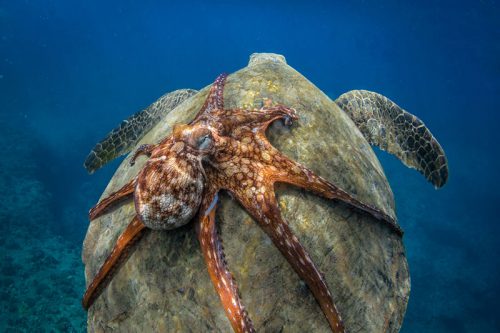
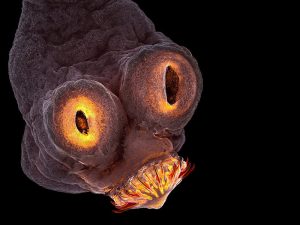
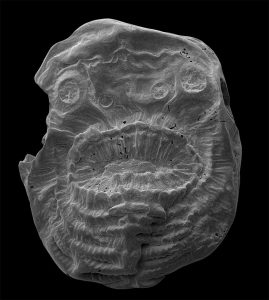
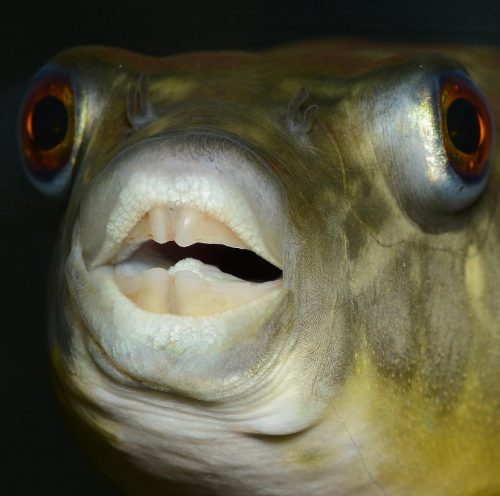
That’s from Nature’s best science images of the year. I can’t resist including a couple of others, just because they’re so lovely. Here’s a pork tapeworm, and a fossil faceprint of a 529 million year old deuterostome. Do you see the resemblance?