A fine demonstration of unpredicted consequences

Global climate change has freaky outcomes. I wouldn’t have predicted that warming Minnesota would freeze septic tanks.

Frozen septic systems are emerging as an unexpected consequence of climate change in Minnesota — one that is bedeviling homeowners across the state and could soon cost taxpayers more for the repair and maintenance of fragile rural roads.

The cause is a dramatic long-term decline in insulating snow early in November and December. Combined with still-freezing conditions, that drives the frost line deep underground — well below septic pipes and drain fields.

So climate change → less snow → frost line goes deeper → frozen septic tanks → more septic tank pumping → heavier traffic on rural roads → rising road repair costs.

What other unforeseen effects are going to hit us in the future?

Jobs! Biology jobs!

Look, gang, the University of Minnesota Morris is hiring biology professors! Two of them! If you meet the requirements and are looking for a position at a small liberal arts university that greatly values teaching, here’s your opportunity!

We’re looking for someone to teach microbiology/biochemistry, and someone to teach cell biology. You’ll also be expected to teach an interesting elective or two, which we can discuss. Here are the descriptions for the two positions:

Full-Time, Multi-Year Position in Biology

Required/Preferred Qualifications:
Required: Candidates must have a Ph.D. in biochemistry or microbiology, or a closely related field by August 20, 2018. Experience and evidence of excellence in teaching undergraduate biology is required. (Graduate TA experience is acceptable).
Preferred: Preference will be given to applicants with experience teaching courses similar to those attached to this position. Ability to supervise undergraduate students in summer research is also valued.
Duties/Responsibilities: Teaching upper-level undergraduate courses for majors in biochemistry and microbiology, both with labs; our introductory Fundamentals of Genetics, Evolution and Development course for majors; contributing to other courses that support the biology curriculum; and sharing in the governance and advancement of the biology program.

Full-Time, One-Year Position in Biology

Required/Preferred Qualifications:
Required: Candidates must have a Ph.D. in cellular biology, or a closely related field by August 20, 2018. Experience and evidence of excellence in teaching undergraduate biology is required. (Graduate TA experience is acceptable).
Preferred: Preference will be given to applicants with experience teaching courses similar to those attached to this position. Ability to supervise undergraduate students in summer research is also valued.
Duties/Responsibilities: Teaching undergraduate courses for majors in cell biology, with labs; our introductory Fundamentals of Genetics, Evolution and Development course for majors; contributing to other courses that support the biology curriculum, including an upper level elective; and sharing in the governance and advancement of the biology program.

And this is some general boilerplate and the specific application instructions.

Program/Unit Description:
A distinctive undergraduate campus within the University of Minnesota system, Morris combines the benefits of an intimate, student-centered residential liberal arts education with access to the resources and opportunities of one of the nation’s largest universities. The University of Minnesota, Morris is a member of the Council of Public Liberal Arts Colleges (COPLAC) and provides students with a rigorous academic experience, preparing them to be global citizens who value and pursue intellectual growth, civic engagement, intercultural competence, and environmental stewardship. The student body of nearly 1800 is supported by approximately 130 faculty members, a student/faculty ratio of 14:1. The Morris campus is the most ethnically diverse in the University of Minnesota system, with 28 percent US students of color (19 percent of whom are American Indian students) and 11 percent international students.

Morris culture is characterized by an unwavering commitment to the liberal arts and undergraduate education as well as by the particular traditions it has developed in pursuing that mission. The community believes in the values of shared governance (embodied in its official policymaking body, an inclusive Campus Assembly), and it recognizes the heritage of its campus (which was founded as an American Indian boarding school) with a vigorous commitment to diversity. With a vibrant sense of community in and out of the classroom, Morris aims to integrate curricular, co-curricular, and extracurricular aspects of the student experience, and it reaches outward to the broader community with collaborative enterprises, partnerships, and service-learning initiatives.

The University of Minnesota shall provide equal access to and opportunity in its programs, facilities, and employment without regard to race, color, creed, religion, national origin, gender, age, marital status, disability, public assistance status, veteran status, sexual orientation, gender identity, or gender expression. Morris values diversity in its students, faculty, and staff. Morris is especially interested in qualified candidates who can contribute to the diversity of our community through their teaching, research, and /or service because we believe that diversity enriches the University experience for everyone.

To request disability accommodation contact: UMM Human Resources, 320-589-6024, Room 201, Behmler Hall, Morris, Minnesota.

Application Instructions:
To apply for this position, go to the University of Minnesota Employment System at https://humanresources.umn.edu/jobs. The job ID# for the multi-year position is 323067. The job ID# for the one-year position is 323104. Please click the Apply button and follow the instructions. Applications must include a letter of application, resume, graduate and undergraduate transcripts, a teaching statement with evidence of teaching effectiveness, and three letters of reference. Supporting documentation may be sent to Ann Kolden, Administrative Assistant, at [email protected], (320) 589-6301, or they may be sent to:

Biology Search Committee Chair
Division of Science and Mathematics
University of Minnesota, Morris
Morris, MN 56267-2128

Applications will be accepted until the position is filled. Screening begins April 16, 2018.

Inquiries can be made to Professor Paul Myers, Search Committee Chair, at (320) 589-6343 ([email protected]).

Note the dates. We’re moving fast on these positions, and will start reviewing applicants in two weeks.

Note also who gets to organize this whole thing…so much work.

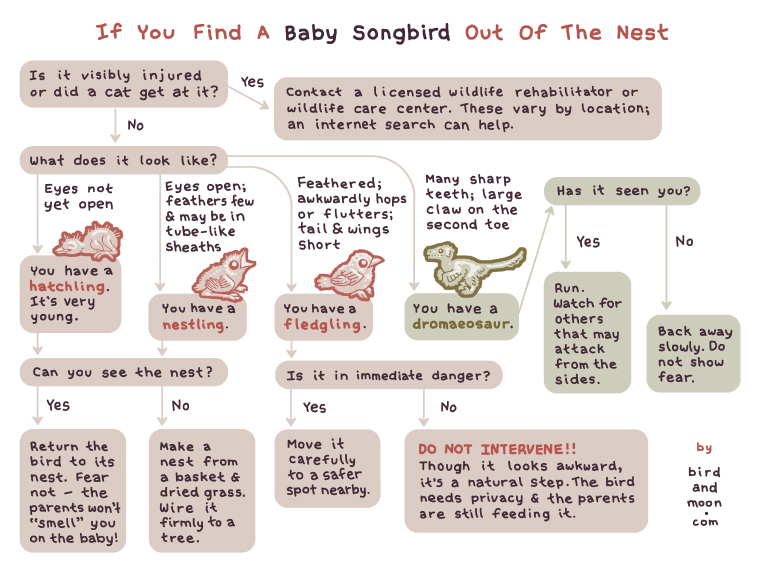
A useful guide for spring accidents

It’s early yet — the birds don’t seem to have started nesting yet, although I am starting to hear more of racket in the trees in the morning — but you should be prepared for the inevitable tragic accidents that will occur.

Quite coincidentally, I found this on my back porch yesterday.

It’s definitely feathered, and doesn’t seem to be in danger, so I guess I should have left it alone. Unfortunately, it is now occupying my desk.

The social media dilemma

Facebook is objectively evil. But at the same time, it’s so delicious. It’s like an evil donut that you can’t resist nibbling on, but it’s going to kill you in the end. I have friends on Facebook! It’s where I go to get my grandbaby photo fix! I have connections there!

But now I’m thinking I really ought to #DeleteFacebook. The arguments are annoyingly strong.

Some say, “I don’t want to stop using Facebook, I want them to change.” And that is wrong. Keeping up with your friends is good. But Facebook’s business and data model is fundamentally flawed. For you, your data is who you are. For Facebook, your data is their money. Taking it from you is their entire business, everything else is fancy decoration.

Others will say, “I need Facebook because that’s where my audience is, and my livelihood depends on that.” And it is true. But depending on Facebook is not safe in the long-term, as others have learned the hard way. Ever changing, opaque algorithms make it harder and harder to reach “your” audience. So even in this case it’s wise to look for other options and have contingency plans.

It would make it easier for me to leave if all of you would go, too, because it’s not Facebook I like (it’s evil, remember), it’s the people. We need an alternative, but the Zuck seems to have devoured them all. Is there something similar emerging from the non-corporate world, like Mastodon, the better Twitter alternative?

Friday Cephalopod: Female cuttlefish are conspiring together!

Oh, sure, you all hear about the bold dominance displays of male cuttlefish, and their camouflage, and the flashing color changes, but this is a new one on me. The females have a unique display, that they only show to other females (or to themselves in a mirror).

Here it is an a drawing: elegant, understated, quite nice.

What I find disturbing is that they do not display this signal to any other males — it’s like a secret code for the lady cuttlefishes only. What are they communicating? Are they talking about me? Do they have secrets no male is permitted to discover?

I bet it’s for the cuttlefish whisper network.

M. E. Palmer, M. Richard Calvé, Shelley A. Adamo (2006) Response of female cuttlefish Sepia officinalis (Cephalopoda) to mirrors and conspecifics: evidence for signaling in female cuttlefish. Animal Cognition 9(2):151-155.

Role models for the modern man

Guys — you’ve been told that Nature wants you to be like lobsters, or fiddler crabs, or bighorn sheep. Those suggestions are all superseded by the True Message of Mother Nature — you’ve been doing everything wrong. You are ambulatory bags of sperm, and your one goal should be to fling yourself at a female, who will extract the entirety of your purpose to propagate offspring. Like the deep sea anglerfish. Isn’t she beautiful? Wouldn’t you love to become…attached?

Or behold the Brown Widow Spider. The older the female, the more likely she is to cannibalize her suitors…but at the same time, the more alluring she is to the males, and the more likely they are to discard all discretion and throw themselves at her gonopore, and subsequently, to stagger from their dalliance into her chelicerae.

Just letting you know that you should fear the naturalistic fallacy, if you didn’t already.

There is such a thing as a stupid question

Here’s click-baity title it’s hard to resist: Science Still Can’t Explain This Biological Mystery, But Scientists Like to Pretend Otherwise. Oooh. What is that “biological mystery”? I want to know!

It’s a bad sign, though, when the author has to strain to stave off criticism before he gets around to spilling the beans.

Those of us who embrace science are growing increasingly impatient with religious and spiritual traditions. To us, absolute faith in claims scribed by backwards people thousands of years ago is delusional. We think it’s time for the faithful to get over themselves. The culture wars will end when it finally does. We’re waiting, though not patiently, because much is at stake.

Much is indeed at stake, but we’re actually waiting for the scientific to get over themselves. I say this as an atheist fully committed to science as the best method yet for discovering the nature of reality.

“I’m an atheist, so you know you can trust me” (oops, no, I can’t), “now you scientists better address my demands!” OK, I know who needs to get over themselves, and it isn’t the scientists here.

But finally, what is the mystery?

Between science and faith, I think faith is te more honest about what the scientific community seems perversely averse to explaining: Organisms: what they are and how they emerge from chemistry. Scientists explain organisms away or simply assume them without explaining them. At least the faithful recognize that life’s purposefulness needs explaining, even though their explanation is no explanation at all.

Organisms? One broad, very general word, and we have to explain it to him? Try this. Go up to a plumber, and say “Pipes. Pipes are a mystery. You can’t explain them to me.” Or a refrigerator repairman: “I am confused by cold. Explain it. I think religion is more honest than physics in describing temperature.” What can you say? And he does go on and on trying to emphasize his ignorance — he’s not much different from Bill O’Reilly saying, “Tide goes in, tide goes out, you can’t explain that.” He even has his very own quaint definition of what an organism is.

Unlike inanimate things, organisms engage in functional, fitted effort. Effort is purposeful work, an organism trying to achieve what is functional – of value to it, fitted or representative of its circumstances. Effort value and representation only make sense with respect to organisms. Organisms try to benefit themselves given their environment. Inanimate things don’t.

I’m just going to have to short-circuit this whole argument. The author, Jeremy Sherman, has simply reified the word “organism” to mean something discrete and unitary — it’s a thing that functions. That’s not very useful, especially since he’s setting it up as thing that cannot have a predecessor.

To a biologist, an organism is an integrated complex of replicating chemical reactions. It’s chemistry. The search for some vital distinction between chemistry and biology is over, there isn’t one, and they simply grade into one another. Sherman is erecting an imaginary wall and telling us we can’t get past it, but all the scientists are looking at him and wondering why they should take this challenge at all seriously — show us that there is a wall, don’t ask us to prove your fantasy is non-existent.

So look at viruses. Just chemistry, right? A bit of nucleic acid, a protein and carbohydrate coat. But they replicate, are functional, and are “fit” (I’m not sure that the “fitted” Sherman is talking about is at all similar to the “fitness” a biologist would discuss) in that some viruses are better at replicating than others. We can replicate RNA with just a nucleic acid strand, an enzyme, and a few cofactors.

Sherman nags that scientists have to get over themselves and come up with an explanation that satisfies him. The thing is, though, that lots of scientists are working on origin of life research, and are asking more sensible questions than “Organisms? WTF?”.

Seriously. Mr Sherman needs to get over himself and try reading any of the wealth of books on the subject. It’s not as if there is a shortage of scientists writing in an informed way about the origin of life comprehensibly for the public.