DEI working exactly as intended

Conservatives like to dismiss Diversity, Equity, and Inclusion statements as empty posturing and virtue signaling, as the politicization of science, as discrimination against conservative points of view. I would counter that by saying that they work.

Case in point: UCLA didn’t hire a professor, Yoel Inbar, in part because grad students pointed out that he didn’t support DEI. This annoyed Matt Yglesias, who wrote:

Guy says DEI statements as a hiring tool is just way to screen candidates for “an allegiance to a certain set of beliefs.”

Grad students pen letter saying that shows he shouldn’t be hired since he doesn’t pledge allegiance to the right beliefs.

That “certain set of beliefs” is the idea that we should respect all of our students, and give every one an equal opportunity to succeed. (I don’t know what happened to Yglesias’s brain, I think he has a terminal case of centrism.)

Inbar’s case was well-researched by the students, and they responded with a lengthy letter documenting his inadequacies. Inbar has a podcast with 101 episodes in which “he discusses various topics relating to current events in academia, including but not limited to: diversity statements, anti-racism in psychological organizations, sexism and racism on college campuses, freedom of speech, polarization, and conservatism in psychology.” Isn’t that nice? He provided a wealth of data, the data was evaluated, and his proposal was rejected. Evidence-based scientific reasoning! Exactly what we want!

Most concerning to us as students is Dr. Inbar’s opposition to institutions endorsing positions on sociopolitical issues he has deemed “contentious” or “controversial.” In particular, he takes a strong stance against promoting DEI initiatives through the use of diversity statements and DEI criterion to evaluate research. He also takes a firm position against the use of diversity statements as a tool in the hiring process, and specifically criticizes their use in the University of California system’s faculty application process. In episode 15, he remarks that his “skepticism about these [diversity statements] is they sort of seem like administrator value signaling. It is not clear what good they do, how they’re going to be used…” He continues, “to lots of people on the left, diversity is such an obviously positive thing,” and says that the left fails to acknowledge that these statements “[signal] an allegiance to a certain set of beliefs.” Rather than recognizing the value of DEI initiatives to improve representation and inclusion of marginalized scholars, he casts valuing diversity, equity, and inclusion as uniquely “liberal” values reflective of ideological bias. These comments frame diversity statements as a threat to ideological diversity, and reflect a lack of prioritization of the needs and experiences of historically marginalized individuals across the lines of race, class, gender, sexuality, and ability. In contrast, our institution’s position on this issue is unequivocal: page one of the UCLA Office of Equity, Diversity, and Inclusion FAQ proclaims “Equity, diversity, and inclusion are integral to how the University of California conceives of “merit.”

So here’s this guy who opposes a key value promoted by the university, the need “to improve representation and inclusion of marginalized scholars,” and he didn’t get hired. Are we supposed to hire people who oppose representation and inclusion?

Inbar did not do well in his on-campus interview, either.

Our concerns were deepened after the graduate student meeting with Dr. Inbar on Monday, January 23rd. During this meeting—which traditionally takes the shape of graduate students asking questions and interviewing faculty candidates—he initially prioritized asking us questions about the Psychology Department and life as graduate students, which would presumably inform his decision on whether to accept a job offer from our program. We interjected to reframe the discussion and ask pointed questions about his past and prospective efforts in advocating for diversity, equity, and inclusion efforts both in mentorship and in his line of research. To most of us in the room, his answers to these questions were less than satisfactory, and some responses were outright disconcerting. For example, he responded by indicating that his “work does not really deal with identity, so these issues don’t come up for [him] in a research context.”

As Dr. Inbar studies issues of morality, social attitudes, and political ideology, including how moral psychology shapes prejudice (e.g., Inbar et al., 2009; Inbar et al., 2012), it was deeply troubling to hear that he does not believe identity (i.e., individual background as it pertains to race, gender, sexuality, class, or ability) has bearing on these research questions. It is our perspective that considerations of identity cannot accurately be disentangled from the study of prejudice and moral behavior, and that disseminating these findings requires a high level of sensitivity to how results might be misrepresented or misunderstood given real-world sociopolitical conditions.

Wow. He studies “morality, social attitudes, and political ideology,” but he doesn’t think identity is relevant to his work. OK, man, you don’t get the job, and further, that calls into the question the value of all your published work.

This is exactly what job applications and interviews are supposed to do, screen applicants to determine whether they are good candidates for a position. We also want students to contribute to the decision — every time we have a job candidate on my campus, I announce it in my classes and tell them that we truly, honestly want their input. If they don’t think the person is someone they’d want teaching them, say so! We don’t usually expect a detailed four-page analysis that required research into the papers and podcasts of the candidate, but that is an impressive effort.

Of course, now the media are irate that Students Pressured University Not To Hire Professor Who Questioned ‘Diversity’ Statements. Pressured? No. The students did as requested and as they were supposed to do and evaluated the quality of a candidate and made a recommendation. That’s going to be the message everywhere, though, and they seem to be unaware of the fact that they are effectively poisoning his job search. If he were desperate enough to apply to UMM, for instance, his notoriety means he wouldn’t get past the initial screening of applications. Like we’d want to hire someone at our minority-serving institution who thinks diversity is a waste of time.

On the other hand, he’ll be greeted with open arms at the University of Austin.

Guilt by association

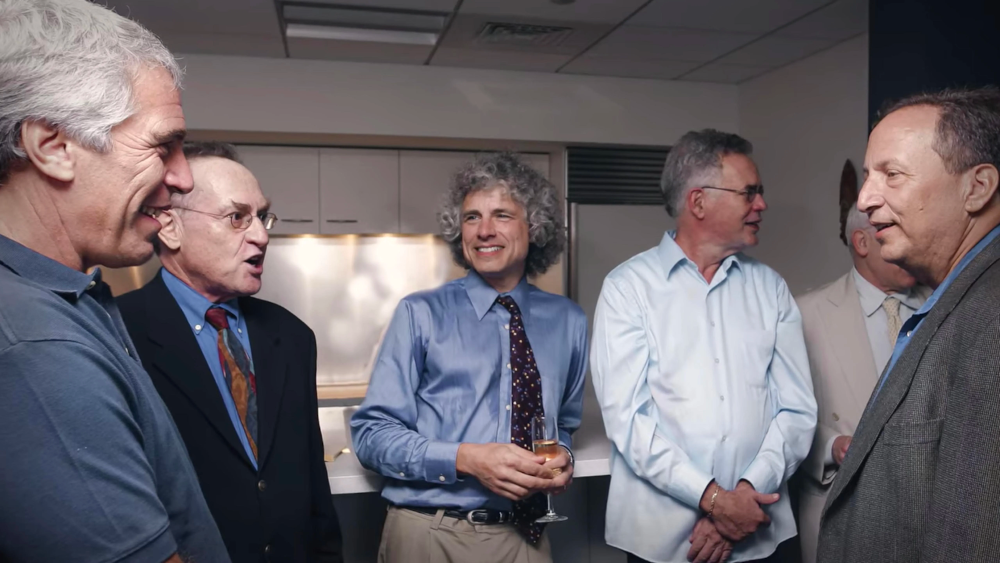
Flash this image to see how fast a ‘free speech warrior’ will block you.

One accidental occurrence is meaningless and forgivable, but when you keep hanging out with the same group of racists for over 20 years, and when you are repeatedly informed that these are bad guys, the correlation becomes rather more substantial. All you have to do is look at Steven Pinker’s history of academic friendships to see that maybe there’s a problem here.

  • 1999 — Pinker joins the human biodiversity (h-bd) group begun by Steve Sailer, now the editor of VDARE, along with race science researchers like Gregory Cochran and Henry Harpending, race science funders like Ron Unz (of the Unz report), J.P. Rushton of the infamous, explicitly eugenic Pioneer Fund, and J. Michael Bailey, who used pseudoscience to stoke transphobia and hate.
  • 2004 — As editor of Best American Science Writing, Pinker publishes Steve Sailer’s essay citing inbreeding in Iraq as a rationale for an inevitable failed state, as well as fellow h-bd members Virginia Postrel and Daniel C. Dennett. Also included is writing by Max Tegmark, the MIT professor who recently attempted to fund a neo-nazi media group as part of the Future of Life institute, and two columns by Nicholas Wade of the New York Times, who later wrote a ‘deeply flawed, deceptive’ book on race science and was condemned by 140 population geneticists for misappropriating their work.
  • 2005 — Pinker writes a letter “to protest the shocking and disgraceful treatment of professor Helmuth Nyborg”, a fellow h-bd member who speaks at the same conferences as David Duke and researches sex and race differences in IQ. In June of 2006 Nyborg was found to be “grossly negligent”, misrepresenting his own scientific efforts and results. Nyborg is subsequently relieved of duty from Aarhus University as part of a 3 year investigation. In 2009, Pinker sends a second letter in defense of Nyborg without changing a word, addressing it this time to the new president of the university. Many fellow h-bd members join him, including Rosalind Arden, Harpending, and Rushton, as does Linda Gottfredson.
  • 2006 — Pinker writes a lengthy article on the the IQ of Ashekenazi Jews by fellow hb-d members Harpending and Cochran (debunked and later proven utterly unfounded by better science and scientists) in which he blithely asserts that “Like intelligence, personality traits are measurable, heritable within a group, and slightly different, on average, between groups.” In 2019, Pinker defends Bret Stephens’ use of the discredited paper, while Stephens goes on say that he regrets not obscuring the source of the data, noting that “I could have cited from any number of other sources not tainted by Harpending’s odious racial views.”
  • 2007 — Pinker provides counsel to Alan Dershowitz, with whom he taught a class on Morality and Taboo as described by the Edge.org (full syllabus here), on the interpretation of the interstate commerce law used to prosecute Jeffrey Epstein. The late Epstein was, of course, a prominent funder of the Edge.org, the elite group of scientists and thinkers which included Wilson, Dawkins, Dennett, Cochran, and Pinker (as well as Gould and many others). Pinker is a bit sensitive about this connection.
  • 2012 — Pinker helps fellow hb-d member and holocaust denier Ron Unz tailor a critique of self-described “scientific racist” Richard Lynn’s work on IQ, emphasizing his openness to it as a legitimate area of inquiry. (arguments about who is the real racist get ever more surreal in these circles).
  • 2013 — Pinker, an advocate for the biological inevitability of war, coordinated with Wilson, Dawkins, and Dennett to urge that book reviewer John Horgan either denounce a book critiquing an ethnographer (Chagnon) and his writing on his subject (the Yanomami of the Amazon) or recuse himself entirely, warning that a positive review might ruin his career. Horgan, in conversation with Chagnon for more than a decade at that point, does not cave to the pressure, later saying “I’m only sorry that my review did not point out the irony that Chagnon — unlike some of his hard-core Darwinian champions and like many of his critics — rejects the view of war as an instinct.”
  • 2018 — Pinker shares a Quillette article by fellow hb-d member Rosalind Arden on the disinvitation of fellow Nyborg supporter, Linda Gottfredson, from a conference. In his note, he tuts at the SPLC for labeling her an ‘extremist’ simply because she has spent nearly half a century insisting that racial disparities in IQ are innate, immutable, and ensure unequal outcomes between racial groups. Perhaps he feels this too is a reasonable hypothesis — or perhaps he feels the conference would benefit from the work of Arden and Gottfredson correlating intelligence and semen quality. (Arden discloses their professional relationship if not the subject of their work in her article, saying of intelligence research “How often do we take the time to walk empathetically in the cognitive shoes of others? Millions of people struggle to maintain their health, their jobs, and their finances for the blameless reason that they are a little less adept.”)
  • 2022 — Upon the posthumous discovery of E.O. Wilson’s approving correspondence with eugenicist (and h-bd member) Rushton, Pinker does not reflect or contemplate the implications of this discovery for either his field or his close collaboration with Wilson. Instead, he promotes an article by Michael Shermer (another one of the New Atheists that took a hard right) and remembers the battles Wilson, like Pinker, fought in the NYRB on behalf of biological determinism.

I’m also grateful that the article reminded me of the argument between Pinker and Stephen Jay Gould on evolutionary psychology. Gould was brilliant. Man, I miss that guy.

The insufferable pettiness of Anna Krylov

I just discovered an op-ed from 2021 written by Anna Krylov, the crusader against political correctness whose terrible paper I criticized on YouTube. It’s also a terrible opinion piece, but it is evidence that she is trying to launch a career that would appeal to the right wing, and also that she isn’t very thoughtful.

The piece is called The Politicization of Science and it’s the same ol’, same ol’. She starts off by giving her personal history — she grew up in the Soviet Union, in a town that was renamed multiple times in response to the shifting political rule, and she knew people who were denied educational opportunities because they weren’t sufficiently deferential to the powers-that-be. It’s deplorable stuff, and the stupid whims of the political class wrecked many aspects of Russian science. I can see where Krylov is sensitive to the problems.

Unfortunately, after the history lesson, it goes off the rails. She thinks the US is following the same path (and it may, but not for the reasons she cites.)

Fast forward to 2021–another century. The Cold War is a distant memory and the country shown on my birth certificate and school and university diplomas, the USSR, is no longer on the map. But I find myself experiencing its legacy some thousands of miles to the west, as if I am living in an Orwellian twilight zone. I witness ever-increasing attempts to subject science and education to ideological control and censorship. Just as in Soviet times, the censorship is being justified by the greater good. Whereas in 1950, the greater good was advancing the World Revolution (in the USSR; in the USA the greater good meant fighting Communism), in 2021 the greater good is “Social Justice” (the capitalization is important: “Social Justice” is a specific ideology, with goals that have little in common with what lower-case “social justice” means in plain English). As in the USSR, the censorship is enthusiastically imposed also from the bottom, by members of the scientific community, whose motives vary from naive idealism to cynical power-grabbing.

Wait, wait, wait: I had to stop at that claim that “Social Justice” (capitalized) has little in common with “social justice” (lower case.) That’s weird. I followed her citations to see where that’s coming from, and it’s all Helen Pluckrose, James Lindsay, Peter Boghossian, and John McWhorter — sources that despise the idea of social justice, and have, shall we say, a rather uninformed and biased perspective. But now I was eager to learn about Western censorship.

Her examples are underwhelming.

Today’s censorship does not stop at purging the scientific vocabulary of the names of scientists who “crossed the line” or fail the ideological litmus tests of the Elect. In some schools, physics classes no longer teach “Newton’s Laws”, but “the three fundamental laws of physics”. Why was Newton canceled? Because he was white, and the new ideology calls for “decentering whiteness” and “decolonizing” the curriculum. A comment in Nature calls for replacing the accepted technical term “quantum supremacy” by “quantum advantage”. The authors regard the English word “supremacy” as “violent” and equate its usage with promoting racism and colonialism. They also warn us about “damage” inflicted by using such terms as “conquest”. I assume “divide-and-conquer” will have to go too. Remarkably, this Soviet-style ghost-chasing gains traction. In partnership with their Diversity, Equity, and Inclusion taskforce, the Information and Technology Services Department of the University of Michigan set out to purge the language within the university and without (by imposing restrictions on university vendors) from such hurtful and racist terms as “picnic”, “brown bag lunch”, “black-and-white thinking”, “master password”, “dummy variable”, “disabled system”, “grandfathered account”, “strawman argument”, and “long time no see”. “The list is not exhaustive and will continue to grow”, warns the memo. Indeed, new words are canceled every day–I just learned that the word “normal” will no longer be used on Dove soap packaging because “it makes most people feel excluded.”

What does it mean that Newton was “canceled”? How? We still learn about his work, Newton still gets a prominent place in the history of science, and calling the laws he discovered “fundamental” seems more important than calling them “Newton’s.”

She cites a letter published in Nature expressing an opinion — you know, like Krylov is doing in the Journal of Physical Chemistry letters — that suggests some of the terminology used in computing is poor. In the 17 December 2019 issue of Nature, Carmen Palacios-Berraquero, Leonie Mueck & Divya M. Persaud say:

We take issue with the use of ‘supremacy’ when referring to quantum computers that can out-calculate even the fastest supercomputers (F. Arute et al. Nature 574, 505–510; 2019). We consider it irresponsible to override the historical context of this descriptor, which risks sustaining divisions in race, gender and class. We call for the community to use ‘quantum advantage’ instead.

The community claims that quantum supremacy is a technical term with a specified meaning. However, any technical justification for this descriptor could get swamped as it enters the public arena after the intense media coverage of the past few months.

In our view, ‘supremacy’ has overtones of violence, neocolonialism and racism through its association with ‘white supremacy’. Inherently violent language has crept into other branches of science as well — in human and robotic spaceflight, for example, terms such as ‘conquest’, ‘colonization’ and ‘settlement’ evoke the terra nullius arguments of settler colonialism and must be contextualized against ongoing issues of neocolonialism.

Instead, quantum computing should be an open arena and an inspiration for a new generation of scientists.

OK, if I were working in the field of quantum computing I’d take that into account, and I can see their point. All it is, though, is a strong suggestion in a scientific journal, exactly equivalent (although far less wordy) to what Krylov was doing…but she is oblivious to the comparison. It’s terrible that anyone would talk about the uses of language, but only when the interpretations differ from Anna Krylov’s.

Another example she gives is a set of recommendations from the “Words Matter” Task Force at the University of Michigan. I confess, there’s a lot in there that I find silly and pointless, such as discouraging the use of the phrase “brown bag lunch” (yeah, that’s what color paper bags are!), but others are worthwhile, such as avoiding the word “crippled” to refer to broken systems, or let’s call “man-hours” “person-hours”. It’s all very bureaucratic, but it’s not censorship or oppression.

That a capitalist company would not want to alienate potential customers by implying that they might be abnormal is also not censorship. She should be far more concerned that I’ve been trying to avoid the use of the “normal” word in my classes, replacing it with less judgmental words like “typical” or “common”. Is color-blindedness not normal? Should I imply that a few students in my class are abnormal because they’re not trichromatic? Krylov is even sillier than that U. Michigan list.

That’s the real problem here. Some people, mostly conservatives and Republicans, are trying to distract us with trivial, petty nonsense as far more serious problems are taking over this country. Sure, go ahead and complain that you’ll continue to defy the tyranny of the Left trying to rename “brown bag” lunches — but meanwhile, the Right is banning books, firing teachers who dare to mention that they’re not heterosexual, outlawing women’s health procedures, and making life a living hell for trans people. Those concerns don’t get mentioned by Krylov. Instead, she wants to damn anyone who tries to expand education to historically deprived groups by removing biases. All in the name of saving humanity.

The answer is simple: our future is at stake. As a community, we face an important choice. We can succumb to extreme left ideology and spend the rest of our lives ghost-chasing and witch-hunting, rewriting history, politicizing science, redefining elements of language, and turning STEM (science, technology, engineering, and mathematics) education into a farce. Or we can uphold a key principle of democratic society–the free and uncensored exchange of ideas–and continue our core mission, the pursuit of truth, focusing attention on solving real, important problems of humankind.

Remember: the Unilever corporation removing the word “normal” from their beauty products is an example of “EXTREME LEFT IDEOLOGY.” Ron Desantis dismantling academic freedom and appointing a Discovery Institute hack to control a liberal arts college…eh, no big deal.

“That’s not how white men fight”

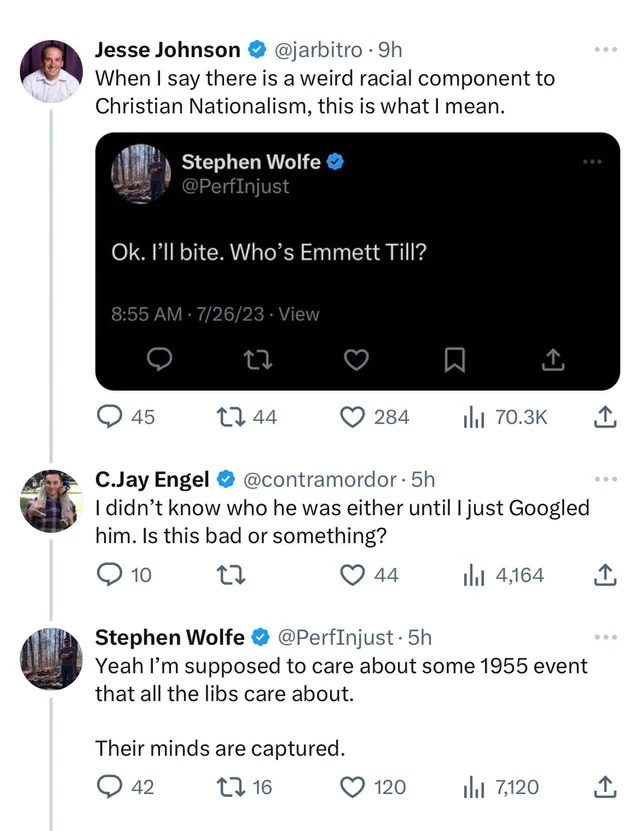
One of the texts that led to Tucker Carlson’s firing has been revealed. It’s surprising.

“That’s not how white men fight”

It’s not surprising because it’s a mild statement — it’s not. It’s deeply, implicitly racist. What’s surprising is that Fox News executives cared. Racism is what Fox News does. It’s just that Carlson plainly spoke out the words of white supremacy, and they knew this was going to be news…even if the Fox News audience would have agreed with the sentiment, and even now are probably looking at each other quizzically, wondering what’s wrong with the comment.

Me, I’m just wondering…how do white men fight? Have I been doing it wrong?

I think the way we’re supposed to do it is take advantage of any good fortune to oppress other people, make them weaker, and then exploit the hell out of them. Then there’s all the lying and cheating and stealing we do to maintain any advantage, all while declaiming that we are obviously superior and meritorious because we’ve got our boot on your neck and aren’t going to let you up. Yeah, that’s how white men fight. Then we live in terror that someone else might manage to do the same thing to us.

A good and lively conversation about bad, tired AI

Adam Conover talks with Emily Bender and Timnit Gebru about stochastic parrots (an excellent label for the surge of interest in “AI,” which really isn’t intelligent).

What I found most interesting was the discussion of TESCREAL, the blanket term for “transhumanism, extropy, singularitarianism, cosmism, rationalism, effective altruism, and longtermism” — and what a muddled, vague, pretentious mess all those topics are. Skip ahead to the 53 minute mark for some horrifying revelations: they talk about the recent letter from the gung-ho Open AI people suggesting a “pause” in development, and an opinion piece that starts out by discussing a definition for “intelligence”. Bender & Gebru looked at the footnotes and what they cited for that — it’s an op-ed defending The Bell Curve! It’s written (or signed) by a bunch of researchers at Microsoft who are using this information as the foundation of their understanding of what intelligence is. They cite a paper that says,

IQ is real, the measures of it are good, they are not racist, and yes, there are group level differences in IQ where Jews and Asians are the smartest but we don’t know exactly how much, and then you’ve got the white people centered around 100, and then they say but the black people are centered around 85.

Jesus. The bad ideas of eugenics and scientific racism have sunk very deep roots. Nineteenth century biology/natural history has significantly tainted all of the sciences with their ugly colonialist/imperialist beliefs, and it’s going to take a long time to dig them out.

You can’t teach this

It might make someone uncomfortable about racism in America.

It’s a crime to ring a doorbell while black in America.

Ralph Yarl, a 16 year old Black boy, was shot twice by a white man in North Kansas City after accidentally ringing the doorbell of the wrong home while attempting to pick up his sibling. The white man reportedly shot Ralph in the head through the glass door, then when Yarl was already bleeding out on the ground, shot him again. The family has described it as a hate crime, and community members are calling for justice for the young victim.

The perpetrator of this vicious crime is in jail, at least. He is in jail, right? Right?

Reports indicate that the white man was taken to the police headquarters briefly to provide a statement but was released shortly after without charge. Yarl’s family is outraged that the perpetrator has not been held accountable.

Unbelievable. He shot an unarmed boy who only rang his doorbell, and put a second bullet in him while he was lying on the ground, and the police didn’t recognize that he committed an act of attempted murder? Let me guess: Missouri has a ‘stand your ground’ law.

Things you won’t be able to teach in Tennessee

Unacceptable in Tennessee

The Tennessee senate has passed a bill to restrict what may be taught in their universities. The bill is fairly long, including rules for assessment and enforcement, but I’ll just excerpt the list of “divisive concepts” you may not teach.

(1) “Divisive concept” means a concept that:
(A) One (1) race or sex is inherently superior or inferior to another race or sex;
(B) An individual, by virtue of the individual’s race or sex, is inherently privileged, racist, sexist, or oppressive, whether consciously or subconsciously;
(C) An individual should be discriminated against or receive adverse treatment because of the individual’s race or sex;
(D) An individual’s moral character is determined by the individual’s race or sex;
(E) An individual, by virtue of the individual’s race or sex, bears responsibility for actions committed in the past by other members of the same race or sex;
(F) An individual should feel discomfort, guilt, anguish, or another form of psychological distress solely because of the individual’s race or sex;
(G) A meritocracy is inherently racist or sexist, or designed by a particular race or sex to oppress another race or sex;
(H) This state or the United States is fundamentally or irredeemably racist or sexist;
(I) Promotes or advocates the violent overthrow of the United States government;
(J) Promotes division between, or resentment of, a race, sex, religion, creed, nonviolent political affiliation, social class, or class of people;
(K) Ascribes character traits, values, moral or ethical codes, privileges, or beliefs to a race or sex, or to an individual because of the individual’s race or sex;
(L) The rule of law does not exist, but instead is a series of power relationships and struggles among racial or other groups;
(M) All Americans are not created equal and are not endowed by their Creator with certain unalienable rights, including, life, liberty, and the pursuit of happiness;
(N) Governments should deny to any person within the government’s jurisdiction the equal protection of the law;
(O) Includes race or sex stereotyping; or
(P) Includes race or sex scapegoating;

Great! (J) means we can kick the Young Republicans off campus.

You can see what they’re trying to do, and it’s antithetical to the university’s purpose. I agree that one race or sex is NOT inherently superior to another, but does this bill mean I couldn’t discuss that, at all, in the classroom, even if my goal is to discuss how I came to that conclusion? We’re just supposed to accept it by legislative fiat? Hey, all you students, memorize this statement, don’t question it, your Republican overlords demand it.

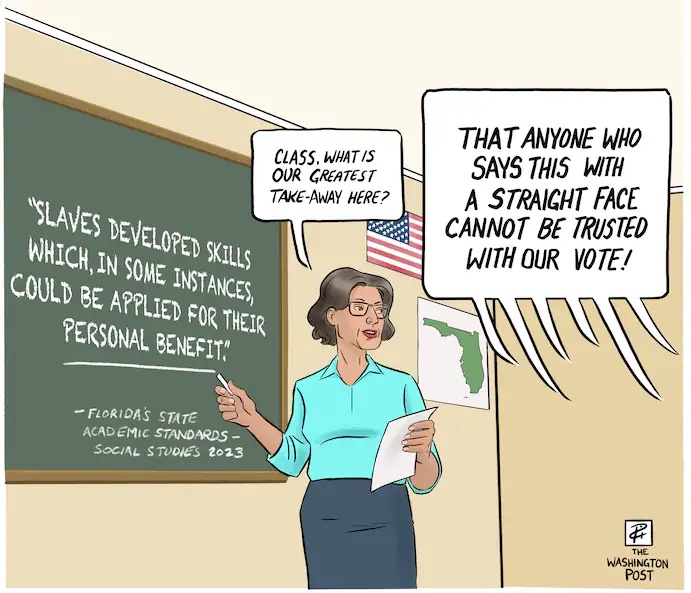
Some restrictions I vehemently disagree with. We can’t say that This state or the United States is fundamentally or irredeemably racist or sexist? But it was and is. We were founded on slavery, women weren’t allowed to vote, etc., and Tennessee Republicans want to prevent people from saying the facts?

Even better: they can fine you up to $5 million for saying what I just wrote.

I can tell where the Republican obsessions lie. This is implicitly a bill against diversity, or any questioning of the wealthy white male American imaginary version of reality. Consider that earlier this year the GOP chastised a new member of the state congress for not conforming to the unwritten laws of what a congressperson looks like.

“If you don’t like rules, perhaps you should explore a different career opportunity that’s main purpose is not creating them,” wrote the Tennessee House GOP on Twitter.

The tweet was a reply to Rep. Justin J. Pearson (D-Shelby County), writing, “We literally just got on the State House floor and already a white supremacist has attacked my wearing of my Dashiki.”

A dashiki is a traditional West African loose-fitted shirt. On Thursday, Pearson wore a black one in the chamber.

(Foreshadowing: later, they’d find an excuse to kick Mr Pearson out.)

A dashiki is respectful, and can be a formal, kind of attire. They have a dress code that both requires a conservative Western style, and has different requirements for men and women. But hell no, they don’t enforce any kind of discrimination. It’s a meritocracy, don’t you know.

The only reason to pay attention to the haters is to shame them

A borough in the UK posted an innocuous tweet, suggesting that people should go in for cervical screening. They had to take it down because a small minority of haters complained that the words “anyone with a cervix” was offensive to women.

The wording was just fine! It was inclusive and was a message to an appropriate audience. In fact, if you look at the thread, there’s a deluge of support for it, with swarms of people, cis and trans, chiming in to see that the message was good and they appreciated it. There were also, of course, a few indignant assholes whining that only women have cervices, and they were the ones they had to listen to, because Calderdale deleted the tweet.

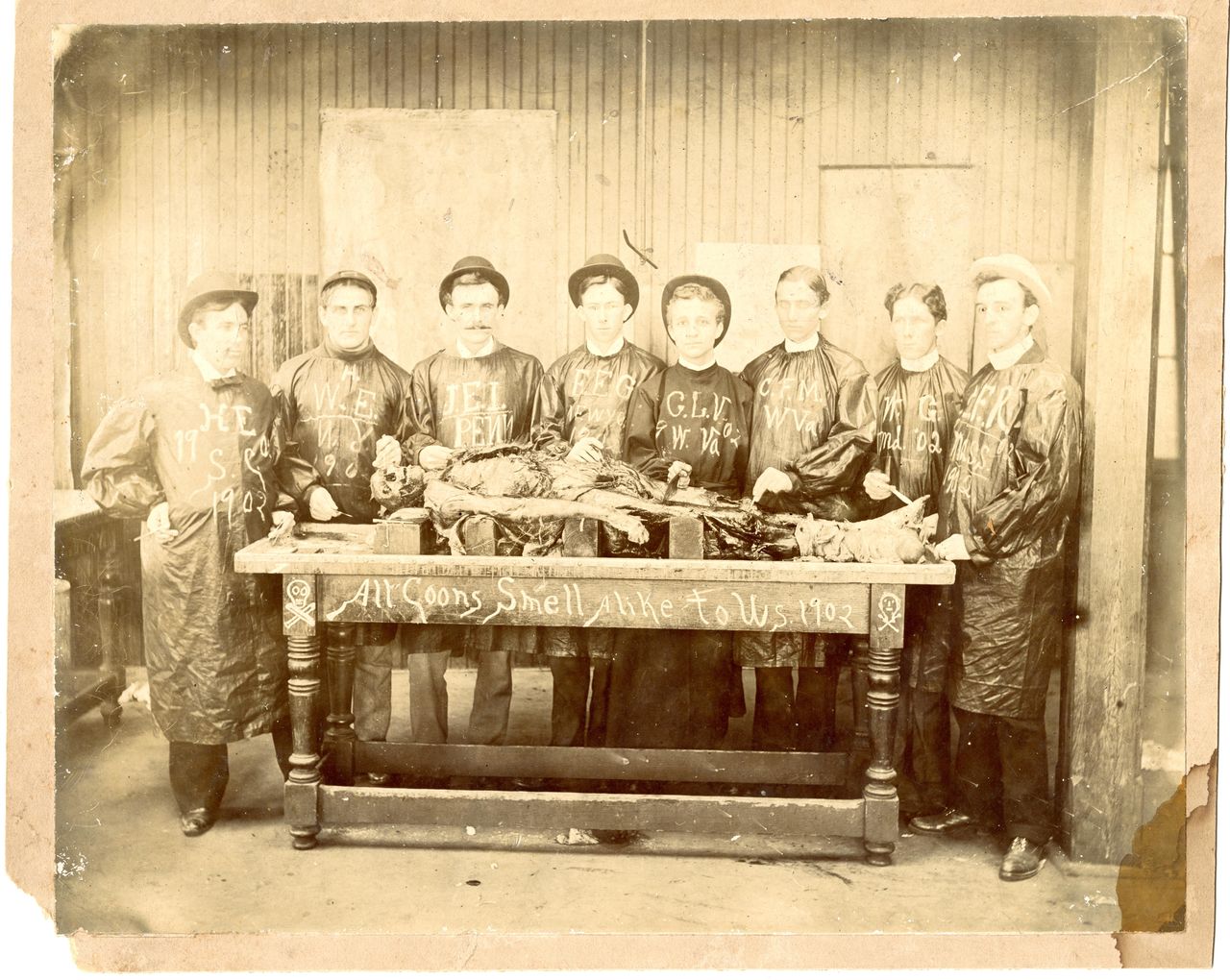
Those few vicious, mocking tweets are the modern equivalent of this, an ugliness that will stain us all for years to come:

Meanwhile, in the science world, the journal Nature is updating their policies. Language matters.

It is regrettable but true that researchers have used and abused science to justify racist beliefs and practices. As previous editorials have acknowledged, Nature has played its part in perpetuating racism — and has now pledged to play its part in tackling it, together with colleagues in the research community.

As part of this pledge, Nature and the Nature Portfolio journals are updating our advice to authors on reporting research that involves race, ethnicity and other socially constructed characteristics. Specifically, we’re asking that authors exercise care and consideration so that the highest standards of rigour are applied where these attributes are found to be an explanation for an outcome or conclusion. This is part of our ongoing updates to guidance asking authors to describe how demographic characteristics, including sex and gender, are considered in the design of studies — and, more broadly, to consider the research’s potential to cause harm.

They aren’t asking a lot. This is what Nature expects now, and I was a little surprised…shouldn’t this have been standing, routine policy all along?

So, what are we asking authors to do, if their research describes people according to race, ethnicity or other socially constructed categories? Essentially, three things. First, specify the categories used and explain why such classification is needed. Second, explain the methods used to describe people in this way — for example, did study participants self-report, or did the information come from a census, social media or administrative data? Third, we would like authors to describe how they controlled for confounding variables, such as socio-economic status. These requests will be added to a paper’s reporting checklist so it is a part of the usual editorial and publishing workflow.

I’m not going to publish in Nature, and the kind of work I do isn’t going to touch on issues of race and sex (although some will try to force it!), but I would have thought that if you were doing work in those areas of sufficient prestige that it would be published in top-tier journals, those rules would have been already incorporated. You can never underestimate the devious efforts of bigots, though!

My genetics class is going ‘woke’!

I’ve been teaching the students all this basic transmission genetics all semester, and while it’s important and fundamental, it can have a bad effect on people’s brains. I cringe when I hear people talking about human traits using simple Mendelian terms like “dominant” and “recessive” because, while it works for many things, for others it misleads and is overly simplistic. I want my students to come away from the class knowing that genetics is complex and subtle and everything is polygenic and epistasis matters, and that’s hard to do when they’re trying to figure out the basics of doing a fly cross.

It’s also a problem because instilling only the basics of Mendel is a good way to make Nazis — it’s easy to distort simple concepts they barely understand into props for your biases. I’d like to forestall that. Also, I’m in Minnesota, and Minnesota has a smug white people problem.

“The racism you see in Minnesota is the type of racism where people say there is no racism. The only race is the human race,” Myers [not me, no relation] said. “How can we say the only race is the human race when all the people with dark skin are people with higher unemployment rates, dying from COVID, more likely to be arrested, more likely to be beaten by police and murdered? How does that happen when there’s no race?”

So I’m going to wake up all the smart students in my class. My strategy involves handing them a digital folder full of articles from science journals as well as newspapers, telling them to pick one, and present it to the class (I’m sure not going to just lecture on these things — I want students to think about them.) They’re getting the folder today, have to pick an article by Wednesday, and are going to prepare a ten minute summary and review for two weeks from today. It’s going to be fun, right?

Here’s a list of just the titles they have to choose from:

A framework for enhancing ethical genomic research with Indigenous communities (2018)
A review of the Hispanic paradox: time to spill the beans? (2014)
Addressing Racism in Human Genetics and Genomics Education (2022)
Can We Cure Genetic Diseases Without Slipping Into Eugenics? (2015)
Eugenics and scientific racism, (2023)
Genetic Essentialism: On the Deceptive Determinism of DNA (2011)
Genetic Evaluation for Hereditary Cancer Syndromes Among African Americans: A Critical Review (2022)
How to fight racism using science (2020).
Implications of biogeography of human populations for ‘race’ and medicine(2004)
National Academies calls for transforming use of racial and ethnic labels in genetics research (2023)
Population genetics, history, and health patterns in Native Americans (2004).
Race and Genetics: Somber History, Troubled Present (2020)
The apportionment of human diversity, (1972)
Using Population Descriptors in Genetics and Genomics Research (2023)
Women’s Brains, Gould (1980)

It’s an eclectic mix of sources, since I’m trying to capture a range of interests and abilities.

By the way, I do warn them that Lewontin’s “The apportionment of human diversity” is an important classic paper, but not for the faint of heart — it’ll be a challenge for even the most advanced students in the class. Some students love a challenge, though.

Another good article on sociogenomics

Do you want to know how sociogenomics works? Here you go.

If this is “the science,” the science is weird. We’re used to thinking of science as incrementally seeking causal explanations for natural phenomena by testing a series of hypotheses. Just as important, good science tries as hard as it can to disprove the working hypotheses.

Sociogenomics has no experiments, no null hypotheses to accept or reject, no deductions from the data to general principles. Nor is it a historical science, like geology or evolutionary biology, that draws on a long-running record for evidence.

Sociogenomics is inductive rather than deductive. Data is collected first, without a prior hypothesis, from longitudinal studies like the Framingham Heart Study, twin studies, and other sources of information—such as direct-to-consumer DNA companies like 23andMe that collect biographical and biometric as well as genetic data on all their clients.

Algorithms then chew up the data and spit out correlations between the trait of interest and tiny variations in the DNA, called SNPs (for single-­nucleotide polymorphisms). Finally, sociogenomicists do the thing most scientists do at the outset: they draw inferences and make predictions, primarily about an individual’s future behavior.

Sociogenomics is not concerned with causation in the sense that most of us think of it, but with correlation. The DNA data often comes in the form of genome-wide association studies (GWASs), a means of comparing genomes and linking variations of SNPs. Sociogenomics algorithms ask: are there patterns of SNPs that correlate with a trait, be it high intelligence or homosexuality or a love of gambling?

Yes—almost always. The number of possible combinations of SNPs is so large that finding associations with any given trait is practically inevitable.

I’m not just being mean when I say it’s garbage science. “Chewing up data and spitting out correlations,” especially when correlations are ubiquitous, is not a productive approach to much of anything.

Where will it take us? That’s easy to see.

Advocates of sociogenomics envision a prospect that not everyone will find entirely benevolent: health “report cards,” based on your genome and handed out at birth, that predict your risk of various diseases and propensity for different behaviors. In the new social sciences, sociologists will examine the genetic component of educational attainment and wealth, while economists will envision genetic “risk scores” for spending, saving, and investment behavior.

Without strong regulation, these scores could be used in school and job applications and in calculating health insurance premiums. Your genome is the ultimate preexisting condition.

There’s precedent. The article mentions how Simon Binet invented the IQ test as a tool to identify and help students who were lagging in school…and then within decades discovered “that people were being sterilized for scoring too low”. I know that if I’d been assigned a genetic “risk score” with my family history, I and my brothers and sisters would have been doing manual labor for our short lives.

Also, I still want to know how this pseudonymous eugenics research program with it’s 15 new hires of “young, often charismatic scientists” is getting funded. Following the money would be a good idea here.