Why I am an atheist – Joel

For most of my life – late teens until mid-30’s – I was an Evangelical Christian, and this wasn’t just a social identification for me. I really believed, I really loved Jesus. My freshman year of college I went to a little Bible college in Minnesota, and seriously considered becoming a pastor or missionary (fortunately in the end I decided to pursue engineering). Over the years I attended various churches within the evangelical/Pentecostal part of the Christian spectrum – Assemblies of God, Vineyard Christian Fellowships, occasionally Baptist or independent churches – but always places that took the Bible seriously and believed that Jesus should be the #1 priority in a believer’s life. At various times I led youth groups, attended men’s fellowship groups, went to prayer meetings, and volunteered for various special events. I tithed. I hosted missionaries in my home when they visited our church on fundraising trips. And, I’m now ashamed to say, for a couple years in the late 90’s I helped run a pray-the-gay-away program that was sponsored by my church. My churches were for most of that time the center of my social and personal life.

[Read more…]

Do creationists evolve to be that stupid?

It’s a serious question! I once thought that maybe Douglas Axe was going to be a serious creationist foe for a change: he has a real Ph.D. in chemical engineering, and he seemed to avoid saying the egregiously stupid things all the other creationists say. And then I saw this little clip of Doug Axe digging in his heels and denying reality — he makes a bogus mathematical argument that evolution is impossible, and flatly denies the existence of any transitional forms — and I got to wondering. Was he always this stupid and I didn’t know it because he kept his mouth mostly shut, or did he gradually become increasingly idiotic as he hung out with IDiots?

He doesn’t believe in change, which would suggest that he’s always been this way. On the other hand, he does believe in Intelligent Design creationism, so maybe he was guided towards stupidity. But then, if he believes purposeful design can shape organisms, why is he denying the existence of transitional forms?

Ah, screw it. I’m just writing him off…another creationist reveals the root ignorance of their position.

Why I am an atheist – CuervodeCuero

I was born rural, poor and white in western Canada, a region soaked in Christianity in all its rainbow of heresies and home to one wannabee theocracy that ruled a province for some years. Prairie communities might have churches as half the buildings in town. Because the populations were/are sparse, the community villages and towns can’t isolate parts. People have to interact, intersect marriages happen.

[Read more…]

OK, I’ll bite

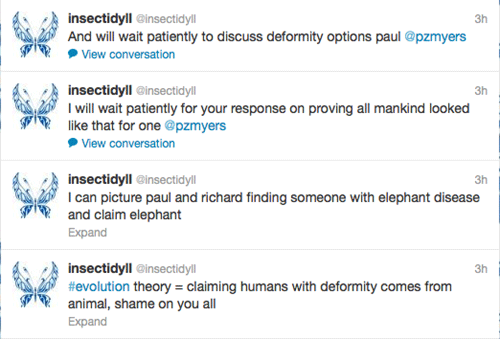
A creationist on twitter is pestering me to ‘debate’ her. Here’s a sampling of her arguments and style.

No way can we have a conversation about that in a 140 character limit. So I’m telling her to come here and expand on her ideas, if she can.

But first, I’d like her to answer a little quiz to see if she’s worth wasting time on.

  1. What is a typical mutation rate? (be specific about the units!)

  2. Are most mutations deleterious, neutral, or beneficial?

  3. What is the difference between phenotype and genotype?

  4. What is the difference between mutation and “deformity”?

  5. What is “elephant disease”?

That’s a start. I’m going to tell her on Twitter to come here and address these very simple questions. Anyone want to take bets on whether she bothers?

Happy Blasphemy Day!

I hope you’ve been spending your Blasphemy Day thinking irreverent thoughts and committing sacrilegious acts. I’ve been at a humanist conference where we damned religion to heck, and I’m about to board an airplane where I will spend the flight putting finishing touches on a profane pro-science and anti-religion (anti-moderate religion, even) column for Free Inquiry, and I’ll try to find a few minutes to cuss out the non-existent angels who are not holding my airplane up in the sky.

But also, this is serious business. Consider the young Greek man who has been arrested for mocking a cleric; Alexander Aan, arrested in Indonesia for denying the existence of god; Alber Saber, arrested in Egypt for linking to a stupid movie that mocked Mohammed; Rimsah Masih, accused of desecrating the Quran and facing hateful death threats; Asia Bibi, sentenced to death for blasphemy in Pakistan; and too many others to list. Consider that the European Union has just called for “full respect of religion” and “the importance of respecting all prophets” — blasphemy laws are spreading.

So blaspheme today! Assert your right to deny bullshit loudly and honestly!

I guess the Secular Coalition for America will let just anyone volunteer

Come on, SCA. Exercise some care and vet your volunteers better. After Edwina Rogers, we need some confidence-builders in the organization, and learning that they’ve made this awfully stupid appointment does NOT fill me with confidence. Why would you want a guy who posted an op-ed on AVoiceForMen, a hate site, and who posts the home addresses of a woman he dislikes on another hate site, as a candidate to represent a state organization?

Of course, it could just be that the organization is so desperate for volunteer help that they’ll take the dregs. That’s not a confidence builder, either.

There’s a petition. Unfortunately, it’s already full of trolls using fake names — change.org really needs to tighten up their procedures. These petitions already reek of uselessness, and the fact that they’re so easily gamed makes them totally pointless.

Why I am an atheist – MD

I had been an atheist for over a decade but hadn’t realized it. It took a child to make me see that. My own child. He asked me one day why I didn’t go to church like others in our family. All these reasons flew through my head in a matter of seconds, but they all boiled down to one. “Because I don’t believe in it,” I answered him. “Me neither,” he said.

[Read more…]

Jonathan Wells talks about history

Oh, boy. Jonathan Wells explains why some of us reject the outrageous interpretations made from the ENCODE work claiming 80%+ functionality of the genome. It was really an effort to get past this sentence.

Some historical context might help.

Bwahahahahaha! First sentence, he makes a joke. Wells is a creationist clown notorious for his tortured abuse of the history of science. He doesn’t have a merely whiggish view of history — it’s more of a Burke&Hareish perspective, where if History isn’t conveniently dead to permit him to commit ghoulish atrocities on it, he’s willing to take a cosh to it’s skull and batter it into extinction. When Wells announces that he’s going to provide “historical context”, brace yourself for a graceless exercise in ugly alternative histories.

After James Watson and Francis Crick discovered the molecular structure of DNA in 1953, Crick announced that they had found "the secret of life," a popular formulation of which became "DNA makes RNA makes protein makes us."

What? I don’t even…OK, second sentence is wrong. That looks like a mangled version of the Central Dogma of molecular biology, with a weird appendage tacked on to claim that it “makes us”. Crick did not discover the secret of life. What the Central Dogma is about is the irreversibility of information flow: nucleotide sequence specifies the order of amino acids in a protein, but there is no mechanism to translate a sequence of amino acids back into a sequence of nucleotides in RNA/DNA. It’s an important concept, but not the secret of life.

But biologists discovered that about 98% of our DNA does not code for protein, and in 1972 Susumu Ohno and David Comings independently used the term "junk" to refer to non-protein-coding DNA (though neither man excluded the possibility that some of it might turn out to be functional).

More garbage. NO. No one equated non-protein-coding DNA with junk. Unless it was a creationist. In 1972, we knew about lots of non-coding DNA that wasn’t just functional, it was essential — genes for tRNAs and regulatory sequences, for instance. The term “Junk DNA” was initally coined to describe pseudogenes — gene duplicates that had been rendered nonfunctional by mutation. We knew that gene duplication was common, but that successful gene duplications, that is events that resulted in a copy with novel functions that would be maintained by natural selection, were going to be rare. So Ohno expected large quantities of such relics to be found in the genome.

Why didn’t biologists simply call non-protein-coding sequences "DNA of unknown function" rather than "junk DNA?" For some, it was because "junk DNA" seemed more suited to the defense of Darwinism and survival of the fittest.

No, because the term was initially applied to a specific class of sequences that were recognized as failed duplications. They weren’t of unknown function…they were the debris left over from unsuccessful natural experiments.

Now we know of other mechanisms that produce repetitive, non-functional sequences. There are transposable elements that have no purpose but to replicate themselves over and over in the genome, there are viral insertions, for instance. We know how they get there, and it’s not because their existence confers greater fitness on the bearer, or because they make active contributions to the phenotype. They’re just splatters of DNA.

The term “Junk DNA” is perfectly reasonable to apply to such mostly-useless sequences. I think the only legitimate argument against the term is that we have so many different classes of the material that more specific labels would be more useful…but the argument that these sequences are functional is a nonstarter.

In 1976, Richard Dawkins wrote in The Selfish Gene that "the true ‘purpose’ of DNA is to survive, no more and no less. The simplest way to explain the surplus [i.e., non-protein-coding] DNA is to suppose that it is a parasite, or at best a harmless but useless passenger, hitching a ride in the survival machines created by the other DNA."

Hey, Wells gets something mostly right! Yes, that’s correct, and it’s the explanation born out by observations of things such as LINEs and SINEs, which code for enzymes (or sequences recognized by such enzymes) that insert copies of themselves back into the genome. This isn’t just a supposition, we know how this works.

He gets the motivation behind the dispute completely wrong, however. We aren’t calling some sequences “junk” because we don’t know what they do: to the contrary, it’s because we know where those sequences come from and what they do. It’s also not because, somehow, it is a Darwinian prerequisite that “junk” exist in the genome. Again, to the contrary, there was initially resistance to the idea of junk because of a Darwinian bias towards seeing adaptedness in everything. The idea of non-functional DNA sequences that don’t contribute significantly to the phenotype emerged from observations of what we actually found when we started taking apart the components of the genome.

That’s why a lot of us are irritated with the ENCODE interpretation that the whole genome is ‘functional’. It’s not because of a philosophical predisposition, or because we apply the label by default to sequences we don’t understand, but because that conclusion rides roughshod over a lot of well-established evidence.

Oh. Right. In addition to history, evidence is another of those esoteric concepts that Jonathan Wells can’t comprehend.