
I have a lot of different genetics texts, and I sometimes browse through them to get different perspectives, or in this case to get ideas for exam questions. I was skimming through Cummings’ Human Heredity: Principles and Issues when I ran into this surprising text box.
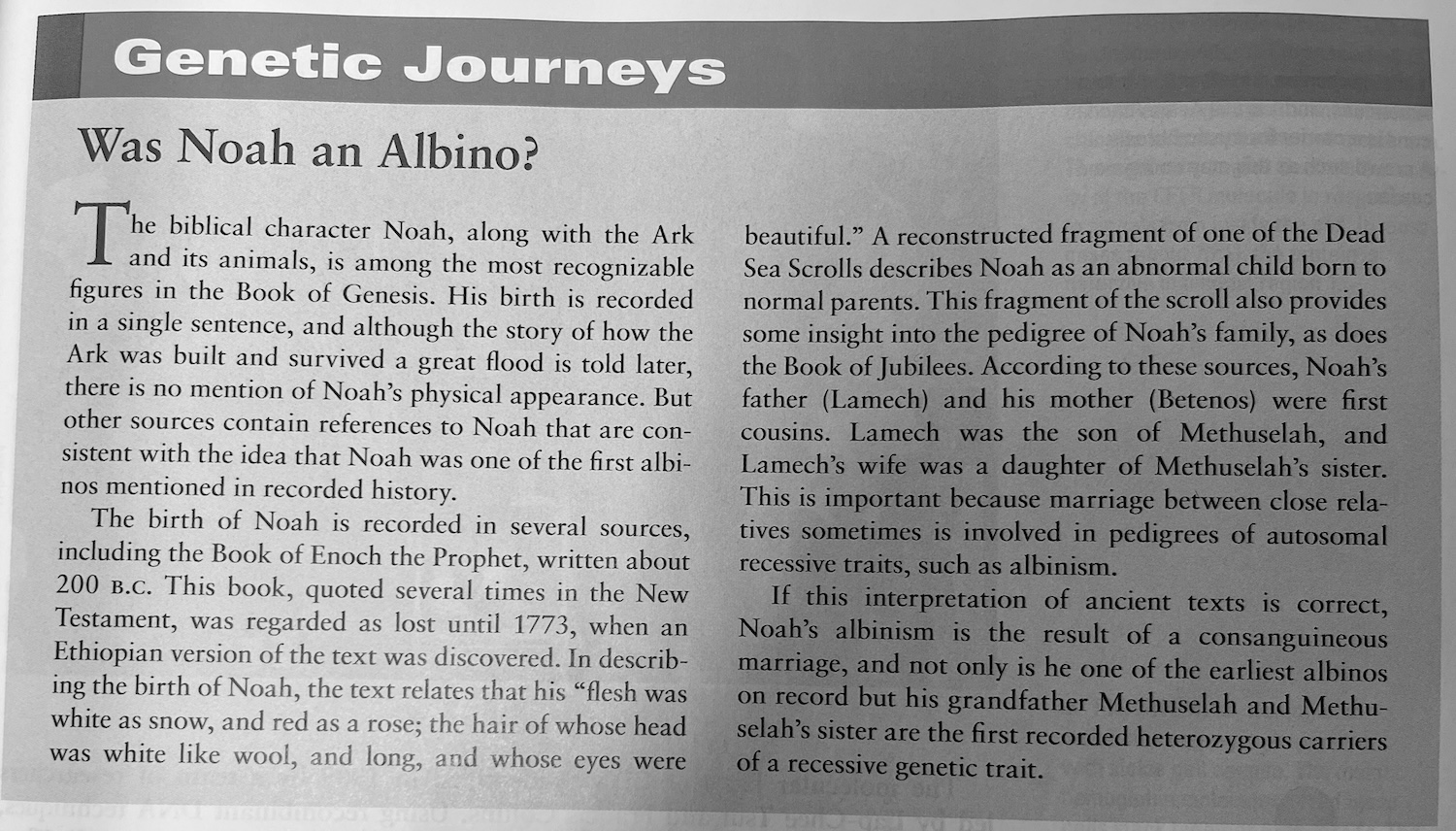
The biblical character Noah, along with the Ark and its animals, is among the most recognizable figures in the Book of Genesis. His birth is recorded in a single sentence, and although the story of how the Ark was built and survived a great flood is told later, there is no mention of Noah’s physical appearance. But other sources contain references to Noah that are consistent with the idea that Noah was one of the first albinos mentioned in recorded history.
The birth of Noah is recorded in several sources, including the Book of Enoch the Prophet, written about 200 B.c. This book, quoted several times in the New Testament, was regarded as lost until 1773, when an Ethiopian version of the text was discovered. In describing the birth of Noah, the text relates that his “flesh was white as snow, and red as a rose; the hair of whose head was white like wool, and long, and whose eyes were beautiful.” A reconstructed fragment of one of the Dead Sea Scrolls describes Noah as an abnormal child born to normal parents. This fragment of the scroll also provides some insight into the pedigree of Noah’s family, as does the Book of Jubilees. According to these sources, Noah’s father (Lamech) and his mother (Betenos) were first cousins. Lamech was the son of Methuselah, and Lamech’s wife was a daughter of Methuselah’s sister. This is important because marriage between close relatives sometimes is involved in pedigrees of autosomal recessive traits, such as albinism.
If this interpretation of ancient texts is correct, Noah’s albinism is the result of a consanguineous marriage, and not only is he one of the earliest albinos on record but his grandfather Methuselah and Methuselah’s sister are the first recorded heterozygous carriers of a recessive genetic trait.
I fail to see what this would add to a student’s understanding of genetics: OK, lot of inbreeding among the Biblical patriarchs, I was entertained by the description of Noah that sounds more like Snow White, I guess Michael Cummings is revealed to have an interest in obscure Biblical text reconstruction, and it might appeal to theologically inclined students, but yeesh, I expect my students to have a better appreciation of the quality of the data.
I don’t think you can claim that Noah was an inbred albino on the basis of such slim evidence. This is a figure who is pretty well swaddled up in myth and legend, who is claimed to have lived through a global flood that didn’t happen, who lived, supposedly, to the age of 950, and who is claimed to have lived around 3000BCE, when your evidence is based on a text fragment from 200BCE. And now we’re going to deduce a detail of his genetics? No, thank you.

No, this will not end up as an exam question.
I suppose it’s possible that whoever invented the Noah character, or decided to make up a description of him later, was inspired by a real person he knew, or knew of. That’s the only sense in which this could be kinda true, it seems to me. But it’s hardly a revelation that albinos existed in 200 BC.
I recommend “The Ark Before Noah” by Irving Finkel.
Much of this rubbish was stolen from the Babylonian ark myth (remember, prominent Jews were working in the Babylonian palace during the Babylonian captivity and they grew so integrated in the culture that when they returned, the name for one of the months was replaced by its Babylonian name).
The absurdly long life spans of some biblical characters can be explained by a glitch when transcribing cuneiform from the Mesopotamian templates of the myths.
A fascinating book with much information about cuneiform. It deserves a place in every well-stocked library, which is why I donated my copy.