
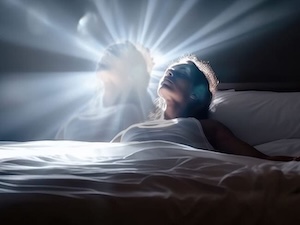
The Washington Post ran an article with the provocative title, “These Patients Saw What Comes After Death. Should We Believe Them? Researchers have developed a model to explain the science of near-death experiences. Others have challenged it.” It’s obviously empty fluff, garbage of the kind that gets pumped out all the time to appeal to the gullible yokels in their readership. I’m not one of them. I also refuse to read the WaPo anymore (rot in hell, Jeff Bezos), but then, fortunately or unfortunately, the same article has appeared on Beliefnet, sans paywall. Now everyone can see how insipid the ‘evidence’ for life after death is. This article should present some evidence. It doesn’t. It’s the usual anecdotal silliness.
Here’s their big example.
After she dropped to her knees outside her home in Midlothian, Virginia, suffocating, after she was lifted into the ambulance and told herself, “I can’t die this way,” and after emergency workers at the hospital cut the clothes off her to assess her breathing, Miasha Gilliam-El, a 37-year-old nurse and mother of six, blacked out.
What happened next has happened to thousands who’ve returned from the precipice of death with stories of strange visions and journeys that challenge what we know of science. Last year, a team of researchers from Belgium, the United States and Denmark launched an ambitious effort to explain these experiences on a neurobiological level — work that is now being contested by a pair of researchers in Virginia.
At stake are questions almost as old as humanity, concerning the possibility of an afterlife and the nature of scientific evidence — questions likely to take center stage at a conference of brain experts in Porto, Portugal, in April.
“The next thing I knew, I was out of my body, above myself, looking at them work on me, doing chest compressions,” Gilliam-El said, recalling Feb. 27, 2012, the day she suffered a rare condition called peripartum cardiomyopathy. For reasons that aren’t fully understood, between the last month of pregnancy and five months after childbirth, a woman’s cardiac muscle weakens and enlarges, creating a risk of heart failure.
Gilliam-El, who had given birth just three days earlier, recalled watching a doctor try to snake a tube down her throat to open an airway. She remembered staring at the machine showing the electrical activity in her heart and seeing herself flatline. Her breathing stopped.
“And then it was kind of like I was transitioned to another place. I was kind of sucked back into a tunnel,” she said. “It is so peaceful in this tunnel. And I’m just walking and I’m holding someone’s hand. And all I’m hearing is the scripture, ‘Yea, though I walk through the valley of the shadow of death …’”
Please, please learn about the concept of confabulation. If you black out, when you resume consciousness, your brain quickly invents stories to fill the gap. They aren’t necessarily accurate. A trained nurse is going to be familiar with happens to patients who lose consciousness, and could overlay that on the period when she was actually non-functional. She’s also pre-loaded with religious mythology, and that gets stuffed into the constructed memory. It’s not evidence of anything.
I have a recent personal experience that applies. I too blacked out after a fall; I remember the pain of bouncing my skull off the sidewalk, and then the next thing was becoming aware that I was sitting in my office at work. I remember nothing of what happened between those moments.
But I quickly made assumptions. I must have (scenario A) got up, dusted myself off, and walked to work by force of habit. Or (scenario B) a pedestrian must have helped me up and sent me on my way, or (scenario C) a passing motorist pulled over and gave me a lift to the building, or (scenario D) an angel swooped down, clutched me to her soft downy bosom, and transported me to my office chair before giving me a revitalizing swig from the cask of whisky she carried in a cask on her collar. Do I have any evidence for A) my indomitable will, B) a pedestrian, C) a motorist, or D) an angel? No I do not. Some might be more likely than others, but I can’t claim I have any verifiable evidence for any of them.
Likewise, Gilliam-El knows she passed out in an ambulance — and we can find evidence for that — and that she regained consciousness in a hospital some time later — also based on evidence. But all the stuff about entering a tunnel and holding hands and hearing scripture, is an unverifiable invention of her brain.
That’s all these articles ever provide, a collection of stories people provide after periods of unconsciousness to rationalize their experience, and then calling them “evidence for life after death”. They’re not.
It’s always annoying that these ideas get “experts” who are unable to distinguish fantasy from evidence to support a popular myth.

E) Time traveler.