The more things change the more they stay the same
We’ve always had cat ladies.
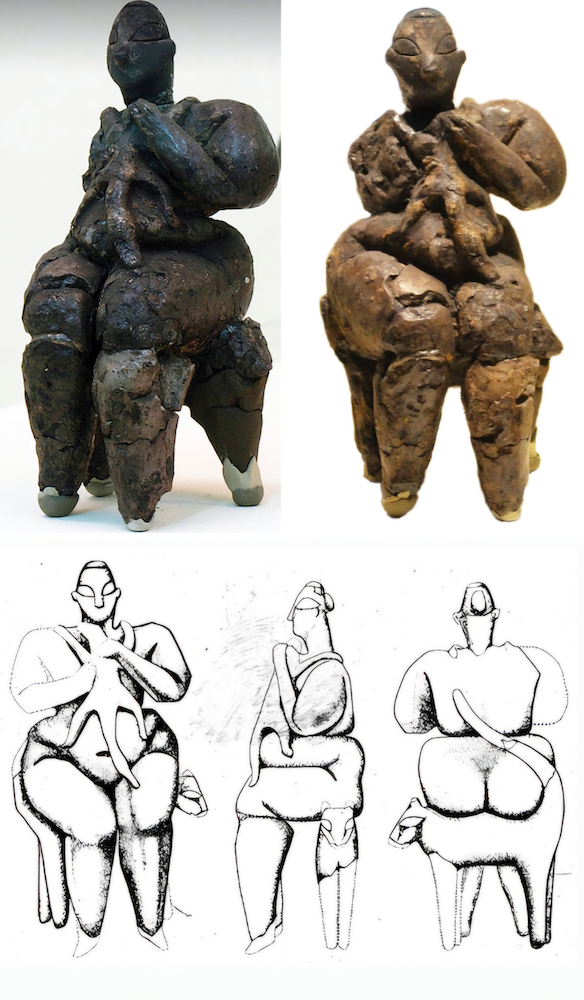
A neolithic figurine depicting a goddess seated on a leopard, and holding a small leopard on her chest. Discovered in a house in Hacılar in Turkey, 5600 BCE, now housed at the Museum of Anatolian Civilizations in Ankara
Don’t show that to the UFO crowd. Since it isn’t a photographically accurate depiction of a human it must be an alien being in a spacesuit doing something or other with Earth cats. For that matter the cat she’s sitting on can’t actually be a cat, because, again, it doesn’t look exactly like a photo from National Geographic of a leopard or other large cat.
Thinking about it it’s surprising at least some of them haven’t decided that Picasso’s abstract paintings of women are actually proof he encountered aliens. Because apparently no one had any sort of imagination before the mid 20th Century.
I wonder if legitimate researchers have clues the person is supposed to be a goddess, and not just a woman the artist knew who liked cats.
StevoRsays
What? That isn’t a photo!?!
Really? Coulda fooled me..
StevoRsays
Oh & if that is a leopard specifically where are its spots?
I can’t spot them..
Doc Billsays
I recognize that style of clay art from the Fourth Grade. It’s an ashtray!
Larrysays
Back in the day, women were really women! None of this kitty, kitty, house cat nonsense. No! Friggin’ leopards, thank you very much.
robrosays
I was wondering why they identified the cats as leopards, too. Naturally some folks seem to think of this as a “mother goddess”, of course.
Doc Bill @ #4 — nuh huh…it’s a flower vase.
Tethyssays
They are leopards because this is not the only piece of ancient Anatolian art that has been excavated from this settlement. The leopards are a common motif, along with bull horns or heads. A woman seated on a leopard and holding a baby leopard does probably depict a Goddess or revered Mother figure.
CompulsoryAccount7746, Sky Captainsays
Hacilar and Çatalhöyük were contemporaneous neighbors, judging from the dates and maps on wikipedia.
Archaeological theories are often the products of their time. It is therefore important when forming our interpretations that we act with caution and always search for the latest research and evidence available. A prime example of such archaeological reinterpretation is shown at Ҫatalhöyük, wherein the popular conception of the ‘mother goddess’ figurines has been challenged.
[…]
James Mellaart, who was the first to lead excavations at the site, interpreted the discovery of female figurines as representing the belief in a female goddess. Some experts on prehistoric art warn that we shouldn’t read too much into these figurines and suggest that they may simply have been creating “art for art’s sake.”
[…]
A lead figure that has influenced the perceptions which many have come to hold about such female figurines is Marija Gimbutas. She advocated the notion of an omnipotent Mother Goddess, who was worshipped with cultural continuity from the Palaeolithic era to modern times. When James Mellaart discovered these voluptuous figurines at Hacilar in the 60s, and later at Çatalhöyük, they sparked a media sensation.
[…]
It wasn’t until Ian Hodder’s longer period of excavation at the site that the numerous figurines in animal and masculine form were discovered, excavated from new areas of the site and otherwise discarded in Mellaart’s spoil heap. In his selective study of just the female figurines, Mellaart potentially altered the picture significantly, and these more recent discoveries have consequently led to a reassessment of the ‘mother goddess’ theory.
Lynn Meskell and Carolyn Nakamura in particular have published[*] a comprehensive and representative range of figurines from the site which balance out the female figurine finds.
Between 1961 and 1965 James Mellaart led a series of excavations at Çatalhöyük […] statues found here, which Mellaart suggested represented a Great goddess, who headed the pantheon of an essentially matriarchal culture.
[…]
Since 1993, excavations were resumed, now headed by Ian Hodder with Lynn Meskell as head of the Stanford Figurines Project that examined the figurines of Çatalhöyük. This team came to different conclusions than Gimbutas and Mellaart. Only a few of the figurines were identified as female and these figurines were found not so much in sacred spaces, but seemed to have been discarded randomly, sometimes in garbage heaps. This rendered a cult of the mother goddess in this location as unlikely.
magistramarlasays
Yup! Before reading anything, my thought was: “Mother Earth has always been a cat lady”.
She looks like Gaia, and so many other mother goddesses that I’ve seen when studying ancient cultures.
(Typed on my laptop while my cat purrs next to me).
fishysays
To my knowledge, I think these things were, given the limited resources of the times, seen to be god-like currency, perhaps more valued then, than they are now.
…or maybe I’m just full of shit.
Don’t show that to the UFO crowd. Since it isn’t a photographically accurate depiction of a human it must be an alien being in a spacesuit doing something or other with Earth cats. For that matter the cat she’s sitting on can’t actually be a cat, because, again, it doesn’t look exactly like a photo from National Geographic of a leopard or other large cat.
Thinking about it it’s surprising at least some of them haven’t decided that Picasso’s abstract paintings of women are actually proof he encountered aliens. Because apparently no one had any sort of imagination before the mid 20th Century.
I wonder if legitimate researchers have clues the person is supposed to be a goddess, and not just a woman the artist knew who liked cats.
What? That isn’t a photo!?!
Really? Coulda fooled me..
Oh & if that is a leopard specifically where are its spots?
I can’t spot them..
I recognize that style of clay art from the Fourth Grade. It’s an ashtray!
Back in the day, women were really women! None of this kitty, kitty, house cat nonsense. No! Friggin’ leopards, thank you very much.
I was wondering why they identified the cats as leopards, too. Naturally some folks seem to think of this as a “mother goddess”, of course.
Doc Bill @ #4 — nuh huh…it’s a flower vase.
They are leopards because this is not the only piece of ancient Anatolian art that has been excavated from this settlement. The leopards are a common motif, along with bull horns or heads. A woman seated on a leopard and holding a baby leopard does probably depict a Goddess or revered Mother figure.
Hacilar and Çatalhöyük were contemporaneous neighbors, judging from the dates and maps on wikipedia.
Çatalhöyük Research Project – Was there a belief in the Mother Goddess at Çatalhöyük? (2017)
*
https://www.catalhoyuk.com/archive_reports/2005/ar05_29.htmlWikipedia – Mother goddess, Excavations at Çatalhöyük
Yup! Before reading anything, my thought was: “Mother Earth has always been a cat lady”.
She looks like Gaia, and so many other mother goddesses that I’ve seen when studying ancient cultures.
(Typed on my laptop while my cat purrs next to me).
To my knowledge, I think these things were, given the limited resources of the times, seen to be god-like currency, perhaps more valued then, than they are now.
…or maybe I’m just full of shit.
She’s literally holding a leopard to her face.
(Surely that will end well)