
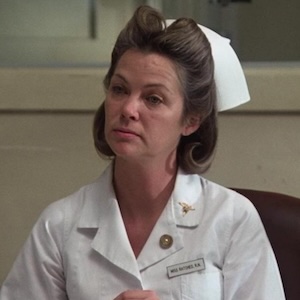
We have preprofessional programs here at UMM, which, if we gave a good goddamn about the opinions ot the Trump administration, we’d have to revise, because they’ve deleted one of our popular majors from the category.
Nursing has been excluded as a “professional degree” by the Trump administration as the Department of Education prepares to make massive cuts to providing student loans.
That’s a surprising absence. If you go to the doctor, you’re most likely first going to encounter a nurse. Nurses get all the grunt work in health care, and are an indispensable part of the medical system, yet somehow the Trump Department of Education (I thought he was going to get rid of that?) has decided it’s less worthy, and is reducing nursing students’ eligibility for loans. Maybe this is a first step in making nursing training free? Somehow I doubt that.
Even worse, they have designated certain other fields of study as “professional” and worthy of encouragement. Notice anything peculiar in this list?
- Medicine
- Pharmacy
- Dentistry
- Optometry
- Law
- Veterinary medicine
- Osteopathic medicine
- Podiatry
- Chiropractic
- Theology
- Clinical psychology
I will admit that after the destruction wrought by RFK’s Health and Human Services, many people might feel a need to call on a priest.

Nurses are key to good healthcare. But the administration has already shown they don’t give a damn about that.
I saw that Audiology was off the list. What a bunch of morons. (The administration, not audiologists!)
My audiologist has a PhD in audiology, a 4-year post-graduate program of study. She has a special interest in the neurological effects of hearing loss. It’s ridiculous to diminish her professional accomplishments on a whim.
Of course, if I were King of the Forest, I’d classify organic chemistry as witchcraft.
Did you know that RFK is a total sicko? Excerpt here.
URL: https://nypost.com/2025/11/22/us-news/what-is-felching-the-raunchy-sex-act-rfk-jr-texted-about-with-olivia-nuzzi-according-to-ryan-lizza/
It would be nice if these articles cited the specific bit of the big ugly bill that did this. (Newsweek gets closer.) Then I could compare it to the current bit in the Code of Federal Regulations: https://www.ecfr.gov/current/title-34/subtitle-B/chapter-VI/part-668/subpart-A/section-668.2
In any case, the GOP hasn’t repealed the Administrative Procedures Act so they still have to go through at least the motions of notice and comment to change the CFR.
ironically, there are a lot of conservative nurses. add to leopard-eaten face file.
re: rfckjr, interesting to see a little woo on that list. et tu, home boy?
ah, reading comprehension… that was the kosher list, not the get fuct list.
@3: I think I’ll choose to remain in blissful ignorance of what felching is, if RFK Jr. is into it.
If you go to the doctor, you are often going to go see the nurse practitioner or physician assistant.
They’ve become more and more common for primary health care.
There is a nursing shortage in the USA and it is projected to get worse in the near future. This is going to stress our falling apart health system even more.
Why nursing?
Many people have pointed out that at 86%, nursing is still largely a female profession. Since the GOP and the Trump regime are deeply misogynistic, this is a way to target women.
It will also hurt the health care system.
It looks like the GOP just wants the US population to suffer even more.
We need to normalize male nurses. But then, MAGA will complain that medicine is getting woker and feminizing men for helping people live.
Reno’s Gay Rodeo is back
Re Doc Bill comment: I also noticed the absence of Audiology. My daughter is an audiologist; she works for the VA. Service-related hearing loss is common for veterans. It irritates me when I hear the no-tax crowd salute the flag and mindlessly say thank you for your service, when they won’t provide health care and other services to those same people. A list that includes Osteopathic medicine, Chiropractic and Theology as professions but leaves off Audiology and Nursing is a joke.
From the original document regarding qualifications for a professional degree:
“A degree that signifies both completion of the academic requirements for beginning practice in a given profession and a level of professional skill beyond that normally required for a bachelor’s degree.”
Call me crazy but I think that the “level of professional skill” required of most bachelor’s programs is “beyond that” for a graduate degree in theology. Ultimately, a doctor of divinity may be just an advanced degree in making up stuff.
Does an engineer with a BS and a PE license not count as a “professional”?
And here I expected to find dowsing and phrenology on the list of professional occupations. Oh well, maybe next year.
When I go to “the doctor” O only ever see a nurse; my last two primary care practioners have been Nurse Practitioners; and frankly, far better than the MD’s I was seeing.
When it comes right down to it, isn’t making stuff up really what engineers do?
Engineers frequently make stuff that demonstrably exists, not just designs in their heads.
@Doc Bill, #2 (et al.): Agree, audiology ought to be on the list.
@Raven, #8: I’m a PA (retired from mostly ER, but did family practice for 7 years after graduation in 1994). You’re right, a lot of medical care is first handled by a PA or NP. Some people are concerned that this is somehow “lesser” than when a physician does it, but they can take a breath and relax. There is always a physician backing them up, and a big part of our training is to know when to call the physician in. Most medical groups and insurance companies require patients to see the physician periodically, anyway. (1 visit in 3, or quarterly/annually, or some such.) And, multiple studies have shown there is no drop-off in the quality of care when a PA or NP is added to a practice, as long as there is proper physician supervision.
If people are still worried about it they should bring their concerns up the next time they see their PA or NP. We can show you how often the physician is reviewing what the PA/NP has done, made suggestions, and followed-up. We can also talk about our mandatory-consultation rules, and if you’re still worried make sure your next appointment is with the physician. If you’re STILL anxious, ask to see the physician right then. It’s part of the job, and we won’t be offended. Well, we SHOULDN’T be offended, anyway. And instead of seeing the physician, you may get handed a telephone. Remote supervision is perfectly cromulent.
The other thing to note is that at nearly all clinic visits you’re not being checked in by a RN, anyway. An MA, or “Medical Assistant” has graduated from a training program that ranges from one semester to one year long. They take vital signs and do nearly all in-office care, including injections but not IV’s. There may be one RN to supervise all the MA’s in an office, but often not.
RN’s are primarily female, true, but to get a clearer picture of the misogyny in medicine you have to look at specialties. For example, RN’s on “the floor” or in nursing homes are virtually 100% female, but in the ER the proportion of males is much higher. I think the distinction is made by how prestigious a specialty is perceived to be. And unfortunately, females are still getting the short end of the stick.
A similar dynamic is happening in medicine. Females have become the majority of entering medical students, but they tend to concentrate in the primary-care specialties: family medicine, pediatrics, OB-GYN, and geriatrics. As a result, I’ve seen those specialties become less valued and less well compensated. But the “high-powered” specialties are still prestigious and well-paid. There are plenty of exceptions that anyone can point to in those specialties but generally, females are still subjected to “step aside, little lady” syndrome. And that’s a shame.
@gleigh, #11: And a final thought, or two. It’s okay for Osteopaths to be on that list. Yes, they are trained in spinal manipulations like a chiropractor, but they also get all the training that an MD does. Everywhere I’ve worked, there is no distinction made between MD’s and DO’s. (Nor between PA’s and NP’s for that matter.)
And, I’m presuming that those PA’s and NP’s are included under the category of “medicine.” If not, they should have their own line-item. Like other professions, they set their own standards of training and ethics, and are self-regulating (within the limits of the laws and regulations under which they practice—just like the rest of the professionals on the list). But, IMO, it’s okay to just include us with the doctors. When someone is unfamiliar with PA’s and NP’s and I sense they only want the one-sentence explanation I say, “just think of me as a junior doctor.” So, it works for me.
Sorry for the long post. I hope it was worthwhile.
And the fake medical practices of Osteopathy and Chiropractic. Don’t get sick PZ.
nomdeplume, way to ignore vinnievidivici.
I checked and the claim about DO training matches: e.g. https://www.aacom.org/become-a-doctor
Apparently in the USA, osteopaths are basically real doctors, but that’s not true in other countries, where they are basically chiropractors but their pseudoscience focuses on muscles instead of the spine.
But including those chiropractic quacks as professionals and not nurses is the most BS infuriating things possible.
Well, come the off year elections next year, the GOP has all but lost the collective nurse’s votes. Oh yes, and cut SS, Medicare, Medicaid, ACA etc.
I try to dig into the background on the stuff I see on the internet. In this case, the Newsweek story referenced led me to an American act that defines this. The page supposedly permits viewing the document as it exists over time back to 2017. The definition therein doesn’t seem to have changed in the past 8 (9-ish) years. (I can’t tell if what I am seeing is correctly generated by the website.)
I’m not sure how the list was generated, but the caveat that the program of studies must be beyond a bachelor’s degree could explain why nursing is not explicitly included. (Depending on the program, most of the degrees listed are not direct entry from secondary schooling. From what PZ is saying, nursing may require extra training before entry in the program.)
I wonder if one issue with nursing is that the rather ambiguous title or label covers a wide range of people from Practical Nurses, who don’t need a college degree, Registered Nurses, who usually do, and Nurse Practitioners, Clinical Nurse Specialists, etc, who often have doctorates. I note that the list also does not include social workers, who have a minimum of an MSW degree, librarians, who have both MLS and doctoral degrees, and others. I suppose librarian educational programs are considered “graduate” rather than “professional,” but the distinction is ridiculous when it comes to setting limits on how much a student can borrow.
Sorry, but seeing that pic of Space Karen AKA Kai Winn is too much for me. IYKYK.
Yeah, Trump is working on abolishing the Education Dept from what I gather. Googled and saw :
Source : https://apnews.com/article/trump-education-department-dismantle-close-b0ae8b677a63273a9b06c2b4005dee4d
Plus :
Source : https://www.politico.com/news/2025/11/18/trump-administration-sets-out-massive-education-department-restructuring-plan-00656464
In addition to :
Source : https://www.cnbc.com/2025/11/18/trump-dismantle-education-department.html
Note the date of that last one is the 18th of November 2025 so recent and I’ve seen and herad nothing to indicate any change in this plan. Which for the record is appalling as is typical of the Trump regime.
chrissevern @20
Yeah, I’ve a Canadian friend who sees an osteopath and he’s pretty much just a good physical therapist–probably due more to his decades of practical experience than to the osteopathic training itself. She says he’s great for her lower back and hips, but she won’t let him work on her above the shoulders, because (as most everyone here knows) craniosacral “therapy” is crazy dangerous. My ex-wife cared for an ICU patient who had locked-in syndrome thanks to a chiropractor screwing around with his neck.
I had a DO in California as a primary care physician, and she was indeed equivalent to an MD. She didn’t really try to do anything osteopath-ish to me.
Autobot Silverwynde @24
Who?
That’s a picture of The Big Nurse.
In most of the world a law degree most emphatically does not display “a level of professional skill beyond that normally required for a bachelor’s degree,” because outside the US and Canada a “law degree” is a bachelor’s degree. And given that there is literally no required course that must be taken prior to law school in the US or Canada, “beyond that normally required for a bachelor’s degree” can be a bit of a stretch.
In the US a Doctor of Osteopathy is licensed in a process very similar to that of a Doctor of Medicine (or a Doctor of Medical Dentistry, or a Doctor of Dental Surgery). That’s far beyond chiropractors… or “osteopaths” in most of the world, very few of whom have doctoral degrees/equivalents. And DOs can’t specialize in the same way as MDs — not even the equivalent of “family medicine” or “internal medicine.” One other distinction is that the osteopathy programs in the US engaged with “diversity” a couple decades before the medical programs did, so the demographics are different.
Re #27
“違う” means Nurse Ratched but his entire shtick is Orientalism so he thinks being “inscrutable” is super cool.
*vomit*
df@29
Provide links to every time I claimed to be Japanese.
Provide links to every time I claimed to be male.
PUT UP OR SHUT UP
you stinking pile of vomit
Apparently, persistent willful misgendering is OK around here.
@28 Jaws — it might also be noted that in much of the former British empire, including the UK itself, the basic medical degree is also an undergraduate degree — MBBS, and variations on that: the Bachelor of Medicine, Bachelor of Surgery.
As for Osteopathic Medicine, I was hired in the late 1970s to write a little book — The Education of Osteopathic Physicians — for AACOM, and in doing so learned a lot about the field, and visited every DO school at the time to interview people from students to presidents. At that time, the primary difference between MD education and DO education was that the DO students took an additional course, sometimes called OPP (Osteopathic Principles and Practice), which, ironically, suggested that osteopathic physicians learned more than their MD colleagues….. I was especially struck by Michigan State University, which had two medical schools: a College of Osteopathic Medicine; and a College of Human Medicine (the MD school) — All students in both schools took the same courses, except for the additional OPP for the DO students. Back then most, perhaps all states allowed for there to be two post-graduate training tracks: MD hospitals and DO hospitals, but that distinction has brokren down, and basically all teaching hospitals now have a combination of MD and DO student, interns, and residents.
I’ll spare you another lecture on the reasons why the distinction still persists, but in practical terms, there’s fundamentally no difference.
Nursing generally isn’t a 4 year degree, to become a RN is an associate degree. There are bachelor degrees but it isn’t as common because of the expense, time and not much change in salary for the position. You wouldn’t need to up the loan amount for programs that don’t require it.
@33. You could not be more wrong. As of 2022, over 70% of working nurses have a bachelor’s degree, and over 20% have a Master’s degree or doctorate.
https://www.aacnnursing.org/news-data/fact-sheets/nursing-workforce-fact-sheet
The push in many states has been to require at least a BSN for nurses, and in many states enhanced nursing practice requires a Master’s degree.
@davetaylor #34, et al.:
Y’all are on the right track about the breadth of what it is to be “a nurse.” There are a thousand flavors. Based on my observations over a 45+-year career as a paramedic and PA:
The entry-level for an RN is, indeed, an Associate’s degree or equivalent certificate. That’s enough to let a person get a nursing license and work as a basic RN.
But, like medicine, there are a lot of ways an RN can specialize within their nursing practice. (Trauma, ICU, ER, oncology…the list goes on.) And most of those require a Batchelor’s degree, or BSN.
But then, many nurses plan for a second act in their career. Roles in administration, education (both of nurses and patients), and an assortment of others usually require a Master’s degree or higher.
And there are plenty of Doctorate programs available, to make a nurse more competitive in the market.
Note that I’m still talking about the US (I don’t have any experience outside it). And also I’m still talking about “nursing,” or the direct or indirect hands-on care of the sick or injured, with varying degrees of independence but usually at the direction of a prescriber.
That’s in contrast to all the different flavors of practitioner out there, sometimes called “prescribers.” The MD/DO, PA, NP, and Nurse Anesthetist (there are probably others) are focused on finding the right treatment or management of a disease, while the nurse focuses on properly treating or managing the patient.
(Disclaimer: the above is personal opinion based on a career of analysis. YMMV. And I’m aware that there is a whole lot of overlap to the two perspectives. Especially when it comes to patient safety; that RN is going to come back to me with questions, if they think an order is incorrect—and I always appreciated it when they did! They saved my butt many times, over the years. But in the end, somebody has to write the orders, and somebody has to carry them out. And both are essential to get a good outcome for the patient.)
During the height of my career, when I was the manager of an Urgent Care attached to an ER, I tried to instill this distinction in my new hires. Upon graduation, an NP is no longer a “nurse” in this sense. They’ve become a practitioner. It helped anchor them in their new role.
My management philosophy in that UC—functionally, the ER’s “Fast Track”—was, “equally screwed.” The PA’s and NP’s all competed for the same crappy job, at the same crappy pay, and worked the same crappy hours seeing the same crappy patients under the same crappy conditions. Including me. I worked a full load of clinical shifts, and did my manager stuff in addition. Helped my credibility a lot!
Don’t get me started on “degree inflation.” There are now mostly Doctorate programs to become an NP, and the PA’s have followed along in order to remain competitive. When I started, becoming a PA was a certificate (!) but I’ve had to follow along, earning a Master’s degree mid-career. I managed to resist the DPA until I could retire, but a lot of my friends didn’t. (I suppose it’s useful if one is going into administration or education, but it’s really not necessary for clinical practice.)
Uh. I guess I got started on degree inflation after all. Sorry.
Again, I hope a personal perspective across several decades is helpful.
@31. Rob Grigjanis : “Apparently, persistent willful misgendering is OK around here.”
Yeah. It really should NOT be the case and Silentbob #29 should be called out and stopped from doing so in future. That si NOT okay or acceptable in my view.
@.30. chigau (違う)
Seconded by me and observation made that Silentbob having been asked to back up that bullshit has proven unable or unwilling to do so. He’s had over a day and presumably seen and made no response as of yet.
@ Silentbob : Three questions / requests I expect you’ll keep ignoring but shouldn’t be allowed to just ignore here :
1) Will you stop your bullying against John Morales?
2) Will you stop misgendering and lying about chigau (違う) ?
3) Why do you keep defending the Trump Enabling Bad Faith Troll “beholder” here? What part of there was a binary choice last election between Kamala and Trump, respectively the non-Fascist party and the outright fascist party, do you fail to understand?