

The corpse flower unfurled its stately bloom at the UW Botany greenhouse tonight and was in full splendor by 10 p.m.
The stench was just starting to stoke up — the flower attracts pollinating insects by smelling like carrion — and had not yet reached its full power. Said to make the eyes water, it should reach full power in the middle of the night tonight. The greenhouse is open til 11 tonight, and reopens for visitors at 8 a.m. tomorrow, when the flower will still be stinky. The scent will fade, but the bloom still be well worth a visit all week.And is it ever. A line of admirers snaked out the door to see the flower, with people waiting half and hour and longer for their chance to come in the steamy greenhouse, and climb a step ladder to peer inside the depths of the flower’s giant bloom. It’s that big.
Its outlandish, Alice in Wonderland appearance is the draw, figures Doug Ewing, who with a team of greenhouse techs at the greenhouse coaxed the flower into bloom after two and a half years of dormancy.
It could be years before the flower blooms again, so see it now!
Boooooooo! I literally work right next to this greenhouse, but I’m out of town for a week! Curse my timing. And opportunity to be a geeky biologist, lost.
I’m alive!
Sorry for the lack of posts lately. Tuesday was my big end of the quarter research presentation, which means Tuesday night was my post-presentation celebration, and Wednesday was my recovery from my post-presentation celebration.
And right now I’m sitting in the Seattle airport, attempting to go back home to Indiana for a week. I say attempting because my flight is already delayed two hours thanks to thunderstorms in Chicago. Ahh, the midwest.
So…posts may be a little filler-y while I’m decompressing. My brain needs to be turned off for a bit before starting up summer research. Seriously, I know I’m stressed when I’m looking forward to going back to Indiana.
Consider this an open thread. What are you up to? What neat things have you read on the internet? Is there anything that could defeat a velociraptor with machine gun arms?
Conservapedia has solved the atheist gender gap
Answer: Ponies.
Gee, thanks, Conservapedia! Now that mystery is solved, my new investigation will be why any women would consider themselves conservative when they’re treated like brainless 5 year olds.
Brought to you by the same people who claimed all atheists were fat. I so wish this were a Poe.

Homeopathy for homosexuality
The Union of Catholic Physicians of Germany is offering a homeopathic therapy to “cure” homosexuality:
The religious association, which calls itself the “voice of the Catholic medical community,” writes on its website that while “homosexuality is not an illness,” a host of treatments are available to keep such “inclinations” at bay. Possibilities include “constitutional treatments with homeopathic tools … such as homeopathic dilutions like Platinum,” “psychotherapy,” and “religious counseling.” Among homeopathy’s controversial treatments are the prescription of “Globuli,” tiny pills that consisting mostly of sugar.
[…]As for the scientific basis of the treatments offered by the UCP, Winkelmann listed “medical-psychotherapeutic, philosophical and theological literature,” the “minority views of psychotherapists,” the “teachings of the Catholic church, the Holy Scripture,” and the “homeopathy of Samuel Hahnemann,” the German physician credited with creating the practice.
When your “scientific basis” includes “philosophical and theological literature”, “teachings of the Catholic church,” and “the Holy Scripture,” you know you’re dealing with top notch research.
This is patently ridiculous on a whole number of levels. One, homosexuality isn’t something that can be cured, nor is it something that should be cured. But even if you did want to cure it, pseudoscientific bunk like homeopathy is probably the least effective way to do so.
Homeopathic medicine is nothing but sugar and water. When they say it consists of dilutions of Platinum, they mean they’ve diluted it so many times that there probably isn’t even a single molecule of Platinum left in the pill.
Though I am curious as to why they used Platinum. Usually homeopathy goes by the notion of “like cures like” – that you put something that causes your problems into the solution and keep diluting it, and then the water will “remember” those bad molecules and flush them out of your system (Yes, it’s that nutty). But what does Platinum have to do with homosexuality? Maybe it was too hard to dissolve the soundtrack to Rent? Since obviously stuff like that is what makes people gay, not hard-wired biology.
Maybe I shouldn’t be complaining, though. I much rather have people receiving sugar pills as treatment than being forced to attend psychologically damaging gay reprogramming camps.
I’m such a meanie!
Apparently some Savage Love listeners are in a tizzy because I called religion “silly.”
Oh dear me! Pass the smelling salts! Silly? Silly? How utterly barbaric!
That religion/spirituality discussion got pretty damned dismissive. I do think it’s useful – probably necessary – to be skeptical about everything (even a person’s own skepticism), but I don’t think person shouldn’t be labeled ‘silly’ or ‘wrong’ or be dismissed outright just for being a part of a religion or for having spiritual interests or beliefs. They may very well be thinking critically about their beliefs (plenty of people do, and I certainly wish more religious people would), but STILL find those beliefs to be valid for them on a personal level and useful in their life (helping them to understand themselves, to figure out what their philosophy is about the world, to find a community of people to relate to and find support with, etc., etc.).
And
Dear Dan: Please don’t have an atheist on your show to explain why those silly religious people are so darn stupid. There are plenty of intelligent people out there who also have religious beliefs. This show was just plain insulting.
And
Dan,
Ugh, please don’t have that hypocritical twit back on the show. She was there to challenge you on some ignorant commentary on a previous podcast, but then calls a religion “silly”; a religion of which she is admittedly ignorant.Look, I get that as a culturally Catholic atheist, you have a narrow view of the variety of religious and spiritual experiences of the rest of the world. You said that you didn’t feel any pull to seek out another religion when you left Catholicism. Your guest so contemptuously surmised that only silly people with mortality anxiety could be drawn to religious practice. Some of us however, feel drawn to express the awe of the numinous, and communion with spirit/the divine/invisible friend(s).
I am really shocked that you chose to dismiss Wicca as something silly. Especially when Wicca is a sex positive, woman positive, queer positive spirituality. Wiccans aren’t out at the polls trying to take away your civil rights. Wiccans aren’t denying your rights to marry, adopt children. Wiccans aren’t beating the shit out of trans people in a McDonalds either.
So, way to go in perpetuating more misinformation about a minority religion. I guess I shouldn’t be surprised that you’d shit on people who are, on the whole, supportive of all the things you believe in.
I find this incredibly amusing, as I went out of my way to be nice and diplomatic knowing I was on a sex advice podcast and not an atheist one. Let’s hope they don’t actually click through to my blog, or their heads will surely explode from righteous indignation.
But in case they’re gluttons for punishment, here they go:
Religion – whether it’s something culturally acceptable for liberals to hate on like Christianity, or a minority religion like Islam or Wicca – are all wrong. They’re based on unsubstantiated claims that have no basis in reality. There is not a shred of evidence that any religions, past or present, are actually correct.
Regardless if your religion goes out of its way to oppress others, or just has private naked kissing rituals, I’m still going to point out how wrong it is. Why? Because the search for truth is important to me, and there are too many beautiful, wonderful real things in this world to be wasting our time on pointless rituals and optimistic daydreaming. It’s intellectually insulting to believe in something just for community, or wonderment, or tradition, or answers about the afterlife – when it’s a fucking fairy tale.
And I’m just as happy to point out when non-religious beliefs are wrong. Your bad ideas don’t get a free pass because you invoke an imaginary friend or magic.
Religious people aren’t necessarily stupid. Plenty of people have false beliefs – even us godless skeptics aren’t perfect. But I’m willing to listen when someone points out that those beliefs are fucking stupid.
And silly.
Alright, *now* I’m motivated to learn how to ride a bike
Thanks, kid.
A video of my bike riding attempt will come sometime after this quarter is over (June 7) and I actually find free time. And, well, someone with a bike.
Over $30,000 raised for Camp Quest!
Here are the final results from our month long fundraiser for Camp Quest:
Team Awesome: $13,550.06
Team PZ: $13,016.01Matched amounts:
Team Awesome: $1,868.73
Team PZ: $1,640.00
Total Match: $3,508.73Grand Total Raised: $30,074.80
You guys are amazing! Thanks so much to everyone who donated and spread the word. Because of you, tons of young freethinkers will have an awesome experience this summer.
Double your impact in helping freethinking kids!
There’s only a couple hours left in our Camp Quest fundraiser. Team Awesome is now ahead of Team PZ, mainly because PZ is a nefarious bastard and hoisted the white flag of defeat after Team Awesome had promised to embarrass themselves in a number of ways if they won.
But there’s exciting news! Todd Stiefel of the Stiefel Freethought Foundation has pledged to match all donations in the last two hours of the drives up to $5,000 per team! That means if you donate before the competition ends at 2pm EST (11 PST), your donation is effectively doubled! That’s everything above $11,681.33 for Beat PZ (aka Team Awesome) and $11,376.01 for Team PZ.
For those of you who have donated so far – thank you so much! It’s amazing that we’ve raised over $20,000. And if you haven’t donated yet, please consider donating now! All the money goes to Camp Quest, a summer camp for the children of non-religious parents that teaches critical thinking skills and science in addition to regular camp activities. And if you want a corny video where I awkwardly say what Camp Quest is about, watch this!
And honestly, I don’t care which team you donate to now, as it’ll be a hollow victory if we win now (goddamnit, PZ). If I were you, I’d aim for a perfect tie.
Though I kind of hate all of you who really, really, really want to see me make a fool out of myself learning how to ride a bike.

Welcome, Savage Lovecast listeners!
As a longtime fan of the Savage Lovecast, I had an absolute blast recording the podcast with Dan. If you found my blog through it, I assume you came here because you found me vaguely interesting.* I talk about a little bit of everything here – mostly atheism, feminism, science, and sex – but here are some posts you’ll probably enjoy:
- Genetics will not be used to abort straights OR gays
- On “fixing the gays” and science used for evil
- Natural sexuality
- Apparently even Humanists can be sex negative
- Anti-Porn event – emotional appeals and dangerous misinformation
- Your personal opinion does not trump scientific studies
- When religion protects sexism
If you want a more in depth analysis on how crappy current G-spot research is, check out my recent post. And if you want more information on the survey by Dr. Darrel Ray that showed atheists feel less guilty about their sex lives, Greta Christina has a wonderful summary article here.
Thanks for stopping by my little corner of the internet!
Current readers – You can find the podcast here.
*Though it’s entirely possible you came here to tell me to stfu and not infringe on your Dan Savage time, which is totally fine since I feel that way about some guests too.
Why is the G-spot still such a mystery?
To put it simply? The current research sucks.
And that’s not just my personal opinion. The Journal of Sexual Medicine did a big review of G-spot research at the end of 2010 (1). Their conclusion?
Although a huge amount of data (not always of good quality) have been accumulated in the last 60 years, we still need more research on one of the most challenging aspects of female sexuality.
For those of you who don’t speak science-ese, allow me to translate: A lot of this data is crap, and therefore we don’t know what’s going on.
After even the briefest overview of the literature, you start to understand why we’re so confused. For example, let’s look at two very popular G-spot papers from very different camps.
First, the “It’s all in your head!” camp. This is the less popular view, but there are some researchers who think the G-spot is nothing more than the placebo effect. The main study they have supporting this was done by Andrea Burri in 2010 (2). They did a twin study and claimed to find no genetic correlation for the G-spot – that is, if a woman had a G-spot, her twin was not more likely to also have a G-spot. It spread like wildfire in the media, and was even picked up by xkcd:
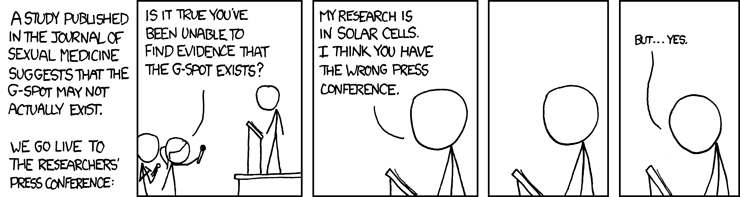
Except this study was a piece of crap.
For one, they did absolutely no physiological studies. How did they know if a woman had a G-spot, then? Why, they simply asked them! In the most leading, biased way possible (emphasis mine):
“Do you believe you have a so called G spot, a small areas the size of a 20p coin on the front wall of your vagina that is sensitive to deep pressure?”
If we ignore how poorly worded that question was, it still is not going to test genetic correlation of having a G-spot. Relying on personal opinion for physiological data is frankly ridiculous – would we determine how many lobes a liver has by asking people what they believe to be true? What they’re actually testing is if someone’s personal opinion about G-spots is genetic! Someone could think she doesn’t have a G-spot, but still have the exact same physiological reactions as her sister.
The other huge flaw of the study was that it didn’t take into account sexual practices. What if one twin only has sex in the missionary position, while the other is purposefully trying out stuff to reach her “so-called” G-spot? It’s wrong to assume that all types of sex produce the same time of stimulation. The researchers seemed somewhat aware of this, because they excluded bisexuals and lesbians…because they tend to have more digital sex.
Wait, what? So you have a group of people having the type of sex that, from conventional wisdom, is more likely to stimulate the “G-spot” – and you leave them out? Why not test to see if that conventional wisdom is actually right?
Well, maybe because the lead researcher is “anxious to remove feelings of “inadequacy or underachievement” that might affect women who fear they lacked a G-spot.” That’s certainly a noble cause, since women shouldn’t feel inadequate if they lack a G-spot…but it also certainly biases your research if you’re searching for a particular answer to support your world-view. Not to mention just swaps the stigma onto women who are told they’re being delusional based on crappy data.
I’ve been harping on the G-spot deniers, but the research on the other side is just as bad. I looked up the paper by Florian Wimpissinger that’s often cited as showing that female ejaculation is way more similar to semen than urine (3).
Yes, I had a good giggle that his name was Wimpissinger.
Anyway, this study looks very impressive on the surface. They did ultrasounds that found prostate-like structures in women! And urethroscopy that found a duct-like thingy! And biochemical analysis that showed it wasn’t urine! Doesn’t that sound fancy and
scientific?
Except they did a crappy job at those things.
Their ultrasound was so blurry and inconclusive that the article is immediately followed by a letter from concerned researchers saying “Dude, you totally misread that ultrasound. That’s a smudge, not prostate tissue.” And their response is basically “No, we’re right!” Not the best sign.

But you know what’s a bigger problem then their possibly blurry ultrasound?
They had a sample size of two women who could ejaculate, and no control women.
Sample size of two.
No controls.
So while you can say some women may have a prostate-like structure (assuming their ultrasound doesn’t suck), you can’t say they all do. Because you tested two women out of 3 billion. What do the non-ejaculators look like? What do the women who think they don’t have G-spots look like? Humans are highly variable – height, skin color, breast size – the same could definitely apply to G-spots.
This is especially important in their biochemical study. They took ejaculate and urine samples from both women and compared them to the ejaculate from men using biochemical assays. They didn’t have a urine sample from men or non-ejaculating women to compare it to as a control. And for the second woman, they didn’t even do 5/9 of the tests! So basically they have a couple tests that vaguely show female ejaculate is more ejaculate-like than urine-like. I say vaguely because they didn’t do any sort of statistical analysis to see if this is significant or due to random chance – probably because they have a freaking sample size of two.
So from looking at these two important studies, it’s crystal clear why we don’t know what’s going on yet. The research just isn’t high quality.
But why haven’t scientists figured this out by now? How is it that we can track every individual cell in a developing worm, but we can’t tell if a structure is there or not in women? How is it that we know genetic variation at millions of sites in the genome across human populations, but we don’t know structural or physiological variation of an often discussed phenomena?
For one thing, the G-Spot is probably complicated. If I had to put my money on a hypothesis, I’d guess the G-spot is actually a combination of structures – maybe the Skene’s glands, the internal part of the clitoris, prostate-like tissue, or vaginal thickness. And I’d guess that it’s variable across women – either due to genetics or hormonal context during development. And when something is complicated, it’s a bit harder to figure out.
Part of the problem of getting a really good study is that sexual science is somewhat of an echo chamber. Almost all of the research is published in the Journal of Sexual Medicine, and almost all of the reviewers of papers are part of the same little group. They don’t have random molecular biologists reviewing their papers and weeping at their sample size, or screaming “Why didn’t you just do a mass spec run?!” There’s a reason why this stuff isn’t getting published in PNAS, Science, or Nature – maybe partly due to blushing editors, but mainly due to quality.
Another problem is that a good study of something complicated calls for thousands of samples – and it’s not easy to find thousands of women willing to participate in such a study. That’s not just because of puritanical views, though that’s definitely a contributing factor. Women have been historically mistreated under the guise of medicine, especially within the realm of sexual medicine. Treatments for hysteria, forced sterilization – those things may be in the past, but they still linger in people’s memories.
But even if you had the best scientists and a thousand volunteers, a lot of it boils down to the politics of science – especially the politics of the science of sex. In the US, the type of research that’s being done is the type of research that’s being funded – mostly from the government. And when you look at these studies, almost none of them are coming from the US – the two I mentioned were from the UK and Austria. Our puritanical views make it less likely that a massive G-spot study is going to be funded to put this question to rest.
I’m not trying to be overly patriotic, but the US produces some of the highest quality scientific research in the world. And when it’s too scared to finance the investigation of women’s sexuality, it’s no wonder we’re left in the dark.
Yet somehow there’s no shortage of money so men can keep having erections. Funny how that works.
So the next time someone claims to know exactly what a G-spot is – especially when they’re trying to sell you something – think of the science behind it. And remember, it’s okay for science to say “I don’t know – yet.”
1. Jannini, EA et al. (2010) Who’s Afraid of the G-spot? Journal of Sexual Medicine. 7:25-34.
2. Burri, AV et al. (2010) Genetic and Environmental Influences on self-reported G-Spots in Women: A Twin Study. Journal of Sexual Medicine. 7:1842-1852.
3. Wimpissinger, F et al. (2007) The female prostate revisited: perineal ultrasound and biochemical studies of female ejaculate. Journal of Sexual Medicine. 4:1388-1393.
- «Previous Page
- 1
- …
- 56
- 57
- 58
- 59
- 60
- …
- 187
- Next Page»