An intro to the neutral theory of evolution

From a top donor:

“I’d like you to write a blog entry (primer) about neutral theory aimed at the layperson.”

Okay, I’m not going to lie. I’ve been secretly hoping someone would bump this question out of the top ten, mainly because neutral theory is kind of boring and vaguely confusing and hard enough to explain while using biology buzzwords. It’s even harder to explain when you only have 30 minutes to write about it and it’s supposed to be targeting non-biologists. When I shared this question with some fellow genetics grad students, the general response was “Ewwwww.”

But I will try my best!

When most people think about evolution, they think of adaptations. Something in the environment puts selective pressure on a certain trait, and organisms with that trait are more “fit” (reproduce more). For example, rabbits that live in snowy climates are more likely to survive (and reproduce) if they have white fur that helps them blend into the snow. If a mutation randomly arises that make their fur white, or just lighter, that rabbit has an advantage over the other rabbits – the dark brown ones are going to be the first ones that are eaten.

There are lots of examples of adaptive evolution through natural selection, and people know them more because they make good stories. The most famous example of evolution, Darwin’s finches, is a case of adaptive evolution.

But not all evolution takes place because of natural selection. Evolution is at its simplest defined as the change in allele frequencies over time. That’s where neutral theory comes in. Neutral theory states that most evolutionary changes are the result of random drift of neutral mutants.

Buzzwords buzzwords, I know. So let’s take it one step at a time and pretend that we’re looking at a population of unicorns (if we’re pretending, might as well pretend all the way).

Alleles are just two different forms of a gene. Genes are usually hundreds or thousands of basepairs long, but let’s pretend we’re zooming in on three bases in a gene for fur color. If you have the sequence AAA, your fur is white. But if you have AAG, your fur is pink. AAA and AAG are different alleles.

Now let’s say all of the unicorns start as AAA, and then from mutation you get a unicorn who’s AAG. Being pink has no effect on the unicorn. He’s not more likely to get eaten, he doesn’t live longer, he doesn’t have more luck with lady unicorns. It’s a “neutral” mutation because it doesn’t change the unicorn’s fitness.

That’s where random drift comes in. Drift simply refers to the frequency of one allele changing due to random chance. That is, nothing is selecting for pinkness. Maybe that unicorn just happened to have more offspring. Maybe the population underwent a bottleneck and was reduced to just a few unicorns, the pink one happened to survive, and now his pinkness will make up a larger percentage of the population. Maybe a couple of unicorns, including the pink one, happened to get isolated on one side of a river, so that side eventually had a lot of pink unicorns, while the other has a lot of white ones. Through random chance alone, a neutral mutation can grow to high frequency or even reach 100% (what biologists call “becoming fixed in a population.”)

When you get into the mathematics, you assume that random neutral mutations occur at the same rates across individuals. This is how biologists get things like “molecular clocks” where they can tell when two species diverged from each other.

…And I have no idea if that made any sense, but I’m out of time. You have all now been exposed to (a shoddy summary of) evolutionary theory, congratulations. If anyone would like to explain further or correct me in the comments, please do so!
This is post 20 of 49 of Blogathon. Pledge a donation to the Secular Student Alliance here.

My blogging persona

From the mailbag:

“We all act a little differently online, as opposed to RL. Are you meaner, nicer, wittier, sillier, or more verbose in RL than in online venues?”

I certainly do have a blogging persona. I don’t craft something on purpose – communicating via written word to a general audience simply has a different effect than talking in person with an individual. I think this is true of a lot of bloggers. The most popular example is how vicious, rude, scathing PZ Myers is actually a soft spoken teddy bear in person (don’t deny it PZ!).

So there are definitely ways that act differently. I’m actually an introvert, which a lot of people have a hard time believing. I think that’s partially because most people don’t know what introversion means. It doesn’t mean I’m shy – it means being around people drains me, and I need time to myself to recharge. I love conferences, but by the end I usually need to sporadically hide in my room and avoid talking to people. It’s challenging being “on” all the time.

I think that’s probably the biggest misconception – that I’m always “on.” I’m not witty and insightful 100% of the time. Hell, that’s not even true here. But at least my blog has a certain level of curation. Shockingly, I don’t generally post my stupid ideas or unfunny jokes. But in person there’s a lot less time to think up something profound, so I think I’m disappointingly derpy a lot of the time.

I’m also a lot less confrontational in person, which is probably true of most people. The internet gives people courage, often the courage to say a lot of stupid crap they would never say to someone’s face. But I balk at saying even some of the non-stupid stuff. I hate getting into verbal debates – not to avoid pissing people off, but because I suck at them. Again, I’m much more intelligent when writing. You don’t want to invite me to debate someone because I’ll get tongue tied.

Other than that…many people have told me I was a lot taller than they expected, haha. I TOWER ABOVE YOU PUNY ATHEISTS! Or something.

If you’ve met me in person, are there any other things that are different between “in person” Jen and “blogger” Jen?

This is post 19 of 49 of Blogathon. Pledge a donation to the Secular Student Alliance here.

Coopting the Norweigan terrorist attacks for Islamophobia

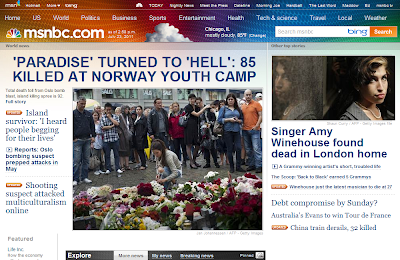
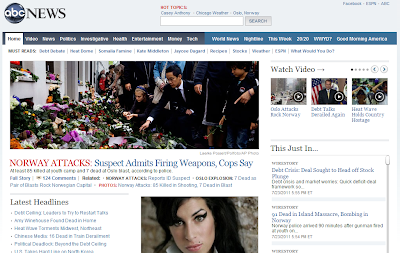
I’m still having a hard time wrapping my mind around how much of a tragedy the Norway terrorist attacks are. 92 people are confirmed dead, 85 of which are youth ages mostly between the ages of 16 and 22. They were at a camp trained to foster future leaders of Norway. Many jumped into the water in an attempt to escape the shooter’s indiscriminate bullets, many to no avail.

What human being does something like that?

But instead of mourning this tragedy, the American media is already falling all over itself to blame Those Evil Muslims. Unsurprisingly, Fox News was one of the first to claim that the horrifying terrorist attacks in Norway were by Muslim extremists. This is despite the fact that the main suspect that’s in custody is a right wing extremist, fundamentalist Christian, and Islamophobe.

And if that’s not enough? The O’Reilly Factor directly juxtaposed the Norwegian attacks with the legal victory of the Park 51 New York City Islamic Center.

Wow, how subtle.

It’s despicable how the media turns a tragedy into an exercise in irrational finger pointing. There are plenty of rational, fact-based reasons to criticize Islam – fabricating connections to every terrorist attacks is not one of them.

But the other annoying point? When it’s an Islamic extremist, the attacker is a religious terrorists. When we find out it’s really a Christian extremist, he’s suddenly a madmen who doesn’t represent other members of that faith.

Double standard much?

My thoughts go out to all of the people of Norway. If I have any Norweigan readers, I hope you and your families and friends are safe.

This is post 17 of 49 of Blogathon. Pledge a donation to the Secular Student Alliance here.
Translating apartment hunting lingo

I’ve spent the last month trawling craigslist for a 2 bedroom apartment in Capitol Hill. Yes, my escape from the Apartment From Hell is nigh! While I haven’t found a replacement yet, I’ve learned a lot about what the various lingo on apartment ads really mean:

  • “Cozy” = Tiny
  • “Old world charm” = Ancient and falling apart
  • “Homey” = Ugly, probably wood paneling
  • “Basement” = I hope you’re under 6 foot tall and don’t have seasonal depression
  • “Near the bustling…” = Noisy
  • “Parking available on street” = Parking never available
  • “Unbeatable prices” = First floor apartment that will get broken into / Next to a fire station / Someone was murdered here
  • “Great location” = If you don’t leave the two block radius around your place
  • “Near Capitol Hill” = A 20 minute bus ride from Capitol Hill
  • “Beautiful” = Not in your price range

And if it seems perfect in every way…the landlord is probably crazy.

This is post 16 of 49 of Blogathon. Pledge a donation to the Secular Student Alliance here.
I’ve relocated!

The last two blogathons I was trapped in my apartment because I only had a desktop. Thankfully I have a laptop now so I’m free, free! I built up enough buffer time with posts that I was able to grab lunch at Ranchos Bravos (yes, mentioning it in an earlier post made me crave it). Now I’m settling into the corner of the awesome little coffee shop by my place:That drink is the reason I keep coming back here. $2.85 for a large everlasting iced coffee. How is it everlasting, you ask? The ice cubes are made of coffee, so as they melt, you get more coffee instead of a sad watered down drink. And they take a surprisingly long time to melt. Perfect for when someone needs a steady supply of caffeine for many, many hours.

Now the real trick will be to still have buffer time when I need to go back to my place.

This is post 15 of 49 of Blogathon. Pledge a donation to the Secular Student Alliance here.

This is my new favorite blog

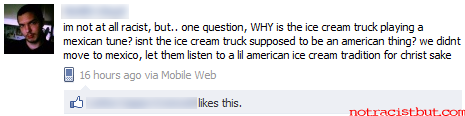
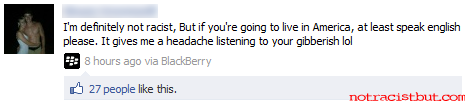
I’m not racist, but…

Because it’s good to get a daily dose of how depressing humanity can be. Protip: If you’re about to say “I’m not racist, but-” just stop talking. And here’s one of my favorite relevant videos:

…Yes this is Blogathon filler so I can build up enough buffer to shower and eat DON’T JUDGE ME.

This is post 14 of 49 of Blogathon. Pledge a donation to the Secular Student Alliance here.

Should we make science girl friendly?

A recent study in the British Journal of Educational Psychology found that using stereotypically feminine examples gets girls more interest in science:

After examining a wide array of science textbooks, University of Luxembourg educational researcherSylvie Kerger concluded that most present real-world examples are “embedded in masculine contexts.” But wrapping scientific subjects — at least initially — around female-friendly topics could kindle interest in scientific fields under-populated by women, Kerger says. Studies have shown that interest counts more than ability toward choosing a major or a career.

[…]Kerger gave 294 eighth- and ninth-grade boys and girls questionnaires asking them whether they would like to study biology, physics, information technology or statistics the following year. Instead of naming these subjects, the questionnaire presented each science through topics found in previous studies to be either male- or female-friendly. “How does a laser read a CD?” was a masculine way to ask about physics, while “how is a laser used in cosmetic surgery?” addressed stereotypical girls’ concerns.

The youngsters rated their interest on a scale from one (not interesting at all) to five (very interesting). Presenting these sciences in a feminine way increased girls’ interest in physics about a half-point, in information technology more than 0.75 of a point and in statistics more than a full point.

But the male-versus-female presentations didn’t affect girls’ interest in biology. (“Watch blood coagulate from a small wound,” appealed to them as much as “reflect on how skin tanning comes about in the summer.”)

“Girls are already very interested” in that science, even when presented in a male-friendly way, says Kerger.

Increasing the girl-friendly content had a predictable effect on boys’ interest. When researchers couched information technology as learning “how to order clothes over the Internet” rather than figuring out “how the inside of the computer is structured,” boys’ interest dampened in that science.

Faced with this zero-sum result, Kerger and her colleagues don’t argue for single-sex classes. This is a cross section, so while some girls aren’t interested in stereotypically feminine topics, they point out, some boys are. The reverse also holds true. So they recommend teachers offer a choice among several modules dealing with the same scientific concepts wrapped around various male- and female-friendly topics.

tl;dr making stereotypically girly science examples increased interest from girls, but decreased interest in boys

I have a couple of concerns before we automatically insert hyperfeminine examples into science textbooks. For one thing, how did they determine that some of these standard examples are “masculine?” What’s masculine about reading CDs or blot clotting? Am I just one of those outliers for finding these things way more interesting?

It seems the real problem is that boys and girls are told from an early age what they’re allowed to be interested in because of their gender. That’s what we should be fighting. We need to destroy the notion that girls can only like science if it’s about makeup and that boys can only like science if it’s about blowing things up. Pandering to these stereotypes only perpetuates the problem.

But on the flip side, that doesn’t mean we have to avoid feminine examples in text books. We shouldn’t leave out the science of skin tanning because it seems too girly – it’s still a relevant and interesting biological question. There’s nothing inherently wrong with femininity, so it shouldn’t be excluded.

I can understand the practical desire to get more girls interested in science, but overall this just rubs me the wrong way. Instead of trying to get them with girly things when they’re almost in high school, why not cultivate a gender neutral interest when they’re even younger? If we fight stereotypes when they’re little, it helps both science and equality.

This is post 13 of 49 of Blogathon. Pledge a donation to the Secular Student Alliance here.

Why I’m an atheist activist

Another question from a top donor:

“I’m curious to hear more about how you first got involved with the SSA and/or what it was that made you decide to become an atheist speaker.”


I co-founded the Society of Non-Theists at Purdue University the summer before my sophomore year. This was after a year of culture shock down at Purdue. I grew up in a part of Indiana that was fairly secular and liberal (yes, it exists!). I wasn’t used to being in such a religious environment, where people were constantly trying to recruit and convert me, or would literally run away when they found out I was an atheist. I wanted to make a club that could act as a safe haven for students like me.

But I didn’t really know about the SSA when I was getting started. If I recall correctly, they found me. It took our group about a year or so to really utilize their services and realize what a big help they were. When I attended my first SSA conference after two years of running the group, I wished I would have gone sooner. It was so helpful for practical skills like fundraising, getting media attention, event planning, and networking – everything we had learned through two years of annoying trial and error.

After that, I was kind of in love. I realized how great of an organization it was, and I wanted to continue helping out. That’s why I ran for the Board of Directors. It’s cheesy as hell, but us young people are the future for secularism and rational thought.

As for being an atheist speaker… I think it just accidentally happened. I’ve always been comfortable giving presentations, and I gave a couple talks for my group. Then I started getting invitations to talk after boobquake exploded. Then I was added to the SSA speaker’s bureau. Then CFI’s speaker’s bureau. Then I started getting invited to major conferences. Then people who saw my talks would go back to their home town and tell their local group to invite me.

And I keep saying yes because, well, they’re fun! I basically get to go on little mini vacations to different parts of the US, not to mention talk to a room full of really bright people for a night. How does it get any better than that?

Well…okay, maybe if I got super famous where people would pay me lots of money to do it (…or any money, for that matter). Or if groups in Europe or Australia would invite me. That would be pretty damn cool. (Did you hear that, international readers?!)

But even if that doesn’t happen, I’ll keep doing it. Like I said, it’s a lot of fun – I wouldn’t do it if it wasn’t. And I think part of my brain considers it a back up plan if the whole academia thing doesn’t work out. Which isn’t totally unlikely – becoming a professor is hard and partially based on luck, and I’m still not totally sure if that’s what I want to do with my life. So might as well enjoy doing what I’m doing now, and maybe it’ll help out in the future!

This is post 12 of 49 of Blogathon. Pledge a donation to the Secular Student Alliance here.