
Thoughts on grad school

“What are you most looking forward to about grad school? What are you hoping to achieve? And, what will you actually be studying? I mean, is there really more to know about copulatory plugs?”

I’m most looking forward to finally be studying what I’ve always wanted to research: human genetics and evolution. I don’t know the exact topic yet since UW has you do a year of lab rotations, but there are a lot of exciting projects going on there. I haven’t been able to investigate that area yet since no one at Purdue really researches human genetics or evolution too much – I think mainly because we don’t have a medical school.

So no, I’m not going to be researching copulatory plugs anymore. Even that wasn’t my main project at Purdue. My bigger project was looking at population genetics and historical demography in kangaroo rats. I’ll be able to talk more about them here once they’re officially published, but until then, I have to keep quiet.

And looking at the bigger picture, I’m excited to be furthering my education and becoming an “expert” in my field. I really enjoy research and teaching, so I think academia is the right place for me. And I just love to learn – I’m geeking out about all the advanced classes that I’ll be taking, which I think is a good sign.

…Okay, and it’s nice knowing I have an assured paycheck for five years in this crappy economy and that I’ll be Dr. McCreight at the end. But really, those are just perks! Really nice perks, hehe.

Curse words and other nonsense

“What is your favorite curse word?”

Fuck.

Okay, that’s not very creative. But it’s so versatile! Is there a way you can’t use it? Maybe not as a preposition… And you can even add stuff to it. Fucktard. Fuckward. Fuckballs.

Other than that, I’m a fan of the more funny, nonsensical, bizarre swear words. Asshat (just imagine a top hat on someone’s butt, it’s funny), douchenozzle (why so specific?!), douchebagel (don’t ask).

I also have some not-really-swear-words that I use as substitutions.* Fudgemuffin is my delicious sounding replacement for fuck. Buttmonkey is basically your bitch who does stuff for you. Meatblanket/shield/purse/etc is a person you’re just using for some task (they’re probably also your buttmonkey).

This isn’t exactly swearing, but I also have a bad habit of saying “I pooped it out” when I mean “I finished that task/project in a very quickly, with probably reduced quality.” This probably would have been good for my twitter followers to know months ago. No, I haven’t been talking about my bowel movements.

What creative swearing or other language do you use?

*I actually never cursed until I got to college, so I had to be creative. I grew up in house where I couldn’t even say “crap” or “sucks” (even though my parents liberally swore and dropped f-bombs around me, hmph). At least it’s better now that I’m an adult. When McCain said his bear DNA nonsense on TV, I lost control and yelled “Fuck you!!” and my mom cheered me on in agreement.

“Atheist” as a derogatory word

“How often, if ever, have you been called an atheist in a derogatory way?”

Honestly, not that often. I think I’m in a unique position, though. Since I’m known for being so vocal about my atheism – I was leader of the horde here for 3 years – people treat me differently. Conversations start with people already knowing my views and the fact that I’m going to stand up for them, so I think they take less pot shots. That and my friends and acquaintances pretty much only contain people who wouldn’t use “atheist” in a derogatory way. I think I scare away the people who would.

That being said, I have gotten it before. It’s more common at a public club event, where some random person is looking for a debate. They’ll sneer about “atheists” using that tone of voice that just drags the word out to emphasize how much they detest it.

To be honest, I think I’ve been called “feminist” in a derogatory way more often. That or various terms that would indicate that I’m homosexual. At least the first two terms are at least true about me.

How about you all?

This event is giving me good vibrations

A public service announcement for anyone interested in a wacky celebration that’s coming soon. May is National Masturbation Month, and Sunday is the 10th Annual Masturbate-A-Thon. Nope, I’m not jerking you around! You can get more information on how to lend a hand at either of those websites, though they may be mildly NSFW.

This event might rub some the wrong way – the idea alone could probably give some people a stroke. But I have to give them a hand for such a creative idea!

I’m going to Disney World!

It sounds very stereotypical, doesn’t it? “You’ve just graduated college – what are you going to do now?!” But it’s true. Tomorrow I’m driving down to Florida with three of my close friends, and staying for a little less than a week. We’re going to Magic Kingdom, Epcot, and a beach or two (still to be determined). the fangirl in me is still a little cranky that the Wizarding World of Harry Potter theme park won’t be open yet…oh well, I’ll have an excuse to come back later.

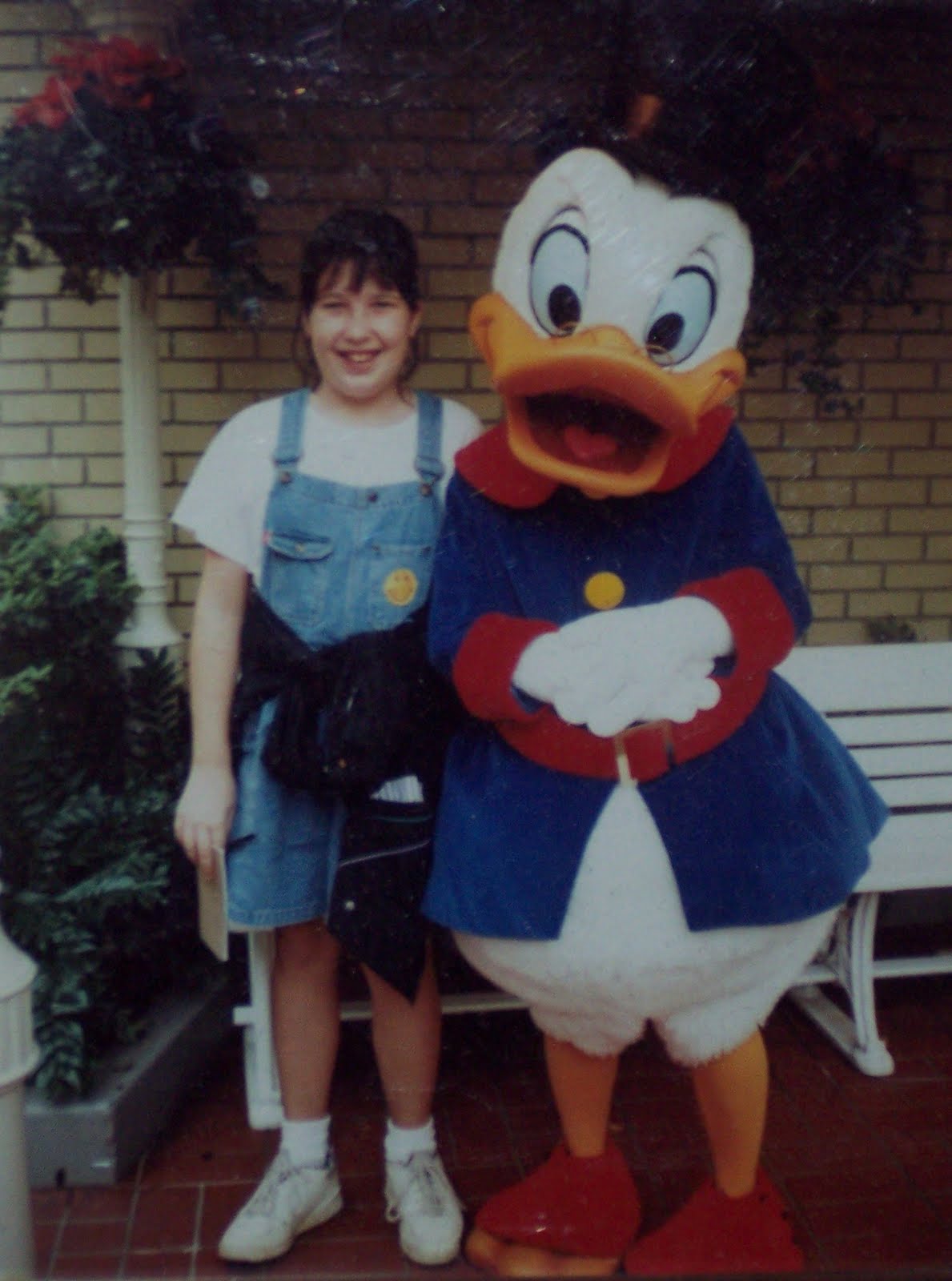
I’m pretty excited. The first and only time I went to Disney World was in 5th grade, when I would have been about 10 years old. Personally, I think that’s the most awkward age to go. I was too old to appreciate all the characters walking around – I knew they were just random people in suits, and that weirded me out a bit. Though I did get a photo with Scrooge McDuck, because DuckTales was awesome.
Yeah 90’s jean overalls, wooo!

But I was also too young to really enjoy most of the rides. I didn’t get into roller coasters until I was peer pressured to go on some when I was about 17, mainly because Disney managed to scare the crap out of me for a while. My mom said we needed to go on at least one real roller coaster, and got us in line for Space Mountain despite my protestation. To this day this amazes me, since my mom hates roller coasters and wouldn’t even get on the spinning teacups with me and my dad.

To make matters worse, my family ended up being in the first car. It’s single file seating, so my dad was first (much to his chagrin), then me, then my mom. Now, my dad is 6’6″. The whole time it looked like he was going to get decapitated by one of the rafters, so I was screaming bloody murder. But then about halfway through the ride I just stopped. The little logical side of my brain (yes, it was there at age 10) thought, “This ride is going to last for another minute. No one can stop the ride because you’re screaming. Might as well just not bother.”

Of course, my parents thought I had passed out.
Dad: Are you okay?!
Me: *whimpers* No.

And since I’m convinced parents are kind of sadistic at times, they think this is the funniest story ever.

Anyway, I’m super excited for my trip. I’m going to ride everything this time now that I actually like roller coasters. I never went on famous stuff like Splash Mountain, and I will conquer Space Mountain! I’m also excited to just sit around on a beach for a while. I finally found a new swim suit that fits me, so I don’t have to stress about that anymore. My solution was buying a top that was much bigger than the bottom. Thank you, boobies!

The one downside for you guys is that I’m going to have limited to no internet for a week. Gasp! I’m going to try to make some posts today, but I need your help for inspiration. Either ask me random questions here in the comments, or ask me questions anonymously at formspring.me. I already have some good questions backlogged there, and I will get to them! You can also follow me on twitter, because I’m sure I’ll be tweeting hilarious things and photos from my Florida adventure via phone.

Now, off I go to pack! Weeeeee!

Video: My lecture on Boobquake, Skepticism, and Feminism

My lecture last night in Chicago went wonderfully. Thanks to Elyse, Dr. Jen, Bruce, Matt, and anyone else I’m missing from Women Thinking Free for doing a great job organizing the event. It was a lot of fun talking to everyone afterward too!

Bruce videotaped the talk, and you can watch it here:

Jen McCreight – Boobquake Presentation from Bruce Critelli on Vimeo.

I hope everyone enjoyed themselves. It was a honor to be the inaugural speaker for WTF, and I hope this organization thrives! We need more active female voices in skepticism, and this is one great way to promote that.

Are second generation atheists more mellow?

During a recent Point of Inquiry podcast, Chris Mooney and Elaine Ecklund discussed the differences between first and second generation atheists (starting about 15 min in). First generation atheists are those that were once theists and raised with religion, while second generation were raised by non-theist parents. Mooney has a summary of Ecklund’s points at his blog:

On the air, Ecklund observed that the first generation atheists tend to be more critical of religion, and more driven in making such criticisms. After all, religion is something that is much more personal to them, and that they have rejected. We second generation atheists, though–for I am one–we tend to be more mellow. Or so Ecklund finds, anyway.

But I pressed her on the point. After all, although I’m “second generation,” I was pretty angry at religion when I was a college atheist activist. I was pretty driven. Yes, I mellowed with time–but I was and still remain second generation.

What’s more, I’m sure that there are some first generation atheists who aren’t particularly driven to bash religion, no matter the difficulty of their deconversion experiences or the powerful impact these had on their lives–it’s just not in their temperament.

Still, Ecklund defended the generalization despite my devil’s advocacy. In general, it is of a piece with her finding that family upbringing is a central predictive factor for later life religiosity or the lack thereof, as well as for who actually becomes a scientist (they tend to come from less religiously observant households).

While I disagree with Mooney on a lot of other topics, I’m going to have to agree with his devil’s advocacy here. There are far too many factors going on to simply pin critical attitudes on your former beliefs (or lack thereof). Now, this is a generalization, so I can’t simply say “Look at me! I’m second generation, and I’m anything but mellow!” I may be an exception to a general trend.

But I think a more accurate idea is that someone’s religious environment as a whole – not just how they were raised – helps shape how critical they are of religion. I know I just got done saying anecdotal evidence is not equivalent to good science, but forgive me while I use some to illustrate my hypothesis:

I am a second generation atheist. My dad, while he won’t label himself, is pretty much an atheist and instilled a good skepticism of religion in me. My mom is a wishy washy deist/Greek Orthodox, but she never taught me her beliefs or took me to church. I was left to my own devices when it came to thinking about religion, and for the most part I considered myself an atheist/agnostic my whole life. As a child, I really didn’t care about religion. I had a very “to each their own” attitude, and saw religion as a general force for good in the world. Everyone in my town was pretty much the same – no one really cared what religion you were, or if you were godless.

Then I moved to a conservative Christian town while simultaneously maturing and realizing the world isn’t all rainbows and unicorns.

I realized religion wasn’t simply about charity and redemption and love. I realized, first hand, that religion could lead people to believe in stupid, ridiculous, unscientific claims, and to say and do hateful and harmful things. I’ve never thought religion automatically made someone a bad person, but I did reject the idea that religion automatically makes someone a good person.

Because of this eye opening experience, I became much more vocal about my atheism and skepticism. If I had gone to Indiana University or an even more liberal college, I can pretty much assure you I would still be a mellow agnostic. “Aggression” toward religion isn’t based solely on your family, but on your experiences on a whole. If you realize the damage religion and religious belief can do, you’re more inclined to speak out against it.

And I know I’m not just one person who has reacted this way. After being President of a student organization for non-theists for three years, I’ve been around hundreds of young atheists – some first generation, some second generation. For those where Purdue is more conservative and religious, they tend to be more vocal and aggressive. For those who see Purdue as a liberal escape from their rural Christian towns (this personally terrifies me), they’re just happy to have another atheist to hang out with.

I’ve even seen the exact opposite of what Ecklund is claiming. Some of the more cooperative, friendly, pro-religion non-theists are those that come from religious families. They often say this is because they’re surrounded by religious people who are wonderful, kind, intelligent people. It makes it hard to speak out against religion when you know it has helped someone you care about and love. On the flip side, sometimes it’s hard for us life-long atheists to relate to religious people, since we don’t have family members to act as examples for us. It’s easier to fall into the trap of stereotyping all theists and religious belief as being the same negative caricature.

I also see this exception when looking at my father. He’s basically an atheist and will be vocal and critical of religion to like-minded people like myself. However, he would never say these things in public or to religious friends. He strongly believes that religion is your own business, and he shouldn’t go around criticizing something that helps so many people. My dad was raised in a religious family, the vast majority of which is still religious (some very devoutly so) – but he’s not an aggressive Dawkins-esque first generation atheist.

Now of course, my observations are not scientific and are still biased – I mostly (but not solely) interact with people who are part of a club for non-theists, which may self select for more critical voices. But at the same time, I don’t think you can say upbringing is the main factor for how atheists treat religion when there are so many other complex factors going on. Family upbringing may be a central predictive factor for later life religiosity and who will become a scientist, but that doesn’t also mean it predicts how critical you are of religion.

I also have to be skeptical if Ecklund doesn’t have other motivation going on. She’s funded by the Templeton Foundation, and it would probably be very nice if she could paint a picture of criticism of religion stemming from some sort of emotional rebellion from our parents rather than a rational realization that we need to speak up. It seems like a scholarly equivalent of “Oh, well they’ll grow out of it eventually.” Ecklund had an interesting interpretation on the frequency of religiosity of scientists in her book Science vs. Religion: What Scientists Really Think – interesting in that she collected the data, but came to a very discordant conclusions in the discussion. That’s also where this first/second generation data comes from, so I don’t know if I can completely trust how she’s interpreting her data.

Regardless, my experiences are not scientific, and I would love to see someone do a broader study. Something that encompasses first and second generation atheists across a while range of ages and professions (the book focuses on just scientists). It would kind of also be nice if the author wasn’t funded by a biased organization, ahem…

Male antelopes lie to increase their chances of having sex

Replace “antelopes” with “humans” and I think most of us would nod in agreement. But this is the first time researchers have found “intentionally misleading behavior in animals for the explicit purposes of mating.” Ars Technica has a great overview of the study:

The four-year study looked at the behavior of topi antelopes (Damaliscus lunatus) in the Masai Mara National Reserve in Kenya. This area is dominated by a huge number of predators, including lions, cheetahs, leopards, and hyenas, all of which prey regularly on antelopes. When topi detect a predator nearby, they often make snort-like alarm calls.

From February to March, male topi hold small territories through which receptive females pass to assess each male’s mating potential. The authors noticed that, while a female in estrus was on a male’s territory, the male would sometimes emit alarm calls, even in the complete absence of a predator. These false alarms are acoustically indistinguishable from true alarm snorts.

The authors set out to determine whether these false alarm snorts are simply predator detection errors, or if they function to deter the female from leaving the territory in order to secure more mating opportunities with her. The results overwhelmingly supported the authors’ “sexual deception hypothesis.” False alarms almost never occurred without a receptive female on the territory, the onset of the false snorts was highly correlated with a female’s attempts to leave the territory, and, after emitting a false snort, males managed an average of 2.8 extra booty calls.

You may be wondering why females continue to fall for the lies of males. If this behavior evolved, you think females would also evolve to detect lies, right? It boils down to probability and consequences: Lies happen a lot less frequently than truthful signals, and believing a lie has less severe consequences (mating with a less desirable male) than ignoring a true signal (getting eaten).

This questions comes up a lot when you’re discussing dishonest signaling, which actually happens more than you would think in nature. One of the more popular example is bluffing in fiddler crabs. Sometimes when a fiddler crab loses its enlarged claw, it will grow back a weaker, cheaper claw. While these claws aren’t as good in fighting, they’re just as good at intimidating other crabs. It’s not worthwhile for crabs to check and see if another crab is bluffing, because the consequences of the signal being true are so large (getting the crap kicked out of your crabby self).

Still, it’s very interesting that they’ve now documented this type of bluffing specifically in regards to sex. I have a feeling we’ll see more examples of this in the future, now that researchers will be keeping their eyes open!

(Via Carnal Nation)

Who needs God when you have biologists?

Yes, I’m being very sensationalist – but this still freaking awesome. Craig Venter’s research team has officially created the first artificial organism. The complexity of this endeavour is mind boggling – a genome isn’t a simple thing – which makes this very technically impressive. But in addition to being able to say “Look what we can do!”, this also has a number of large implications for future projects. Now that we can make our own genomes, we can create artificial organisms specialized for fuel production, insulin production, etc… How neat is that?!

PZ has a more scientific summary, and Jerry Coyne has a very good “quick guide” for the not so biologically inclined readers.

I do like Coyne’s response to those that are wondering if biologists are “playing God”:

But what creationists cannot get around is the increasing demonstration that life is merely an immensely complicated chemical reaction. Venter’s team made a genome able to direct and support life using off-the-shelf nucleotides and some other reagents. Eventually, in a few decades, they’ll be able to make a fully living bacterium in the same way. And then we will have played God, at least the way religious people mean it. …Life is just complex chemicals—nothing more, nothing less.

Biology is awesome*!

*Obviously not a biased statement.